
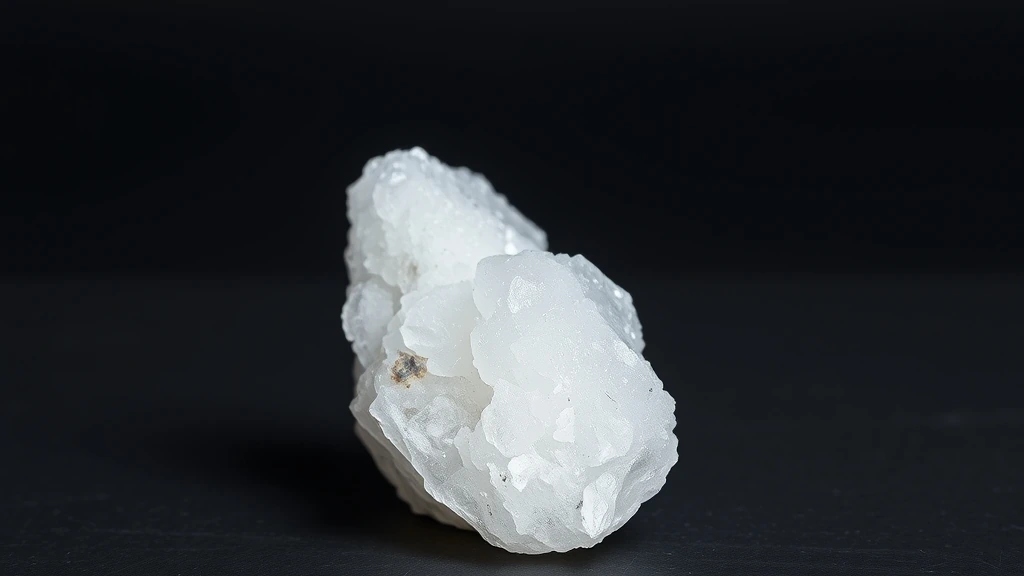
Halite belongs to the natural mineral family of evaporite crystals, forming when seawater or saline lakes evaporate under arid conditions. Though commonly encountered as rock‑salt, gem‑grade halite is harvested from ancient evaporite beds where it remains intact within the parent mineral group: Natural Mineral / Crystal. Its transparency and subtle coloration make it a niche gemstone prized for metaphysical uses rather than durability.
What is Halite (rock Salt) Gemstone? Geological Overview & Definition
Halite is an evaporite mineral that precipitates from brines rich in sodium and chloride ions. In its gem form, it is cut as cabochons or facets, showcasing a glassy luster that can range from colorless to pastel hues due to trace impurities.
The stone is typically sourced from ancient marine basins where repeated cycles of evaporation left thick salt layers. These layers are later uplifted and mined, yielding crystals that retain the original cryptocrystalline texture essential for gem quality.
Halite (rock Salt) Gemstone Chemical Composition & Crystallographic Properties
Halite’s formula NaCl reflects a simple ionic lattice of sodium and chloride ions; however, on a macroscopic scale it behaves as an amorphous aggregate of microscopic crystals. This cryptocrystalline nature gives the gem its characteristic brittleness and low hardness.
Cation substitution is limited, but trace amounts of magnesium, potassium, or calcium can enter the lattice, subtly shifting the refractive index and sometimes producing faint color tints. Such substitutions do not alter the fundamental NaCl framework.
Halite is highly acid‑sensitive; exposure to dilute acids rapidly dissolves the lattice, releasing hydrogen chloride gas. This reactivity restricts its use in jewelry and necessitates protective settings for any ornamental application.
Color in halite arises from color centers created by radiation or impurity ions, producing pink (Mn²⁺), blue (Cu²⁺), or gray shades. Thermal treatment can anneal these centers, fading the color, while heating above 800 °C causes the crystal to melt, confirming its low thermal stability.
| Property | Specification |
|---|---|
| Mineral Group | Natural Mineral / Crystal |
| Chemical Formula | NaCl |
| Mohs Hardness | 2.0 – 2.5 |
| Crystal System | Isometric |
| Specific Gravity (Density) | 2.16 – 2.19 |
| Refractive Index | 1.544 |
| Color & Optical Properties | Natural Halite (rock Salt) Gemstone color spectrum and optical dispersion |
| Primary Mining Localities | Global primary localities |
| Water & Chemical Resistance | Sensitive (Avoid prolonged water soaking) |
| Chakra Alignment (Traditional) | Root Chakra, Sacral Chakra |
| Zodiac Affinity (Traditional) | Taurus, Cancer |
| Symbolic Meaning (Traditional) | Purification, grounding, and emotional cleansing |
Halite (rock Salt) Gemstone Varieties & Color Spectrum
Classic White Halite
Pure halite crystals exhibit a brilliant, transparent white appearance due to minimal impurities in the NaCl lattice structure. This variety forms in deep evaporite basins where slow evaporation allows large, well-formed cubic crystals to develop. Its clarity makes it highly valued for optical studies and high-purity industrial applications.
Pink Himalayan Salt
This renowned variety owes its distinctive rosy hue to trace amounts of iron oxide (Fe2O3) dispersed within the crystal matrix. Mined from ancient seabeds in Pakistan, these deposits are over 250 million years old. The color intensity varies significantly, with deeper pinks indicating higher concentrations of these metallic impurities.
Red Halite (Sylvite)
Often confused with pure halite, this reddish variety actually contains significant amounts of sylvite (KCl) mixed with the primary salt. The red coloration stems from manganese impurities or the specific optical properties of the potassium chloride admixture. It is less common in gem-quality specimens but frequently encountered in industrial mining operations.
Green Halite
Rare green halite crystals result from the presence of chloride-deficient defects or trace elements like copper within the crystal structure. This color morph is exceptionally uncommon in natural settings and is often the subject of intense collector interest. Its formation requires specific geochemical conditions that are rarely met in standard evaporite environments.
Black Halite
True black halite is extremely rare and usually indicates heavy contamination with carbonaceous organic matter or other dark mineral inclusions. It is not a pure color morph but rather a composite of halite and dark impurities. Such specimens are primarily of scientific interest rather than gemological value due to their lack of transparency.
Clear “Ice” Halite
This variety appears colorless and glassy, resembling ice, due to its high purity and lack of visible inclusions. It forms in the upper layers of salt domes where conditions favored rapid, clean crystallization. Its isometric crystal habit is often perfectly preserved, showcasing the geometric beauty of the cubic system.
Where is Halite (rock Salt) Gemstone Found? Geological Mining & Extraction
Halite primarily occurs in evaporite deposits formed by the evaporation of ancient inland seas and lagoons. These massive sedimentary layers are often found deep underground, requiring extensive mining operations to access. The most significant deposits are located in regions with a history of tectonic activity and arid climates.
Major global extraction sites include the Himalayan foothills in Pakistan, the salt domes of the United States, and the vast basins of Poland and Germany. Modern mining techniques range from open-pit operations for surface deposits to deep-shaft mining for subsurface reserves. These regions provide the bulk of the world’s industrial and gemological halite supply.
Historical Significance & Cultural Lore of Halite (rock Salt) Gemstone
Ancient civilizations revered halite as a sacred substance essential for preservation and ritual purity. The Romans used it to pave roads and preserve food, while Egyptian priests employed it in embalming processes. Its scarcity in certain regions elevated its value to that of precious metals in trade networks.
Archaeological findings reveal salt offerings in temples across Mesopotamia and the Andes, highlighting its spiritual significance. In many cultures, salt was believed to ward off evil spirits and purify spaces, a belief that persists in various modern traditions. This enduring legacy underscores the mineral’s profound impact on human history and culture.
Modern Uses & Jewelry Applications of Haline (rock Salt) Gemstone
Halite can be cut into cabochons or modestly faceted stones, though its low hardness (2‑2.5 on the Mohs scale) limits intricate faceting. Artisans often embed thin slabs in pendants, earrings, or decorative beads, taking advantage of its natural translucency and salty‑white hue. Ornamental carving—such as miniature sculptures, lamp bases, and architectural inlays—remains popular for interior design.
- Cabochon pendants with polished domes for pendant necklaces
- Faceted beads set in silver or gold chains for subtle sparkle
- Carved miniatures (e.g., salt crystals, animal figures) for display pieces
- Inlay work in furniture or glassware for a luminous accent
Metaphysical Properties & Traditional Meaning of Halite (rock Salt) Gemstone
According to historical traditions and metaphysical lore, halite is celebrated for its purifying energy, believed to cleanse both physical spaces and emotional fields. It is thought to ground the wearer, fostering a sense of stability while simultaneously encouraging the release of stagnant emotions, aligning with the concepts of grounding and emotional cleansing.
Which Chakra and Zodiac Signs Align with Halite (rock Salt) Gemstone?
Halite resonates most strongly with the Root Chakra, supporting foundational security and physical well‑being. It also vibrates with the Sacral Chakra, enhancing creative flow and emotional balance, making it a dual‑chakra stone for those seeking both stability and fluidity.
In astrology, halite is linked to Taurus and Cancer. Taurus benefits from the stone’s grounding influence, reinforcing perseverance and material comfort, while Cancer draws on its soothing properties to nurture emotional depth and familial harmony. No other zodiac signs are traditionally associated with halite.
How to Identify Real vs. Fake Halite (rock Salt) Gemstone
Artificial imitations of halite include clear synthetic glass, dyed quartz, and resin‑filled composites that mimic its salty appearance. These substitutes often lack the characteristic salty taste, low hardness, and distinctive cubic cleavage of genuine rock salt, making simple tests essential for verification.
Practical At-Home Authenticity Tests
- Temperature Test (Thermal Feel): Real halite feels cool to the touch and retains that coolness longer than glass or plastic, due to its high thermal conductivity.
- Specific Gravity & Weight Test: Halite has a specific gravity of ~2.17; it feels noticeably lighter than quartz (2.65) or glass of similar size.
- Scratch & Hardness Test (Mohs Comparison): Using a fingernail (hardness ~2.5) or a copper coin (hardness ~3), a genuine halite will be easily scratched, whereas glass or synthetic stones will resist.
- Microscopic & Loupe Inspection (Internal Inclusions): Under 10× magnification, natural halite shows cubic cleavage planes and tiny fluid inclusions, while synthetic glass appears uniformly clear with no natural fracture patterns.
Halite (rock Salt) Gemstone Valuation Factors, Grading & Pricing
Market value is primarily driven by Color Saturation, where deep, uniform pink or red hues command higher premiums than pale tones. Consistent tone uniformity across the specimen indicates superior chemical purity and formation stability. Additionally, high optical clarity and a distinct vitreous luster significantly enhance the stone’s visual appeal and desirability.
The Carat Weight of the specimen directly influences its rarity and overall market price, with larger pieces being increasingly scarce. Facet symmetry is critical for polished gems, as precise angles maximize light reflection and brilliance. The presence of matrix or internal inclusions can either detract from value or add unique character, depending on collector preference.
Geographical Provenance Premium plays a significant role, with stones from renowned deposits often fetching higher prices. Wholesale values fluctuate based on global supply chains, while retail prices reflect brand prestige and craftsmanship. Understanding these trends helps buyers make informed decisions in the competitive gemstone market.
How to Clean and Care for Halite (rock Salt) Gemstone
Due to its high solubility, halite requires gentle handling to maintain its structural integrity and surface finish. You should use warm soapy water and a soft cloth to gently wipe away dust and oils. Avoid prolonged soaking, as water exposure can cause the crystal lattice to dissolve and weaken over time.
It is crucial to avoid ultrasonic cleaners entirely, as the high-frequency vibrations can cause severe structural fractures. These mechanical stresses exploit natural cleavage planes, leading to irreversible damage and loss of value. Always dry the stone immediately after cleaning to prevent any residual moisture from affecting its stability.
Cleansing and Recharging Halite (rock Salt) Gemstone (Energetic Care)
For energetic maintenance, utilize dry methods that respect the mineral’s water-soluble nature without risking physical degradation. Smoke smudging with sage or palo santo is an effective technique to clear stagnant energy from the crystal. This method allows for spiritual cleansing while keeping the stone completely dry and structurally sound.
Alternatively, place the halite on a selenite plate or expose it to moonlight for gentle recharging. Selenite is known to amplify and purify energy, making it an ideal companion for sensitive stones. Ensure the environment is dry to prevent any accidental moisture contact during the recharging process.
Frequently Asked Questions About Halite (rock Salt) Gemstone
Is halite safe to wear in the shower?
No, you should strictly avoid exposing halite to prolonged water soaking. As a soluble mineral, it is highly sensitive to moisture. Even brief exposure to steam or running water can cause surface erosion. To preserve its integrity, remove jewelry before bathing or swimming.
How should I clean my halite jewelry?
Use warm soapy water and a soft cloth for gentle maintenance. Avoid ultrasonic cleaners entirely, as they can cause structural fractures in the crystal lattice. Pat the stone dry immediately after wiping. This careful approach prevents the salt from absorbing excess moisture and degrading.
Which zodiac signs are compatible with halite?
Halite is energetically aligned with Taurus and Cancer. These earth and water signs resonate with the stone’s stabilizing properties. Wearing halite can enhance their natural connection to security and emotional balance. It serves as a supportive talisman for these specific astrological profiles.
Which chakras does halite activate?
Halite primarily activates the Root Chakra and Sacral Chakra. It grounds energy into the earth element while stimulating creative flow. This dual alignment helps balance physical stability with emotional expression. Practitioners use it to anchor energy during meditation or daily wear.
Can halite dissolve in rain or humidity?
Yes, halite is sensitive to moisture and can dissolve over time. Prolonged exposure to rain or high humidity causes the crystal structure to erode. You must store it in a dry environment. Avoid leaving it outdoors or in damp areas to prevent significant material loss.
Is halite durable enough for daily jewelry?
Halite has a low Mohs hardness of 2.5, making it fragile. It scratches easily and can fracture under impact. Treat it as a delicate accessory rather than a rugged everyday piece. Store it separately from harder gemstones to prevent abrasive damage to its surface.
Does halite have any metaphysical cleansing properties?
It is renowned for purification, grounding, and emotional cleansing. Practitioners believe it absorbs negative energy and stabilizes the aura. This makes it ideal for meditation or placing in living spaces. Its association with saltwater traditions reinforces its role in spiritual hygiene.
How should I store halite long-term?
Keep halite in a dry, cool place away from direct sunlight. Use a sealed container to protect it from ambient humidity. Avoid stacking it with other minerals to prevent physical contact. Proper storage ensures the crystal retains its clarity and structural integrity for years.