
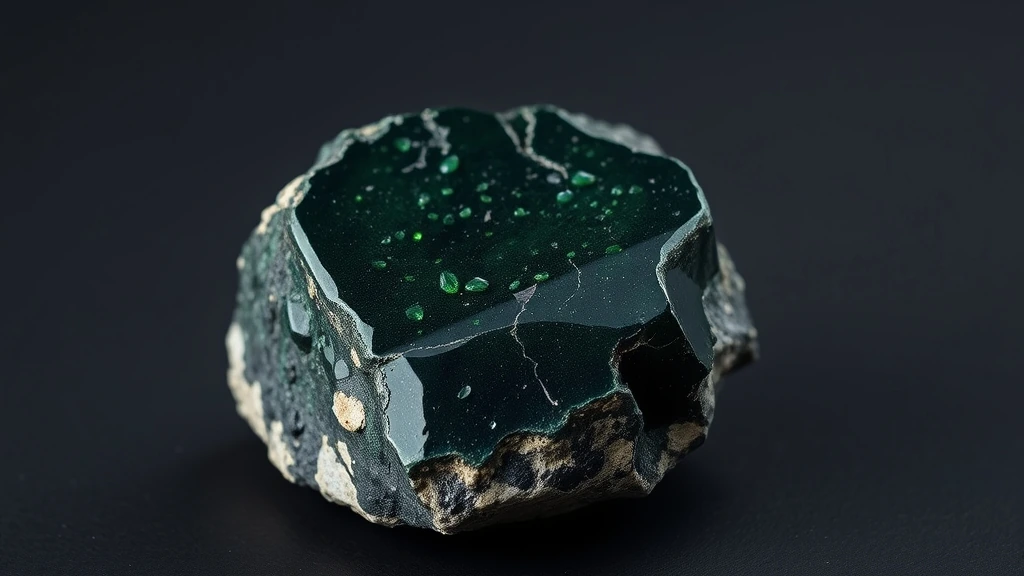
Augite belongs to the pyroxene family, a primary component of many igneous and metamorphic rocks such as basalt, gabbro, and diorite. As a natural mineral/crystal, it forms elongated prismatic grains that aggregate into the dark, speckled rocks prized by collectors and occasionally cut as a gemstone. Its monoclinic symmetry and robust lattice make it resistant to weathering, while its variable chemistry produces a rich palette of earthy hues.
What is Augite Rock ? Geological Overview & Definition
Augite is the most common clinopyroxene in the Earth’s crust, typically occurring in mafic to ultramafic igneous suites. In its rock form, the mineral aggregates into a dense, fine‑grained matrix that can be polished for ornamental use, though it is rarely faceted due to its modest hardness.
The gemstone is valued for its deep green, brown, or black coloration, which stems from iron‑ and titanium‑rich chromophore centers. While not a true single‑crystal gem, augite rock retains the mineral’s intrinsic optical properties, making it a distinctive collector’s item for those drawn to its earthy, grounding energy. In comparative mineralogical collections, practitioners and geologists frequently study Chrome Diopside alongside this crystal to appreciate their subtle energetic and structural differences.
Augite Rock Chemical Composition & Crystallographic Properties
The crystal structure of augite is monoclinic, belonging to the space group C2/c, with a single‑axis tilt that creates the characteristic prismatic habit. Its lattice consists of chains of SiO₄ tetrahedra linked by shared oxygen atoms, forming a robust framework that accommodates extensive cation substitution. This robust silicate framework is not unique to augite, as the high-pressure mineral Glaucophane also relies on a similar chain structure to maintain stability under extreme metamorphic conditions.
Cations such as Ca²⁺, Na⁺, Mg²⁺, Fe²⁺, and Al³⁺ occupy the M1 and M2 sites, allowing the formula (Ca,Na)(Mg,Fe,Al)(Si,Al)₂O₆ to vary widely. This solid‑solution series explains the range of densities (2.90–3.20 g/cm³) and refractive indices observed in different specimens. In comparative mineralogical collections, practitioners and geologists frequently study Cummingtonite alongside this crystal to appreciate their subtle energetic and structural differences.
Augite is relatively acid‑sensitive; exposure to strong acids can leach calcium and sodium, subtly altering surface luster. However, its strong Fe‑Ti chromophores remain stable, preserving the dark green to black hues even after mild chemical weathering.
Thermally, augite exhibits a sharp exsolution of clinopyroxene intergrowths at temperatures above 800 °C, often producing lamellar twinning visible under polarized light. Upon cooling, the mineral contracts anisotropically, which can generate microfractures—an important consideration when cutting the rock for gemstone applications.
| Property | Specification |
|---|---|
| Mineral Group | Natural Mineral / Crystal |
| Chemical Formula | Augite (Ca,Na)(Mg,Fe,Al)(Si,Al)₂O₆, Plagioclase feldspar, Amphibole |
| Mohs Hardness | 5.0 – 6.5 |
| Crystal System | Monoclinic |
| Specific Gravity (Density) | 2.90 – 3.20 |
| Refractive Index | 1.670 – 1.730 |
| Color & Optical Properties | Natural Augite Rock Gemstone color spectrum and optical dispersion |
| Primary Mining Localities | Global primary localities |
| Water & Chemical Resistance | High (Safe for gentle water washing) |
| Chakra Alignment (Traditional) | Root Chakra |
| Zodiac Affinity (Traditional) | Taurus, Virgo, Capricorn |
| Symbolic Meaning (Traditional) | Grounding, stability, and protection |
Augite Rock Varieties & Color Spectrum
Dark Forest Augite
Formed in high‑temperature basaltic flows, Dark Forest Augite displays deep emerald‑to‑black hues caused by fine‑grained magnetite inclusions. The monoclinic crystals grow in elongated prismatic habits, often exhibiting a subtle chatoyancy when cut as cabochons. This variety is most common in the Canadian Shield, yet gem‑quality stones are scarce, making them prized by collectors.
Sunset Amber Augite
Originating from volcanic ash‑laden tuffs of the Andes, Sunset Amber Augite is renowned for its warm amber‑orange to reddish‑brown coloration, a result of trace titanium and iron oxides. Thin lamellar growths produce a faint pleochroic effect that shifts with viewing angle. While abundant in raw form, transparent, eye‑clean gems are rare and command premium prices on the market.
Oceanic Blue Augite
Found in the ultramafic complexes of the Baltic region, Oceanic Blue Augite acquires its striking teal‑blue tone from low‑level chromium substitution within the crystal lattice. The stones often contain microscopic fluid inclusions that create a delicate labradorescence under UV light. High‑clarity specimens are exceptionally uncommon, and the variety is sought after for bespoke jewelry pieces.
Desert Sandstone Augite
Developed within sandstone-hosted mafic intrusions of the Sahara, Desert Sandstone Augite exhibits a muted yellow‑to‑gold palette due to iron‑bearing hematite specks. Its granular matrix yields a characteristic microlite texture visible under magnification. Although the deposits are extensive, gem‑grade crystals are limited, rendering the variety a niche favorite among mineral enthusiasts.
Alpine Green Augite
Extracted from the Alpine ophiolite belts of Austria, Alpine Green Augite showcases vivid green to olive tones imparted by elevated chromium and vanadium content. The crystals frequently display striated terminations and occasional twinned twins, hallmarks of slow cooling in metamorphic shear zones. This variety is considered one of the most exclusive, with only a handful of polished gems entering the global trade each year.
Pacific Island Pearl Augite
Unique to the volcanic islands of Fiji, Pacific Island Pearl Augite possesses a pearlescent sheen over a base of pale gray‑green, caused by microscopic mica platelets intergrown with the augite lattice. The stones often form in pillow lava environments, resulting in rounded, conchoidal fracture surfaces. Their rarity and distinctive luster make them highly coveted for high‑end ornamental applications.
Where is Augite Rock Found? Geological Mining & Extraction
Augite typically occurs in mafic to ultramafic igneous rocks, especially within basaltic lava flows, gabbroic pegmatites, and layered intrusions. The mineral crystallizes under rapid cooling conditions, producing the characteristic monoclinic prisms that are later liberated through selective crushing and gravity separation techniques in mining operations.
Major extraction zones include the Canadian Shield (Ontario and Quebec), the Andes of Chile and Argentina, the Baltic Shield (Finland and Sweden), and the Alpine ophiolite complexes of Central Europe. In each locale, artisanal miners and industrial firms employ a combination of hand‑sorting and mechanized jigging to isolate gem‑quality augite from abundant host rock matrices.
Historical Significance & Cultural Lore of Augite Rock
Ancient Mesoamerican cultures prized dark augite as a talisman for warriors, embedding polished shards into obsidian blades to invoke grounding and protective energies. Archaeological digs in the Yucatán have uncovered augite in burial caches, suggesting its role in after‑life rituals and as a status symbol among the elite.
In early European and Mediterranean agricultural lore, basaltic stones containing augite were linked to the Root Chakra and soil fertility, with rural farmers placing them in fields to promote robust harvests. Medieval European alchemists recorded augite’s “earth‑binding” properties, believing it could safeguard against poison and misfortune, a belief that persists in modern metaphysical practices.
Modern Uses & Jewelry Applications of Augite Rock
Augite’s monoclinic crystals are prized by lapidaries for their high refractive index (1.670‑1.730) and striking dark‑green to brown hues. The stone is typically cut as a cabochon to showcase its chatoyant sheen, though skilled artisans also produce modestly faceted pieces for avant‑garde jewelry. Ornamental carving—small beads, pendants, and decorative inlays—leverages its relatively easy cleavage while preserving structural integrity.
- Cabochon cuts emphasize the stone’s silky luster and natural color zoning.
- Faceted cuts are limited to low‑grade pieces due to the mineral’s modest hardness (5‑6.5 Mohs).
- Carved miniatures and beads are popular in ethnic and folk‑art jewelry.
- Augite is occasionally used as an accent stone in mixed‑mineral settings, paired with quartz or hematite for contrast.
Safety & Mineral Profile of Augite Rock
When handling augite, wear gloves and eye protection; fine dust generated during cutting can irritate respiratory passages. The mineral is chemically stable under ambient conditions, resisting weathering but may release trace iron when exposed to strong acids. Augite is primarily a collector mineral, valued for scientific study and display rather than therapeutic use; any historical metaphysical claims (e.g., grounding for the Root Chakra) should be treated as folklore, not evidence‑based practice.
Mineralogical Group and Planetary Lore of Augite Rock
Augite belongs to the pyroxene group, sharing a chain silicate structure with diopside and hedenbergite. Its formula (Ca,Na)(Mg,Fe,Al)(Si,Al)₂O₆ reflects a solid‑solution series that accommodates a wide range of cations, giving rise to its variable color palette and density (2.90‑3.20 g/cm³).
In traditional planetary symbolism, augite has been linked to Saturn, reinforcing themes of grounding, stability, and protection—attributes echoed in its alignment with the Root Chakra and Earth‑sign zodiac triad (Taurus, Virgo, Capricorn). While these associations appear in esoteric literature, they hold no scientific weight and should be regarded as cultural narrative rather than mineral fact.
How to Identify Real vs. Fake Augite Rock
Artificial imitations of augite include dyed glass, synthetic pyroxene, and resin composites that mimic its dark green‑brown coloration. These substitutes often lack the mineral’s characteristic monoclinic crystal habit and display uniform clarity not typical of natural specimens. Careful testing can quickly separate genuine augite from its look‑alikes.
Practical At-Home Authenticity Tests
- Temperature Test (Thermal Feel): Natural augite feels cool to the touch and retains that coolness longer than glass or plastic, which quickly equilibrate to ambient temperature.
- Specific Gravity & Weight Test: Weigh the stone and compare its density (2.90‑3.20 g/cm³) to a calibrated reference; fakes usually feel lighter due to lower specific gravity.
- Scratch & Hardness Test (Mohs Comparison): Use a steel nail (≈5.5 Mohs) or a quartz point (≈7 Mohs); augite should resist a nail but may be scratched by quartz, confirming its 5‑6.5 hardness range.
- Microscopic & Loupe Inspection (Internal Inclusions): Under 10×–30× magnification, genuine augite shows characteristic mineral inclusions, cleavage steps, and occasional exsolution lamellae, whereas glass replicas appear uniformly flawless.
Augite Rock Valuation Factors, Grading & Pricing
Market value hinges primarily on Color Saturation, where deep, uniform greenish-black tones command higher prices. Consistent tone across the specimen is critical for aesthetic appeal and collector interest. Additionally, high optical clarity and a distinct vitreous luster significantly enhance the stone’s visual desirability.
Specimen Dimensions & Matrix Intactness directly influences pricing, as larger, intact specimens are rarer and more valuable. crystal cluster integrity, when cut, must be precise to maximize light return and structural integrity. The presence of heavy matrix or prominent inclusions generally reduces value, though some collectors prefer natural, uncut forms.
Geographical Provenance Premium applies to stones from renowned localities with documented geological history. Wholesale prices remain modest due to the mineral’s common occurrence in mafic rocks. Retail values increase for polished, certified specimens, reflecting the labor and expertise involved in preparation.
How to Clean and Care for Augite Rock
To maintain the stone’s integrity, use warm soapy water and a soft cloth for gentle surface cleaning. This method effectively removes dust and oils without risking damage to the crystal structure. Always dry the gemstone thoroughly with a lint-free towel after washing.
You must strictly avoid ultrasonic cleaners to prevent structural fractures within the mineral lattice. The monoclinic crystal system can be susceptible to internal stress during high-frequency vibrations. Regular inspection for cracks ensures long-term preservation of the specimen’s physical condition.
Cleansing and Recharging Augite Rock (Energetic Care)
For energetic cleansing, utilize safe dry methods that respect the mineral’s sensitivity to moisture. Smoke smudging with sage or palo santo is an effective, non-invasive technique for clearing negative energy. This approach avoids any risk of chemical interaction or physical stress to the stone.
Place the augite on a selenite plate under moonlight for recharging purposes. This method leverages natural lunar energy to restore the stone’s vibrational balance without water exposure. Ensure the stone is securely positioned to prevent accidental drops during the overnight process.
Frequently Asked Questions About Augite Rock
What is the hardness of augite and can it be used in everyday jewelry?
Augite rates 5.0–6.5 on the Mohs scale. This makes it suitable for pendants and earrings that receive moderate wear, but it may scratch more easily than quartz or sapphire. Its monoclinic crystal system and relatively modest hardness require careful handling to preserve surface luster.
How should I clean an augite safely?
Clean augite with warm soapy water and a soft cloth. Avoid ultrasonic cleaners, as the rapid vibrations can cause micro‑fractures in the crystal lattice. Gentle manual cleaning maintains the stone’s refractive index (1.670–1.730) without compromising structural integrity.
Is augite water‑resistant enough for daily wear?
Augite is water‑sensitive; prolonged soaking should be avoided. Short exposure to rain or brief hand washing is generally harmless, but extended immersion can promote surface etching. Treat the stone as sensitive to moisture to keep its density (2.90–3.20 g/cm³) stable.
Which zodiac signs are traditionally linked to augite?
Augite is associated with Taurus, Virgo, and Capricorn. These earth‑sign personalities are said to benefit from the stone’s grounding energy. In astrological contexts, the gemstone’s chemical composition (Ca, Na, Mg, Fe, Al) is thought to echo the steady, practical nature of these signs.
Which chakra does augite support, and how is it used in meditation?
Augite aligns with the Root Chakra. Practitioners place the stone at the base of the spine to foster grounding, stability, and protection during meditation. Its monoclinic structure is believed to channel earthy vibrations that reinforce a sense of security and physical presence.
Can augite be set in a ring without risk of cracking?
Augite can be set in rings, but the setting must protect against stress. Because the mineral’s crystal system can be brittle under pressure, a bezel or protective prong setting is recommended to distribute force evenly and reduce fracture risk.
Does augite exhibit any notable optical properties for collectors?
Augite displays a refractive index of 1.670–1.730, giving it a bright, glassy luster. Its monoclinic crystals often show subtle pleochroism, shifting between greenish‑brown and darker hues when viewed from different angles, a feature prized by mineral collectors.
How does augite differ from plagioclase feldspar in appearance?
Augite is typically darker and more opaque than plagioclase feldspar. While both share a similar chemical formula, augite’s higher iron and magnesium content yields a richer, brown‑to‑black hue, whereas plagioclase appears lighter, often white to gray, with a more pronounced cleavage.