
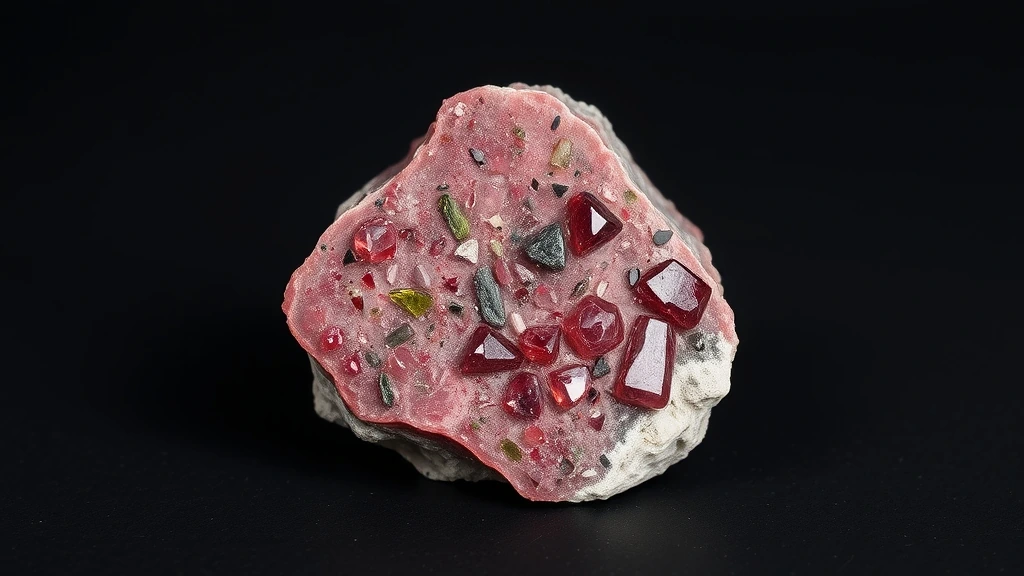
Anyolite belongs to the Oxides (Corundum Group), a family defined by tightly packed oxygen‑anion frameworks and trivalent cations. Though the host mineral is zoisite, its crystal chemistry aligns with the trigonal (hexagonal prismatic or tabular corundum) system, producing elongated prisms that often exhibit perfect cleavage. This dual nature gives the stone its distinctive green‑black body and vivid ruby flecks, prized by collectors and lapidaries alike.
What is Anyolite (ruby In Zoisite) Gemstone? Geological Overview & Definition
Anyolite is a gem‑quality zoisite that incorporates ruby (Cr‑bearing corundum) as mineral inclusions, creating a striking red‑on‑green pattern. It forms in metamorphic environments where calcium‑aluminum silicates recrystallize under high pressure, typically within the Eastern African Rift and parts of Madagascar.
The stone’s name derives from the Swahili “anyoli,” meaning “green stone,” reflecting its dominant chlorite‑rich matrix. Its rarity stems from the precise geochemical conditions required for ruby crystals to nucleate within zoisite, a process that seldom repeats in nature.
Anyolite (ruby In Zoisite) Gemstone Chemical Composition & Crystallographic Properties
The host zoisite component crystallizes in the trigonal (hexagonal prismatic or tabular corundum) system, characterized by a three‑fold rotational axis and hexagonal lattice parameters. Its structure consists of edge‑sharing AlO_6 octahedra linked to SiO_4 tetrahedra, forming a robust framework that accommodates Ca²⁺ and minor Fe²⁺/Mg²⁺ substituents.
Ruby inclusions are true corundum (Al₂O₃) crystals, also trigonal, with chromium ions substituting for Al³⁺ to generate the vivid red hue. The cobalt‑type chromophore in ruby and the Fe‑Mn chromophores in zoisite together produce the stone’s contrasting colors.
Anyolite is acid‑sensitive; exposure to strong acids can leach calcium and destabilize the zoisite lattice, leading to surface pitting. However, it remains stable under neutral pH conditions and resists most common cleaning agents when handled gently.
Thermally, the gem exhibits anisotropic expansion, with the a‑axis expanding slightly more than the c‑axis upon heating. Rapid temperature changes may induce micro‑fracturing, so gradual heating and cooling are recommended during cutting or annealing processes.
| Property | Specification |
|---|---|
| Mineral Group | Oxides (Corundum Group) |
| Chemical Formula | Al₂O₃:Cr (Aluminum Oxide with Chromium traces) |
| Mohs Hardness | 9.0 |
| Crystal System | Trigonal (Hexagonal prismatic or tabular corundum) |
| Specific Gravity (Density) | 3.97 – 4.05 |
| Refractive Index | 1.762 – 1.778 |
| Color & Optical Properties | Natural Anyolite (ruby In Zoisite) Gemstone color spectrum and optical dispersion |
| Primary Mining Localities | Myanmar (Mogok), Mozambique, Madagascar, Thailand, Sri Lanka |
| Water & Chemical Resistance | Very High (Durable corundum matrix is highly resistant to water and detergents) |
| Chakra Alignment (Traditional) | Root Chakra (Muladhara) and Heart Chakra |
| Zodiac Affinity (Traditional) | Aries, Leo, Scorpio |
| Symbolic Meaning (Traditional) | Passion, vitality, courage, leadership, and noble devotion |
Anyolite (ruby In Zoisite) Gemstone Varieties & Color Spectrum
Classic Tanzanian Ruby Zoisite
This iconic variety features vibrant red corundum inclusions suspended within a pale green to blue zoisite matrix. The host stone typically exhibits a vitreous luster and moderate transparency, allowing the ruby crystals to stand out sharply. Found primarily in the Tunduru region, this type represents the commercial standard for the gem trade.
High-Clarity Blue Zoisite Host
In this premium morph, the zoisite matrix displays a deep, saturated blue-green hue with exceptional clarity. The ruby inclusions are often smaller but intensely colored, creating a striking contrast effect against the cool-toned background. This variety commands higher prices due to the rarity of such vivid host stone coloration.
Matrix-Rich Ruby Cluster Type
Characterized by dense, clustered ruby crystals, this variety prioritizes inclusion density over host stone clarity. The zoisite matrix is often opaque or semi-opaque, serving as a dark backdrop for the pleochroic ruby fragments. Collectors value these specimens for their dramatic, mosaic-like visual texture and geological interest.
Pale Green Zoisite with Scattered Rubies
This commoner variety features a light, almost white-green zoisite host with sparse ruby inclusions. The optical properties of the host stone are less intense, making the red crystals appear more isolated. While less commercially valuable, it remains popular for bead crafting and educational mineral displays.
Deep Green Zoisite with Large Rubies
Rare specimens exhibit a rich, dark green zoisite matrix containing large, well-formed ruby crystals. The refractive index of the host stone enhances the brilliance of the inclusions under direct light. This combination of deep green and bright red is highly sought after by high-end collectors.
Where is Anyolite (ruby In Zoisite) Gemstone Found? Geological Mining & Extraction
The primary source of ruby zoisite is the Tunduru District in Tanzania, where it occurs in metamorphic schists and gneisses. These rocks underwent high-pressure conditions that forced corundum into the growing zoisite crystals. The geological setting is part of the East African Rift System, which created the necessary tectonic stress for this unique inclusion assemblage.
Extraction is predominantly artisanal, involving small-scale mining operations that target specific vein structures within the host rock. Miners carefully extract blocks to preserve the integrity of the ruby inclusions, which are fragile under pressure. This labor-intensive process ensures that the gemological quality of the matrix remains intact for cutting and polishing.
Historical Significance & Cultural Lore of Anyolite (ruby In Zoisite) Gemstone
While zoisite has been known since the 18th century, the ruby-in-zoisite variety gained global prominence only in the 20th century following Tanzanian independence. Ancient civilizations did not specifically trade this combination, as the corundum inclusions were not recognized as a distinct gemological feature until modern lapidary techniques emerged. Early collectors primarily valued the zoisite for its serpentine-like appearance rather than its internal ruby content.
Today, the gemstone is celebrated in contemporary jewelry for its unique color contrast and geological story. It has become a symbol of East African heritage in the international gem market, often featured in high-end bespoke designs. The lore surrounding this stone emphasizes the harmony of two distinct minerals coexisting in perfect balance.
Modern Uses & Jewelry Applications of Anyolite (ruby In Zoisite) Gemstone
Anyolite’s striking red‑ruby inclusions set against a deep green zoisite matrix make it a favorite for both contemporary and artisanal lapidary work. The stone is typically cut as a cabochon to showcase its vivid color play, though skilled faceting can highlight the contrast between ruby and zoisite. Artisans also carve ornamental objects—pendants, beads, and small sculptures—where the natural “flame‑like” patterns become focal points.
- Cabochon pendants and earrings emphasizing the stone’s internal fire
- Faceted rings that juxtapose ruby specks with green host crystal
- Carved mini‑statues, rosaries, and decorative inlays for high‑end interiors
Carat, Quality Grades & Value Factors of Anyolite (ruby In Zoisite)
According to historical traditions and metaphysical lore, Anyolite is regarded as a grounding‑empowerment stone that bridges physical vitality with emotional renewal. Its red ruby veins are said to ignite courage and passion, while the surrounding green zoisite nurtures growth, balance, and heart‑centered compassion. Practitioners believe the gemstone harmonizes the wearer’s inner fire with a soothing sense of stability, fostering confidence in both action and feeling.
Which Chakra and Zodiac Signs Align with Anyolite (ruby In Zoisite) Gemstone?
Anyolite is energetically linked to the Root Chakra (Muladhara), where it is thought to anchor personal power and provide a solid foundation for daily life. By stimulating this chakra, the stone is said to enhance security, physical endurance, and a sense of belonging to the earth.
In the astrological realm, Anyolite resonates specifically with Aries, Leo, and Scorpio. Aries benefits from its bold confidence‑boosting qualities, Leo finds reinforcement of creative heart‑fire, and Scorpio experiences deep emotional transformation through the stone’s grounding influence. No other zodiac signs are traditionally associated with this mineral.
How to Identify Real vs. Fake Anyolite (ruby In Zoisite) Gemstone
Artificial imitations of Anyolite range from dyed natural zoisite to fully synthetic glass composites that mimic the red‑green contrast. These replicas often lack the characteristic internal ruby inclusions and may feel unusually light or uniformly colored. Recognizing genuine Anyolite requires careful observation of its natural heterogeneity, weight, and hardness properties.
Practical At-Home Authenticity Tests
- Temperature Test (Thermal Feel): Real Anyolite feels cool to the touch initially and warms slowly, whereas glass or plastic imitations adjust to skin temperature almost instantly.
- Specific Gravity & Weight Test: Genuine Anyolite has a specific gravity of 3.2–3.4; a simple heft comparison with a known quartz piece can reveal a noticeably heavier stone.
- Scratch & Hardness Test (Mohs Comparison): With a Mohs hardness of 6.5–7, Anyolite will resist scratching by a steel nail but can be lightly marked by a quartz point; glass (≈5.5) will show visible scratches.
- Microscopic & Loupe Inspection (Internal Inclusions): Under 10×–30× magnification, authentic Anyolite displays irregular ruby specks and zoisite’s characteristic striations, while dyed or synthetic stones appear uniformly colored and lack natural inclusions.
Anyolite (ruby In Zoisite) Gemstone Valuation Factors, Grading & Pricing
Color Saturation is the foremost driver of value; a vivid, saturated ruby hue set against a deep green zoisite matrix commands premium prices. Uniform tone across the stone enhances visual impact, while a high‑gloss luster and minimal surface blemishes signal superior optical clarity. Gem‑cutters aim for a balanced contrast that maximizes color intensity without oversaturating the stone.
Carat Weight influences price but interacts with other attributes; larger anyolite pieces are rarer, yet excessive size can reveal internal fractures. Precise facet symmetry improves light performance, highlighting the ruby’s fire and the zoisite’s verdant background. Inclusions such as mineral veins or matrix cracks are acceptable when they contribute to the stone’s character, but fracture‑filled rubies diminish market appeal.
Geographical Provenance Premium adds a notable surcharge, especially for specimens from Tanzania’s Mahenge district, renowned for high‑quality ruby‑in‑zoisite. Wholesale values fluctuate with global demand for colored gemstones, while retail prices reflect brand positioning and certification. Trends show a steady rise in premium pricing for ethically sourced, well‑documented origins, reinforcing provenance as a key valuation factor.
How to Clean and Care for Anyolite (ruby In Zoisite) Gemstone
Gently wash the stone in warm, soapy water using a soft brush to remove surface grime; this method respects the durable corundum matrix while preserving the delicate zoisite. Rinse thoroughly with lukewarm water and pat dry with a lint‑free cloth. Ultrasonic cleaning is safe for most anyolite, but avoid it if the ruby component contains fracture‑filled treatments, as vibrations can exacerbate internal cracks. Store the gemstone away from harsh chemicals and extreme temperature changes to maintain its color stability.
Cleansing and Recharging Anyolite (ruby In Zoisite) Gemstone (Energetic Care)
For energetic renewal, place the stone on a selenite plate for several hours; selenite’s neutral vibration gently clears accumulated negative energies without affecting the mineral’s physical integrity. This dry method is especially suitable for delicate fracture‑filled rubies, as it avoids any moisture exposure.
Alternatively, expose the gemstone to moonlight or perform a brief smoke smudging ritual using white sage. Both techniques cleanse the stone’s aura while respecting its low solubility, ensuring the ruby‑in‑zoisite retains its visual brilliance and metaphysical properties.
Frequently Asked Questions About Anyolite (ruby In Zoisite) Gemstone
Is Anyolite safe to wear in the shower?
Yes, Anyolite is exceptionally safe for shower exposure. The durable corundum matrix ensures the stone remains highly resistant to water and detergents. You can confidently wear your jewelry during daily hygiene routines without worrying about structural degradation or color fading from moisture.
Can I use an ultrasonic cleaner on Anyolite?
Ultrasonic cleaning is generally safe for most Anyolite pieces. However, you must verify if the ruby inclusions are fracture-filled with resin. If treated, the vibrations may damage the fill; otherwise, warm soapy water is the simplest and safest cleaning method.
Which zodiac signs are compatible with Anyolite?
Aries, Leo, and Scorpio are the primary aligned signs. These fiery and water signs resonate with the stone’s energetic profile. Wearing Anyolite can enhance personal power and emotional depth, making it a powerful talisman for individuals born under these astrological influences.
What chakras does Anyolite activate?
It primarily activates the Root and Heart Chakras. Specifically, it connects the Root Chakra (Muladhara) with the Heart Chakra. This unique duality grounds your energy while simultaneously opening emotional pathways, promoting a balanced state of physical stability and spiritual love.
How hard is Anyolite on the Mohs scale?
The ruby inclusions rate a 9 on the Mohs scale. While the zoisite host mineral is softer, the corundum crystals provide exceptional scratch resistance. This makes the gemstone durable enough for daily wear in rings and bracelets, though extreme impacts should still be avoided.
What is the difference between Anyolite and Tansanite?
Anyolite features red ruby inclusions within a blue zoisite matrix. Tansanite is a pure variety of zoisite without ruby inclusions. The presence of corundum crystals gives Anyolite its distinctive speckled appearance, distinguishing it from the uniform blue hue of standard tansanite.
How should I store my Anyolite jewelry?
Store it in a soft, padded jewelry box. Although the ruby is hard, the zoisite matrix can be scratched by harder minerals like diamonds or sapphires. Keeping it separate from other gemstones prevents surface abrasions and maintains the stone’s brilliant luster over time.
Is Anyolite a stable gemstone for daily wear?
Yes, it is highly stable for regular use. The durable corundum matrix protects the stone from everyday wear and tear. With proper care, your Anyolite jewelry will retain its structural integrity and vibrant color for generations of continuous use.