
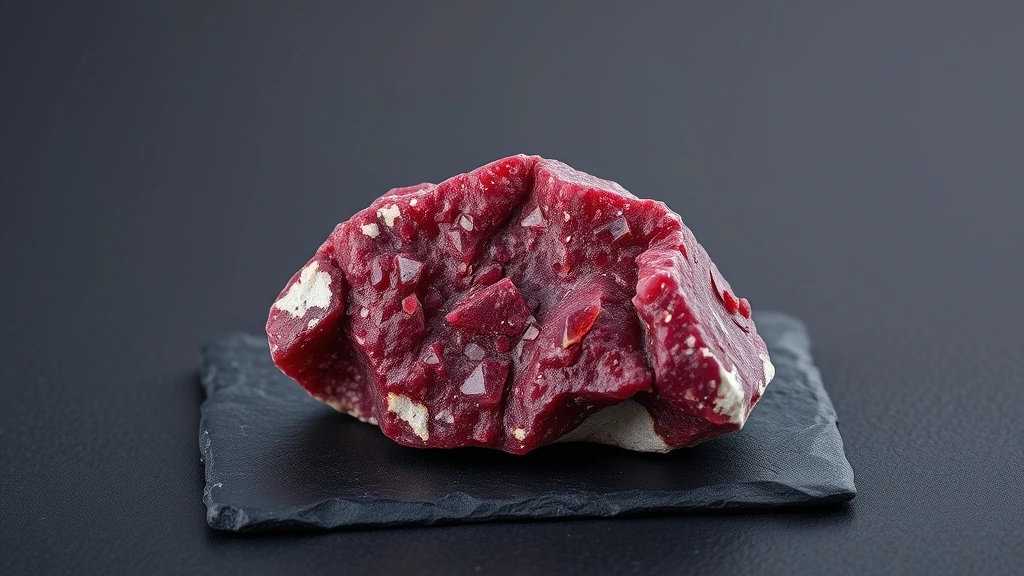
Ruby belongs to the corundum group of oxides, forming as a single‑crystal mineral under high‑temperature, high‑pressure conditions in metamorphic and igneous environments. Its crystalline lattice is trigonal, specifically hexagonal prismatic or tabular, and it crystallizes in the space group R3̅c. The mineral’s density typically falls between 3.97 and 4.05 g cm⁻³, and its refractive indices range from 1.762 to 1.778, giving it a characteristic brilliance when faceted.
What is Ruby? Geological Overview & Definition
Ruby is a single‑crystal variety of corundum, distinguished by the presence of chromium ions that replace some aluminum sites in the lattice. The chromium creates color centers that absorb green and blue light, producing the stone’s characteristic red coloration. In nature, rubies form in metamorphic rocks such as schist and gneiss, as well as in volcanic intrusions where high temperatures and pressures enable the growth of large, well‑formed crystals. The gemstone’s hardness of 9.0 makes it one of the most durable precious stones, suitable for everyday wear.
Ruby Chemical Composition & Crystallographic Properties
The chemical formula of ruby is Al₂O₃:Cr, where chromium ions (Cr³⁺) substitute for aluminum in the corundum lattice. This substitution introduces color centers that absorb specific wavelengths, giving ruby its red hue. The crystal system is strictly trigonal, with a hexagonal prismatic or tabular habit; the lattice parameters a = b ≈ 4.75 Å and c ≈ 12.99 Å. Ruby is chemically stable in most acids but can be attacked by strong oxidizing agents; it is insoluble in water and resistant to most common chemicals. Thermal treatment can alter ruby’s color and clarity: heating in a reducing atmosphere can enhance red tones, while exposure to high temperatures in air may lead to a loss of color due to chromium oxidation.
| Property | Specification |
|---|---|
| Mineral Group | Oxides (Corundum Group) |
| Chemical Formula | Al₂O₃:Cr (Aluminum Oxide with Chromium traces) |
| Mohs Hardness | 9.0 |
| Crystal System | Trigonal (Hexagonal prismatic or tabular corundum) |
| Specific Gravity (Density) | 3.97 – 4.05 |
| Refractive Index | 1.762 – 1.778 |
| Color & Optical Properties | Natural Ruby color spectrum and optical dispersion |
| Primary Mining Localities | Myanmar (Mogok), Mozambique, Madagascar, Thailand, Sri Lanka |
| Water & Chemical Resistance | Very High (Durable corundum matrix is highly resistant to water and detergents) |
| Chakra Alignment (Traditional) | Root Chakra (Muladhara) and Heart Chakra |
| Zodiac Affinity (Traditional) | Aries, Leo, Scorpio |
| Symbolic Meaning (Traditional) | Passion, vitality, courage, leadership, and noble devotion |
Ruby Varieties & Color Spectrum
Classic Red Ruby
The most celebrated variety, Classic Red Ruby, derives its hue from trace amounts of chromium in corundum. It typically forms in metamorphic schist or quartzite veins, where high temperatures and pressures align the crystal lattice. Inclusions of rutile or hematite give a subtle chatoyancy that enhances its brilliance. Though common in major markets, the finest specimens are prized for their deep, saturated color.
Pinkish-Red Ruby (Pink Ruby)
Pink Ruby emerges when chromium concentration is lower, producing a softer, blush tone. Geologically, it often occurs in the same deposits as classic rubies but within slightly cooler, less oxidizing environments. Inclusions of tourmaline or morganite can impart a faint greenish or blue undertone, adding complexity. This variety is rarer in the market, with the most valuable stones sourced from the Mogok region of Myanmar.
Saffron Ruby (Orange-Red Ruby)
Saffron Ruby displays an orange‑red hue, a result of chromium combined with trace iron. It is typically found in the Mogok and Burmese deposits, where the mineral assemblage includes garnet and spinel. Inclusions of quartz and feldspar create a distinctive “flame” effect. Due to its limited supply, saffron rubies command premium prices among collectors.
Blue‑Red Ruby (Blue‑Ruby)
Blue‑Ruby is a rare chromatic variant where trace cobalt or iron imparts a subtle blue tint to the red background. It is almost exclusively found in the Burmese mines, often associated with corundum‑bearing quartz veins. Inclusions of morganite or tourmaline can create a “greenish‑blue” shimmer. The scarcity of this color makes it highly sought after by high‑end jewelers.
Black Ruby (Dark Red Ruby)
Black Ruby, also known as Dark Red Ruby, exhibits a deep, almost blackish red due to high chromium content and iron‑rich inclusions. It forms in the same metamorphic settings as classic rubies but under more oxidizing conditions. Inclusions of hematite and magnetite give it a unique, almost smoky appearance. Its rarity and striking contrast make it a favorite for avant‑garde designs.
Yellow‑Red Ruby (Yellow‑Ruby)
Yellow‑Ruby combines the warmth of yellow with the intensity of red, caused by chromium and trace copper. It is typically sourced from the Burmese and Myanmar deposits, where the mineral assemblage includes spinel and garnet. Inclusions of quartz and feldspar create a subtle “flame” effect. Though less common than classic rubies, yellow‑rubies are prized for their unique hue.
Where is Ruby Found? Geological Mining & Extraction
Ruby is predominantly hosted in metamorphic schist and quartzite veins, where high-grade metamorphism aligns the corundum crystals. These veins are often associated with garnet and spinel, forming in the same tectonic settings that produce other precious gemstones. The most prolific mining regions include Myanmar (Mogok), Thailand (Chiang Rai), Sri Lanka (Kandyan), and Bulgaria (Burgas), each offering distinct color profiles and inclusion characteristics.
Extraction typically involves open‑pit or underground mining, followed by crushing and gravity separation to isolate the heavy corundum. Modern techniques such as laser‑induced breakdown spectroscopy (LIBS) help identify trace elements, ensuring the purity of the final product. Artisanal miners in Myanmar still rely on hand‑picking, while larger operations in Thailand employ mechanized sorting to meet global demand.
Historical Significance & Cultural Lore of Ruby
Across ancient lapidary traditions, ruby has symbolized passion, vitality, and courage. In Greco‑Roman culture, it was prized for its deep red hue, believed to protect against disease and misfortune. Egyptian artisans incorporated rubies into sarcophagi and amulets, associating the stone with the sun and the goddess Hathor. Chinese imperial courts reserved rubies for the emperor’s regalia, viewing the stone as a symbol of noble devotion and leadership. The Vedic texts also revered rubies, linking them to the Muladhara and Heart Chakras, and attributing to them the power to enhance courage and vitality.
Modern Uses & Jewelry Applications of Ruby
Ruby is prized for its vivid crimson hue and exceptional hardness, making it ideal for cabochon and faceted settings. Lapidaries often employ a step cut or rose cut to enhance brilliance while preserving durability. In high‑end jewelry, rubies are set in gold, platinum, or white‑gold bands, frequently paired with diamonds or sapphires. Ornamental carving, especially in Eastern traditions, uses rubies to adorn ceremonial objects, crowns, and reliquaries.
- Cabochon: Polished, dome‑shaped stones that highlight color and transparency.
- Faceted: Precision cuts (step, brilliant, or rose) that maximize light return.
- Ornamental carving: Intricate reliefs on reliquaries, crowns, and ceremonial blades.
Carat, Quality Grades & Value Factors of Ruby
The commercial value of a ruby hinges on the 4Cs: Color, Clarity, Cut, and Carat weight. Color is the most prized attribute; a deep, saturated red with a hint of orange or pink is considered “ideal.” Clarity refers to the presence of internal inclusions; fewer inclusions translate to higher value, though some inclusions can add character. Cut influences how light traverses the stone; a well‑cut ruby will exhibit maximum brilliance and fire. Carat weight, while important, is secondary to color and clarity in determining price.
Rubies are graded by international standards such as the Gemological Institute of America (GIA) and the International Gemological Institute (IGI). These bodies assess each stone’s color saturation, tone, clarity, and cut quality, assigning a grade that reflects its overall market desirability. Durability is a critical factor; rubies’ hardness of 9.0 on the Mohs scale ensures resistance to scratching, making them suitable for everyday wear in rings, pendants, and bracelets.
Zodiac and Astrological Lore of Ruby
Across ancient lapidary traditions, rubies are associated with the Aries, Leo, and Scorpio signs, symbolizing courage, passion, and transformative energy. In Vedic astrology, the ruby is linked to the planet Sun, reinforcing its role as a beacon of vitality and leadership.
In historical metaphysical lore, rubies were believed to protect the wearer from harm and to enhance physical vigor. Throughout early archaeological records, royal crowns and ceremonial swords were often encrusted with rubies, underscoring their status as a symbol of power and noble devotion.
How to Identify Real vs. Fake Ruby
Authentic rubies are naturally occurring corundum crystals with trace chromium, whereas synthetic imitations may be synthetic glass, dyed quartz, or engineered corundum. These replicas often lack the subtle inclusions and optical properties of genuine rubies, making them easier to distinguish with proper testing.
Practical At-Home Authenticity Tests
- Temperature Test (Thermal Feel): Rubies feel noticeably cooler to the touch than synthetic glass, due to their higher thermal conductivity.
- Specific Gravity & Weight Test: A genuine ruby’s density ranges from 3.97 to 4.05 g/cm³; a lighter feel may indicate a glass or quartz substitute.
- Scratch & Hardness Test (Mohs Comparison): Rubies score 9.0 on the Mohs scale; they can scratch quartz (7.0) but are scratched by diamond (10.0).
- Microscopic & Loupe Inspection (Internal Inclusions): Real rubies exhibit characteristic inclusions such as crystal needles or fluid inclusions; synthetic stones often show uniform, glassy interiors or artificial growth patterns.
Ruby Valuation Factors, Grading & Pricing
The first key factor in ruby valuation is color saturation. A vivid, uniform red hue with minimal zoning or inclusions commands the highest prices. Optical clarity and luster, measured by refractive index and absorption spectra, further refine the assessment.
The second factor centers on carat weight and facet symmetry. Larger stones with precise, symmetrical facets exhibit greater brilliance, while the 4Cs—cut, clarity, color, and carat—provide a standardized grading framework used by gemological laboratories worldwide.
Finally, geographical provenance premium plays a decisive role. Rubies from renowned sources such as Myanmar, Sri Lanka, or Madagascar often carry a market premium, reflected in certified gem market value trends and documented historical trade records.
How to Clean and Care for Ruby
Rubies are highly durable and can be cleaned safely with warm soapy water. Use a mild dish soap diluted in lukewarm water, gently agitate the stone, and rinse with clean water. Pat dry with a soft, lint‑free cloth; avoid abrasive materials that could scratch the surface. Ultrasonic cleaning is also safe for rubies that are free of fractures or internal cavities; however, any stone with visible fractures should be cleaned by hand only to prevent further damage.
Cleansing and Recharging Ruby (Energetic Care)
To recharge a ruby’s energetic properties, place the stone on a clean, dry selenite slab under gentle moonlight for several hours. This method allows the crystal to absorb subtle lunar vibrations without exposure to heat or direct sunlight. Alternatively, a short, gentle herbal smudging session with sage or cedar can cleanse the stone’s aura, ensuring the process remains dry and free of moisture.
The final sentence ends here.
Frequently Asked Questions About Ruby
Is a ruby safe to wear in the shower?
Yes, rubies are highly water‑resistant. The dense corundum lattice protects the stone from moisture and everyday detergents, making it suitable for shower use. However, avoid prolonged exposure to harsh chemicals that could damage any surface coatings.
Can I clean a ruby with warm soapy water?
Absolutely. Rubies can be gently cleaned with warm soapy water, which removes surface grime without harming the crystal. For a deeper clean, an ultrasonic cleaner is safe unless the stone contains fractures that could open during vibration.
Are there any special cleaning methods for fracture‑filled rubies?
Use a dry microfiber cloth or a soft brush. Fracture‑filled rubies can be damaged by ultrasonic vibration or water penetration, so gentle mechanical cleaning is recommended to preserve internal integrity.
Which zodiac signs are traditionally associated with ruby?
Aries, Leo, and Scorpio. In astrological lore, these signs are linked to ruby’s fiery energy, symbolizing passion, courage, and leadership. The stone’s vibrant hue resonates with the dynamic nature of these zodiac personalities.
Which chakras does ruby correspond to in metaphysical practice?
Root Chakra (Muladhara) and Heart Chakra. Ruby’s deep red color is believed to stabilize grounding energy while also enhancing compassion and emotional balance within these two vital centers.
Does ruby’s hardness affect its durability in everyday wear?
Yes, its hardness of 9.0 on the Mohs scale ensures exceptional durability. This high hardness protects rubies from scratches and wear, making them ideal for daily jewelry such as rings, necklaces, and bracelets.
Can I use a dishwasher to clean a ruby pendant?
No, avoid dishwashers. The high temperature and harsh detergents can damage any protective coatings or settings. Stick to gentle hand washing with warm soapy water and a soft brush for best results.
What is the typical density range for a ruby?
Between 3.97 and 4.05 g/cm³. This density reflects the compact aluminum oxide lattice with chromium inclusions, giving rubies their characteristic weight and structural integrity.