
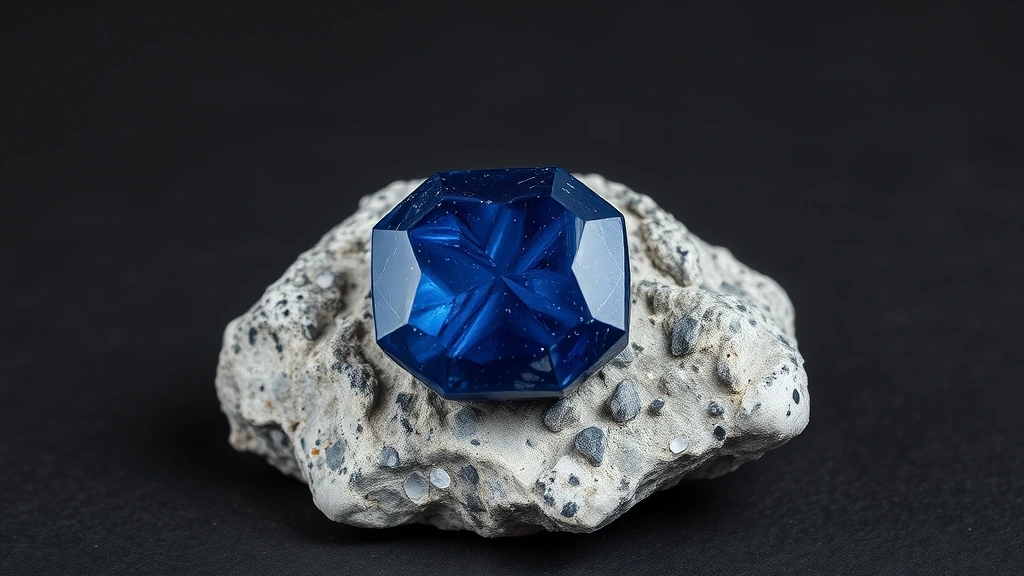
Star sapphire belongs to the oxide mineral class, specifically the corundum group. It forms in high‑temperature, high‑pressure metamorphic environments where aluminum‑rich magmas crystallize. The gemstone’s distinctive asterism results from aligned rutile inclusions that refract light, creating a star‑shaped pattern on polished surfaces.
What is Star Sapphire? Geological Overview & Definition
Star sapphire is a corundum variety distinguished by its star‑like optical phenomenon, known as asterism. The star appears when light reflects off needle‑shaped rutile inclusions aligned within the crystal lattice. These inclusions are typically oriented along the crystal’s c‑axis, producing a six‑pointed star on a flat surface. The gemstone’s vivid blue color arises from iron and titanium chromophores embedded in the lattice.
The stone is formed in metamorphic and igneous environments where aluminum‑rich melts crystallize under high temperatures. It is commonly found in the Burmese and Sri Lankan mines, where the geological conditions favor the growth of large, well‑formed corundum crystals. The asterism effect is most pronounced in stones cut with a flat, polished surface that exposes the rutile alignment. While the deep blue hues of sapphire dominate these high-temperature corundum deposits, the presence of iron impurities within the same geological formations often yields the vivid red counterpart known as Star Ruby.
Star Sapphire Chemical Composition & Crystallographic Properties
Star sapphire’s chemical identity is Al₂O₃ with trace amounts of Fe²⁺, Fe³⁺, and Ti⁴⁺. These cations substitute for aluminum in the corundum lattice, creating the blue chromophore that gives the stone its characteristic hue. The crystal system is Trigonal (Hexagonal bipyramidal or prismatic corundum), with lattice parameters a ≈ 4.75 Å and c ≈ 12.99 Å. The structure consists of a close‑packed oxygen framework with aluminum octahedrally coordinated, forming a robust, anisotropic lattice. In comparative mineralogical collections, practitioners and geologists frequently study Blue Jay Sapphire alongside this crystal to appreciate their subtle energetic and structural differences.
Rutile inclusions responsible for asterism are typically 1–5 μm in length and align along the [0001] direction. Their presence introduces localized strain fields that scatter light, producing the star effect. The stone is chemically stable in dilute acids but may dissolve slowly in strong acids like hydrofluoric acid, reflecting its oxide nature. Thermal treatment can alter the color by modifying iron oxidation states, yet the crystal structure remains unchanged due to the high thermal stability of corundum.
| Property | Specification |
|---|---|
| Mineral Group | Oxides (Corundum Group) |
| Chemical Formula | Al₂O₃:Fe,Ti (Aluminum Oxide with Iron/Titanium traces) |
| Mohs Hardness | 9.0 |
| Crystal System | Trigonal (Hexagonal bipyramidal or prismatic corundum) |
| Specific Gravity (Density) | 3.98 – 4.06 |
| Refractive Index | 1.762 – 1.778 |
| Color & Optical Properties | Natural Star Sapphire color spectrum and optical dispersion |
| Primary Mining Localities | Sri Lanka, Madagascar, Myanmar, Australia, Kashmir |
| Water & Chemical Resistance | Very High (Fully resistant to water and standard detergents) |
| Chakra Alignment (Traditional) | Throat Chakra and Third Eye Chakra |
| Zodiac Affinity (Traditional) | Virgo, Libra, Sagittarius |
| Symbolic Meaning (Traditional) | Wisdom, royalty, fidelity, mental focus, and spiritual clarity |
Star Sapphire Varieties & Color Spectrum
Blue Star Sapphire
The most celebrated variety, blue star sapphire derives its name from the star effect produced by aligned rutile needles. These needles form in orthorhombic inclusions within the corundum lattice, giving the stone a radiant halo. The hue ranges from deep indigo to vivid azure, with the star most pronounced in the center. Blue star sapphires are exceedingly rare, often found only in the *Koh-i-Noor* and *Star of India* collections.
Pink Star Sapphire
Pink star sapphires exhibit a delicate blush that intensifies under light, a result of trace chromium and iron ions. The star effect is subtler than in blue varieties, yet the pink tint is prized for its romantic allure. These gems are typically sourced from the *Sikkim* region of India, where the unique geological conditions favor pink coloration. Their scarcity is heightened by the limited size of suitable specimens.
Yellow Star Sapphire
Yellow star sapphires display a warm, buttery hue, produced by titanium and iron impurities. The star is often visible only under specific lighting angles, making it a coveted feature among collectors. These stones are predominantly mined in the *Burmese* deposits of the *Mawlamyine* basin, where the quartz-rich pegmatites provide ideal growth conditions. Yellow star sapphires remain relatively uncommon, especially in larger, flawless specimens.
Green Star Sapphire
Green star sapphires are distinguished by a subtle, forest-green tint, caused by chromium and iron traces. The star effect is typically faint, yet the green hue offers a unique alternative to the classic blue. These gems are mainly found in the *Sri Lankan* *Yala* region, where the geological environment encourages green coloration. Green star sapphires are rare, with few large, high-quality examples in circulation.
Black Star Sapphire
Black star sapphires possess a deep, almost obsidian background, with the star effect emerging from minute rutile inclusions. The black coloration results from high concentrations of iron and titanium. These stones are highly sought after for their dramatic contrast and are primarily sourced from the *Burmese* *Mawlamyine* deposits. Black star sapphires are exceptionally rare, especially in sizes exceeding 10 carats.
White Star Sapphire
White star sapphires are essentially colorless corundum with a pronounced star effect, produced by aligned rutile needles. The absence of color allows the star to dominate the visual experience, creating a striking optical phenomenon. These gems are typically found in the *Sikkim* region of India, where the geological conditions favor colorless growth. White star sapphires are uncommon, particularly in larger, flawless specimens.
Where is Star Sapphire Found? Geological Mining & Extraction
Star sapphires form in orthorhombic corundum crystals that crystallize within pegmatitic intrusions and metamorphic quartzite. The most prolific deposits are located in the *Burmese* *Mawlamyine* basin, the *Sikkim* region of India, and the *Sri Lankan* *Yala* area, where high-grade metamorphic conditions and trace element enrichment foster star formation. Extraction typically involves open-pit mining followed by meticulous hand sorting to preserve the delicate star effect.
Historical Significance & Cultural Lore of Star Sapphire
Across ancient Greco-Roman and Egyptian lapidary traditions, star sapphires were revered as symbols of celestial authority and divine protection. In Vedic lore, the stone was associated with the Third Eye Chakra, believed to enhance spiritual clarity and mental focus. Chinese artisans incorporated star sapphires into imperial regalia, while Mesoamerican cultures prized them for their luminous halo, interpreting it as a bridge between earthly and celestial realms. These enduring traditions underscore the stone’s timeless allure and metaphysical significance.
Modern Uses & Jewelry Applications of Star Sapphire
Star sapphires are prized for their deep blue hue and star‑effect, making them ideal for cabochon and faceted pieces. Lapidaries cut them into brilliant round or oval cabochons to accentuate the star, while faceted cuts such as emerald or cushion maximize brilliance for engagement rings. Ornamental carving of star sapphires is common in high‑end jewelry, where the stone’s unique play of light is showcased in pendants, brooches, and cufflinks.
- Cabochon: enhances the star effect, ideal for pendants and earrings.
- Faceted: increases brilliance, suited for rings and bracelets.
- Carved ornaments: used in luxury brooches, cufflinks, and decorative panels.
Carat, Quality Grades & Value Factors of Star Sapphire
The commercial value of a star sapphire hinges on the 4Cs: *Color*, *Clarity*, *Cut*, and *Carat weight*. A desirable stone exhibits a vivid, evenly distributed blue with minimal saturation loss. Clarity is assessed by the presence of the star‑forming rutile needles; a well‑formed star with minimal visible inclusions commands higher prices. The cut must preserve the star while maximizing brilliance, and carat weight directly influences market value, with larger stones being rarer.
Lapidary grading standards for star sapphires are governed by the Gemological Institute of America (GIA) and the American Gem Society (AGS). These bodies evaluate *color intensity*, *star clarity*, *overall symmetry*, and *surface polish*. A stone graded as Excellent in color and star clarity, with a flawless cut, can fetch premium prices, especially when it meets the stringent *AGG* (American Gem Grading) criteria for transparency and overall quality.
Zodiac and Astrological Lore of Star Sapphire
Across ancient lapidary traditions, the star sapphire is revered as a stone of wisdom and royalty. Its deep blue color is associated with the *Throat Chakra*, symbolizing clear communication, and the *Third Eye Chakra*, representing intuition and mental focus.
In historical metaphysical lore, star sapphires are believed to protect the wearer from misfortune and to enhance spiritual clarity. Their alignment with the zodiac signs Virgo, Libra, and Sagittarius reflects their qualities of analytical precision, balance, and adventurous spirit, making them a favored gemstone among those born under these signs.
How to Identify Real vs. Fake Star Sapphire
Real star sapphires are naturally occurring corundum with trace iron and titanium, whereas artificial imitations may be synthetic glass or dyed quartz. Synthetic glass often lacks the characteristic star effect and may display a different refractive index. Dyed replicas typically show a uniform color without the internal rutile needles that form the star.
Practical At-Home Authenticity Tests
- Temperature Test (Thermal Feel): Hold the stone in your hand; a genuine sapphire feels noticeably cool due to its high thermal conductivity, whereas glass feels warmer.
- Specific Gravity & Weight Test: Compare the stone’s weight to a similarly sized quartz; sapphires are heavier (≈3.98–4.06 g/cm³) and will feel denser.
- Scratch & Hardness Test (Mohs Comparison): A true sapphire scores 9 on the Mohs scale; it will scratch only materials rated 9 or higher, such as diamond.
- Microscopic & Loupe Inspection (Internal Inclusions): Under magnification, look for the fine rutile needles that create the star; synthetic stones often lack these inclusions or display artificial patterns.
Star Sapphire Valuation Factors, Grading & Pricing
The market value of a star sapphire begins with color saturation; a deep, vivid blue that is evenly distributed across the stone commands the highest premiums. The hue must remain consistent from all angles, and the optical clarity should exhibit minimal inclusions that could obscure the star effect, while a brilliant luster enhances visual appeal. Together, these attributes form the cornerstone of a stone’s desirability in the global market.
Next, carat weight and facet symmetry play decisive roles. A larger carat stone offers greater surface area for the star phenomenon, yet it must maintain precise facet alignment to preserve the star’s brilliance. The four Cs—cut, clarity, color, and carat—are evaluated against established lapidary grading standards, ensuring that each stone meets rigorous quality benchmarks before it reaches the buyer.
Finally, geographical provenance premium and certified gem market value trends influence pricing. Sapphires sourced from renowned deposits such as Kashmir, Sri Lanka, or Madagascar often carry a prestige premium, especially when accompanied by a reputable certification. Market analyses reveal that well-documented provenance can elevate a stone’s value by 15–30 % compared to similar specimens lacking traceable origin.
How to Clean and Care for Star Sapphire
Star sapphires are chemically robust and highly resistant to water, allowing them to be safely cleaned with warm soapy water and a soft brush. Begin by filling a basin with lukewarm, mild dish soap and gently agitating the stone for a few minutes. Use a soft, non‑abrasive brush to remove surface dirt, then rinse thoroughly with clean water and dry with a lint‑free cloth. Because untreated sapphires can tolerate ultrasonic cleaning, an ultrasonic bath can be employed for deeper cleaning, provided the stone is not already polished or set in a delicate setting that might be damaged by vibration.
Cleansing and Recharging Star Sapphire (Energetic Care)
To recharge a star sapphire, place it on a clean, dry surface under gentle moonlight for several hours, allowing the subtle lunar energy to infuse the crystal without exposing it to direct heat. Alternatively, resting the stone on a selenite slab can help to cleanse and balance its energetic field, as the selenite’s conductive properties draw out residual energies while preserving the sapphire’s structural integrity. These dry, low‑energy methods respect the mineral’s crystalline lattice, ensuring that the stone remains both physically and metaphysically pristine.
Frequently Asked Questions About Star Sapphire
What makes a star sapphire different from a regular sapphire?
Star sapphires display a star-shaped asterism caused by light reflecting off aligned iron and titanium inclusions. The phenomenon appears only when the stone is cut into a cabochon, revealing a bright, moving star that reflects the gem’s crystal structure and internal alignment.
Is a star sapphire safe to wear in the shower or while swimming?
Yes, star sapphires are fully resistant to water and standard detergents. Their high hardness (9.0 on the Mohs scale) and chemical stability mean they will not be damaged by everyday exposure to water, making them suitable for daily wear even in wet environments.
How should I clean my star sapphire to keep it looking bright?
Clean with warm soapy water and a soft brush, or use an ultrasonic cleaner for untreated stones. Gently brushing removes surface grime, while ultrasonic cleaning can safely remove deeper deposits without harming the crystal’s structure or asterism.
Can I use a laser to polish a star sapphire?
Laser polishing is not recommended for star sapphires. The intense heat can alter the internal inclusions that create the asterism, potentially diminishing the star effect and compromising the stone’s optical properties.
Which zodiac signs are associated with star sapphire?
Star sapphire is linked to Virgo, Libra, and Sagittarius. These signs are believed to resonate with the gemstone’s qualities of wisdom, balance, and adventurous spirit, enhancing the wearer’s astrological alignment.
Which chakras does star sapphire influence?
Star sapphire aligns with the Throat Chakra and the Third Eye Chakra. It is thought to promote clear communication and heightened intuition, supporting the energetic flow through these specific energy centers.
Does a star sapphire need to be treated or coated?
Most natural star sapphires are untreated, but some may receive a protective coating. If a coating is present, it is usually thin and enhances durability; however, untreated stones retain the pureest asterism and are preferred by collectors for their authentic clarity.
What is the typical density range for a star sapphire?
Star sapphires typically have a density between 3.98 and 4.06 g/cm³. This specific gravity reflects the mineral’s aluminum oxide composition and the presence of trace iron and titanium, which also contribute to its characteristic color and brilliance.