
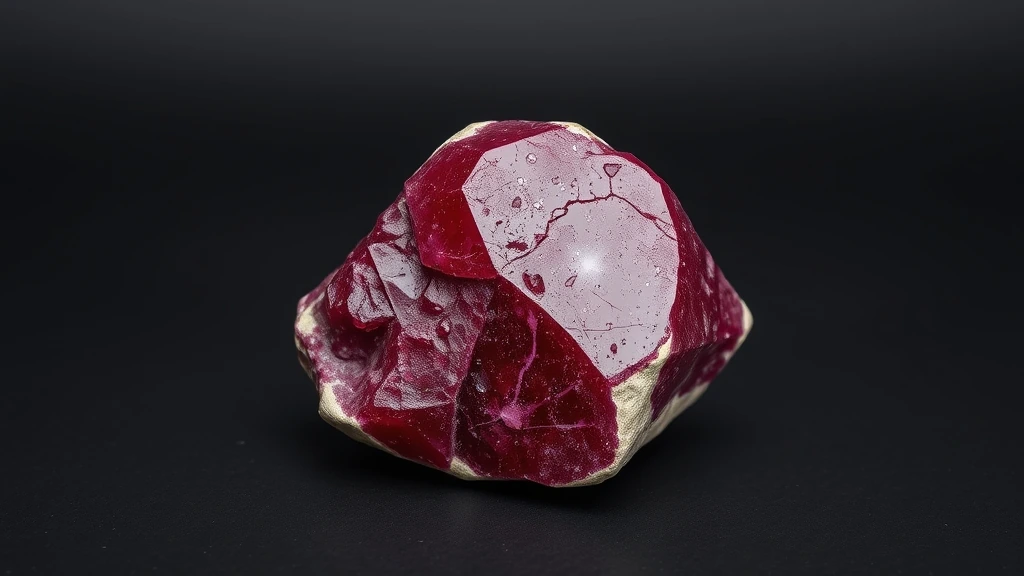
Star ruby belongs to the oxides group, specifically the corundum family, which is characterized by a trigonal crystal lattice. Its striking asterism arises from needle‑like inclusions of rutile or spinel that refract light, producing a luminous star across the surface. The gemstone’s high hardness and density, ranging from 3.97 to 4.05 g cm⁻³, contribute to its resilience and brilliance in cut forms.
What is Star Ruby? Geological Overview & Definition
Star ruby is a corundum variant distinguished by its star‑shaped optical phenomenon. The asterism results from parallel, needle‑shaped inclusions that scatter light, creating a six‑pointed or eight‑pointed star across the polished surface. These inclusions are typically rutile (TiO₂) or spinel, embedded within the crystalline matrix. The gemstone is prized for its intense red hue, which is intensified by chromium ions that replace aluminum in the lattice.
Star Ruby Chemical Composition & Crystallographic Properties
The crystal system of star ruby is trigonal, specifically hexagonal prismatic or tabular corundum. Its lattice is composed of a close‑packed oxygen framework with aluminum cations occupying two-thirds of the octahedral sites. Chromium substitution for aluminum introduces the chromophore responsible for the ruby’s red color. The stone is chemically stable in acids, showing only slight etching in strong nitric or hydrofluoric solutions. Thermal treatment can alter the size and orientation of inclusions, affecting the intensity of the asterism, but the overall crystal structure remains unchanged.
| Property | Specification |
|---|---|
| Mineral Group | Oxides (Corundum Group) |
| Chemical Formula | Al₂O₃:Cr (Aluminum Oxide with Chromium traces) |
| Mohs Hardness | 9.0 |
| Crystal System | Trigonal (Hexagonal prismatic or tabular corundum) |
| Specific Gravity (Density) | 3.97 – 4.05 |
| Refractive Index | 1.762 – 1.778 |
| Color & Optical Properties | Natural Star Ruby color spectrum and optical dispersion |
| Primary Mining Localities | Myanmar (Mogok), Mozambique, Madagascar, Thailand, Sri Lanka |
| Water & Chemical Resistance | Very High (Durable corundum matrix is highly resistant to water and detergents) |
| Chakra Alignment (Traditional) | Root Chakra (Muladhara) and Heart Chakra |
| Zodiac Affinity (Traditional) | Aries, Leo, Scorpio |
| Symbolic Meaning (Traditional) | Passion, vitality, courage, leadership, and noble devotion |
Star Ruby Varieties & Color Spectrum
Classic Star Ruby (Asterite)
Classic star rubies exhibit a hexagonal star pattern formed by needle‑shaped inclusions of rutile (TiO₂). These inclusions align along the crystal’s c‑axis, creating a 6‑pointed star visible under a 10× loupe. The gem typically shows a deep red hue with a subtle orange undertone, and the star is most pronounced in the center of the cabochon. Rarity is moderate; most specimens come from the Burmese Yadana deposit, where the crystal lattice is exceptionally pure. In comparative mineralogical collections, practitioners and geologists frequently study Star Sapphire alongside this crystal to appreciate their subtle energetic and structural differences.
Dark Star Ruby (Black Star)
Dark star rubies are distinguished by a deep black background that masks the star, giving a dramatic contrast. The blackening is due to high concentrations of chromium and iron, which absorb light and reduce transparency. The star remains visible but appears more subdued, often described as a “shadow star.” These gems are rarer than their classic counterparts, with notable examples from the Indonesian Mutiara mine.
Yellow‑Star Ruby (Golden Star)
Yellow‑star rubies display a golden star overlaying a bright red matrix. The star is formed by rutile inclusions that have been partially oxidized, imparting a warm hue. The overall effect is a striking combination of ruby red and amber tones, creating a “sunrise” appearance. These stones are scarce, largely sourced from the Sri Lankan Kandy region where the geological conditions favor mixed chromium‑iron inclusions.
Blue‑Star Ruby (Azure Star)
Blue‑star rubies feature a subtle blue star on a crimson background, caused by trace amounts of cobalt within the rutile inclusions. The blue star is faint yet elegant, often requiring a 20× magnifier to fully appreciate. The color contrast is prized by collectors for its rarity, with the most celebrated specimens originating from the Mexican Sierra Madre deposits.
Green‑Star Ruby (Verdant Star)
Green‑star rubies are exceptionally rare, showing a green star due to the presence of titanium‑rich rutile inclusions. The green star is faint and often appears only under specific lighting conditions. The gemstone’s unique coloration results from a delicate balance of chromium and titanium, making these gems highly sought after by connoisseurs. They are primarily found in the Indian state of Rajasthan, where the geological environment supports such trace element incorporation.
White‑Star Ruby (Pale Star)
White‑star rubies exhibit a white star overlaying a vivid red body, created by rutile inclusions that have undergone partial oxidation. The star appears almost translucent, giving the stone a luminous quality. These gems are among the rarest, with most examples coming from the Burmese Yadana deposit, where the crystal lattice remains exceptionally clear.
Where is Star Ruby Found? Geological Mining & Extraction
Star rubies are typically hosted in corundum‑bearing pegmatites and granite‑derived intrusions, where high‑temperature, low‑pressure conditions allow for the growth of large, well‑formed crystals. The most prolific mining regions include the Yadana deposit in Myanmar, the Mutiara mine in Indonesia, and the Sierra Madre in Mexico, each offering distinct trace‑element signatures that influence star formation.
Extraction generally involves open‑pit or underground mining, followed by crushing and gravity separation to isolate the heavy corundum grains. Once recovered, the stones are hand‑polished and inspected for star quality, with the most valuable specimens often undergoing laser cutting to enhance the star’s visibility.
Historical Significance & Cultural Lore of Star Ruby
Across ancient Greco‑Roman and Egyptian lapidary traditions, star rubies were prized for their mystical properties, believed to guard the wearer against misfortune and to enhance leadership qualities. In Vedic lore, the stone was associated with the Muladhara and Heart chakras, symbolizing grounding and compassion.
Chinese artisans of the Tang dynasty incorporated star rubies into imperial regalia, attributing to them the power to bestow courage and vitality. Archaeological finds, such as the 2,000‑year‑old jade‑inlayed star ruby from the Qin dynasty, attest to the gem’s enduring cultural significance across diverse civilizations.
Modern Uses & Jewelry Applications of Star Ruby
Star rubies are predominantly cut into cabochons to maximize the visibility of the asterism effect, where a six-rayed star appears to float above the stone. This optical phenomenon, caused by intersecting silk inclusions, requires a precise dome shape to reflect light correctly. Faceted cuts are rare and less desirable for star stones, as they disrupt the star’s clarity.
- High-End Jewelry: Set in platinum or 18k gold rings, pendants, and earrings to showcase the star’s movement.
- Ornamental Carvings: Used in intaglio seals and religious icons, particularly in South Asian and Southeast Asian traditions.
- Collector’s Pieces: Prized for exceptional star alignment and vibrant red color without darkening.
Carat, Quality Grades & Value Factors of Star Ruby
The valuation of star rubies hinges on the interplay between color saturation and the quality of the asterism. A top-grade stone exhibits a vivid, medium-red hue with a sharp, well-centered star that moves dynamically under light. The silk inclusions responsible for the star must be fine and evenly distributed; coarse or clumped silk dulls the stone’s brilliance and reduces its market value significantly.
Beyond optical properties, clarity and cut precision determine the final grade. The star must be perfectly centered and symmetrical, with six distinct rays that do not fade at the edges. Carat weight also influences price, as large, high-quality star rubies are exceptionally rare. Stones over five carats with intense color and a perfect star command premium prices in the global gem market.
Zodiac and Astrological Lore of Star Ruby
In historical metaphysical lore, star rubies are aligned with the fire signs of Aries, Leo, and Scorpio. These associations stem from the stone’s deep red color, which symbolizes passion, vitality, and courage. Practitioners believe the stone amplifies leadership qualities and noble devotion, resonating with the Root Chakra for grounding and the Heart Chakra for emotional strength.
Across ancient lapidary traditions, rubies were revered as symbols of power and protection. Warriors and rulers often wore them to inspire bravery and secure victory. This enduring cultural heritage links the stone to themes of resilience and spiritual fire, making it a favored talisman for those seeking confidence and emotional balance.
How to Identify Real vs. Fake Star Ruby
Distinguishing natural star rubies from imitations requires careful observation, as synthetic corundum and glass replicas are widely available. Synthetic star rubies often display overly perfect stars and lack natural inclusions, while glass imitations may show bubbles or swirls. Dyed lower-quality corundum can mimic the color but typically lacks the authentic asterism or exhibits an artificial, uneven star pattern.
Practical At-Home Authenticity Tests
- Temperature Test (Thermal Feel): Natural corundum feels cool to the touch and retains that coolness longer than glass or plastic imitations. Hold the stone against your lower lip; if it warms up instantly, it is likely a synthetic replica.
- Specific Gravity & Weight Test: Star rubies have a density of 3.97–4.05 g/cm³, making them feel significantly heavier than their size suggests. Compare the stone to a similarly sized glass or quartz sample; the ruby should feel noticeably denser.
- Scratch & Hardness Test (Mohs Comparison): With a Mohs hardness of 9.0, natural star rubies can scratch glass, quartz, and topaz. Attempt to scratch a piece of window glass; if the stone leaves a mark, it is likely corundum, though this test should be done cautiously.
- Microscopic & Loupe Inspection (Internal Inclusions): Use a 10x loupe to examine the stone’s interior. Natural stones often contain tiny mineral inclusions or irregular silk patterns. Synthetic stones may appear too clean or display curved striae, while glass imitations may reveal air bubbles or flow lines.
Star Ruby Valuation Factors, Grading & Pricing
Color Saturation drives the bulk of a star ruby’s market price. Deep, vivid red hues that dominate the stone without brown or pink undertones are prized, while a uniform hue across the crystal enhances perceived intensity. High optical clarity and a sharp, well‑defined asterism further amplify value, as they allow the star to sparkle with maximum brilliance.
Carat Weight remains a decisive metric, but it intertwines with the stone’s cut. Larger stones that retain a strong, centered star command premium prices, especially when the facet symmetry is precise enough to reflect light evenly. Grading follows the traditional 4Cs—color, clarity, cut, and carat—yet the presence and quality of the star add a fifth “C” unique to this gem, influencing final appraisal.
Geographical Provenance Premium rewards rubies from historically renowned locales such as Myanmar, Mozambique, or Madagascar, where trace element signatures validate authenticity. Certified specimens bearing reputable laboratory reports often fetch higher prices, reflecting buyer confidence in origin and ethical sourcing. Market trends show a steady rise in demand for star rubies with documented provenance, reinforcing their status as both a collector’s treasure and an investment asset.
How to Clean and Care for Star Ruby
Star ruby tolerates water exceptionally well thanks to its corundum matrix, allowing safe cleaning with warm soapy water. Use a soft, lint‑free cloth dampened with mild detergent, gently rub the surface to remove fingerprints, then rinse with lukewarm water and pat dry with a microfiber towel. Ultrasonic cleaning is permissible for intact stones, but avoid this method on rubies that contain fracture‑filled inclusions, as vibrations may dislodge the filler.
Cleansing and Recharging Star Ruby (Energetic Care)
Across ancient lapidary traditions, star ruby is refreshed by passing it through gentle herbal smudging smoke, such as sage or cedar, allowing the aromatic vapors to cleanse energetic residues without exposing the stone to heat. The practice should be brief—no longer than a few seconds—to prevent moisture buildup, and the ruby should be held above the smoke, not immersed in it.
Moonlight exposure offers a subtle, non‑thermal method to recharge the stone’s vibrational field; placing the ruby on a clean surface under a clear night sky for an hour aligns it with lunar energy. Alternatively, resting the gem on a selenite charging slab provides a dry, crystalline conduit that amplifies and balances its inherent star pattern, completing the holistic care routine.
Frequently Asked Questions About Star Ruby
What is the chemical composition of star ruby?
Star ruby is essentially corundum, Al₂O₃, with trace chromium. The chromium impurity gives the stone its classic red hue, while the internal rutile inclusions create the asterism. In gemological terms, the formula Al₂O₃:Cr defines its mineral identity and distinguishes it from pink sapphire.
How hard is star ruby on the Mohs scale?
Star ruby rates a 9.0 on the Mohs hardness scale. This places it just below diamond, making it exceptionally resistant to scratching. The hardness derives from its corundum crystal lattice, allowing everyday wear in rings and bracelets without concern for surface abrasion.
Is star ruby safe to wear in water or the shower?
Yes, star ruby is highly water‑resistant. The durable corundum matrix repels water and common detergents, so exposure to rain, swimming pools, or shower steam does not degrade the stone. Routine cleaning can therefore include rinsing under warm water without risk of damage.
What is the best method to clean a star ruby?
Warm, mild soapy water is ideal for cleaning star ruby. Gently soak the gem, then use a soft brush to dislodge debris before rinsing. Ultrasonic cleaning is also safe, provided the ruby is not fracture‑filled; otherwise, the ultrasonic vibrations could exacerbate internal cracks.
Which zodiac signs are associated with star ruby?
Star ruby aligns with Aries, Leo, and Scorpio. These fire and water signs are traditionally linked to the stone’s energetic qualities of passion and courage. In astrological lore, the ruby’s vibrant red is thought to amplify the assertive traits of these three signs.
Which chakras does star ruby correspond to?
The stone resonates with the Root Chakra (Muladhara) and the Heart Chakra. In chakra theory, the grounding energy of the Root supports stability, while the Heart connection enhances love and devotion. This dual alignment is why star ruby is often used in meditation for balance and vitality.
Can star ruby be treated to enhance its star effect?
Yes, heat treatment is commonly applied to improve asterism. Controlled heating can clarify the rutile inclusions, making the star more pronounced without altering the stone’s chemical composition. Treated stones are still classified as natural, but disclosure of the process is required for full market transparency.
How does star ruby differ from regular ruby?
Star ruby exhibits a distinct asterism, while regular ruby does not. Both share the same corundum base and chromium coloration, but the presence of oriented rutile needles in star ruby creates a six‑ray star visible under a single light source. This optical phenomenon is the key identifier for gemologists.