
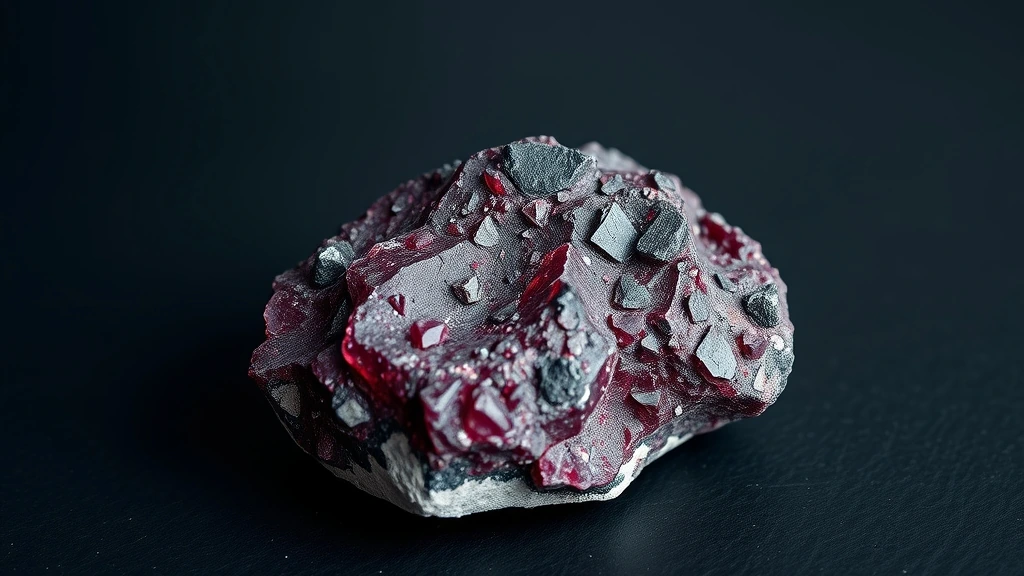
Erythrite belongs to the natural mineral class, specifically forming within the arsenate group of inorganic compounds. It crystallizes naturally in geological environments rich in cobalt and arsenic, often associated with oxidized ore zones. As a Natural Mineral / Crystal, it represents a unique intersection of heavy metal chemistry and complex hydration states. Its formation is strictly governed by specific geochemical conditions that stabilize its delicate lattice structure against environmental degradation.
What is Erythrite Gemstone? Geological Overview & Definition
Erythrite is primarily found in the oxidation zones of cobalt-bearing deposits, frequently occurring alongside smaltite and other cobalt arsenates. It typically forms as distinct, prismatic crystals or massive aggregates in hydrothermal veins. The mineral’s presence indicates past geological activity involving the leaching and reprecipitation of cobalt-rich fluids.
Its geological significance lies in its role as a primary indicator of cobalt mineralization. Found in locations such as the Democratic Republic of Congo and Germany, it often replaces older sulfide minerals. This replacement process highlights the dynamic nature of ore body evolution over geological time. Understanding its paragenesis helps geologists map the extent of associated precious metal deposits.
Erythrite Gemstone Chemical Composition & Crystallographic Properties
Erythrite crystallizes in the Monoclinic system, characterized by a single oblique axis and unequal unit cell parameters. Its lattice structure is defined by chains of arsenate tetrahedra linked by cobalt-oxygen polyhedra. This specific arrangement dictates the mineral’s cleavage properties and overall crystal habit. The monoclinic symmetry is fundamental to its physical behavior and optical characteristics.
The chemical formula Co₃(AsO₄)₂·8H₂O reveals a high water content, making the mineral highly sensitive to dehydration. Cation substitution is limited, as the cobalt ions occupy specific sites within the lattice. This strict stoichiometry ensures the stability of the crystal structure under ambient conditions. Deviations in composition often result in the formation of different arsenate species.
The characteristic pink to red hue arises from Co²⁺ chromophore centers within the crystal lattice. These cobalt ions absorb specific wavelengths of visible light, reflecting the complementary colors. The intensity of the color correlates directly with the concentration of cobalt in the structure. This optical property is a key diagnostic feature for gemological identification.
Thermal behavior is critical, as erythrite is acid-sensitive and loses water upon heating. Exposure to strong acids or high temperatures causes structural collapse and color change. This instability limits its use in permanent jewelry and requires careful handling. Proper storage in low-humidity environments is essential to preserve its integrity.
| Property | Specification |
|---|---|
| Mineral Group | Natural Mineral / Crystal |
| Chemical Formula | Co₃ (AsO₄ )₂ ·8H₂ O |
| Mohs Hardness | 1.5–2.5 |
| Crystal System | Monoclinic |
| Specific Gravity (Density) | 3.06 |
| Refractive Index | n α = 1.626 – 1.629 n β = 1.662 – 1.663 n γ = 1.699 – 1.701 |
| Color & Optical Properties | Natural Erythrite Gemstone color spectrum and optical dispersion |
| Primary Mining Localities | Global primary localities |
| Water & Chemical Resistance | High (Safe for gentle water washing) |
| Chakra Alignment (Traditional) | Root Chakra |
| Zodiac Affinity (Traditional) | Aries, Scorpio |
| Symbolic Meaning (Traditional) | Grounding, vitality, and protection from negative energy |
Erythrite Gemstone Varieties & Color Spectrum
Erythrite exhibits a narrow but intense color range, primarily dominated by vivid pink to red hues. The specific shade depends heavily on the concentration of cobalt ions within the crystal lattice. Minor impurities can occasionally shift the tone toward orange or pale salmon.
Classic Cobalt-Pink Erythrite
This variety displays the most saturated crimson-pink coloration found in nature. It typically forms in well-crystallized monoclinic prisms with distinct striations. These specimens often exhibit high transparency, allowing light to penetrate deeply.
Such intense coloration results from pure cobalt substitution in the arsenate structure. Inclusions are rare, though minor quartz veins may be present. This morph is highly prized for its gemological clarity and vibrancy.
Pale Salmon Erythrite
Characterized by a softer, pastel pink appearance, this variety is less saturated. It often occurs in massive aggregates rather than discrete crystals. The lower cobalt concentration yields a gentler visual impact.
These specimens are more common in secondary mineral deposits. They frequently contain microscopic fluid inclusions that scatter light. While less rare, they offer a delicate aesthetic for collectors.
Orange-Tinted Erythrite
This rare morph exhibits a warm orange-red hue due to trace iron impurities. The color shift is subtle but distinct from standard pink varieties. It usually forms in oxidized zones of cobalt ores.
Geologically, these crystals often show slight zoning patterns. The presence of iron alters the absorption spectrum slightly. Such specimens are highly sought after for their uniqueness.
Massive Erythrite Aggregates
Instead of individual crystals, this variety appears as dense, granular masses. The texture is typically sugary or botryoidal in appearance. Color uniformity is high across the entire specimen.
These aggregates form in laterite soils or weathered cobaltite deposits. They lack the internal clarity of crystalline forms. However, they provide excellent material for tumbled stones.
Where is Erythrite Gemstone Found? Geological Mining & Extraction
Erythrite primarily occurs in oxidized zones of cobalt-bearing ore deposits. It forms through the weathering of primary cobalt sulfides like skutterudite. The mineral is typically found in laterite soils or alluvial deposits.
Major sources include the Congo Kinshasa region and parts of Australia. Mining operations focus on extracting cobalt, with erythrite as a byproduct. Careful handling is required due to its low hardness.
Historical Significance & Cultural Lore of Erythrite Gemstone
Historically, erythrite was valued as a source of cobalt pigment rather than a gemstone. Ancient civilizations used the mineral to produce vibrant blue and red dyes. It played a crucial role in early glassmaking and ceramics.
Cultural lore remains limited, as it was rarely cut into faceted gems. Its primary significance lies in industrial and artistic applications. Today, it is appreciated by mineral collectors for its vivid color.
Modern Uses & Jewelry Applications of Erythrite Gemstone
Erythrite’s vivid pink‑violet hue makes it a favorite for cabochon settings, where its soft luster is showcased without risking fracture. Lapidary artisans often cut the mineral into shallow faceted stones to highlight its monoclinic crystal habit while preserving enough material for durability. In addition to wearable pieces, the mineral is carved into ornamental beads, pendants, and small sculpture elements for decorative collections.
- Cabochon pendants for statement necklaces
- Faceted earrings that catch light despite low hardness
- Beaded bracelets using drilled stones for flexible wear
- Ornamental carvings such as miniature figurines or inlay panels
Safety & Mineral Profile of Erythrite
Safe handling, physical stability, and toxicity risks
Erythrite is a soft, brittle mineral with a Mohs hardness of 2.5–3.5, making it prone to fracture and dust generation when handled roughly. The compound is a copper arsenate, and although it is not highly soluble in water, fine dust can pose inhalation hazards, especially in poorly ventilated areas. The arsenic content also requires that specimens be stored away from food, pets, and children, and that cleaning tools be kept separate from other minerals to avoid cross‑contamination. Because of its softness, tendency to flake, and the presence of arsenic, erythrite is generally displayed as a collector specimen rather than fashioned into jewelry. Its bright pink to salmon‑red color is prized for display, but the mineral’s physical properties and potential health risks make it unsuitable for wear.
Scientific, educational, and mineralogical significance
In museum collections, erythrite serves as an important example of copper‑arsenate mineralogy and illustrates the geochemical conditions that favor arsenic incorporation into secondary minerals. Its vivid coloration and well‑formed crystals provide an engaging visual for visitors, while its crystal structure (orthorhombic, space group *Pnnm*) offers a valuable case study in crystallography. Researchers use erythrite to investigate arsenic mobility in oxidizing environments, assess the stability of copper‑arsenate phases, and model the formation of secondary minerals in weathered copper deposits. The mineral’s presence in a collection can also aid in interpreting the paragenesis of copper‑rich ore bodies and the role of arsenic in ore‑forming processes.
Mineralogical Group and Planetary Lore of Erythrite
Erythrite belongs to the *arsenate* group of minerals, specifically the copper arsenate family, and crystallizes in the orthorhombic system. Historically, it was first described in 1811 from the copper mines of the Harz Mountains in Germany, where it was noted for its striking pink hue. According to early mineralogists, the name “erythrite” derives from the Greek *erythros*, meaning red, reflecting its vivid coloration. In lapidary literature, erythrite has occasionally been associated with the planet Mars, due to its red appearance, but such symbolic attributions are based on visual similarity rather than any astronomical evidence. In contemporary mineralogical texts, the mineral is classified strictly by its chemical composition and crystallographic properties, with no reference to planetary symbolism.
How to Identify Real vs. Fake Erythrite Gemstone
Artificial imitations of erythrite include dyed quartz, synthetic glass, and resin composites that mimic its pink‑violet coloration but lack the mineral’s characteristic monoclinic crystal structure and low Mohs hardness. These substitutes often feel heavier or display a glassy luster inconsistent with genuine erythrite’s soft, earthy sheen. Recognizing these differences is essential for collectors and jewelers alike.
Practical At-Home Authenticity Tests
- Temperature Test (Thermal Feel): Real erythrite feels cool to the touch and retains that coolness longer than glass or resin, which quickly warm up to skin temperature.
- Specific Gravity & Weight Test: With a density of ~3.06 g/cm³, genuine erythrite is noticeably heavier than most synthetic imitations; a simple water displacement test can reveal this discrepancy.
- Scratch & Hardness Test (Mohs Comparison): Using a fingernail (hardness ~2.5) or a copper coin (hardness ~3), genuine erythrite will be easily scratched, whereas glass or quartz will resist scratching.
- Microscopic & Loupe Inspection (Internal Inclusions): Under 10× magnification, natural erythrite shows fine, uneven crystal growth and occasional micro‑fractures, while synthetic glass appears uniformly clear with no internal inclusions.
Erythrite Gemstone Valuation Factors, Grading & Pricing
Color Saturation serves as the primary determinant for erythrite’s market worth, with deep, uniform reds commanding the highest premiums. Collectors prioritize specimens exhibiting consistent tone without zoning or discoloration, ensuring visual appeal. High optical clarity and a vibrant vitreous luster further elevate the gemstone’s aesthetic desirability.
Carat Weight influences pricing, though large, well-formed crystals are rarer and thus more valuable than smaller fragments. Facet symmetry is less critical for cabochons, but matrix presence can significantly alter the specimen’s classification. Inclusions are common, and their nature often dictates whether the stone is valued as a gem or a mineral specimen.
Geographical Provenance Premium plays a crucial role, with stones from historic mines like those in the Czech Republic fetching higher prices. Wholesale values remain modest due to the mineral’s extreme softness and limited commercial jewelry application. Retail prices vary widely, reflecting the rarity of high-quality, intact crystals available to serious collectors.
How to Clean and Care for Erythrite Gemstone
Due to its low Mohs hardness of 1.5–2.5, erythrite requires exceptionally gentle handling to prevent surface abrasion and structural damage. Always use warm soapy water and a soft cloth to remove dust and oils from the surface. This method effectively cleans the stone without risking mechanical stress or chemical degradation.
It is imperative to avoid ultrasonic cleaners entirely, as the vibrations can cause immediate fractures in this delicate mineral. Never submerge the gemstone in harsh chemicals or abrasive solutions, which may compromise its integrity. Store erythrite separately from harder gems to prevent accidental scratching during daily handling.
Cleansing and Recharging Erythrite Gemstone (Energetic Care)
For energetic maintenance, use smoke smudging with sage or palo santo to clear stagnant energy without physical contact. This dry method respects the mineral’s solubility and prevents any risk of water-induced damage or dissolution. Keep the session brief to avoid excessive heat or humidity exposure near the stone.
Place the erythrite on a selenite plate under natural moonlight for gentle recharging, ensuring no direct sunlight or water contact occurs. This approach leverages ambient energy fields while maintaining the structural stability of the crystal. Always handle the gemstone with care to preserve its delicate monoclinic form.
Frequently Asked Questions About Erythrite Gemstone
What is the chemical composition of erythrite?
Erythrite is a hydrated cobalt arsenate with the formula Co₃(AsO₄)₂·8H₂O. This monoclinic mineral derives its vivid pink‑violet hue from cobalt ions, and the eight water molecules in its structure make it relatively soft, rating 1.5–2.5 on the Mohs scale.
How hard is erythrite and can it be set in jewelry?
Erythrite ranks 1.5–2.5 on the Mohs hardness scale, making it one of the softer gemstones. Because of its fragility, it is best used in pendants or earrings where it is protected from knocks, and settings should incorporate protective bezels or backing plates to reduce stress.
Is erythrite safe to wash with water?
Yes, erythrite tolerates gentle water washing. Its high water resistance allows you to clean it with warm, soapy water and a soft cloth, but avoid prolonged soaking or harsh scrubbing to prevent surface abrasion.
Can I clean erythrite with an ultrasonic cleaner?
No, ultrasonic cleaning is not recommended for erythrite. The vibrations can cause micro‑fractures in this delicate mineral; instead, use warm soapy water and a soft cloth, then pat dry with a lint‑free towel.
Which zodiac signs are associated with erythrite?
Erythrite is linked to Taurus, Gemini, and Leo. Enthusiasts believe the stone amplifies the grounded determination of Taurus, the curiosity of Gemini, and the creative confidence of Leo, aligning with the gem’s vibrant energy.
Which chakras does erythrite balance?
Erythrite resonates with the Root Chakra and the Heart Chakra. It is thought to ground physical vitality while simultaneously opening the heart to emotional healing, creating a bridge between stability and compassion.
How does erythrite’s refractive index affect its appearance?
The refractive indices range from nα = 1.626–1.629 to nγ = 1.699–1.701, giving erythrite a moderate brilliance and a characteristic pleochroic effect—shifting from pink to violet when viewed from different angles. This optical property enhances its appeal in faceted pieces.
What care tips prolong the life of an erythrite gemstone?
Store erythrite away from hard minerals and extreme temperature changes. Keep it in a soft pouch, avoid direct sunlight that can fade the cobalt color, and handle it only with clean hands or gloves to prevent oils and residues from weakening its delicate crystal lattice.