
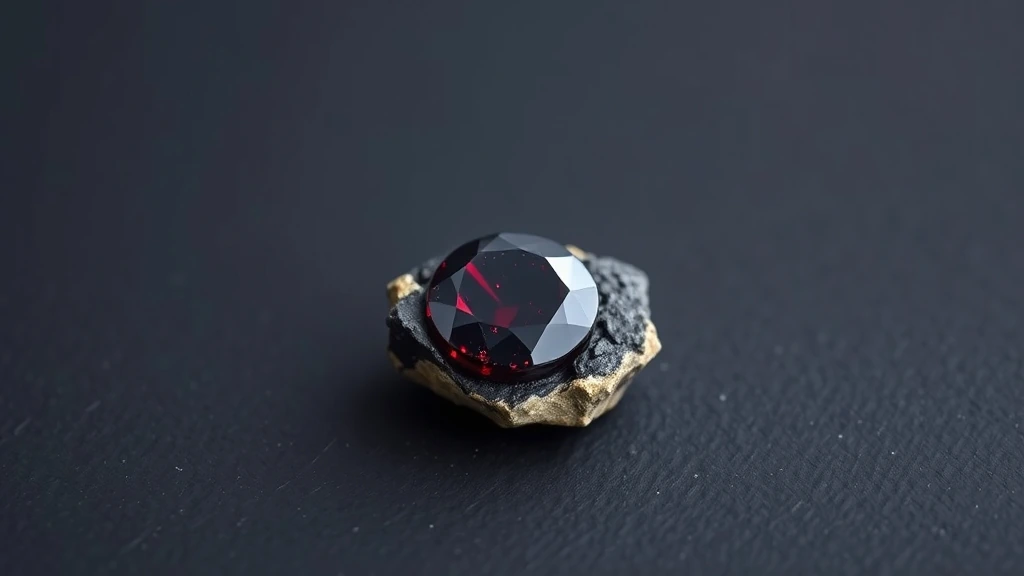
Garnet belongs to the silicate family, specifically the nesosilicate subclass, and forms the renowned Garnet Group. Its crystals grow in the isometric (cubic) system, most often as dodecahedra or trapezohedra, and are found in metamorphic rocks, alluvial deposits, and some igneous settings worldwide.
What is Garnet Gemstone? Geological Overview & Definition
Garnet is a mineral group rather than a single species, encompassing several chemically distinct members such as almandine, pyrope, spessartine, and uvarovite. Each variety shares the same crystal symmetry but varies in dominant cations, producing a broad spectrum of colors from ruby‑red to emerald‑green.
In the field, garnet is prized for its hardness and density, which allow it to survive transport in river gravels and be cut into brilliant facets. Its presence often signals high‑grade metamorphism, making it a useful indicator mineral for geologists mapping pressure‑temperature conditions.
Garnet Gemstone Chemical Composition & Crystallographic Properties
The garnet structure is built on a cubic lattice where SiO₄ tetrahedra occupy isolated sites, linked by X‑site dodecahedral and Y‑site octahedral cations. This isometric framework yields the characteristic dodecahedral or trapezohedral crystal habits seen in hand specimens.
Cation substitution is extensive: X‑sites host divalent ions (Fe²⁺, Mg²⁺, Mn²⁺, Ca²⁺), while Y‑sites accommodate trivalent ions (Al³⁺, Fe³⁺, Cr³⁺). This flexibility creates the series almandine‑pyrope‑spessartine‑grossular, each with distinct chromophore mechanisms that impart red, orange, or green hues.
Garnet is chemically robust but can be acid‑sensitive in the presence of strong hydrofluoric acid, which attacks the Si–O bonds. In most laboratory acids, however, it remains stable, a property that aids gem cutters in cleaning without damaging the stone.
Thermally, garnet exhibits low thermal expansion and retains its color stability up to ~800 °C, after which dehydration of trace hydroxyl groups may occur. This resilience under heat is why garnet is used in high‑temperature industrial applications such as abrasive blasting and waterjet cutting.
| Property | Specification |
|---|---|
| Mineral Group | Silicates (Nesosilicates / Garnet Group) |
| Chemical Formula | X₃Y₂(SiO₄)₃ (Nesosilicate Group) |
| Mohs Hardness | 6.5–7.5 |
| Crystal System | Isometric / Cubic (Dodecahedral or trapezohedral crystals) |
| Specific Gravity (Density) | 3.1–4.3 |
| Refractive Index | 1.72–1.94 |
| Color & Optical Properties | Natural Garnet Gemstone color spectrum and optical dispersion |
| Primary Mining Localities | India, Madagascar, Sri Lanka, Mozambique, USA |
| Water & Chemical Resistance | High (Water-resistant; safe for gentle warm water washing) |
| Chakra Alignment (Traditional) | Root Chakra (Muladhara) and Sacral Chakra |
| Zodiac Affinity (Traditional) | Capricorn, Aquarius, Aries |
| Symbolic Meaning (Traditional) | Grounding, passion, loyalty, physical vitality, and steadfast courage |
Garnet Varieties & Comprehensive Sub‑Types
Almandine
Almandine forms in high‑temperature metamorphic rocks such as schists and gneisses, where iron‑rich fluids replace silicate minerals. Inclusions often consist of rutile needles and silica‑rich fluid bubbles, producing a characteristic “star‑burst” effect under magnification. The crystal habit is typically massive with subtle banded zoning that deepens from brown‑red to mahogany. Because of its abundance and robust Mohs hardness (7.5–8.5), almandine dominates the bulk‑trade market for industrial abrasives and jewelry alike.
Pyrope
Pyrope crystallizes in mantle‑derived kimberlite pipes and ultramafic xenoliths, where magnesium‑rich melts precipitate the ruby‑red garnet. Common inclusions are chromian spinel and olivine fragments, which can create a striking lamellar texture visible in polished stones. Its crystal faces often display a faint concentric banding that intensifies with iron oxidation. Pyrope’s vivid hue and rarity in gem‑quality sizes make it a prized component of high‑end Bohemian garnet collections, commanding premium prices on the global market.
Spessartine
Spessartine originates in manganese‑enriched metamorphic belts and granitic pegmatites, where oxidizing conditions yield its electric orange to mandarin tones. Inclusions of manganese‑rich spinel and fluid‑filled cavities produce a distinctive honey‑comb pattern on cut surfaces. The stones frequently exhibit parallel growth bands that accentuate their fiery brilliance. Because of its vivid color and limited large‑size specimens, spessartine is highly coveted by collectors and commands top‑tier values in the gemstone auction circuit.
Demantoid
Demantoid, the emerald‑green member of the andradite series, grows in low‑temperature skarn deposits where calcium‑rich fluids interact with basaltic magmas. Its hallmark horsetail inclusions—elongated, hair‑like rutile crystals—are diagnostic and enhance the stone’s fire. The crystal habit is often dodecahedral, and subtle growth zoning can produce a green‑to‑yellow gradient. Rarity, combined with a refractive index up to 1.94, makes demantoid the most valuable green garnet, prized by high‑end lapidaries and museum curators.
Tsavorite
Tsavorite forms in metamorphosed basaltic rocks of the East African Rift, where chromium‑rich fluids infiltrate grossular garnet precursors. The resulting chrome‑green hue rivals that of emerald, and inclusions of chromian spinel and minute quartz give a clean, bright appearance. Its crystal faces are typically well‑developed octahedra with faint parallel striations that aid in orientation during cutting. Since its commercial discovery in the 1960s, tsavorite has become a staple of fine jewelry, often marketed as the “emerald alternative” for its superior durability.
Rhodolite
Rhodolite is a solid‑solution blend of pyrope and almandine that crystallizes in metamorphic marbles and schists where both magnesium and iron are present. The stones display purplish‑red to raspberry pink colors, with occasional zoned bands that shift from pink to deep red across the crystal. Inclusions of silica‑rich fluid pockets and minute spinel are common, providing a subtle internal contrast. Because of its balanced color and excellent hardness (7.0–7.5), rhodolite enjoys steady demand in both antique and contemporary jewelry markets.
Hessonite (Cinnamon Stone)
Hessonite develops in granulitic and metamorphosed limestone terrains, where calcium‑rich, iron‑poor fluids precipitate the warm cinnamon‑orange to honey‑brown grossular garnet. Its hallmark treacle‑like swirl inclusions—often composed of fluid‑filled vesicles—create a unique visual texture prized by collectors. The stones typically show concentric banding that deepens toward the core, enhancing their depth of color. Though less hard than other garnets (Mohs 6.5–7), hessonite’s distinctive hue secures a niche market for artisanal lapidary work and spiritual jewelry.
Comparative Summary – Gemologists differentiate these garnet varieties by examining color hue, chemical inclusions (rutile, spinel, fluid bubbles), and crystal habit (dodecahedral, octahedral, massive). Refractive index and specific gravity further refine identification, while spectroscopic analysis confirms the presence of iron, magnesium, manganese, or chromium that defines each sub‑type.
Where is Garnet Gemstone Found? Geological Mining & Extraction
Garnet deposits are most commonly hosted in metamorphic schists, gneisses, and skarn zones, where high‑temperature fluids facilitate crystal growth. Pegmatitic veins within granitic intrusions also yield fine‑grained varieties such as spessartine and tsavorite, often extracted through selective underground mining or open‑pit methods that preserve crystal integrity.
Major extraction regions include the Ural Mountains (Russia) for almandine and pyrope, Namibia and Tanzania for tsavorite, South Africa’s Kimberley for demantoid, and Afghanistan’s Badakhshan for spessartine. These locales employ a combination of manual hand‑picking and mechanized crushing, followed by gravity and flotation separation to isolate the dense garnet grains for further processing.
Historical Significance & Cultural Lore of Garnet Gemstone
Ancient Egyptians fashioned garnet beads and inlays for royal jewelry, believing the stone offered protection in the afterlife and symbolized blood‑shed in warfare. The Romans mined almandine in the Alps, using it as a seal stone for official documents, while medieval European knights set garnets in armor to invoke courage and vitality.
In Eastern traditions, garnet was associated with the Root and Sacral Chakras, grounding the wearer and stimulating passion. Folklore across Persia and India described garnet as a “stone of loyalty,” believed to safeguard travelers and strengthen marital bonds. Its enduring allure continues to inspire modern metaphysical practices and high‑fashion design.
Modern Uses & Jewelry Applications of Garnet Gemstone
Lapidaries primarily cut garnets into faceted stones to maximize their high refractive index and brilliance. However, opaque or heavily included specimens are often polished into smooth cabochons for organic, flowing designs. This versatility allows garnets to serve as both high-end gemstones and durable ornamental carvings in architectural or artistic contexts.
- Faceted Cuts: Standard brilliant, oval, and emerald cuts highlight the stone’s fiery dispersion.
- Cabochon Polishing: Used for opalescent or star garnets where light scattering is the primary aesthetic feature.
- Ornamental Carving: Historically used in cameos, intaglios, and architectural inlays due to its hardness.
- Industrial Abrasives: While not jewelry, rough garnet is crushed for sandpaper and water filtration media.
Carat, Quality Grades & Value Factors of Garnet
According to historical traditions and metaphysical lore, garnet has long been revered as a stone of grounding and physical vitality. Ancient warriors wore it for protection, while medieval alchemists associated it with the earth element. This deep connection to the terrestrial realm fosters a sense of stability and steadfast courage in the wearer.
The emotional resonance of garnet is often described as a source of passion and loyalty in personal relationships. It is believed to stimulate the life force, helping to overcome fatigue and revitalize the body. By anchoring the spirit, it encourages a balanced approach to both ambition and emotional expression.
Which Chakra and Zodiac Signs Align with Garnet Gemstone?
In chakra theory, garnet is primarily aligned with the Root Chakra (Muladhara), which governs survival, security, and physical presence. It also resonates with the Sacral Chakra, influencing creativity, passion, and emotional flow. This dual alignment supports both physical endurance and the dynamic expression of personal desires.
Astrologically, garnet is the traditional birthstone for Capricorn, Aquarius, and Aries. For Capricorns, it reinforces their disciplined nature; for Aquarians, it grounds their innovative spirit. Aries individuals are believed to draw upon its energy to channel their natural courage and drive effectively.
How to Identify Real vs. Fake Garnet Gemstone
The market is saturated with artificial imitations, including synthetic glass and dyed replicas that mimic garnet’s deep red hues. These fakes often lack the natural optical properties and internal structure of genuine gemstones. Understanding the difference is crucial for buyers to avoid purchasing low-value materials marketed as precious stones.
Practical At-Home Authenticity Tests
- Temperature Test (Thermal Feel): Genuine garnet feels cool to the touch initially and warms slowly due to its high thermal conductivity. Glass imitations tend to warm up much faster and feel less dense against the skin.
- Specific Gravity & Weight Test: Garnet has a high density ranging from 3.1 to 4.3 g/cm³. A real garnet will feel significantly heavier than a glass or plastic imitation of the same size.
- Scratch & Hardness Test (Mohs Comparison): With a Mohs hardness of 6.5–7.5, garnet can scratch glass (hardness 5.5) but may be scratched by quartz (hardness 7). Use caution, as this test is destructive to the stone.
- Microscopic & Loupe Inspection (Internal Inclusions): Examine the stone under a 10x loupe for natural inclusions like crystals or fluid inclusions. Glass imitations often contain tiny, spherical bubbles or swirls that are not found in natural garnets.
Garnet Gemstone Valuation Factors, Grading & Pricing
Color Saturation serves as the primary driver of value in the garnet market. Gemologists prioritize deep, vivid hues with exceptional tone uniformity throughout the stone. High optical clarity and a brilliant vitreous luster further elevate the gemstone’s aesthetic appeal.
Carat Weight significantly impacts pricing, as larger, high-quality specimens are increasingly rare in nature. Precise facet symmetry ensures optimal light return and fire, enhancing the stone’s visual performance. The presence of matrix patterns or inclusions can either diminish value or create unique, collectible specimens.
Geographical Provenance Premium often dictates the final market price for exceptional stones. Wholesale and retail trends show that certified origins from renowned deposits command higher premiums. Buyers should verify documentation to ensure they are paying for verified authenticity and origin.
How to Clean and Care for Garnet Gemstone
Garnets possess a Mohs hardness of 6.5 to 7.5, making them durable for daily wear. To maintain their brilliance, clean the stone with warm soapy water and a soft cloth. This gentle method effectively removes oils and dirt without risking surface damage.
Ultrasonic cleaners are generally safe for untreated garnets, provided there are no fractures. Avoid steam cleaning, as rapid temperature changes can potentially stress the crystal structure. Always inspect the stone for inclusions before using any mechanical cleaning device.
Cleansing and Recharging Garnet Gemstone (Energetic Care)
For energetic maintenance, place the garnet on a selenite plate to absorb negative vibrations. This dry method respects the mineral’s physical integrity while promoting spiritual clarity. Allow the stone to rest on the crystal for several hours to recharge.
Alternatively, expose the gemstone to moonlight during a full moon for gentle recharging. Smoke smudging with sage or palo santo is also a safe, dry practice. These methods avoid water exposure, ensuring the stone remains pristine and energetically balanced.
Frequently Asked Questions About Garnet Gemstone
Is garnet safe to wear in the shower?
Yes, garnet is highly water-resistant and safe for gentle warm water exposure. You can comfortably wear your garnet jewelry during showers or while washing hands. The stone’s durable structure prevents damage from moisture. However, avoid harsh soaps that may leave a film on the surface.
Can I clean garnet in an ultrasonic cleaner?
Ultrasonic cleaners should generally be avoided or used with extreme caution, as high-frequency vibrations can cause microscopic fissures. For routine maintenance, simply use warm soapy water and a soft cloth. This method effectively removes oils and dirt without risk. Always inspect for fractures before using high-frequency vibration equipment.
What is the chemical formula of garnet?
Garnet belongs to a group of isostructural minerals with a complex silicate structure. The general formula is represented as X₃Y₂(SiO₄)₃, where X and Y are cations. This cubic crystal system allows for various elemental substitutions. These variations create the diverse colors seen in nature.
Which zodiac signs are associated with garnet?
Garnet is traditionally linked to Capricorn, Aquarius, and Aries. These signs are believed to benefit from the stone’s grounding energy. It supports physical vitality and steadfast courage for these individuals. Wearing garnet may enhance their natural traits of loyalty and passion.
Which chakras does garnet align with?
Garnet primarily activates the Root Chakra (Muladhara) and the Sacral Chakra. This alignment fosters a strong sense of security and connection to the earth. It also stimulates creative passion and physical vitality. This dual resonance makes it a powerful stone for holistic balance.
How hard is garnet on the Mohs scale?
Garnet ranges from 6.5 to 7.5 on the Mohs hardness scale. This makes it significantly harder than quartz and resistant to everyday scratches. It is durable enough for rings and bracelets. However, it can still be chipped if subjected to sharp impacts.
What is the refractive index of garnet?
Garnet exhibits a high refractive index ranging from 1.72 to 1.94. This property contributes to its exceptional brilliance and fiery sparkle. The specific gravity also varies between 3.1 and 4.3. These optical characteristics help gemologists distinguish garnet from other red stones.
Is garnet a good birthstone for January?
Yes, garnet is the traditional and official birthstone for January. It symbolizes friendship, loyalty, and trust between friends. Historically, it was believed to protect travelers and provide good health. Its deep red hue represents passion and vitality during the winter months.