
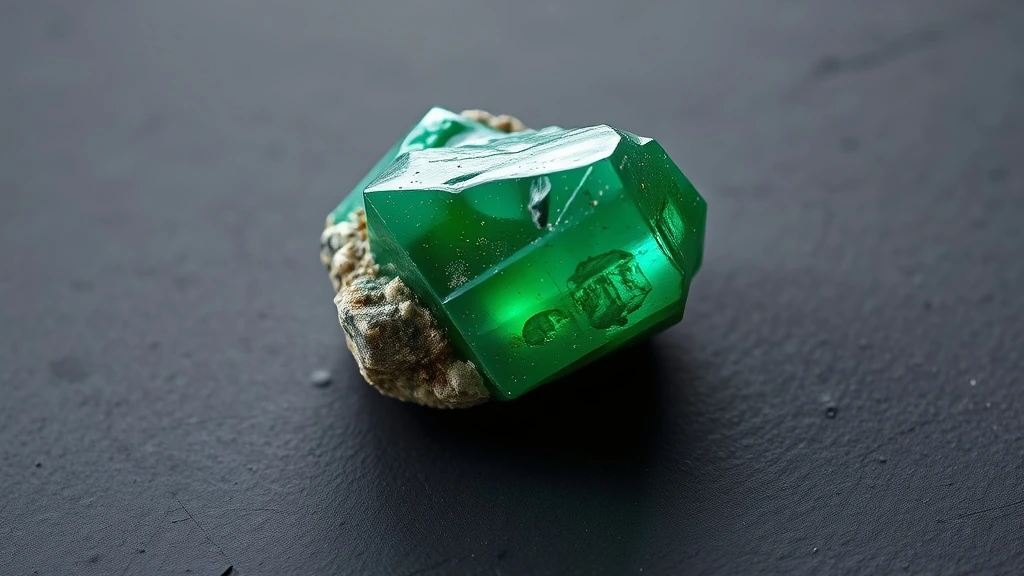
Emerald belongs to the silicate family, specifically the cyclosilicates or Beryl Group. Its crystal lattice is built from interlocking SiO₄ tetrahedra that form rings, with beryllium, aluminum, and oxygen occupying the framework. The green coloration arises from trace chromium and vanadium substituting for aluminum, creating chromophore centers that absorb red and blue light.
What is Emerald? Geological Overview & Definition
Emerald is a hexagonal prismatic member of the beryl mineral series, crystallizing in the hexagonal system with a characteristic prismatic habit. It is a silicate, meaning its structure is dominated by silicon‑oxygen tetrahedra linked into rings, a hallmark of the cyclosilicate subgroup. The gemstone’s distinct green color is due to trace chromium and vanadium ions that replace aluminum in the crystal lattice, producing chromophore centers that absorb specific wavelengths of light.
Emerald is typically found in pegmatitic veins and hydrothermal veins, often associated with quartz, tourmaline, and mica. Its formation requires a highly silica‑rich, alkaline environment where beryllium, aluminum, and trace elements can co‑precipitate. The gemstone’s durability and vivid color have made it prized across cultures for millennia.
Emerald Chemical Composition & Crystallographic Properties
Emerald’s chemical formula is Be₃Al₂Si₆O₁₈, with chromium and vanadium substituting for aluminum to produce the green chromophore. The mineral crystallizes in the hexagonal system, specifically the hexagonal prismatic class, with lattice parameters a = b ≠ c and α = β = 90°, γ = 120°. This geometry results in a six‑fold symmetry axis and prismatic crystal faces.
The crystal structure is composed of alternating layers of SiO₄ tetrahedra and BeO₆ octahedra, creating a robust framework that resists deformation. Cation substitution occurs primarily at the aluminum sites, where Cr³⁺ and V³⁺ ions replace Al³⁺, forming color centers that absorb red and blue light, leaving green visible.
Emerald is chemically stable in neutral to slightly acidic environments but can be attacked by strong acids such as hydrofluoric acid, which dissolves the beryllium component. Thermal treatment can alter the color by modifying the oxidation state of chromium and vanadium, but high temperatures typically lead to decomposition of the beryl structure.
The gemstone’s optical properties, including a refractive index of 1.565–1.602 and a birefringence of 0.010–0.020, are characteristic of hexagonal crystals and contribute to its brilliance when cut properly.
| Property | Specification |
|---|---|
| Mineral Group | Silicates (Cyclosilicates / Beryl Group) |
| Chemical Formula | Be₃Al₂Si₆O₁₈:Cr,V (Beryl with Chromium/Vanadium traces) |
| Mohs Hardness | 7.5 – 8.0 |
| Crystal System | Hexagonal (Hexagonal prismatic beryl) |
| Specific Gravity (Density) | 2.67 – 2.78 |
| Refractive Index | 1.565 – 1.602 |
| Color & Optical Properties | Natural Emerald color spectrum and optical dispersion |
| Primary Mining Localities | Colombia (Muzo, Chivor), Zambia, Brazil, Russia |
| Water & Chemical Resistance | Moderate (Gentle brief lukewarm water only; avoid hot water and strong detergents that strip cedar oil) |
| Chakra Alignment (Traditional) | Heart Chakra (Anahata) |
| Zodiac Affinity (Traditional) | Taurus, Gemini, Cancer |
| Symbolic Meaning (Traditional) | Unconditional love, abundance, rejuvenation, and deep heart healing |
Emerald Varieties & Color Spectrum
The emerald market is defined by distinct regional origins that dictate value, clarity, and specific chromium saturation levels. Each geographic source produces unique visual characteristics driven by local geological conditions. Understanding these differences is essential for accurate gemological identification and valuation.
Colombian Emeralds
Colombian stones from Muzo and Chivor mines are renowned for their intense, saturated green hue and exceptional transparency. These gems often exhibit the characteristic jardin inclusion pattern, which serves as a primary authenticity marker for collectors. The high chromium content in the host rock yields a vivid, electric green that commands premium prices globally.
Zambian Emeralds
Zambian emeralds typically display a bluer, cooler green tone compared to their Colombian counterparts, often with slightly lower saturation. They frequently contain more abundant inclusions, including pyrite and chlorite, which can affect clarity but also provide identification clues. Despite these traits, high-quality Zambian stones are highly valued for their consistent color and large crystal sizes.
Brazilian Emeralds
Brazilian emeralds from the Minas Gerais region often feature a yellowish-green or olive-green hue with moderate to high saturation. These stones commonly display a distinct pleochroism, showing different shades of green and yellow when viewed from various angles. While generally less expensive than Colombian varieties, they offer a unique aesthetic appeal for jewelry design.
Afghan Emeralds
Afghan emeralds from the Panjshir Valley are characterized by a deep, dark green color with high saturation and excellent clarity. These stones often exhibit a distinct vitreous luster and may contain minor inclusions that do not significantly impact their overall beauty. Their rarity and historical significance contribute to their high market value among connoisseurs.
Siberian Emeralds
Siberian emeralds from the Ural Mountains are known for their deep, bluish-green color and exceptional transparency. These gems often contain fewer inclusions than other varieties, making them highly desirable for high-end jewelry. The hexagonal prism crystal habit is well-preserved in many specimens, showcasing their natural geological formation.
Where is Emerald Found? Geological Mining & Extraction
Emeralds form within pegmatite and marble host rocks, where hydrothermal fluids rich in beryllium and aluminum interact with chromium-bearing minerals. The geological process requires specific pressure and temperature conditions to crystallize the beryl structure with trace elements. This formation typically occurs in ancient metamorphic terrains that have undergone significant tectonic activity.
Primary mining regions include Colombia, Zambia, Brazil, and Afghanistan, each with distinct geological histories. Colombia’s mines are located in the Andes mountains, while Zambia’s deposits are found in the Copperbelt region. Extraction methods vary from open-pit mining to underground shafts, depending on the depth and accessibility of the ore bodies.
Historical Significance & Cultural Lore of Emerald
Ancient Egyptian and Greco-Roman civilizations revered emeralds as symbols of rebirth and eternal life, often embedding them in royal jewelry and funerary artifacts. Cleopatra famously possessed extensive emerald collections, which were later seized by Roman conquerors and displayed in temples. In Vedic traditions, emeralds were associated with the planet Mercury and believed to enhance wisdom and communication.
Throughout history, emeralds have been prized by rulers and nobles across diverse cultures, from the Mughal Empire to the Spanish colonial era. Archaeological findings reveal emerald carvings in Peruvian and Inca artifacts, highlighting their importance in pre-Columbian societies. The gemstone’s enduring allure reflects its universal appeal as a symbol of love, hope, and prosperity.
Modern Uses & Jewelry Applications of Emerald
Emeralds are prized for their vivid green hue and are cut into both cabochon and faceted styles to accentuate their natural inclusions. Lapidaries often employ a step cut or crown and pavilion design to enhance brilliance while preserving structural integrity. In high‑end jewelry, emeralds appear in solitaire rings, pendants, and earrings, frequently set in platinum or white gold to contrast the stone’s color. Ornamental carving of emeralds is rare due to their brittleness, but historical artifacts from the Mughal and Chinese courts showcase miniature emerald panels.
- Cabochon cuts highlight the stone’s natural banding and chatoyancy.
- Faceted cuts (step or brilliant) maximize light return and showcase inclusion patterns.
- Emeralds are set in platinum or white gold to avoid color interference.
- Historical carvings feature emerald panels in royal regalia and ceremonial objects.
Carat, Quality Grades & Value Factors of Emerald
The value of an emerald hinges on the 4Cs: Color, Clarity, Cut, and Carat weight. Color is judged by hue, saturation, and tone; the most prized stones exhibit a deep, uniform green with a slight bluish undertone. Clarity is assessed by the presence of veining and inclusions; a “flawless” emerald is exceedingly rare, so a moderate level of inclusions that do not obscure the color is often preferred. Cut quality determines how well a stone reflects light; a well‑proportioned cabochon or faceted cut can enhance the emerald’s natural brilliance. Carat weight influences price linearly, but larger stones are rarer and command premium prices.
Commercial grading follows GIA and GIA‑style standards, where each emerald is assigned a color grade (e.g., D–E for green), a clarity grade (e.g., I1–I3), and a cut grade (e.g., Excellent, Very Good). Durability is a critical factor; emeralds are notoriously brittle and prone to fissures, so a stone’s structural integrity is evaluated alongside its aesthetic qualities.
Zodiac and Astrological Lore of Emerald
Across ancient lapidary traditions, emerald is associated with the Heart Chakra (Anahata), symbolizing unconditional love, abundance, and rejuvenation. Its vibrant green is believed to align with the Taurus, Gemini, and Cancer zodiac signs, reflecting stability, adaptability, and emotional depth.
In historical metaphysical lore, emeralds were treasured by Egyptian pharaohs as symbols of rebirth and by Roman emperors for their protective qualities. The gemstone’s enduring appeal is evident in its continued use in royal jewelry and ceremonial artifacts throughout the centuries.
How to Identify Real vs. Fake Emerald
Authentic emeralds are rarely replicated perfectly; artificial imitations often use dyed glass, synthetic beryl, or corundum. Synthetic glass may mimic the green hue but lacks the characteristic inclusions and refractive index of natural emerald. Dyed replicas typically show uneven coloration and can be distinguished by their lower density and different thermal properties.
Practical At-Home Authenticity Tests
- Temperature Test (Thermal Feel): Hold the stone in your hand; a genuine emerald feels noticeably cooler than synthetic glass due to its higher thermal conductivity.
- Specific Gravity & Weight Test: Compare the stone’s weight to a similarly sized quartz; emeralds are denser (≈2.67–2.78 g/cm³) and will feel heavier.
- Scratch & Hardness Test (Mohs Comparison): Gently scratch the stone with a known Mohs hardness reference (e.g., a steel file); emerald should resist scratching up to 7.5–8.0, whereas glass will show marks.
- Microscopic & Loupe Inspection (Internal Inclusions): Under a loupe, look for natural veining or crustacean‑like inclusions; synthetic stones often appear flawless or show artificial patterns.
Emerald Valuation Factors, Grading & Pricing
Emerald value hinges first on color saturation; a vivid, pure green with minimal yellow or blue undertones commands the highest prices. Uniform hue across the stone and the presence of a lively, vitreous luster further enhance desirability, while any visible inclusions that dull the brilliance reduce market worth.
The second driver is carat weight, though size alone does not guarantee premium pricing. Well‑cut emeralds exhibit precise facet symmetry that maximizes light return, and they are assessed against the traditional 4Cs—color, clarity, cut, and carat—adapted for beryl’s unique optical properties. Larger stones with flawless symmetry can command exponential price jumps.
Finally, geographical provenance premium plays a decisive role, with Colombian, Zambian, and Brazilian emeralds historically fetching higher bids due to their renowned clarity and depth. Certified provenance, verified by reputable gemological laboratories, stabilizes price trends and assures buyers of ethical sourcing, reinforcing confidence in the global market.
How to Clean and Care for Emerald
Emeralds should never be subjected to ultrasonic or steam cleaning; the stone’s natural fissures and common oil treatments make it vulnerable to damage. Gently wipe the surface with a damp, soft cloth, using only lukewarm water and avoiding any detergents or harsh chemicals. After cleaning, pat the gem dry with a clean microfiber cloth and store it in a padded, low‑humidity compartment to preserve its brilliance.
Cleansing and Recharging Emerald (Energetic Care)
For holistic maintenance, place the emerald in a bowl of dried sage or palo santo smoke, allowing the gentle herbal aroma to clear stagnant energy without exposing the gem to moisture. Alternatively, lay the stone on a polished selenite slab overnight; the selenite’s neutral charge subtly revitalizes the emerald’s vibrational field while keeping it dry.
A brief exposure to soft moonlight, preferably during a waxing or full moon, can also refresh the stone’s energetic alignment; position the gem on a clean, non‑reflective surface and avoid direct sunlight, which can overheat the crystal lattice. These dry, low‑impact practices honor both the mineral’s physical integrity and its traditional metaphysical associations.
Frequently Asked Questions About Emerald
Emerald displays distinct mineralogical characteristics across its geological varieties and structural habits. Gemologists evaluate these natural varieties based on crystal habit, trace chromophore concentrations, and visual luster.
Primary Natural Emerald
The benchmark natural variety exhibiting diagnostic color saturation and classic crystallographic symmetry.
Distinct Geological Morphs of Emerald
Secondary regional and structural varieties formed under localized geological temperature and pressure conditions.
Is emerald safe to wear in the shower?
No, emeralds should not be exposed to prolonged water or steam. The stone’s natural fissures often contain cedar oil treatments that stabilize its structure. Hot water and strong detergents can strip this protective layer, leading to increased brittleness and potential damage.
Can you clean emerald in an ultrasonic cleaner?
Ultrasonic and steam cleaning are strictly prohibited for emeralds. The high-frequency vibrations can shatter the stone’s internal inclusions, known as jardin, which compromise its structural integrity. Always clean emeralds gently using a damp, soft cloth to preserve their delicate nature.
What is the chemical composition of emerald?
Emerald is a chromium- or vanadium-bearing variety of beryl. Its chemical formula is Be₃Al₂Si₆O₁₈:Cr,V, where trace elements impart the iconic green hue. This specific mineralogical composition distinguishes it from other beryl varieties like aquamarine or morganite.
Which zodiac signs are associated with emerald?
Taurus, Gemini, and Cancer are the primary aligned signs. In traditional astrological lore, emerald is believed to enhance the traits of these earth and air signs. Wearing the stone is thought to promote balance and emotional stability for these individuals.
Which chakra does emerald correspond to?
Emerald is exclusively aligned with the Heart Chakra (Anahata). This connection stems from its vibrant green color, which resonates with the energy center governing love and compassion. It is used in meditation to facilitate deep heart healing and emotional openness.
What is the Mohs hardness of emerald?
Emerald rates between 7.5 and 8.0 on the Mohs scale. While this indicates good scratch resistance, the stone remains brittle due to its hexagonal crystal system and internal fractures. Care is required to prevent chipping during daily wear or setting.
Why do emeralds have visible inclusions?
Internal inclusions, or jardin, are a hallmark of natural emeralds. These imperfections often contain cedar oil or other treatments to improve clarity. Their presence is a key indicator of authenticity, distinguishing natural stones from synthetic alternatives.
How should you store emerald jewelry safely?
Store emeralds in a soft pouch or separate compartment. Because the stone is sensitive to impact, it should be kept away from harder gems like diamonds or sapphires. This prevents micro-abrasions and protects the delicate surface from accidental chipping.