
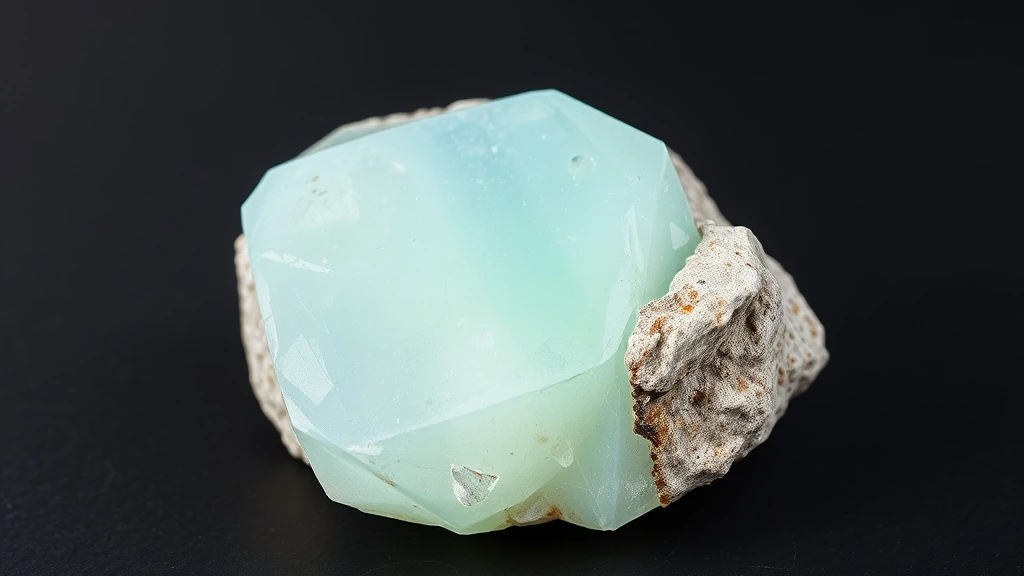
The Green Opal is a member of the Mineraloid group, specifically classified as a hydrated silica mineraloid, which is a group of minerals that do not have a crystalline structure. This geological classification is significant, as it sets Green Opal apart from other minerals with more rigid crystal structures. The parent mineral group of Green Opal is Hydrated Silica, which is a key factor in determining its properties and behavior.
What is Green Opal? Geological Overview & Definition
The Green Opal is a type of mineraloid, which means it does not have a crystalline structure like other minerals. Instead, it is composed of hydrated silica spheres that give it a unique set of properties. This classification is important, as it affects the way Green Opal forms and behaves. Green Opal is often found in sedimentary rocks and can form through a variety of geological processes. This amorphous nature is shared by its close relative, Yellow Opal, which also forms through the same silica sphere aggregation process within sedimentary deposits.
The geological definition of Green Opal is closely tied to its amorphous structure, which is characterized by a lack of long-range order. This means that the atoms in Green Opal are not arranged in a repeating pattern, unlike crystals. As a result, Green Opal exhibits a range of properties that are distinct from those of crystalline minerals. Its mineraloid classification also means that it can exhibit a range of colors and properties.
Green Opal Chemical Composition & Crystallographic Properties
The Green Opal has a chemical composition of SiO₂·nH₂O, which indicates that it is a hydrated silicon dioxide mineraloid. This composition is characterized by a lattice structure that is more akin to a network of silica spheres than a crystalline lattice. The cation substitution in Green Opal is limited, which means that the silicon and oxygen atoms are not readily substituted by other elements. As a result, Green Opal exhibits a unique set of properties that are influenced by its amorphous structure.
The acid sensitivity of Green Opal is relatively high, which means that it can be damaged by exposure to acidic substances. This is due to the fact that the silica spheres in Green Opal can be dissolved by acids, which can cause the mineraloid to break down. The chromophore color centers in Green Opal are responsible for its characteristic green color, which can range from pale to vibrant. These color centers are thought to be caused by the presence of certain impurities or defects in the amorphous structure of Green Opal.
The thermal behavior of Green Opal is also influenced by its amorphous structure. When heated, Green Opal can undergo a range of changes, including dehydration and recrystallization. This can cause the mineraloid to become more brittle and prone to cracking. The thermal stability of Green Opal is relatively low, which means that it can be damaged by exposure to high temperatures. As a result, Green Opal is often treated with care to avoid damaging its delicate structure.
| Property | Specification |
|---|---|
| Mineral Group | Mineraloid (Hydrated Silica) |
| Chemical Formula | SiO₂·nH₂O (Hydrated Silicon Dioxide) |
| Mohs Hardness | 5.5 – 6.5 |
| Crystal System | Amorphous (Hydrated silica spheres / Mineraloid) |
| Specific Gravity (Density) | 1.98 – 2.25 |
| Refractive Index | 1.370 – 1.470 |
| Color & Optical Properties | Natural Green Opal color spectrum and optical dispersion |
| Primary Mining Localities | Australia (Coober Pedy, Lightning Ridge), Ethiopia (Welo), Mexico |
| Water & Chemical Resistance | Moderate/Sensitive (%3-%21 water content; avoid prolonged soaking for hydrophane Welo opals) |
| Chakra Alignment (Traditional) | Crown Chakra and Heart Chakra |
| Zodiac Affinity (Traditional) | Libra, Scorpio, Pisces |
| Symbolic Meaning (Traditional) | Creativity, hope, emotional depth, and spontaneous inspiration |
Green Opal Varieties & Color Spectrum
Green Opal is a versatile gemstone with various natural varieties, each exhibiting unique characteristics. The Hyaloophane variety, for instance, displays a pale green to yellowish-green color due to the presence of iron oxide inclusions. The Prase Opal variety, on the other hand, showcases a more vibrant green hue. These variations in color are a result of different geochemical conditions during the formation process.
Hyaloophane Green Opal
Hyaloophane Green Opal is formed through the hydration of silica-rich solutions, resulting in a gel-like substance that eventually solidifies. This variety often features dendritic inclusions, which are branching, tree-like patterns that add to its visual appeal. The rarity of Hyaloophane Green Opal is relatively high due to the specific geological conditions required for its formation.
Prase Opal
Prase Opal is characterized by its vibrant green color, which is caused by the presence of chromium or vanadium ions. This variety is often found in hydrothermal veins and is prized for its chatoyant properties, exhibiting a cat’s eye effect when cut correctly. Prase Opal is relatively rare, with notable deposits found in Australia and Brazil.
Fire Opal
Fire Opal is a variety of Green Opal that exhibits a red or orange body color, often accompanied by a green or yellow play-of-color. This variety is formed through the oxidation of iron-rich solutions, resulting in a hyaline substance with a glassy appearance. Fire Opal is highly prized for its iridescence and is often found in Mexico and United States.
Common Opal
Common Opal, also known as Light Opal, is the most abundant variety of Green Opal. It exhibits a white or light-colored body with a green or yellow play-of-color. This variety is formed through the precipitation of silica-rich solutions, resulting in a porous substance with a matte appearance. Common Opal is widely available, with notable deposits found in Australia and India.
Boulder Opal
Boulder Opal is a type of Green Opal that forms on ironstone or sandstone matrices. It exhibits a green or blue-green color and often features concentric or linear patterns. This variety is formed through the replacement of iron-rich solutions, resulting in a hard and dense substance. Boulder Opal is highly prized for its pattern and is often found in Australia.
Where is Green Opal Found? Geological Mining & Extraction
Green Opal is typically found in sedimentary and volcanic rocks, often in association with silica-rich minerals. The primary extraction regions for Green Opal include Australia, Brazil, Mexico, and United States, where it is often mined from pegmatites and hydrothermal veins. The host rock for Green Opal can vary, but it is commonly found in rhyolite, andesite, and basalt.
The mining and extraction of Green Opal involve careful excavation and sorting to ensure the quality and integrity of the gemstone. Open-pit mining and underground mining are common methods used to extract Green Opal, with the gemstone often being found in alluvial deposits or eluvial deposits. The geological conditions required for the formation of Green Opal are specific, making it a relatively rare and valuable gemstone.
Historical Significance & Cultural Lore of Green Opal
Across ancient lapidary traditions, Green Opal has been revered for its metaphysical properties and symbolic significance. In ancient Greco-Roman culture, Green Opal was associated with hope and creativity, while in Egyptian culture, it was believed to possess protective qualities. The use of Green Opal in jewelry and ornaments dates back to ancient civilizations, with notable examples found in Chinese and Vedic artifacts.
Throughout early archaeological records, Green Opal has been found in various funerary and ritualistic contexts, highlighting its importance in ancient cultures. The esoteric significance of Green Opal is still recognized today, with many believing it to possess emotional and spiritual healing properties. As a testament to its enduring appeal, Green Opal remains a highly prized gemstone, cherished for its beauty and cultural significance.
Modern Uses & Jewelry Applications of Green Opal
Green Opal is a versatile gemstone used in various jewelry applications, including lapidary cutting and ornamental carving. It is often cut into cabochon or faceted shapes to enhance its natural beauty. Some common uses of Green Opal include:
- Pendants and earrings
- Rings and brooches
- Beaded jewelry and ornaments
Metaphysical Properties & Traditional Meaning of Green Opal
According to historical traditions and metaphysical lore, Green Opal is believed to possess emotional resonance and spiritual attributes. Across ancient lapidary traditions, it is associated with hope, creativity, and emotional depth. In historical metaphysical lore, Green Opal is said to inspire spontaneous inspiration and foster a sense of balance and harmony.
Which Chakra and Zodiac Signs Align with Green Opal?
Green Opal is aligned with the Crown Chakra and Heart Chakra, which are believed to govern spiritual awareness and emotional balance. This alignment is thought to enhance the gemstone’s metaphysical properties and promote a sense of inner peace and harmony.
The canonical zodiac signs associated with Green Opal are Libra, Scorpio, and Pisces. These signs are believed to resonate with the gemstone’s energetic vibrations, amplifying its effects on the wearer’s emotional and spiritual well-being. Across various cultural traditions, Green Opal is revered for its ability to balance and harmonize the energies of these zodiac signs.
How to Identify Real vs. Fake Green Opal
Green Opal is often imitated by artificial means, including synthetic glass and dyed replicas. These imitations can be difficult to distinguish from genuine Green Opal, making it essential to conduct thorough authenticity tests.
Practical At-Home Authenticity Tests:
- Temperature Test (Thermal Feel): Genuine Green Opal tends to feel cool to the touch, while fake or synthetic versions may feel warmer or more neutral in temperature.
- Specific Gravity & Weight Test: Green Opal has a relatively low density, typically ranging from 1.98 to 2.25. By measuring the gemstone’s weight and volume, you can calculate its specific gravity and determine if it falls within the expected range.
- Scratch & Hardness Test (Mohs Comparison): Green Opal has a Mohs hardness of 5.5-6.5, which means it can be scratched by minerals with a higher hardness rating. By carefully scratching the gemstone with a known mineral, you can determine if it exhibits the expected level of hardness.
- Microscopic & Loupe Inspection (Internal Inclusions): Genuine Green Opal often exhibits unique internal inclusions, such as tiny bubbles or hydrated silica spheres. By examining the gemstone under a microscope or loupe, you can look for these characteristic inclusions and determine if they are present.
Green Opal Valuation Factors, Grading & Pricing
The value of Green Opal is significantly influenced by its Color Saturation, with more vibrant and intense hues commanding higher prices. Visual vibrancy and natural energetic luster also play a crucial role in determining the stone’s value. The overall appearance of the Green Opal, including its color distribution and pattern, is carefully evaluated to determine its worth.
The Crystal Size & Weight (Grams) of the Green Opal is another key factor in its valuation, with larger and heavier stones generally being more valuable. The quality of the polish, whether raw or tumbled, also affects the stone’s value, as does the presence of natural matrix inclusions. The size and weight of the Green Opal, combined with its polish quality, determine its overall value in the market.
In holistic and collector markets, the Ethical Sourcing & Locality Premium of Green Opal can significantly impact its value. Stones sourced from reputable and environmentally responsible suppliers may command a higher price due to their ethical and sustainable origins. The locality of the Green Opal, including its geographic origin and mining history, can also influence its value and desirability among collectors.
How to Clean and Care for Green Opal
To clean and care for Green Opal, it is essential to avoid using ultrasonic cleaners and steam, as these can cause micro-fracturing due to the stone’s internal water content. Instead, gently dust the specimen using a completely dry, soft microfiber cloth or camel-hair brush. This method ensures the stone remains free from damage and maintains its natural beauty. Store the Green Opal in a low-humidity environment away from liquids to prevent damage.
Cleansing and Recharging Green Opal (Energetic Care)
To cleanse and recharge Green Opal, use safe dry holistic methods such as herbal smudging or gentle moonlight exposure. These methods allow the stone to release any negative energy and absorb positive vibrations without causing damage. Resting the Green Opal on a selenite charging slab is also a gentle and effective way to recharge its energy. This method promotes the stone’s natural healing properties and maintains its energetic balance.
By using these gentle and non-invasive methods, the Green Opal can be cleansed and recharged without compromising its integrity. Avoid exposing the stone to direct intense sunlight, domestic heating, or ovens, as heat can destroy the mineral crystal lattice. Instead, opt for gentle and natural methods that promote the stone’s energetic well-being and maintain its beauty. The Green Opal’s delicate nature requires careful handling and attention to its specific needs, ensuring it remains a treasured and vibrant gemstone.
Frequently Asked Questions About Green Opal
Green Opal displays distinct mineralogical characteristics across its geological varieties and structural habits. Gemologists evaluate these natural varieties based on crystal habit, trace chromophore concentrations, and visual luster.
Primary Natural Green Opal
The benchmark natural variety exhibiting diagnostic color saturation and classic crystallographic symmetry.
Distinct Geological Morphs of Green Opal
Secondary regional and structural varieties formed under localized geological temperature and pressure conditions.
What is the chemical composition of Green Opal?
SiO₂·nH₂O (Hydrated Silicon Dioxide) is the chemical formula, indicating a mineraloid with hydrated silica spheres. This composition affects its physical properties and durability.
Is Green Opal water-resistant?
Moderate/Sensitive water resistance is a characteristic of Green Opal, with 3-21% water content. Prolonged soaking should be avoided, especially for hydrophane Welo opals.
How do I clean my Green Opal jewelry?
Dry microfiber cloth or a soft brush is recommended for dusting and cleaning Green Opal. Avoid using ultrasonic cleaners or steam, as they can cause micro-fracturing.
Can I wear Green Opal in the shower or rain?
Avoid prolonged exposure to water, as Green Opal has moderate/sensitive water resistance. Brief exposure to water may not cause damage, but it’s best to minimize contact.
What are the aligned zodiac signs for Green Opal?
Libra, Scorpio, Pisces are the zodiac signs associated with Green Opal, making it a suitable gemstone for individuals born under these signs.
Which chakras are aligned with Green Opal?
Crown Chakra and Heart Chakra are the chakras connected to Green Opal, promoting emotional depth and spiritual growth.
Can I use an ultrasonic cleaner for my Green Opal?
Strictly avoid using ultrasonic cleaners or steam, as they can cause micro-fracturing (crazing) due to the internal water content of Green Opal.
What are the metaphysical properties of Green Opal?
Creativity, hope, emotional depth, and spontaneous inspiration are the esoteric properties associated with Green Opal, making it a gemstone for those seeking emotional balance and inspiration.