
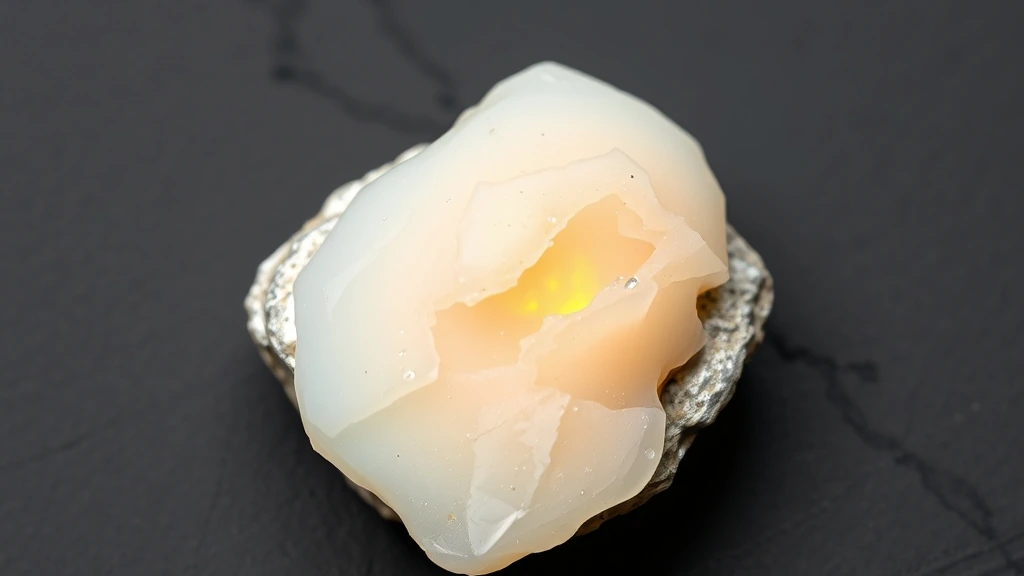
Opal does not belong to the crystalline mineral groups but is classified as a mineraloid within the hydrated silica family. Unlike quartz or chalcedony, it lacks long-range atomic order, forming instead through the precipitation of colloidal silica in cavities. This geological process creates a unique structure that defies standard crystallographic classification. Consequently, geologists treat it as a distinct material with properties intermediate between glass and crystalline minerals.
What is Opal ? Geological Overview & Definition
Opal forms when silica-rich water evaporates or cools, leaving behind hydrated silica in voids of host rocks like rhyolite or basalt. This process occurs over millions of years, creating deposits in specific geological settings worldwide. The resulting stone is not a single crystal but a complex aggregate of microscopic components.
The term “opalescence” describes the play-of-color effect caused by light diffraction within the stone. This phenomenon distinguishes precious opal from common opal, which lacks this iridescent display. Understanding this structural basis is crucial for gemological identification and valuation. While opal’s iridescence stems from its internal silica sphere structure, it is important to distinguish it from Perlite, a volcanic glass that expands upon heating and is often confused with opal due to its similar pearly luster and light-refracting properties.
Opal Chemical Composition & Crystallographic Properties
Opal is strictly amorphous, meaning it lacks a repeating crystal lattice structure. Instead, it consists of tightly packed, ordered spheres of hydrated silica. This mineraloid status explains why it does not exhibit cleavage or distinct crystal faces. The arrangement of these spheres determines the stone’s optical properties.
The chemical composition is SiO₂·nH₂O, with water content varying between 3% and 21%. This hydration makes opal sensitive to dehydration, which can cause cracking or “crazing.” The lack of a rigid lattice structure contributes to its relatively low density and hardness.
Optical effects stem from the refractive index range of 1.370 to 1.470. Light interacts with the silica spheres, creating interference patterns known as play-of-color. There are no traditional chromophores; color arises purely from physical diffraction.
Thermal behavior is critical for stability, as rapid temperature changes can fracture the stone. The amorphous structure provides no thermal expansion buffer, making it vulnerable to stress. Proper care requires avoiding extreme heat or sudden cooling to preserve integrity.
| Property | Specification |
|---|---|
| Mineral Group | Mineraloid (Hydrated Silica) |
| Chemical Formula | SiO₂·nH₂O (Hydrated Silicon Dioxide) |
| Mohs Hardness | 5.5 – 6.5 |
| Crystal System | Amorphous (Hydrated silica spheres / Mineraloid) |
| Specific Gravity (Density) | 1.98 – 2.25 |
| Refractive Index | 1.370 – 1.470 |
| Color & Optical Properties | Natural Opal Gemstone color spectrum and optical dispersion |
| Primary Mining Localities | Australia (Coober Pedy, Lightning Ridge), Ethiopia (Welo), Mexico |
| Water & Chemical Resistance | Moderate/Sensitive (%3-%21 water content; avoid prolonged soaking for hydrophane Welo opals) |
| Chakra Alignment (Traditional) | Crown Chakra and Heart Chakra |
| Zodiac Affinity (Traditional) | Libra, Scorpio, Pisces |
| Symbolic Meaning (Traditional) | Creativity, hope, emotional depth, and spontaneous inspiration |
Opal Varieties & Comprehensive Sub‑Types
Black Opal
Black opal forms in the silica‑rich, arid alluvial gravels of Lightning Ridge, New South Wales, where groundwater evaporates, leaving a dark‑bodied matrix (N1‑N4). Minute silica spheres arrange in a hexagonal close‑packed lattice, producing vivid play‑of‑color that flashes against the black background. The rarity of this dark host tone, combined with high contrast color flashes, makes Black Opal the most valuable opal on the market, often sold as “precious” stones in 1‑carat slabs or polished cabochons.
White / Light Opal
White (or light) opal develops in silica‑laden, low‑temperature sedimentary basins where the host material is a milky or whitish matrix of fine silica particles. The body tone is light, allowing the internal diffraction of light to create soft to bright flashes that appear as a pastel rainbow. These stones are abundant in Australia’s Coober Pedy and Andamooka districts and are widely used for fashion jewelry, though they command lower prices than their darker counterparts.
Fire Opal
Fire opal originates in volcanic rhyolite cavities of the Mexican states of Querétaro and Jalisco, where silica precipitates from hot, iron‑rich fluids. The stone is translucent to transparent with a warm body tone ranging from red to orange or yellow, often lacking the classic play‑of‑color but exhibiting a uniform internal glow. Because of its vivid hue, fire opal is frequently faceted like a traditional gemstone and is prized in both high‑end and collector markets.
Boulder Opal
Boulder opal forms when opalized silica infiltrates the porous ironstone host rock of Queensland’s Boulder Creek region. The opal grows in narrow, undulating seams that cling to the ironstone, creating a striking contrast between the dark matrix and the colorful opal patches. These stones are typically cut as slabs to showcase the natural “boulder” effect, and their unique appearance commands premium prices among collectors.
Ethiopian Welo Opal
Ethiopian Welo opal is a hydrophane volcanic opal from the Wollo province, where rapid cooling of silica‑rich lava creates a porous, water‑absorbing structure. When dry, the stone appears milky; after absorbing moisture, it reveals a vivid 3‑dimensional honeycomb or patchwork play‑of‑color. This reversible optical effect makes Welo opal highly sought after for artistic cabochons and limited‑edition jewelry pieces.
Dendritic Opal (Merlinite)
Dendritic opal, also known as Merlinite, forms in sedimentary silica deposits where manganese‑rich fluids precipitate black, branching dendrites within a white to cream‑colored opal matrix. The resulting pattern resembles fern fronds or tree branches, giving the stone a dual‑nature aesthetic prized for metaphysical work. Though lacking play‑of‑color, dendritic opal is widely used in beads and ornamental objects and is valued for its distinctive visual texture.
Comparative Summary – Gemologists differentiate these varieties primarily by body tone, presence or absence of play‑of‑color, and host‑rock relationship. Black and white opals are identified by their dark or light matrices and strong diffraction effects, while fire opal is distinguished by its uniform warm hue. Boulder opal’s inseparable ironstone matrix, Ethiopian Welo’s hydrophane behavior, and dendritic opal’s manganese patterns each require specific visual and microscopic criteria during grading and cutting.
Where is Opal Found? Geological Mining & Extraction
Opal deposits are most prolific in sedimentary basins and volcanic terrains where silica‑rich fluids have precipitated amorphous silica. In Australia, the Great Artesian Basin hosts extensive Coober Pedy, Andamooka, and Lightning Ridge fields, where miners extract opal from soft, unconsolidated gravels using hand tools, suction pumps, and small‑scale open‑pit methods.
Outside Australia, significant opal sources include Mexico’s volcanic rhyolite (fire opal), Ethiopia’s Wollo volcanic fields (hydrophane opal), and Queensland’s Boulder Creek (boulder opal). Extraction here often involves controlled blasting of host rock followed by careful water‑based separation to preserve the delicate silica spheres and prevent fracture.
Historical Significance & Cultural Lore of Opal
Opal has fascinated ancient cultures, appearing in Roman jewelry and Mayan ceremonial objects, where it symbolized hope and purity. The Romans prized opal for its ability to display many colors, believing it could capture the essence of the rainbow, while the Mayans used it in burial masks to guide souls through the afterlife.
In the Middle Ages, opal’s reputation fluctuated; superstition labeled it a “stone of misfortune” after a 19th‑century novel, yet many Eastern traditions, such as in India and Turkey, continued to associate it with creativity and emotional depth. Today, opal remains a metaphysical favorite, celebrated for its spontaneous inspiration and connection to the Crown and Heart chakras.
Modern Uses & Jewelry Applications of Opal
Opal is primarily cut as a cabochon to maximize its play-of-color, as faceting would disrupt the internal light diffraction. Lapidaries must handle the stone with extreme care due to its susceptibility to cracking from thermal shock or mechanical stress. This delicate nature requires specialized cutting techniques that preserve the integrity of the silica sphere structure.
- Cabochon Cutting: The standard method for displaying opal’s iridescence, featuring a smooth, domed surface without facets.
- Bezel Settings: Preferred over prong settings to protect the stone’s edges from chipping during daily wear.
- Ornamental Carving: Used in intaglio work or cameos, though less common due to the risk of structural failure.
- Doublets and Triplets: Thin opal slices bonded to backing materials to enhance stability and depth.
Metaphysical Properties & Traditional Meaning of Opal
According to historical traditions and metaphysical lore, opal is revered as a stone of emotional depth and spontaneous inspiration. It is believed to amplify feelings and encourage the wearer to embrace their creative potential without hesitation. This gemstone is often associated with hope, serving as a talisman for those navigating periods of change or uncertainty.
In spiritual practices, opal is thought to open the channels of intuition and foster a deep connection with one’s inner self. It is said to balance the emotional body, helping to release past traumas and promote creativity. Practitioners often use this stone to enhance meditation and facilitate a state of heightened awareness and spiritual clarity.
Which Chakra and Zodiac Signs Align with Opal ?
Opal is canonically aligned with the Crown Chakra and the Heart Chakra, bridging spiritual insight with emotional compassion. The Crown Chakra connection supports higher consciousness and universal truth, while the Heart Chakra alignment fosters love, empathy, and emotional healing. This dual alignment makes opal a powerful tool for integrating spiritual wisdom with heartfelt human connection.
In astrological terms, opal resonates most strongly with the signs of Libra, Scorpio, and Pisces. These water and air signs share the stone’s affinity for intuition, emotional sensitivity, and creative expression. Wearing opal is believed to enhance the natural traits of these zodiac signs, promoting harmony and deeper self-understanding.
How to Identify Real vs. Fake Opal
Distinguishing natural opal from artificial imitations requires careful observation of optical properties and physical characteristics. Common fakes include synthetic glass, dyed chalcedony, and plastic replicas that mimic the play-of-color but lack the authentic internal structure. These imitations often exhibit uniform color patterns or artificial inclusions that differ significantly from natural silica spheres.
Practical At-Home Authenticity Tests
- Temperature Test (Thermal Feel): Natural opal feels cool to the touch initially and warms up slowly, whereas glass imitations may feel warmer faster or retain heat differently due to varying thermal conductivity.
- Specific Gravity & Weight Test: Genuine opal has a density of 1.98 – 2.25 g/cm³, making it feel slightly lighter than glass of similar size; a hydrostatic weighing test can confirm this difference.
- Scratch & Hardness Test (Mohs Comparison): With a hardness of 5.5 – 6.5, natural opal can scratch glass but will be scratched by a steel knife; glass imitations are typically harder and will not scratch easily.
- Microscopic & Loupe Inspection (Internal Inclusions): Under a 10x loupe, natural opal shows a honeycomb or tile-like pattern of silica spheres, while glass may contain bubbles or swirls, and plastic may show mold lines.
Opal Valuation Factors, Grading & Pricing
Color Saturation is the foremost driver of an opal’s market price. Deep, vivid hues—especially fire reds, blues, and greens—command premium rates, while pastel tones are less valuable. Uniform tone across the stone and a high‑gloss optical clarity further enhance desirability, reducing the appearance of milky or cloudy zones.
Specimen Size & Weight influences price but interacts with cut quality. Larger opals are rarer, yet a well‑proportioned stone with precise tumbled polish and natural geometry can outshine a heavier, poorly cut example. The presence of a dark matrix or visible inclusions may either add character or diminish value, depending on their pattern and contrast.
Geographical Provenance Premium rewards stones from famed locales such as Lightning Ridge (Australia) or Ethiopian Welo. Provenance can add 15‑30 % to wholesale prices, reflecting rarity and historical reputation. Retail trends show steady growth, with online platforms driving modest price inflation while traditional dealers maintain tighter margins.
How to Clean and Care for Opal
Physical cleaning should be gentle and water‑based. Use a soft, lint‑free cloth dampened with lukewarm distilled water, then pat dry with another clean cloth; avoid soaking the stone, as opal contains 3‑21 % water and is prone to crazing. Never place opal in ultrasonic cleaners or expose it to steam—these methods create micro‑fractures that permanently damage the gemstone.
Cleansing and Recharging Opal (Energetic Care)
For energetic renewal, hold the opal in the gentle glow of moonlight for several hours, allowing lunar energy to restore its inner vibrancy without introducing moisture. Alternatively, pass the stone through a thin veil of smoke smudging using sage or cedar, which clears stagnant energies while respecting the mineral’s low solubility.
A second safe method is to rest the opal on a selenite plate or in a crystal grid overnight; selenite’s high vibrational frequency subtly recharges the opal without any physical contact that could disturb its hydrated structure. Both techniques honor the stone’s delicate nature while enhancing its metaphysical qualities.
Frequently Asked Questions About Opal
What is the chemical composition of opal?
Opal is hydrated silicon dioxide, expressed as SiO₂·nH₂O. It consists of a three‑dimensional network of silica spheres that trap varying amounts of water (typically 3‑21 %). This amorphous mineraloid lacks a true crystal lattice, giving opal its unique play‑of‑color and relatively low Mohs hardness of 5.5–6.5.
How hard is opal compared to other gemstones?
Opal rates 5.5 to 6.5 on the Mohs scale. This places it between apatite and orthoclase, making it softer than quartz but harder than many organic gems. Because of its moderate hardness, opal should be protected from scratches by harder stones and stored separately in jewelry boxes.
Can I wear opal jewelry while swimming or showering?
Opal tolerates only moderate moisture; prolonged soaking is discouraged. Its water content (3‑21 %) makes it hydrophane in some varieties, which can swell or develop surface crazing if left in water too long. Quick exposure to rain is fine, but avoid baths, pools, or long showers to preserve its brilliance.
Should I clean opal with an ultrasonic cleaner or steam?
Never use ultrasonic or steam cleaning on opal. The internal water molecules cause micro‑fracturing, known as crazing, when subjected to high‑frequency vibrations or heat. Instead, gently wipe the stone with a soft, damp cloth and mild soap, then pat dry with a lint‑free towel.
Which zodiac signs are traditionally linked to opal?
Opal is associated with Libra, Scorpio, and Pisces. These signs are believed to resonate with the stone’s emotional depth and inspirational qualities. Wearing opal is thought to enhance balance for Libra, transformation for Scorpio, and intuition for Pisces, aligning with each sign’s astrological themes.
Which chakras does opal activate?
Opal works with the Crown Chakra and the Heart Chakra. The stone’s creative energy stimulates higher‑mind awareness while also opening the heart to compassion and love. Meditating with opal over these chakras can promote spiritual insight and emotional healing simultaneously.
How can I tell if an opal is genuine or synthetic?
Natural opal displays a random, three‑dimensional play‑of‑color, while synthetic stones often show uniform patterns. Look for irregular color flashes and a slightly milky background caused by the silica sphere matrix. A trained gemologist can confirm authenticity with a refractive index test (1.370–1.470) and microscopic examination.
What care routine will keep my opal jewelry looking its best?
Store opal separately in a padded pouch and avoid exposure to extreme temperature changes. Clean gently with a soft cloth, keep it away from harsh chemicals, and limit direct sunlight to prevent fading of the play‑of‑color. Regularly inspect for tiny cracks, especially after any accidental moisture exposure.