
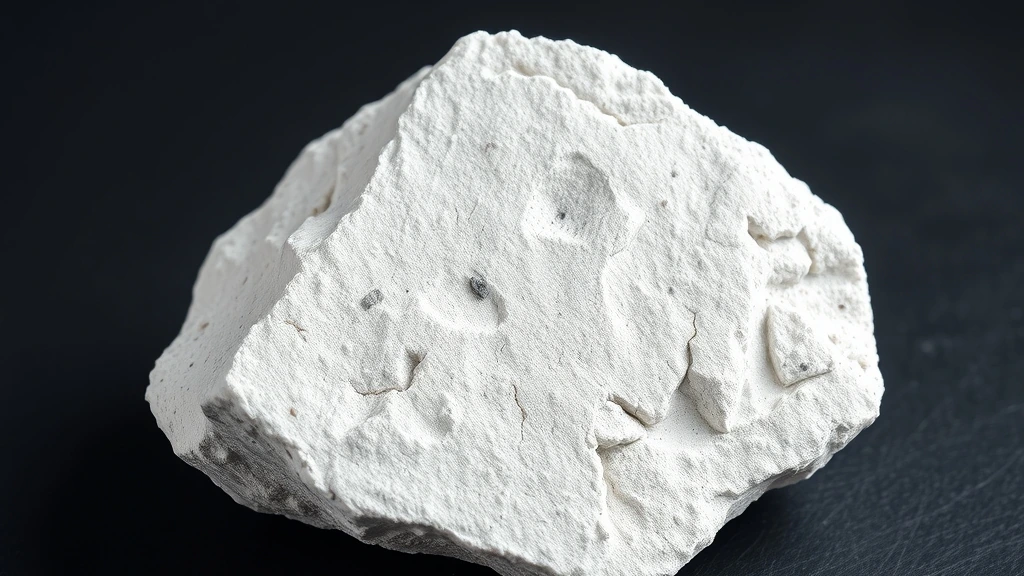
Perlite belongs to the Natural Mineral / Crystal group, representing a specific variety of volcanic glass formed from rapid cooling of silica-rich magma. Unlike crystalline minerals, it lacks a long-range ordered atomic arrangement, distinguishing it from quartz or feldspar. This geological origin places it within the broader category of igneous rocks, specifically those formed during explosive volcanic eruptions. Its classification emphasizes its unique position as a non-crystalline solid with distinct physical properties.
What is Perlite? Geological Overview & Definition
Perlite forms when rhyolitic lava cools rapidly upon contact with water or air during volcanic eruptions. This sudden quenching traps water molecules within the glassy structure, creating a hydrated silicate matrix. The resulting material is a natural, non-crystalline solid that differs fundamentally from traditional gemstones. In comparative mineralogical collections, practitioners and geologists frequently study Peanut Obsidian alongside this crystal to appreciate their subtle energetic and structural differences.
Geologically, perlite is classified as an amorphous mineraloid rather than a true crystal. It lacks the repetitive lattice structure found in crystalline minerals, giving it unique physical characteristics. This formation process results in a material that is lightweight and porous in its natural state. Understanding this distinction is crucial for accurate mineralogical identification and classification.
Perlite Chemical Composition & Crystallographic Properties
Perlite possesses an amorphous crystal system, meaning it lacks a defined, repeating lattice structure. Its composition is primarily hydrated silica (SiO₂) with significant amounts of aluminum, iron, and magnesium oxides. This disordered atomic arrangement prevents the formation of distinct crystal faces or cleavage planes. The absence of long-range order defines its fundamental mineralogical identity.
Cation substitution within the silicate network involves the replacement of silicon by aluminum and other metal ions. This process creates a complex, heterogeneous chemical environment that influences the material’s stability. The structure is sensitive to acidic conditions, which can alter the silicate bonds over time. Such chemical reactivity is a key factor in its long-term preservation.
Color in perlite arises from chromophore impurities and structural defects rather than pure crystallographic alignment. Iron and manganese oxides often produce brown or gray hues within the glassy matrix. These color centers are distributed irregularly due to the amorphous nature of the material. Thermal treatment can further modify these optical properties by altering the internal structure.
When heated, perlite undergoes exfoliation, a process where trapped water vaporizes and expands the material. This thermal behavior transforms the dense glass into a lightweight, porous aggregate. The expansion ratio can be significant, drastically changing the density from 2.4 to 0.1 g/cm³. This unique property makes perlite valuable in industrial applications beyond gemology.
| Property | Specification |
|---|---|
| Mineral Group | Natural Mineral / Crystal |
| Chemical Formula | Volcanic glass (hydrated silicate, primarily SiO₂ with Al₂O₃, FeO, MgO, CaO, Na₂O, K₂O) |
| Mohs Hardness | 5.5 – 6.5 |
| Crystal System | Amorphous |
| Specific Gravity (Density) | 0.1 – 2.4 |
| Refractive Index | 1.45 – 1.50 |
| Color & Optical Properties | Natural Perlite color spectrum and optical dispersion |
| Primary Mining Localities | Global primary localities |
| Water & Chemical Resistance | Sensitive (Avoid prolonged water soaking) |
| Chakra Alignment (Traditional) | Crown Chakra, Third Eye Chakra |
| Zodiac Affinity (Traditional) | Virgo, Scorpio |
| Symbolic Meaning (Traditional) | Mental clarity, spiritual expansion, and purification |
Perlite Varieties & Color Spectrum
White Perlite
Formed from rapid cooling of silica‑rich volcanic ash, white perlite is the most common commercial grade. Its glassy matrix is riddled with microscopic vesicles that expand when heated, creating a lightweight, porous texture. The near‑colorless appearance makes it a staple in horticulture and construction, and its abundance renders it relatively inexpensive.
Amber‑Tinted Perlite
Occurring where iron oxides partially oxidize within the glass, amber‑tinted perlite displays a warm honey hue. The coloration is often enhanced by thin layers of hematite or goethite inclusions that settle during solidification. Though less common than the white form, it is prized for decorative aggregates and specialty lighting fixtures.
Green‑Veined Perlite
In regions with elevated copper and nickel content, perlite can develop green veining from mineralized chlorite or serpentine inclusions. These veins create striking contrast against the translucent matrix, making the stone attractive to collectors. The rarity of the requisite geochemical environment limits its extraction to a few volcanic fields in Central America.
Black Perlite
When manganese and magnetite are abundant during formation, black perlite acquires a deep, opaque shade. The dense inclusions reduce its expansion ratio, affecting its industrial utility but enhancing its appeal as a gemstone for cabochons. This variety is chiefly sourced from volcanic islands in the Pacific, where basaltic flows interact with hydrothermal fluids.
Pink‑Blush Perlite
Trace amounts of titanium and manganese oxides impart a subtle pink‑blush tint to perlite, often observed in deposits adjacent to rhyolitic domes. The delicate coloration is uniform and can be enhanced by gentle polishing, yielding a gemstone suitable for artisanal jewelry. Its limited geographic distribution makes it a niche collector’s item.
Frosted Perlite
Exposure to mild weathering or hydrothermal alteration can produce a frosted surface texture, scattering light and giving the stone a milky opalescence. This surface effect is not a true color but a micro‑structural phenomenon that enhances visual depth. Frosted perlite is frequently harvested from older volcanic tuffs in the Mediterranean basin for ornamental panels.
Where is Perlite Found? Geological Mining & Extraction
Perlite occurs primarily in silicic volcanic tuffs and rhyolitic ash‑flow deposits where rapid quenching traps water vapor within the glass. These amorphous rocks are often interbedded with pumice and obsidian, forming extensive horizons that can be mined via open‑pit methods. The low density (0.1–2.4 g/cm³) of the raw material facilitates bulk handling and transport.
The largest commercial operations are located in the United States (Arizona, California, and Nevada), Turkey, Greece, and Japan, where thick tuff sequences are exposed at the surface. Extraction involves drilling, blasting, and crushing the ore to a uniform size before a controlled thermal expansion process creates the characteristic lightweight aggregate used worldwide.
Historical Significance & Cultural Lore of Perlite
Ancient peoples in the Anatolian plateau recognized perlite’s lightweight nature, employing it as a fire‑proof filler in early kiln construction and as a polishing medium for metalwork. Archaeological sites in Crete and the Levant have yielded perlite fragments embedded in ceramic glazes, indicating its role in early glazing technologies.
Esoteric traditions attribute perlite with mental clarity and spiritual expansion, linking its porous structure to the purification of thought. In medieval alchemical manuscripts, the stone was symbolically associated with the Crown Chakra, believed to facilitate insight and the ascent of consciousness, a belief that persists in contemporary crystal healing practices.
Modern Uses & Jewelry Applications of Perlite
Perlite is primarily valued in industrial contexts for its lightweight, porous structure rather than traditional gemstone cutting. Its amorphous nature and low Mohs hardness of 5.5–6.5 make it unsuitable for high-polish faceting, as it lacks the structural integrity required for durable jewelry. Consequently, lapidary work is rare and typically limited to rough specimen display or specialized ornamental carving where weight reduction is a priority.
- Industrial Insulation: Expanded perlite is widely used in construction and horticulture for its thermal insulation properties.
- Specimen Display: Collectors often mount raw, unexpanded volcanic glass pieces to showcase their natural texture and geological origin.
- Ornamental Carving: Rarely, soft, hydrated forms may be carved into small decorative objects, though they remain fragile and prone to chipping.
Safety & Mineral Profile of Perlite
Handling perlite requires standard mineral safety precautions, particularly regarding its porous, dust-generating nature when expanded. The material is chemically stable under normal conditions, consisting primarily of hydrated silicate glass with trace oxides. It is essential to recognize perlite as a collector mineral valued for its scientific study and geological significance, rather than as a therapeutic crystal. While historical esoteric traditions have loosely associated it with mental clarity, these claims lack empirical scientific validation and should not supersede proper material safety protocols.
Mineralogical Group and Planetary Lore of Perlite
Perlite belongs to the volcanic glass family, specifically a hydrated form of obsidian that undergoes exsolution during cooling. It is not a crystalline mineral but an amorphous silicate structure, which distinguishes it from traditional gemstones in crystallographic classification. This unique formation process results in a material that is geologically significant for understanding volcanic degassing and magma composition.
Traditional astrological associations often link perlite to Virgo and Scorpio, reflecting themes of purification and transformation. These symbolic connections are rooted in cultural folklore rather than mineralogical science. Modern gemological standards emphasize the importance of distinguishing such metaphysical lore from the physical and chemical properties that define the mineral’s true identity.
How to Identify Real vs. Fake Perlite
Artificial imitations of perlite are uncommon due to the material’s distinct industrial utility, but synthetic glass or dyed porous stones may occasionally be misrepresented. Synthetic glass replicas lack the natural micro-porosity and specific chemical signature of volcanic glass. Dyed replicas may exhibit unnatural color saturation in the pores, which can be detected through careful visual inspection and basic chemical testing.
Practical At-Home Authenticity Tests
- Temperature Test (Thermal Feel): Genuine perlite feels cool to the touch initially but warms quickly due to its low thermal conductivity and porous structure. Synthetic glass imitations often retain heat longer or feel uniformly cold without the rapid temperature equalization seen in natural volcanic glass.
- Specific Gravity & Weight Test: With a density ranging from 0.1 to 2.4 g/cm³, expanded perlite is exceptionally light. A stone that feels significantly heavier for its size likely contains dense glass or mineral fillers, indicating it is not natural expanded perlite.
- Scratch & Hardness Test (Mohs Comparison): Perlite has a Mohs hardness of 5.5–6.5, meaning it can be scratched by a steel knife (hardness 5.5) or a quartz point (hardness 7). If the material scratches glass easily or resists scratching by steel, it is likely a harder synthetic material or a different mineral entirely.
- Microscopic & Loupe Inspection (Internal Inclusions): Under a 10x loupe, genuine perlite displays a uniform, cellular microstructure with tiny gas bubbles trapped during expansion. Imitations may show flow lines, air bubbles with different shapes, or dye pooling in larger voids that do not match the natural volcanic texture.
Perlite Valuation Factors, Grading & Pricing
Specimen aesthetic quality dominates market value, with collectors favoring transparent, vitreous luster and a uniform amber hue. Crystals that display flawless, glassy surfaces and an undisturbed matrix command premium prices, while surface weathering or discoloration reduces desirability. Even subtle internal fractures can markedly lower a piece’s appraisal.
Rarity and specimen dimensions are the next decisive criteria, measured in centimeters and grams rather than carats. Large, intact clusters that retain their original volcanic glass morphology are scarce and fetch higher bids, especially when the mass exceeds typical field finds. Specimens free of handling damage, such as chips or abrasion, further enhance their market appeal.
Mineralogical provenance and locality value provide the final layer of assessment, with perlite from historically documented volcanic fields gaining scientific prestige. Provenance from renowned sites in Turkey, the United States, or Italy adds credibility and often attracts museum curators. Detailed documentation, including GPS coordinates and geological context, can elevate a specimen from a simple curiosity to a prized collection highlight.
How to Clean and Care for Perlite
Gently wipe the surface of perlite with a lightly dampened cloth, then immediately dry it with a soft, dry microfiber towel to prevent moisture absorption. This brief, controlled contact removes dust without compromising the fragile glass structure. Avoid any prolonged exposure to water, as the mineral is sensitive and may develop micro‑fractures.
Ultrasonic cleaning devices must be avoided; the high‑frequency vibrations can induce internal stress and cause the amorphous glass to fracture. Instead, handle the specimen with clean hands or tools, and store it in a low‑humidity environment to maintain its structural integrity over time.
Cleansing and Recharging Perlite (Energetic Care)
For energetic maintenance, place the perlite in a gentle stream of herbal smudging smoke, allowing the aromatic vapors to pass over the surface for a few minutes. This method clears stagnant energy without introducing moisture or heat, preserving the mineral’s delicate lattice while promoting mental clarity.
Alternatively, expose the specimen to soft moonlight overnight or rest it on a clean selenite slab for a few hours. Both practices recharge the stone’s metaphysical properties safely, avoiding direct sunlight or intense heat that could destabilize its amorphous structure.
Frequently Asked Questions About Perlite
Is perlite safe to wear in the shower?
No, perlite should not be exposed to prolonged water contact. Its amorphous, hydrated glass structure can absorb moisture, leading to swelling and surface deterioration. A brief wipe with a damp cloth is permissible, but the stone must be dried immediately to preserve its integrity and optical clarity.
How should I clean perlite jewelry?
Use a soft, dry microfiber cloth or a gentle brush and avoid liquids. Because perlite is water‑sensitive, any lingering moisture can cause micro‑fractures that compromise its density (0.1–2.4 g/cm³) and refractive index (1.45–1.50). Regular dusting maintains its luster without risking damage.
Can I use an ultrasonic cleaner on perlite?
Do not place perlite in an ultrasonic cleaner. The high‑frequency vibrations can create internal stresses that fracture the amorphous glass matrix. Instead, a brief wipe with a lightly dampened cloth followed by immediate drying is the safest method to keep the stone stable.
What zodiac signs are associated with perlite?
Perlite is linked to Virgo and Scorpio. These signs are thought to benefit from the stone’s reputed ability to promote mental clarity and spiritual expansion, aligning with the analytical nature of Virgo and the transformative energy of Scorpio.
Which chakras does perlite activate?
Perlite resonates with the Crown Chakra and the Third Eye Chakra. Activation of these energy centers is believed to enhance intuition, higher consciousness, and purification, supporting meditation practices that seek insight beyond the physical realm.
How hard is perlite compared to other gemstones?
Perlite rates 5.5–6.5 on the Mohs hardness scale. This places it between apatite and orthoclase, making it moderately resistant to scratches but still softer than quartz or topaz. Careful handling is advised to avoid abrasion that could dull its glass‑like surface.
Does perlite have any notable optical properties?
Its refractive index ranges from 1.45 to 1.50, giving a subtle, glassy sheen. The amorphous, non‑crystalline structure means it lacks cleavage, so light is scattered uniformly, producing a gentle luminance prized in decorative applications rather than high‑brilliance jewelry.
Is perlite suitable for everyday wear?
Perlite can be worn daily if protected from moisture and harsh impacts. Its low density (as low as 0.1 g/cm³) makes it lightweight, but its water sensitivity and moderate hardness require protective settings and routine dry cleaning to maintain appearance.