
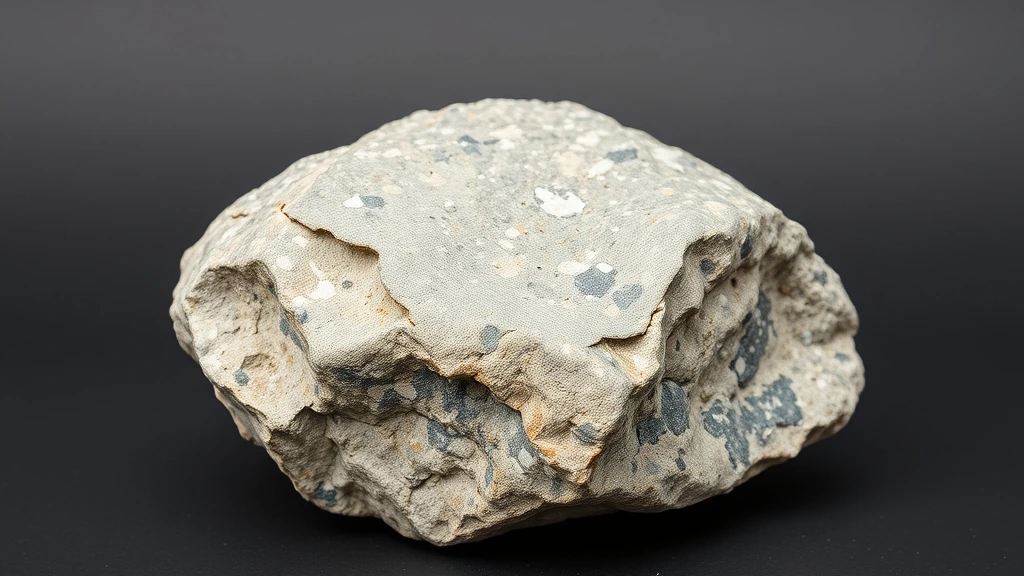
Rhyolite belongs to the Natural Mineral / Crystal parent group, specifically classified as a volcanic igneous rock. It forms from the rapid cooling of silica-rich magma, resulting in a dense, glassy, or fine-grained texture. Unlike single-crystal gemstones, rhyolite is a polycrystalline aggregate of multiple mineral phases. This composite structure gives it unique optical and physical properties distinct from pure mineral specimens.
What is Rhyolite? Geological Overview & Definition
Rhyolite is defined as a felsic volcanic rock that is the extrusive equivalent of granite. It typically exhibits a fine-grained or aphanitic texture due to rapid surface cooling. The rock often contains phenocrysts of quartz and feldspar suspended in a finer matrix.
The geological formation of rhyolite occurs during explosive volcanic eruptions. High viscosity magma traps gas, leading to violent ejections that cool quickly. This process creates a polycrystalline structure with minimal large crystal growth. Consequently, rhyolite serves as a key indicator of high-silica volcanic activity.
Rhyolite Chemical Composition & Crystallographic Properties
Rhyolite lacks a single stoichiometric formula because it is a composite polycrystalline rock. Its primary components are quartz ($SiO_2$) and alkali feldspar ($KAlSi_3O_8$ or $NaAlSi_3O_8$). The crystal system is therefore classified as Composite (Polycrystalline). This aggregate nature means optical properties vary slightly across the sample.
The lattice structure within individual mineral grains follows their specific crystallographic systems. Quartz grains exhibit a trigonal lattice, while feldspars are triclinic or monoclinic. These distinct lattices interlock to form the macroscopic rock structure. Cation substitution between sodium and potassium in feldspar phases influences density and optical character.
Rhyolite demonstrates moderate acid sensitivity, particularly in its feldspar components. Hydrofluoric acid can etch the silicate framework, altering surface luster. The chromophore centers are generally absent, resulting in pale, earthy colors. Iron impurities may introduce subtle brown or red tints.
Thermal behavior is characterized by low thermal conductivity due to the polycrystalline matrix. The rock resists rapid temperature changes better than pure quartz. Refractive index values range from 1.544 to 1.560, typical of silicate aggregates. This stability makes rhyolite suitable for various lapidary applications.
| Property | Specification |
|---|---|
| Mineral Group | Natural Mineral / Crystal |
| Chemical Formula | Volcanic rock (Felsic); Predominantly Quartz (SiO₂) and Alkali Feldspar (KAlSi₃O₈ / NaAlSi₃O₈) |
| Mohs Hardness | 5.5 – 7.0 |
| Crystal System | Composite (Polycrystalline) |
| Specific Gravity (Density) | 2.40 – 2.65 |
| Refractive Index | 1.544 – 1.560 |
| Color & Optical Properties | Natural Rhyolite color spectrum and optical dispersion |
| Primary Mining Localities | Global primary localities |
| Water & Chemical Resistance | Sensitive (Avoid prolonged water soaking) |
| Chakra Alignment (Traditional) | Root Chakra |
| Zodiac Affinity (Traditional) | Taurus, Virgo |
| Symbolic Meaning (Traditional) | Grounding, protection, and stability |
Rhyolite Varieties & Color Spectrum
Rhyolite presents a diverse palette driven by volcanic oxidation states and specific mineral impurities. The most common hues range from pale pink to deep red, influenced by iron content. Alkali feldspar dominates the matrix, creating a fine-grained, glassy texture.
Red Rhyolite
This variety features intense crimson tones resulting from hematite inclusions within the felsic matrix. Geologically, it forms during rapid cooling of silica-rich magma near the surface. The crystal structure remains microcrystalline, offering a smooth, polished finish.
Pink Rhyolite
Often mistaken for rose quartz, this morph displays soft pastel shades due to microscopic iron oxides. It typically occurs in pegmatite veins associated with granitic intrusions. The refractive index remains consistent, providing a subtle, waxy luster.
Black Rhyolite
Characterized by high carbon content or obsidian admixtures, this variety appears jet-black. It forms in effusive lava flows where rapid quenching traps gas bubbles. The density is slightly higher due to these dense inclusions.
White Rhyolite
This rare morph consists primarily of pure quartz and feldspar without significant iron staining. It often exhibits a porphyritic texture with visible phenocrysts. The Mohs hardness ranges from 5.5 to 7.0, ensuring durability.
Green Rhyolite
Tinting arises from chlorite or epidote inclusions replacing original minerals. This alteration occurs in hydrothermal zones surrounding volcanic vents. The crystal system remains polycrystalline, maintaining structural integrity.
Where is Rhyolite Found? Geological Mining & Extraction
Rhyolite deposits are predominantly located in continental volcanic arcs and island chains. Major sources include the Andes in Chile and the Pacific Northwest of the United States. These regions feature extensive felsic igneous provinces formed by subduction activity.
Extraction typically involves open-pit mining or quarrying from exposed lava flows. The rock is cut into slabs for polishing or tumbled into cabochons. Geological stability allows for large-scale commercial harvesting in these active zones.
Historical Significance & Cultural Lore of Rhyolite
Ancient civilizations utilized rhyolite for ritual tools and ceremonial beads due to its durability. Archaeological sites in Mesoamerica and the Andes reveal its widespread trade. The volcanic origin imbued the stone with spiritual power for early cultures.
Modern gemology recognizes rhyolite for its grounding properties and connection to the root chakra. It remains a popular choice for protective amulets in contemporary jewelry. This enduring legacy highlights its significance in both geological and cultural contexts.
Modern Uses & Jewelry Applications of Rhyolite
Rhyolite’s fine‑grained texture and vivid banding make it a favorite for lapidary cutting that showcases its natural fire. Artisans often produce smooth cabochons for pendants, while skilled faceters can coax a subtle sparkle from its quartz‑rich matrix. In addition, the stone is carved into ornamental beads, inlays, and decorative plaques for interior design.
- Cabochon pendants and earrings emphasize its grounding hues.
- Faceted rings highlight the stone’s refractive index (1.544‑1.560).
- Ornamental carvings include figurines, box tops, and architectural accents.
Metaphysical Properties & Traditional Meaning of Rhyolite
According to historical traditions and metaphysical lore, rhyolite is regarded as a grounding stone that anchors emotional turbulence and fosters stability. Practitioners claim it absorbs negative energies, converting them into a sense of protection that supports personal resilience. Its earthy resonance is said to nurture confidence, encouraging pragmatic action in daily life.
Which Chakra and Zodiac Signs Align with Rhyolite?
Rhyolite is firmly linked to the Root Chakra, the energetic center associated with survival, security, and physical vitality. When placed on the base of the spine, it is believed to reinforce a sense of belonging and reinforce the body’s connection to the earth.
In astrology, rhyolite’s vibration corresponds exclusively to Taurus and Virgo. These earth signs value practicality, reliability, and steady progress, mirroring the stone’s reputed ability to promote grounded determination and methodical growth.
How to Identify Real vs. Fake Rhyolite
Artificial imitations of rhyolite include colored glass, resin composites, and dyed natural stones that mimic its characteristic banding. Synthetic glass may display a uniform sheen lacking the subtle inclusions of true rhyolite, while dyed replicas often show overly bright, unnatural hues. Recognizing these differences requires careful observation and simple tests.
Practical At-Home Authenticity Tests
- Temperature Test (Thermal Feel): Genuine rhyolite feels cool to the touch and retains that coolness longer than glass, which quickly warms to skin temperature.
- Specific Gravity & Weight Test: Real rhyolite has a density of 2.40‑2.65 g/cm³; it feels noticeably heavier than glass of comparable size.
- Scratch & Hardness Test (Mohs Comparison): With a Mohs hardness of 5.5‑7.0, rhyolite can scratch glass (hardness ~5.5) but will be scratched by a steel file (hardness ~6.5‑7).
- Microscopic & Loupe Inspection (Internal Inclusions): Under 10× magnification, authentic rhyolite reveals fine quartz crystals and feldspar intergrowths, whereas glass shows a homogenous, bubble‑free structure.
Rhyolite Valuation Factors, Grading & Pricing
Vibrant color saturation drives the highest premiums for rhyolite, especially deep reds, oranges, and pinks that display a uniform, glassy glow. Specimens with a natural, energetic luster that catches light without artificial enhancement command top prices, while muted or weathered tones reduce market value. Collectors also favor pieces that retain their original chromatic intensity after minimal polishing.
The crystal size & weight (grams) of a rhyolite sample is a core determinant of price, with larger, dense blocks offering greater heft and visual impact. Raw, unpolished material is typically priced lower than tumbled, high‑gloss finishes that showcase the stone’s innate sheen. Inclusions of a natural matrix, such as tiny feldspar or quartz fragments, can add character and increase desirability when they are well‑distributed and not disruptive.
Ethical sourcing & locality premium increasingly influences both holistic practitioners and serious collectors. Rhyolite sourced from responsibly managed quarries in the western United States or the volcanic fields of Italy carries a market premium, reflecting transparent labor practices and minimal environmental impact. Provenance documentation that confirms a stone’s origin and ethical extraction can add a significant surcharge in niche markets.
How to Clean and Care for Rhyolite
Wipe the surface of rhyolite briefly with a damp cloth, then dry it immediately with a soft, lint‑free microfiber towel. This gentle approach removes dust without allowing moisture to linger, which could weaken the polycrystalline structure. Ultrasonic cleaners must be avoided, as the rapid vibrations can cause micro‑fractures in the stone’s matrix.
Cleansing and Recharging Rhyolite (Energetic Care)
For holistic maintenance, gently smudge the rhyolite with white sage or sweetgrass, allowing the aromatic smoke to pass over the stone for a few breaths. This dry method clears stagnant energy without exposing the mineral to heat or moisture, preserving its physical integrity while enhancing its grounding properties.
Alternatively, place the rhyolite on a clean selenite charging slab or expose it to soft moonlight for several hours, preferably during a waning or full moon. The subtle lunar illumination and the neutral energy of selenite refresh the stone’s vibrational field without risking thermal stress or structural damage.
Frequently Asked Questions About Rhyolite
What is rhyolite used for in jewelry?
Rhyolite is primarily used as a decorative cabochon or bead. Its polycrystalline texture and vibrant red, orange, or brown hues make it popular for statement pieces, while its Mohs hardness of 5.5‑7.0 offers moderate durability for everyday wear.
Is rhyolite safe to wear in the shower?
Rhyolite should not be exposed to prolonged water soaking. The stone is water‑sensitive, and extended contact can weaken the matrix, leading to micro‑fractures. A quick rinse is acceptable, but drying immediately is essential to preserve its integrity.
How should I clean a rhyolite pendant?
Wipe briefly with a damp cloth and dry immediately. Avoid ultrasonic cleaners, as the composite crystal structure can fracture under vibration. A soft, lint‑free microfiber cloth removes dust without compromising the stone’s surface.
Can rhyolite be repaired if it cracks?
Professional lapidary repair is possible but not guaranteed. Because rhyolite consists of intergrown quartz and alkali feldspar, cracks may propagate under stress. Skilled gem cutters can stabilize minor fractures, though severe damage often remains visible.
Which zodiac signs are associated with rhyolite?
Rhyolite aligns with Taurus and Virgo. These earth‑signs are said to benefit from the stone’s grounding energy, reinforcing stability and practicality in personal endeavors. The connection is rooted in traditional astrological correspondences.
What chakra does rhyolite balance?
Rhyolite is linked to the Root Chakra. This alignment supports grounding, protection, and a sense of physical stability, helping wearers feel more anchored in their environment and daily activities.
Does rhyolite have a specific refractive index range?
Its refractive index falls between 1.544 and 1.560. This modest range contributes to a subtle brilliance that enhances the stone’s natural coloration without the fire of higher‑index gems like diamond or sapphire.
How dense is rhyolite compared to other gemstones?
Rhyolite’s density ranges from 2.40 to 2.65 g/cm³. This relatively low specific gravity makes it lighter than many traditional gems, allowing for comfortable, larger‑sized pieces without excessive weight on the wearer.