
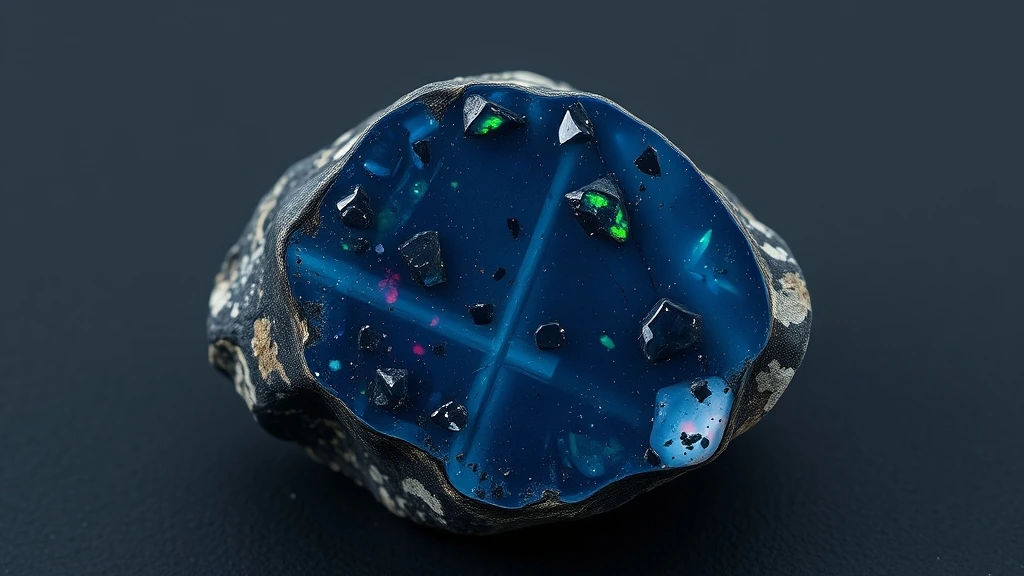
Black opal belongs to the Mineraloid (Hydrated Silica) group, distinguishing it from crystalline minerals due to its lack of long-range atomic order. It forms through the precipitation of colloidal silica spheres within porous host rocks, creating a disordered lattice. Unlike quartz, this material lacks a repeating crystal lattice, classifying it strictly as a mineraloid. Its geological origin is tied to ancient hydrothermal activity, where silica-rich fluids infiltrated sedimentary basins. Over millions of years, these fluids solidified into the distinctive amorphous structure that defines the gemstone.
What is Black Opal? Geological Overview & Definition
Black opal is defined by its dark body tone, which ranges from deep charcoal to jet black. This dark background is crucial because it provides high contrast, making the play-of-color appear more vibrant and intense. The stone forms in specific geological environments, primarily in the Cretaceous and Jurassic sedimentary basins of Australia. These unique conditions allow for the preservation of the delicate silica sphere structure that generates optical phenomena. In comparative mineralogical collections, practitioners and geologists frequently study Ethiopian Welo Opal alongside this crystal to appreciate their subtle energetic and structural differences.
The term “black” refers strictly to the body color, not the presence of black minerals. The stone is actually a translucent to opaque aggregate of microscopic silica spheres. This amorphous structure scatters light in multiple directions, creating the characteristic iridescent flashes. Understanding this distinction is vital for accurate gemological identification and valuation. The dark tone is a result of trace impurities and the density of the silica matrix. In comparative mineralogical collections, practitioners and geologists frequently study Dragon Stone alongside this crystal to appreciate their subtle energetic and structural differences.
Black Opal Chemical Composition & Crystallographic Properties
The fundamental composition of black opal is hydrated silicon dioxide, represented by the formula SiO₂·nH₂O. It is an amorphous mineraloid, meaning it lacks a defined crystal system or lattice structure. Unlike crystalline minerals, its atoms are arranged in a disordered, glass-like matrix. This structural absence prevents the formation of distinct crystal faces or cleavage planes. In comparative mineralogical collections, practitioners and geologists frequently study Crazy Lace Agate alongside this crystal to appreciate their subtle energetic and structural differences.
The optical properties arise from the ordered packing of silica spheres within the amorphous matrix. These spheres are arranged in a three-dimensional array that diffracts light, producing the play-of-color. The size and spacing of these spheres determine the specific wavelengths of light scattered. This mechanism is distinct from the electronic transitions found in crystalline gemstones.
Black opal is chemically sensitive to acids and alkaline solutions, which can degrade the silica structure. It is also susceptible to dehydration under high heat or low humidity conditions. This thermal instability can cause the stone to crack or lose its luster permanently. Proper storage in a humid environment is essential to maintain its structural integrity and optical performance.
The refractive index ranges from 1.370 to 1.470, reflecting its variable density and water content. The density typically falls between 1.98 and 2.25 g/cm³, depending on the degree of hydration. These physical properties are critical for distinguishing natural black opal from synthetic imitations. Precise measurement of these parameters ensures accurate identification in gemological laboratories.
| Property | Specification |
|---|---|
| Mineral Group | Mineraloid (Hydrated Silica) |
| Chemical Formula | SiO₂·nH₂O (Hydrated Silicon Dioxide) |
| Mohs Hardness | 5.5 – 6.5 |
| Crystal System | Amorphous (Hydrated silica spheres / Mineraloid) |
| Specific Gravity (Density) | 1.98 – 2.25 |
| Refractive Index | 1.370 – 1.470 |
| Color & Optical Properties | Natural Black Opal color spectrum and optical dispersion |
| Primary Mining Localities | Australia (Coober Pedy, Lightning Ridge), Ethiopia (Welo), Mexico |
| Water & Chemical Resistance | Moderate/Sensitive (%3-%21 water content; avoid prolonged soaking for hydrophane Welo opals) |
| Chakra Alignment (Traditional) | Crown Chakra and Heart Chakra |
| Zodiac Affinity (Traditional) | Libra, Scorpio, Pisces |
| Symbolic Meaning (Traditional) | Creativity, hope, emotional depth, and spontaneous inspiration |
Black Opal Varieties & Color Spectrum
Banded Black Opal
Formed in silica‑rich, water‑logged sandstones of ancient lake beds, banded black opal displays parallel strata of dark matrix intersected by vivid, rainbow‑colored layers. The bands arise from periodic fluctuations in silica concentration during deposition, creating a “play‑of‑color” that shifts with viewing angle. This variety is relatively common in Australian mines but prized for its consistent, wide‑ranging chromatic bands.
Split‑Face Black Opal
The split‑face form exhibits a sharp, planar fracture that reveals a dark, almost coal‑black background on one side while the opposite side dazzles with iridescent flashes of red, blue, and green. This optical effect results from tightly packed silica spheres that diffract light at the fracture plane, enhancing the gemstone’s depth perception. Split‑face opals are rarer than banded types, often commanding higher market values due to their dramatic visual contrast.
Harlequin Black Opal
Named for its jester‑like mosaic of color, harlequin black opal contains irregular, multicolored patches that appear to dance across a deep black field. The pattern emerges from localized pockets of silica spheres of varying size, each diffracting a different wavelength of light. Harlequins are among the most sought‑after specimens, especially when the color patches include vivid reds and blues, making them scarce and highly collectible.
Fire‑Streak Black Opal
Distinct for thin, luminous streaks of orange‑red fire that cut across a dark matrix, fire‑streak black opal forms when silica spheres align in linear arrays during slow sedimentation. These streaks are intensified by minute iron oxide inclusions that act as chromophores, amplifying the warm hues. The rarity of well‑defined fire streaks makes this variety a favorite among connoisseurs seeking dramatic, high‑contrast pieces.
Lightning‑Bolt Black Opal (Lightning Opal)
The lightning‑bolt variety showcases a single, bold, lightning‑shaped flash of color—often electric blue or vivid green—radiating from a dark background. This phenomenon is produced by a concentrated channel of larger silica spheres that focus light into a narrow, intense beam. Lightning opals are exceptionally rare, with only a few documented finds per mining season, and they command premium prices at auction.
Red‑Black Opal (Australian “Red‑Black”)
Predominantly mined in Queensland’s Coober Pedy region, red‑black opal features a dominant deep red hue that overlays a black base, creating a dramatic, almost blood‑like appearance. The red coloration is due to high concentrations of iron and manganese within the silica matrix, which absorb shorter wavelengths and enhance longer, red wavelengths. This regional trade name is highly valued for its intense, uniform color field, making it one of the most coveted black opal types worldwide.
Where is Black Opal Found? Geological Mining & Extraction
Black opal occurs chiefly within silica‑saturated, volcanic ash‑derived sediments that have undergone extensive diagenesis in arid, ancient lake basins. The host rocks are typically fine‑grained sandstones and mudstones where groundwater leached silica from volcanic glass, precipitating microscopic spheres that later formed the opal’s amorphous structure.
The premier extraction zones lie in Australia’s Lightning Ridge, Coober Pedy, and White Cliffs districts, where miners employ both open‑pit and underground techniques to follow the opal‑bearing horizons. Small‑scale artisanal shafts and mechanized tunneling intersect the opal seams, and careful water management is essential to preserve the delicate hydrated silica during removal and processing.
Historical Significance & Cultural Lore of Black Opal
Indigenous Australian peoples revered black opal as a spiritual conduit, embedding it in ceremonial pendants and trade items that symbolized protection and insight. Early European settlers recorded opal exchanges with Aboriginal groups as early as the 1850s, noting the stone’s reputed ability to amplify intuition and connect wearers to the Crown Chakra.
In the late 19th century, black opal entered Western fashion, inspiring Art Nouveau jewelry that celebrated its play‑of‑color as a metaphor for emotional depth and spontaneous inspiration. Folklore from the mining towns claimed that a black opal found in a thunderstorm foretold sudden wealth, reinforcing its mystic reputation and cementing its status as a gemstone of both artistic and esoteric significance.
Modern Uses & Jewelry Applications of Black Opal
Lapidaries primarily cut black opal into cabochons to maximize the display of its vibrant play-of-color, as faceting often diminishes the optical phenomenon. The stone’s relatively low Mohs hardness of 5.5 to 6.5 necessitates careful handling during polishing to prevent chipping or surface abrasion. Designers frequently set these gems in protective bezels to shield the delicate dome from accidental impacts.
- Cabochon Cutting: The standard method for preserving the full spectrum of iridescent flashes.
- Protective Settings: Bezel or halo settings are preferred to minimize exposure to mechanical stress.
- Ornamental Carving: Rarely used for intricate carving due to the stone’s brittleness and value.
Metaphysical Properties & Traditional Meaning of Black Opal
According to historical traditions and metaphysical lore, black opal is revered as a stone of profound emotional depth and creative awakening. Practitioners believe it acts as a catalyst for spontaneous inspiration, helping individuals navigate complex emotional landscapes with clarity. The dark body tone is thought to ground the wearer while the flashing colors stimulate the mind.
This gemstone is traditionally associated with creativity and hope, offering a sense of balance during periods of transition. It is said to enhance intuition and foster a deeper connection to one’s inner self. The interplay of darkness and light symbolizes the integration of shadow and spirit in personal growth.
Which Chakra and Zodiac Signs Align with Black Opal?
In esoteric practice, black opal is energetically aligned with the Crown Chakra and the Heart Chakra. This dual alignment suggests a bridge between spiritual insight and emotional compassion, facilitating a holistic understanding of life experiences. The stone is believed to open channels for higher consciousness while nurturing the heart’s capacity for empathy.
Astrologically, the gemstone resonates most strongly with Libra, Scorpio, and Pisces. These water and air signs are thought to benefit from the opal’s ability to balance emotional intensity with intellectual clarity. The stone is considered particularly supportive for individuals seeking harmony in relationships and creative expression.
How to Identify Real vs. Fake Black Opal
Artificial imitations of black opal are common and often crafted from synthetic glass or dyed quartz to mimic the natural play-of-color. These replicas may appear visually similar to the untrained eye but lack the unique structural integrity of natural hydrated silica. Identifying these fakes requires attention to subtle optical and physical characteristics that distinguish genuine mineraloids from manufactured substitutes.
Practical At-Home Authenticity Tests
- Temperature Test (Thermal Feel): Hold the stone in your palm for several seconds; genuine opal typically feels cooler to the touch than plastic or glass imitations due to its lower thermal conductivity.
- Specific Gravity & Weight Test: Compare the weight of the stone against a similarly sized piece of glass; natural opal has a density of 1.98 to 2.25, which may feel slightly lighter or heavier depending on the specific imitation material.
- Scratch & Hardness Test (Mohs Comparison): Gently rub the stone against a steel knife blade; genuine opal (Mohs 5.5-6.5) should not leave a mark on the steel, whereas softer imitations might.
- Microscopic & Loupe Inspection (Internal Inclusions): Examine the stone under a 10x loupe for curved, bubble-like inclusions common in glass; natural opal often displays a distinctive “dust” or honeycomb pattern without gas bubbles.
Black Opal Valuation Factors, Grading & Pricing
The primary driver of market value is Color Saturation, which dictates the stone’s visual vibrancy. High-grade specimens exhibit intense, flashing hues of red, orange, and green against the dark body tone. This natural energetic luster creates a dynamic interplay that captivates collectors and investors alike.
Crystal Size & Weight (Grams) significantly influences the final retail price of the gemstone. Larger, well-polished pieces command higher premiums due to the rarity of substantial, crack-free material. Natural matrix inclusions are also evaluated, as they add unique character without diminishing the stone’s structural integrity.
Ethical Sourcing & Locality Premium plays a crucial role in the holistic and collector markets. Stones from renowned Australian deposits, such as Lightning Ridge, often carry a significant price advantage. Buyers increasingly prioritize provenance, ensuring that their acquisitions support sustainable mining practices and fair labor standards.
How to Clean and Care for Black Opal
Black opal is a hydrated silica mineral that contains 3% to 21% water within its internal structure. This moisture content makes the stone highly sensitive to rapid temperature and humidity changes. Consequently, Ultrasonic cleaners and steam must be strictly avoided to prevent internal stress fractures.
To maintain the stone’s integrity, gently dust the surface using a completely dry, soft microfiber cloth. Avoid any liquid soaps, damp cloths, or water soaking, as these can penetrate the porous matrix. Store the gem in a low-humidity environment away from direct heat sources to preserve its natural stability.
Cleansing and Recharging Black Opal (Energetic Care)
For holistic energetic maintenance, practitioners often employ herbal smudging to clear perceived negative energies. This dry method involves wafting smoke from sage or palo santo near the stone without direct contact. It is essential to keep the environment cool and stable during this process to protect the delicate silica spheres.
Alternatively, placing the black opal on a selenite charging slab allows for gentle, passive recharging. This method leverages the selenite’s natural properties without exposing the opal to intense heat or light. Always ensure the stone remains in a shaded, temperature-controlled area to prevent dehydration and cracking.
Frequently Asked Questions About Black Opal
How should I care for a black opal jewelry piece?
Clean it with a dry microfiber cloth or a soft brush only. Black opal contains 3‑21 % water, making it moderately water‑sensitive; prolonged soaking or exposure to rain can cause surface clouding. Store it in a padded box away from humidity and avoid sudden temperature changes.
Can I wear black opal in the shower or while swimming?
No, avoid water exposure altogether. The internal water content makes black opal prone to crazing if it absorbs moisture, especially in warm or chlorinated environments. Even brief immersion can weaken the stone’s delicate silica spheres, leading to permanent loss of brilliance.
Is ultrasonic cleaning safe for black opal?
Never use ultrasonic or steam cleaners on black opal. The high‑frequency vibrations create micro‑fractures within the hydrated silica matrix, resulting in irreversible crazing. Manual dusting with a soft, lint‑free cloth is the only recommended cleaning method.
What is the chemical composition of black opal?
It is hydrated silicon dioxide, expressed as SiO₂·nH₂O. The water molecules are trapped between microscopic silica spheres, giving the stone its characteristic play of color. This structure classifies black opal as an amorphous mineraloid, not a true crystal.
Which zodiac signs are most associated with black opal?
Libra, Scorpio, and Pisces are the traditional astrological matches. These signs are believed to resonate with the stone’s emotional depth and spontaneous inspiration, enhancing creativity and hope for those born under them.
Which chakras does black opal align with?
It is linked to the Crown Chakra and the Heart Chakra. Activation of these energy centers is said to promote spiritual insight and emotional balance, supporting the wearer’s quest for higher consciousness and compassionate love.
How hard is black opal compared to other gemstones?
Its Mohs hardness ranges from 5.5 to 6.5. This places black opal between fluorite and quartz, meaning it can be scratched by harder materials like diamonds or sapphires. Handle it gently and avoid contact with abrasive surfaces.
What is the typical density of black opal and why does it matter?
Black opal’s specific gravity falls between 1.98 and 2.25. This relatively low density reflects the high water content within the stone, influencing its buoyancy and making it lighter than many other gemstones. Understanding density helps in accurate gem identification and appraisal.