
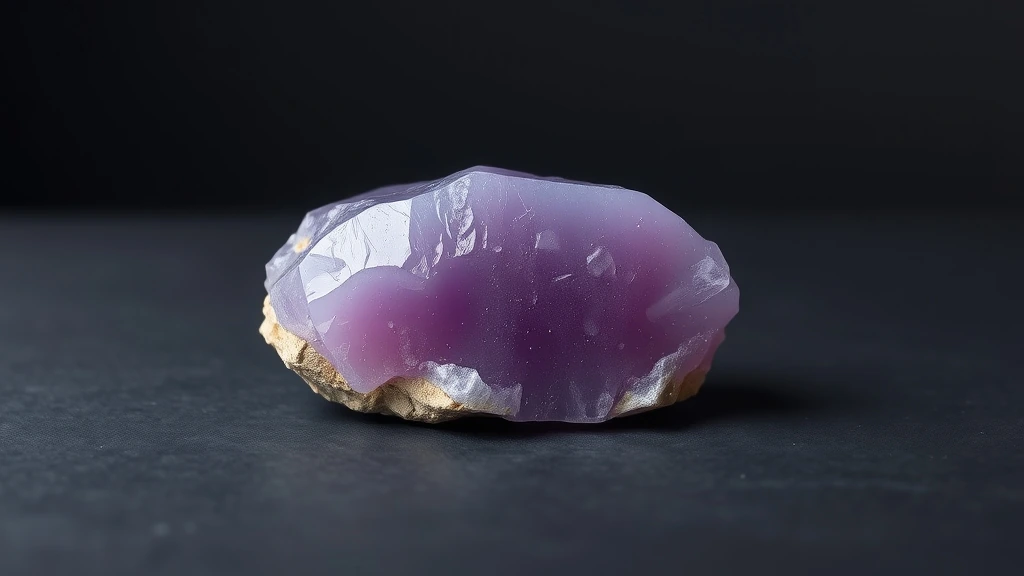
Purple chalcedony belongs to the extensive quartz mineral group, specifically classified as a cryptocrystalline silica aggregate. It forms within hydrothermal veins and cavities in igneous and metamorphic rocks. As a natural mineral crystal, it lacks the large, visible facets of macrocrystalline quartz. Instead, it consists of tightly interlocked microscopic fibers that create a smooth, waxy luster. This geological formation process results in a stone that is chemically consistent with SiO₂ yet visually distinct due to trace impurities and structural defects.
What is Purple Chalcedony? Geological Overview & Definition
Purple chalcedony is a microcrystalline quartz variety characterized by its fine-grained, interlocking fibrous structure. Unlike macrocrystalline quartz, it does not display visible crystal faces to the naked eye. The stone typically forms in geodes, veins, and nodules within volcanic and sedimentary host rocks. This geological setting allows for slow, steady precipitation of silica-rich solutions over millions of years.
The distinctive purple coloration arises from trace elements or structural defects within the silica lattice. The purple hue in chalcedony is primarily caused by irradiation‑induced color centers involving Fe³⁺ charge‑transfer complexes (and related structural defects) within the silica lattice, rather than manganese or iron impurities alone. The stone often exhibits a waxy luster and high translucency, allowing light to penetrate the dense matrix. Its physical properties make it highly valued for carvings, beads, and cabochon cuts in lapidary arts.
Purple Chalcedony Chemical Composition & Crystallographic Properties
The fundamental chemical composition of purple chalcedony is silicon dioxide (SiO₂), identical to all quartz varieties. It crystallizes in the trigonal crystal system, reflecting the underlying atomic arrangement of the silica tetrahedra. The lattice structure consists of a three-dimensional network where silicon atoms are covalently bonded to oxygen atoms. This robust bonding framework contributes to the stone’s exceptional chemical stability and resistance to weathering.
Cation substitution is minimal in pure chalcedony, as the silica lattice is highly saturated. Any color variation is primarily due to chromophore color centers or minute inclusions rather than major element replacement. The stone is chemically inert to most acids, though strong alkalis can slowly attack the silica structure. This acid sensitivity is low, making it safe for standard jewelry cleaning and storage environments.
Thermal behavior of purple chalcedony is stable under normal ambient conditions, but extreme heat can cause fracturing. The stone does not undergo phase transitions at standard jewelry temperatures, preserving its structural integrity. However, rapid temperature changes may induce thermal shock, leading to internal cracks. Proper handling ensures the preservation of its delicate fibrous texture and vibrant coloration over time.
| Property | Specification |
|---|---|
| Mineral Group | Natural Mineral / Crystal |
| Chemical Formula | SiO₂ |
| Mohs Hardness | 6.5 – 7.0 |
| Crystal System | Trigonal |
| Specific Gravity (Density) | 2.60 – 2.65 |
| Refractive Index | 1.530 – 1.543 |
| Color & Optical Properties | Natural Purple Chalcedony color spectrum and optical dispersion |
| Primary Mining Localities | Global primary localities |
| Water & Chemical Resistance | High (Safe for gentle water washing) |
| Chakra Alignment (Traditional) | Crown Chakra (Sahasrara) |
| Zodiac Affinity (Traditional) | Cancer, Pisces |
| Symbolic Meaning (Traditional) | Creativity, motivation and self-confidence |
Purple Chalcedony Varieties & Color Spectrum
Purple Chalcedony displays distinct mineralogical characteristics across its geological varieties and structural habits. Gemologists evaluate these natural varieties based on crystal habit, trace chromophore concentrations, and visual luster.
Primary Natural Purple Chalcedony
The benchmark natural variety exhibiting diagnostic color saturation and classic crystallographic symmetry.
Distinct Geological Morphs of Purple Chalcedony
Secondary regional and structural varieties formed under localized geological temperature and pressure conditions.
Amethyst‑Tinted Chalcedony
Formed in silica‑rich volcanic tuffs, this variety acquires its soft violet hue from trace manganese and iron impurities during low‑temperature hydrothermal alteration. Microscopic cryptocrystalline fibers give a waxy luster, while occasional rutile needles produce a subtle asterism. It is moderately rare, chiefly sourced from Brazil’s Minas Gerais region and the western United States.
Lavender Chalcedony
Lavender chalcedony develops in sedimentary basins where silica precipitates from alkaline lake waters, incorporating minute amounts of chromium that shift the color toward a pastel purple. The stone exhibits a uniform, milky translucency with occasional fluid inclusions that appear as tiny bubbles. High‑grade material is limited to deposits in Madagascar and the Czech Republic, making it a collector’s favorite.
Imperial Purple Chalcedony
This deep‑violet form originates in metamorphic schists where intense pressure drives cobalt and nickel into the silica lattice, producing a saturated royal hue. Its surface often shows a faint chatoyancy due to aligned micro‑fibers, and it may contain thin calcite veins that enhance contrast. Imperial purple chalcedony is exceptionally scarce, with notable occurrences only in the Ural Mountains of Russia and a few pockets in Kazakhstan.
Orchid‑Shade Chalcedony
Found in basaltic lava flows that have undergone secondary silica enrichment, orchid‑shade chalcedony displays a vivid, slightly pinkish purple caused by vanadium traces. The stone’s characteristic banded pattern arises from rhythmic growth layers, and occasional mica flakes add a subtle sparkle. Commercially viable deposits are limited to the Philippines and northern India, where artisanal miners extract it by hand.
Violet‑Band Chalcedony
Violet‑band chalcedony forms in alluvial gravels derived from eroded siliceous host rocks, where alternating layers of pure chalcedony and impurity‑rich silica create striking parallel bands. The bands range from pale lilac to deep plum, each accentuated by refraction of light along the laminae. This variety is primarily traded from the United States’ Pacific Northwest, where placer mining yields gem‑quality specimens.
Where is Purple Chalcedony Found? Geological Mining & Extraction
Purple chalcedony commonly occurs within silica‑saturated veins that intersect volcanic tuffs, basaltic flows, and low‑grade metamorphic schists. The mineral precipitates from silica‑rich hydrothermal fluids at temperatures between 150 °C and 250 °C, often filling fractures and creating cryptocrystalline aggregates that are later liberated by careful blasting or hand‑picking.
Major extraction zones include Brazil’s Minas Gerais, the Ural‑Kazakh border, and the basaltic terrains of the Philippines and northern India. In these locales, miners employ a combination of small‑scale open‑pit methods and selective panning to separate the fine chalcedony nodules from surrounding matrix, preserving the delicate color zoning that defines each variety.
Historical Significance & Cultural Lore of Purple Chalcedony
Across ancient lapidary traditions, purple chalcedony was prized for its regal hue and associated with the Crown Chakra, believed to enhance creativity and self‑confidence. In Greco‑Roman jewelry, it adorned signet rings and cameos, while Egyptian amulets fashioned from the stone were buried with pharaohs to ensure a dignified afterlife.
Vedic texts describe a violet chalcedony talisman as a conduit for divine inspiration, and Chinese imperial courts prized it for its subtle elegance in ornamental hairpins. Throughout early archaeological records, the stone appears in burial caches and temple altars, underscoring its enduring symbolic power across continents.
Modern Uses & Jewelry Applications of Purple Chalcedony
Purple chalcedony is prized for its subtle translucency and gentle hue, making it a versatile choice for contemporary jewelry. Skilled lapidaries cut the stone into smooth cabochons that accentuate its natural luster, or facet it to create delicate, prism‑like brilliance. The material’s moderate hardness (6.5–7.0 on the Mohs scale) allows for intricate ornamental carving in pendants, rings, and cufflinks.
- Cabochon beads for stackable bracelets
- Faceted earrings with subtle sparkle
- Carved pendants for pendants and brooches
- Decorative inlay in watch dials and architectural accents
Metaphysical Properties & Traditional Meaning of Purple Chalcedony
According to historical traditions and metaphysical lore, purple chalcedony is believed to balance emotional turbulence and foster inner calm. Across ancient Mediterranean and Vedic lapidary traditions, the stone is associated with creativity, motivation, and self‑confidence, encouraging the wearer to pursue personal goals with clarity. Its gentle purple tone is thought to soothe the mind, inviting a peaceful transition from chaos to serenity, and is often used in rituals aimed at enhancing spiritual insight.
Which Chakra and Zodiac Signs Align with Purple Chalcedony?
The stone aligns with the Crown Chakra (Sahasrara), the center of higher consciousness and spiritual connectivity. Its energetic influence is said to expand awareness, inviting a deeper sense of purpose and unity with the cosmos.
The canonical zodiac signs associated with purple chalcedony are Cancer and Pisces. Those born under these signs are believed to resonate strongly with the stone’s calming and intuitive qualities, enhancing emotional depth and empathetic understanding.
How to Identify Real vs. Fake Purple Chalcedony
Authentic purple chalcedony can be mimicked by artificial imitations, synthetic glass, or dyed natural stones. These replicas often lack the subtle internal inclusions and natural color gradations that characterize genuine specimens.
Practical At-Home Authenticity Tests
- Temperature Test (Thermal Feel): Hold the stone in your hand; real chalcedony feels cool to the touch due to its thermal conductivity, whereas glass feels warmer.
- Specific Gravity & Weight Test: Compare the stone’s weight to a known quartz sample of the same size; chalcedony typically has a slightly lower specific gravity (≈2.65) than quartz (≈2.65–2.66).
- Scratch & Hardness Test (Mohs Comparison): Use a steel nail or glass plate; chalcedony should resist scratching, matching its hardness of 6.5–7.0, while glass may show minor scratches.
- Microscopic & Loupe Inspection (Internal Inclusions): Under magnification, real chalcedony displays fine, fibrous inclusions or subtle banding, whereas synthetic replicas often appear uniformly clear or show artificial patterns.
Purple Chalcedony Valuation Factors, Grading & Pricing
The market value of purple chalcedony is first and foremost driven by color saturation. A deep, evenly distributed violet hue with minimal zoning commands higher prices, as it signals superior natural energetic luster and a more vibrant visual presence. Light or uneven coloration reduces desirability, even if other attributes are favorable.
Second, crystal size and weight (grams) play a decisive role. Larger, heavier specimens are prized, especially when they retain a natural matrix that showcases the stone’s internal beauty. Raw, unpolished stones fetch a lower premium than tumbled, polished pieces, but a well‑polished surface can enhance the stone’s tactile appeal and overall marketability.
Finally, ethical sourcing and locality premium influence collector and holistic markets. Stones mined from responsibly managed sites with transparent supply chains command a premium, while provenance from renowned localities—such as the ancient deposits of the Caucasus or the historic mines of the Himalayas—adds a layer of cultural and historical value that collectors actively seek.
How to Clean and Care for Purple Chalcedony
To preserve the integrity of purple chalcedony, gently clean the stone with warm soapy water and a soft cloth. This method removes surface grime without compromising the crystal lattice. Avoid ultrasonic cleaners, as the vibration can induce microfractures in the delicate chalcedony structure. After cleaning, allow the stone to air dry completely before storage.
Cleansing and Recharging Purple Chalcedony (Energetic Care)
For energetic renewal, place the stone in a quiet, shaded area and expose it to gentle moonlight for several hours. This natural light source recharges the chalcedony’s vibrational energy without subjecting it to heat. Alternatively, resting the stone on a selenite charging slab during the night allows subtle electromagnetic interactions to cleanse and amplify its metaphysical properties. Both methods respect the mineral’s structural integrity while supporting its energetic balance.
Frequently Asked Questions About Purple Chalcedony
Purple Chalcedony displays distinct mineralogical characteristics across its geological varieties and structural habits. Gemologists evaluate these natural varieties based on crystal habit, trace chromophore concentrations, and visual luster.
Primary Natural Purple Chalcedony
The benchmark natural variety exhibiting diagnostic color saturation and classic crystallographic symmetry.
Distinct Geological Morphs of Purple Chalcedony
Secondary regional and structural varieties formed under localized geological temperature and pressure conditions.
Is purple chalcedony safe to wear in the shower?
Yes, it is safe for gentle water washing. Purple chalcedony, a form of quartz, is chemically stable and does not dissolve in water. Regular exposure to light rain or shower mist will not damage its surface, though prolonged soaking in harsh detergents can dull its luster.
Can I clean my purple chalcedony with an ultrasonic cleaner?
Avoid ultrasonic cleaners; use warm soapy water and a soft cloth instead. Ultrasonic vibrations can induce microfractures in the crystal structure, leading to surface damage or internal cracking. Gentle cleaning with mild soap preserves the stone’s integrity and brilliance.
Does purple chalcedony have any special care instructions for jewelry?
Store it in a dry, soft pouch and clean it with a damp microfiber cloth. Purple chalcedony is resistant to most chemicals, but prolonged contact with oils or harsh cleaners can stain its surface. Keeping it away from abrasive jewelry settings prevents scratches.
Which zodiac signs are associated with purple chalcedony?
Cancer and Pisces are the aligned zodiac signs. In astrological traditions, these signs resonate with the stone’s calming energy and are believed to enhance intuition and emotional balance for those born under them.
Which chakra does purple chalcedony correspond to?
The Crown Chakra (Sahasrara). This stone is thought to facilitate spiritual connection and higher consciousness, supporting meditation and inner clarity for practitioners.
Is purple chalcedony suitable for use in a hot tub or pool?
It can be exposed to hot tub water, but avoid prolonged soaking. While the stone is water‑resistant, high temperatures and chlorine can gradually affect its surface. Brief exposure is fine, but regular cleaning with a mild soap solution is recommended.
Can I use a soft brush to dust off my purple chalcedony?
Yes, a soft brush is ideal for dusting. A gentle brush removes surface debris without scratching the stone. Avoid abrasive materials that could create micro‑scratches or dull the natural sheen.
Does purple chalcedony react with household cleaners?
It is generally inert to most household cleaners, but avoid acidic solutions. Strong acids or bleach can etch or discolor the stone. Stick to mild, pH‑neutral cleaners and rinse with clean water afterward to maintain its natural polish.