
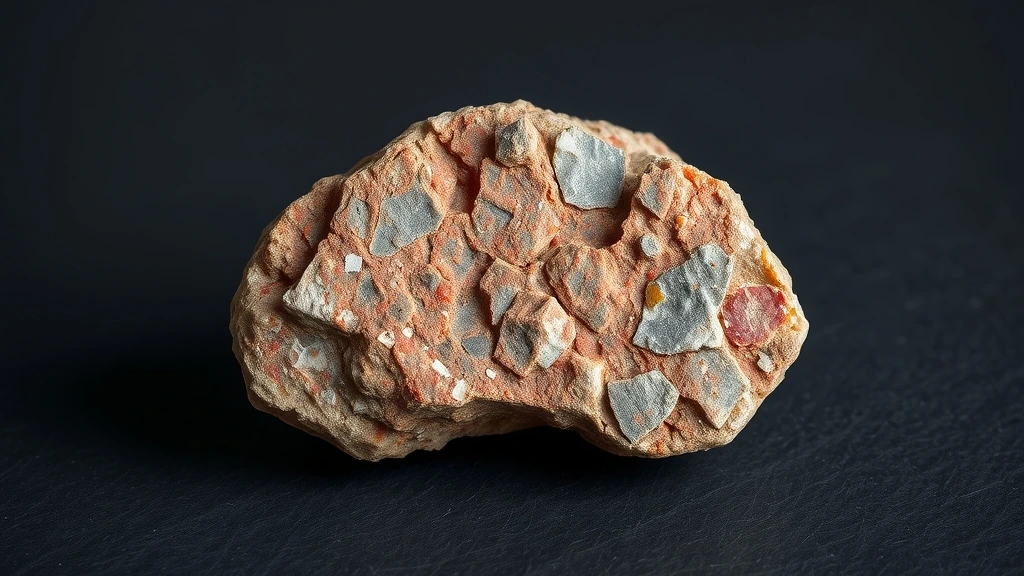
Realgar belongs to the natural mineral family of arsenic sulfides and is classified as a distinct crystal rather than a rock or aggregate. Its occurrence is typically in hydrothermal veins, volcanic fumaroles, and oxidized zones of arsenic‑rich ore deposits. The mineral forms striking tabular or prismatic crystals that often aggregate into radiating clusters, reflecting its monoclinic symmetry. Despite its brilliant color, realgar is chemically unstable, darkening to pararealgar when exposed to light or heat, a transformation that underscores its delicate nature.
What is Realgar? Geological Overview & Definition
Realgar is an arsenic sulfide mineral that crystallizes in the monoclinic system, producing orange‑red crystals that are prized for their vivid coloration. It commonly occurs alongside minerals such as orpiment, native arsenic, and pyrite in oxidized arsenic deposits.
The mineral forms as well‑developed tabular or prismatic crystals, often radiating from a central point, and can also appear as massive, granular aggregates. Its bright hue is due to electronic transitions within the As–S lattice, making it a distinctive indicator of arsenic‑rich geological environments.
Realgar Chemical Composition & Crystallographic Properties
The definitive chemical formula of realgar is As₄S₄, an eight‑atom molecular unit that packs into a monoclinic lattice with space group P2₁/c. The structure consists of paired As₄S₄ molecules linked by weak van der Waals forces, giving the mineral its low hardness and perfect cleavage.
Realgar’s crystal lattice tolerates limited cation substitution, most notably minor incorporation of antimony (Sb) in place of arsenic, which can subtly shift its optical properties. However, the core stoichiometry remains unchanged, preserving the characteristic arsenic‑sulfur framework.
The mineral is highly acid‑sensitive; exposure to dilute acids rapidly dissolves the As–S bonds, releasing arsenic trioxide and sulfide ions. This reactivity necessitates careful handling and storage, especially in laboratory or gem‑cutting contexts.
Color in realgar arises from chromophore color centers created by charge‑transfer transitions between arsenic and sulfur atoms. When heated above ~300 °C or exposed to intense light, these centers reorganize, converting realgar to the yellow‑orange pararealgar polymorph, a process that also alters its refractive indices and density.
| Property | Specification |
|---|---|
| Mineral Group | Natural Mineral / Crystal |
| Chemical Formula | As₄S₄ |
| Mohs Hardness | 1.5–2 |
| Crystal System | Monoclinic |
| Specific Gravity (Density) | 3.56 |
| Refractive Index | n α = 2.538 n β = 2.684 n γ = 2.704 |
| Color & Optical Properties | Natural Realgar color spectrum and optical dispersion |
| Primary Mining Localities | Global primary localities |
| Water & Chemical Resistance | EXTREMELY SENSITIVE: Water Soluble / Moisture Sensitive! (Avoid liquids) |
| Chakra Alignment (Traditional) | Root Chakra, Sacral Chakra |
| Zodiac Affinity (Traditional) | Scorpio, Aries |
| Symbolic Meaning (Traditional) | Protection from negative energy, transformation, and grounding |
Realgar Varieties & Color Spectrum
Realgar exhibits a striking range of hues, primarily driven by trace impurities and oxidation states within its arsenic sulfide lattice. The most prized specimens display a deep, saturated orange-red that commands high value in the gem trade.
Classic Orange Realgar
This variety represents the purest form of the mineral, characterized by its intense vermillion coloration. It typically forms in hydrothermal veins associated with volcanic activity, where rapid cooling preserves its vibrant tone.
Red Realgar
Often confused with cinnabar, this morph displays a deeper, blood-red appearance due to minor iron inclusions. Its crystal habit remains monoclinic, but the color saturation distinguishes it from standard orange specimens.
Yellow-Orange Realgar
This lighter variant results from slight oxidation or the presence of sulfur-rich fluids during formation. It is less common in high-grade gem material but frequently appears in matrix specimens from specific deposits.
Greenish Realgar
A rare morph where trace amounts of nickel or cobalt alter the spectral absorption of the arsenic sulfide structure. These stones are highly sought after by collectors for their unusual chromatic deviation.
Blackened Realgar
This form indicates significant surface oxidation, where the outer layer has converted to orpiment or arsenic trioxide. While visually dull, the interior may still retain the original orange hue if carefully cleaned.
Where is Realgar Found? Geological Mining & Extraction
Realgar predominantly occurs in hydrothermal veins within volcanic and metamorphic rock settings, often alongside orpiment and pyrite. These deposits form at shallow depths where sulfur-rich fluids interact with arsenic-bearing host rocks.
Primary mining regions include the Pyrenees in France and Spain, as well as historical sites in China and Russia. Modern extraction focuses on high-purity veins where the crystal quality allows for faceting rather than bulk industrial processing.
Historical Significance & Cultural Lore of Realgar
Ancient civilizations valued realgar for its potent medicinal and alchemical properties, using it as a purifying agent in various rituals. Archaeological artifacts from Mesopotamia and Egypt reveal its use in pigments and protective amulets.
In Chinese culture, realgar was a critical component in traditional medicine and alchemy, believed to ward off evil spirits. Its historical significance persists in folklore, where it remains a symbol of transformation and spiritual grounding.
Modern Uses & Jewelry Applications of Realgar
Realgar’s vivid orange‑red hue makes it attractive for niche lapidary work, though its extreme softness (Mohs 1.5–2) limits durability. Artisans typically fashion it into cabochon pendants or shallow faceted pieces that showcase its pleochroism without excessive wear. Ornamental carving is also popular for decorative inlays, but designers must seal the stone to mitigate surface oxidation.
- Cabochon pendants set in protective metal bezels
- Shallow facets for brooches and earrings
- Inlay work for ceremonial objects and box lids
- Sealed display pieces for collectors
Safety & Mineral Profile of Realgar
Handling realgar requires gloves and a well‑ventilated workspace because the arsenic sulfide can release toxic dust when cut or polished. The mineral is chemically unstable in humid air, gradually turning to pararealgar and releasing arsenic vapors, so storage in airtight containers is essential. Although historical texts attribute protective and transformational properties, modern gemology stresses that realgar is a collector mineral valued for scientific study and specimen display rather than crystal healing.
Mineralogical Group and Planetary Lore of Realgar
Realgar belongs to the arsenic sulfide group, sharing a structural relationship with pararealgar and orpiment; all crystallize in the monoclinic system with a characteristic layered lattice. In planetary symbolism, realgar has been linked to Mars due to its fiery color and to Mercury for its alchemical association with transformation, though such lore is purely cultural.
Practical At-Home Authenticity Tests
- Temperature Test (Thermal Feel): Realgar feels noticeably cooler to the touch than glass or plastic imitations because of its higher density (3.56 g/cm³).
- Specific Gravity & Weight Test: Weigh the stone and compare to its calculated specific gravity; realgar will feel heavier than synthetic glass of the same size.
- Scratch & Hardness Test (Mohs Comparison): A fingernail or copper coin will easily scratch realgar, whereas many imitations resist such marks.
- Microscopic & Loupe Inspection (Internal Inclusions): Under 10× magnification, realgar shows characteristic layered fracture surfaces and occasional tiny arsenic crystals, unlike the uniform glassy texture of fakes.
Realgar Valuation Factors, Grading & Pricing
Market value hinges primarily on Specimen Aesthetic Quality, which dictates the visual appeal of the mineral. High-grade specimens exhibit vivid orange-red coloration with exceptional luster and transparency. Collectors prioritize crystals that display perfect habit, free from significant inclusions or surface imperfections.
Rarity & Specimen Dimensions (Centimeters/Grams) significantly influence the final price in the collector market. Large, intact crystal clusters measuring several centimeters command premium prices due to their scarcity. The absence of handling damage, such as chipped edges or broken tips, is essential for maintaining high valuation.
Mineralogical Provenance & Locality Value plays a critical role in scientific and museum acquisitions. Specimens from historically significant or geologically unique localities often fetch higher prices. Documented origin adds scientific credibility, enhancing the specimen’s worth for institutional collections.
How to Clean and Care for Realgar
Realgar is extremely sensitive to moisture and can dissolve or degrade upon contact with water. Never wash this mineral with liquid soap, damp cloths, or any aqueous solutions. Ultrasonic cleaning is strictly forbidden as the vibrations and moisture will cause irreversible structural damage.
To maintain the specimen’s integrity, gently dust the surface using a completely dry, soft microfiber cloth. A camel-hair brush is also effective for removing loose dust from intricate crystal formations. Store the mineral in a low-humidity environment, away from direct liquids or high-moisture areas.
Cleansing and Recharging Realgar (Energetic Care)
For holistic maintenance, utilize dry methods that avoid any exposure to moisture or extreme heat. Herbal smudging with sage or palo santo is a safe practice to clear energetic stagnation. Ensure the area is well-ventilated to prevent smoke residue from settling on the delicate crystal surfaces.
Gentle moonlight exposure offers a subtle recharging method without the risk of thermal stress. Alternatively, place the specimen on a selenite charging slab for several hours. These dry techniques preserve the crystal lattice structure while addressing energetic concerns safely.
Frequently Asked Questions About Realgar
Can I wear realgar in the shower?
Absolutely not, as realgar is extremely sensitive to moisture and water. The mineral is chemically unstable in liquid environments and will degrade rapidly upon contact. You must remove the stone before any exposure to steam, rain, or bathwater. Keeping it dry is essential for preserving its structural integrity.
How should I clean my realgar jewelry?
Use only a dry, soft microfiber cloth to gently dust the surface. Never submerge the stone in water or apply liquid soap, as these substances cause immediate chemical damage. Avoid ultrasonic cleaners entirely, as the vibrations and liquid medium are strictly forbidden for this mineral. Dry brushing with a soft hairbrush is also acceptable for loose dust.
Is realgar safe to wear in the rain?
No, you should avoid wearing realgar during rainy weather. The stone’s chemical structure is vulnerable to liquid water, which can lead to surface erosion and discoloration. Moisture sensitivity is a defining characteristic of this arsenic sulfide mineral. Always store it in a dry environment when not in use to prevent irreversible degradation.
What is the Mohs hardness of realgar?
Realgar rates between 1.5 and 2 on the Mohs scale of mineral hardness. This makes it exceptionally soft and prone to scratching from common household materials like dust or metal. Handle the gemstone with extreme care to avoid marring its surface. Its low durability limits its use in rings or bracelets subject to daily impact.
Which zodiac signs align with realgar?
Realgar is traditionally associated with Scorpio and Aries. These signs are believed to resonate with the stone’s intense protective and transformative energies. Wearers often seek its grounding properties to balance their elemental natures. The connection reflects the mineral’s fiery appearance and deep historical significance in astrology.
Which chakras does realgar activate?
Realgar primarily activates the Root Chakra and Sacral Chakra. These energy centers are linked to stability, survival, and creative passion. The stone’s deep red-orange hue visually corresponds to these lower energy points. Practitioners use it to enhance feelings of security and emotional flow within the body.
What is the chemical formula of realgar?
The chemical composition of realgar is As₄S₄, representing arsenic and sulfur. This formula defines its identity as an arsenic sulfide mineral. The specific arrangement of atoms dictates its unique optical and physical properties. Understanding this composition is crucial for identifying genuine specimens versus lookalikes.
Can I use an ultrasonic cleaner on realgar?
Ultrasonic cleaning is strictly forbidden for realgar due to its moisture sensitivity. The combination of liquid medium and high-frequency vibrations will dissolve or permanently damage the stone. Never place this mineral in any liquid-based cleaning device. Stick exclusively to dry cleaning methods to maintain the gemstone’s structural stability.