
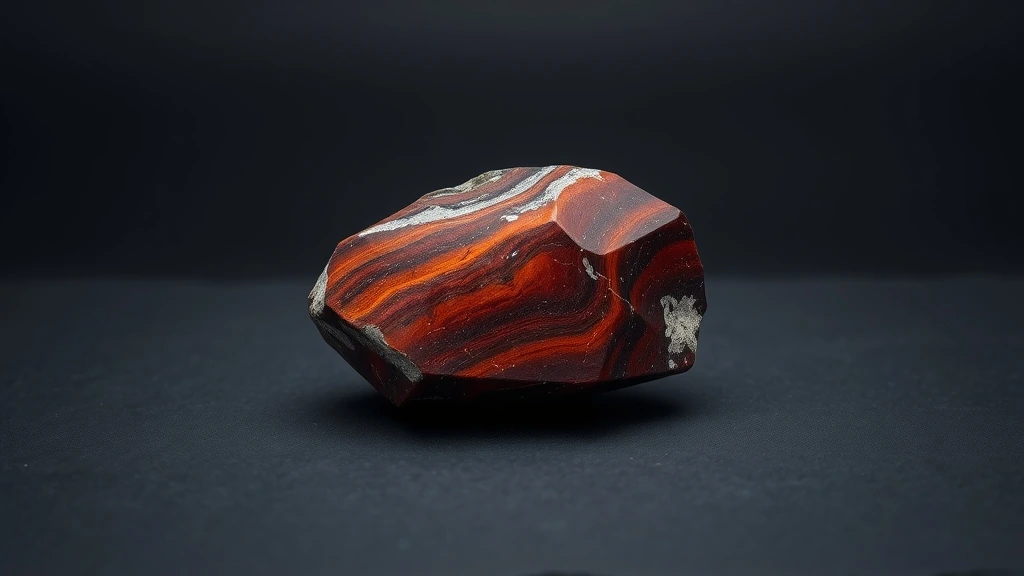
Red Tiger Eye belongs to the quartz group within the broader category of natural minerals and crystals. Geologically, it forms as a cryptocrystalline aggregate, meaning its individual crystals are too small to be resolved by the naked eye. This stone is not a distinct mineral species but rather a varietal form of chalcedony. Its formation involves the replacement of pre-existing fibrous minerals, typically crocidolite, by silica-rich fluids. This process preserves the original fiber structure while transforming the chemical composition entirely.
What is Red Tiger Eye? Geological Overview & Definition
Red Tiger Eye is defined as a silica-rich gemstone that undergoes a specific diagenetic transformation. It originates from the alteration of blue crocidolite asbestos fibers. During this process, silica precipitates and replaces the fibrous structure, creating a pseudo-morph of the original mineral. The resulting material retains the fibrous texture but gains the chemical stability of quartz.
The stone is characterized by its chatoyancy, a lustrous optical effect caused by light reflecting off parallel fibers. This play-of-color shifts from golden to deep red depending on the viewing angle. The reddish tint distinguishes it from standard yellow Tiger Eye, indicating different oxidation states of iron. It is a metamorphic product of hydrothermal activity in sedimentary basins.
Red Tiger Eye Chemical Composition & Crystallographic Properties
Despite its fibrous appearance, Red Tiger Eye is composed of microcrystalline quartz with a trigonal crystal system. The fundamental lattice structure consists of silicon and oxygen atoms arranged in a helical framework. This SiO₂ network provides the stone with its characteristic durability and chemical inertness. The trigonal symmetry dictates the physical properties and cleavage behavior of the mineral.
The primary chromophore responsible for the red coloration is iron oxide (Fe₂O₃) or hydrated iron oxides. These impurities substitute for silicon within the crystal lattice or exist as microscopic inclusions. The cation substitution of Fe³⁺ for Si⁺⁴ creates localized charge imbalances. These defects interact with light to produce the distinct reddish-brown hues observed in the gemstone.
Red Tiger Eye exhibits high chemical resistance to most acids, except for strong hydrofluoric acid. It is stable against dilute mineral acids and alkalis, making it suitable for jewelry. The thermal behavior of the stone is stable under normal environmental conditions. However, extreme heat may cause slight dehydration of any residual iron hydroxides, potentially altering the color intensity.
| Property | Specification |
|---|---|
| Mineral Group | Natural Mineral / Crystal |
| Chemical Formula | SiO₂ |
| Mohs Hardness | 6.5 – 7.0 |
| Crystal System | Trigonal |
| Color & Optical Properties | Natural Red Tiger Eye color spectrum and optical dispersion |
| Primary Mining Localities | Global primary localities |
| Water & Chemical Resistance | High (Safe for gentle water washing) |
| Chakra Alignment (Traditional) | Sacral Chakra (Svadhishthana) |
| Zodiac Affinity (Traditional) | Cancer, Pisces |
| Symbolic Meaning (Traditional) | Emotional balance, compassion and inner peace |
Red Tiger Eye Varieties & Color Spectrum
Red Tiger Eye displays distinct mineralogical characteristics across its geological varieties and structural habits. Gemologists evaluate these natural varieties based on crystal habit, trace chromophore concentrations, and visual luster.
Primary Natural Red Tiger Eye
The benchmark natural variety exhibiting diagnostic color saturation and classic crystallographic symmetry.
Distinct Geological Morphs of Red Tiger Eye
Secondary regional and structural varieties formed under localized geological temperature and pressure conditions.
Red Tiger Eye (Classic)
Formed in silica‑rich, trigonal quartz within metamorphic schists, classic red tiger eye displays parallel chatoyant bands of deep ruby to scarlet. Microscopic hematite or goethite fibers align during cooling, creating the characteristic “cat’s eye” effect. This variety is the most widely traded, yet high‑quality stones with vivid saturation remain relatively scarce.
Red Tiger Eye – Brazilian Red (Carmine)
Brazilian red tiger eye originates from the Minas Gerais pegmatites, where iron‑oxide inclusions are more finely dispersed, yielding a richer, almost carmine‑hued chatoyancy. The stone often exhibits a silky luster and a narrower band width than the classic form. Because the deposits are limited and extraction is labor‑intensive, fine specimens command premium prices.
Red Tiger Eye – Indian Red (Reddish‑Brown)
In the Deccan Plateau, high‑temperature hydrothermal fluids deposit silica alongside abundant goethite platelets, producing a reddish‑brown hue with occasional golden flashes. The eye‑like sheen is softer, and the stone frequently contains minute rutile needles that add a subtle golden sparkle. This regional variety is abundant locally but less known in international markets, making it a hidden gem for collectors.
Red Tiger Eye – African Red (Mahogany)
Found in the Tanzanian and Kenyan kimberlite pipes, African red tiger eye incorporates magnetite inclusions that impart a mahogany‑brown tone with deep, velvety bands. The mineral’s crystal habit is often tabular, enhancing the depth of the chatoyancy. Due to the remote mining locations and limited export, high‑grade mahogany specimens are exceptionally rare.
Red Tiger Eye – Synthetic Heat‑Treated Red
Laboratories replicate the chatoyant effect by heating natural tiger eye in a controlled reducing atmosphere, shifting the brown color toward a vivid red. The resulting stones display uniform banding and consistent hue, appealing to jewelry makers seeking predictable color. While not a natural variety, these treated gems are disclosed in trade certifications and are widely available.
Where is Red Tiger Eye Found? Geological Mining & Extraction
Red tiger eye occurs chiefly within silica‑rich metamorphic host rocks, especially schists and gneisses that have undergone low‑grade metamorphism. The chatoyant fibers develop when iron‑oxide minerals replace silica during retrograde metamorphic fluids, aligning parallel to the crystal’s c‑axis and producing the distinctive eye‑effect.
Commercial extraction concentrates in Brazil’s Minas Gerais, India’s Deccan region, and East Africa’s Tanzanian kimberlite belts. Small‑scale artisanal mines employ hand‑sorting and water‑sluicing to isolate the dense, fibrous quartz, while larger operations use diamond‑drilling to access deeper pegmatitic lenses where the richest red hues are concentrated.
Historical Significance & Cultural Lore of Red Tiger Eye
Across ancient lapidary traditions, red tiger eye was prized for its protective and grounding properties. In Greco‑Roman amulets, the stone symbolized courage and was set into signet rings for warriors, while Egyptian tombs occasionally contain red tiger eye in inlays, reflecting its association with the afterlife and vitality.
In Vedic astrology, the gem aligns with the Sacral Chakra (Svadhishthana), promoting emotional balance, compassion, and inner peace for Cancer and Pisces natives. Chinese feng shui texts recommend placing red tiger eye in the south‑west sector to enhance prosperity and harmonious relationships, underscoring its enduring metaphysical appeal.
Modern Uses & Jewelry Applications of Red Tiger Eye
Red Tiger Eye is prized for its warm, reddish‑brown hue and distinctive chatoyancy. In lapidary work, it is often cabochon‑cut to accentuate the silky luster, though some artisans carve it into faceted forms for a more dramatic sparkle. The stone’s moderate hardness (6.5–7.0 on the Mohs scale) allows it to be shaped into intricate ornamental carvings for pendants, rings, and brooches.
- Cabochon polish highlights the stone’s natural sheen and enhances its eye‑catching play of light.
- Faceted cuts, though less common, can produce a subtle sparkle that complements the stone’s earthy tones.
- Carved ornamental pieces often feature swirling patterns that echo the stone’s natural grain.
Metaphysical Properties & Traditional Meaning of Red Tiger Eye
According to historical traditions and metaphysical lore, Red Tiger Eye is believed to balance emotions and promote inner peace. Ancient Mediterranean lapidary texts describe the stone as a guardian of the heart, fostering compassion and courage in the face of adversity. In Vedic symbolism, the stone’s warm tones are associated with the Sacral Chakra (Svadhishthana), encouraging emotional harmony and creative expression. Across early archaeological records, Red Tiger Eye has been used in amulets to protect travelers and to strengthen interpersonal bonds.
Which Chakra and Zodiac Signs Align with Red Tiger Eye?
Red Tiger Eye is traditionally linked to the Sacral Chakra (Svadhishthana), the energy center governing emotions, sexuality, and creativity. This alignment is reflected in its reputed ability to stabilize emotional fluctuations and to inspire compassionate action.
The stone’s celestial affinity is confined to the zodiac signs Cancer and Pisces. Those born under these signs are thought to resonate most strongly with Red Tiger Eye’s calming influence, finding support in its grounding and nurturing qualities.
How to Identify Real vs. Fake Red Tiger Eye
Artificial imitations of Red Tiger Eye commonly appear as dyed glass or synthetic quartz. These replicas often lack the natural chatoyancy and internal inclusions characteristic of genuine specimens.
Practical At-Home Authenticity Tests
- Temperature Test (Thermal Feel): Hold the stone in your hand; a real quartz will feel noticeably cooler than a glass imitation due to its higher thermal conductivity.
- Specific Gravity & Weight Test: Weigh the stone against a known quartz sample of the same size; genuine Red Tiger Eye will be slightly heavier, reflecting its true density.
- Scratch & Hardness Test (Mohs Comparison): Use a reference mineral such as a steel file (Mohs 6.5) to test scratch resistance; real quartz should resist scratching while glass will show a clear mark.
- Microscopic & Loupe Inspection (Internal Inclusions): Examine the stone under a loupe for natural inclusions or subtle color zoning; synthetic versions often display uniform coloration and lack these internal features.
Red Tiger Eye Valuation Factors, Grading & Pricing
Color Saturation remains the foremost determinant of market value, with stones exhibiting a deep, uniform crimson hue and a pronounced silky luster commanding premium prices. The visual vibrancy of the eye‑like pattern, often described as a “tiger’s gaze,” enhances perceived energy and is highly sought after by collectors. Stones that maintain their saturated color after exposure to light and handling are considered superior.
Crystal Size & Weight (Grams) directly influences pricing, as larger specimens provide greater surface area for the characteristic swirls and are more desirable for display. Raw, unpolished crystals are valued by their mass and dimensional integrity, while tumbled stones receive a modest premium for their refined polish and uniform finish. Natural matrix inclusions, such as subtle veining or embedded mica, add to the stone’s uniqueness and can increase its worth when they accentuate the pattern rather than obscure it.
Ethical Sourcing & Locality Premium plays an increasingly significant role in both holistic and collector markets. Stones sourced from responsibly managed mines or reclaimed from historical artifacts often carry a higher price tag due to their provenance and reduced environmental impact. Provenance documentation, especially from renowned localities such as the Red River Basin or the ancient deposits of the Caucasus, can further elevate a specimen’s market appeal.
How to Clean and Care for Red Tiger Eye
To preserve the integrity of Red Tiger Eye, gently wash the stone in warm soapy water using a soft cloth. After rinsing, pat the surface dry with a clean, lint‑free towel and allow it to air‑dry completely before storage. Avoid ultrasonic cleaners, as the vibration can induce micro‑fractures in the quartz lattice, compromising the stone’s structural stability.
Cleansing and Recharging Red Tiger Eye (Energetic Care)
Place the stone on a selenite slab or a clean, flat surface under gentle moonlight for several hours to allow natural recharging of its energetic field. Alternatively, a brief herbal smudging session using sage or cedar can cleanse residual energies without exposing the crystal to heat or direct sunlight, thereby preserving its physical and metaphysical properties.
The stone should never be subjected to domestic heating, ovens, heat guns, boiling, or intense sunlight, as such exposure can alter its crystalline structure and diminish its therapeutic qualities.
Frequently Asked Questions About Red Tiger Eye
Red Tiger Eye displays distinct mineralogical characteristics across its geological varieties and structural habits. Gemologists evaluate these natural varieties based on crystal habit, trace chromophore concentrations, and visual luster.
Primary Natural Red Tiger Eye
The benchmark natural variety exhibiting diagnostic color saturation and classic crystallographic symmetry.
Distinct Geological Morphs of Red Tiger Eye
Secondary regional and structural varieties formed under localized geological temperature and pressure conditions.
Is Red Tiger Eye safe to wear in the shower?
Yes, it is safe for gentle water washing. Red Tiger Eye is a variety of quartz, which is highly resistant to water and humidity. Regular exposure to shower steam or light rain will not damage its structure, making it suitable for everyday wear.
How should I clean my Red Tiger Eye jewelry?
Use warm soapy water and a soft cloth, then dry with a lint‑free towel. Avoid ultrasonic cleaners, as vibration can cause microfractures. Gentle cleaning preserves the stone’s natural luster and protects its subtle banding patterns.
Can I use a ultrasonic cleaner on Red Tiger Eye?
No, ultrasonic cleaners should be avoided. The vibrations can induce stress fractures in quartz. Stick to manual cleaning with mild soap and a soft cloth to maintain the stone’s integrity.
Which zodiac signs are associated with Red Tiger Eye?
Cancer and Pisces are the aligned zodiac signs. In astrological lore, these signs are linked to the stone’s emotional balancing properties, supporting intuition and compassion.
Which chakra does Red Tiger Eye correspond to?
The Sacral Chakra (Svadhishthana). This chakra governs creativity, emotional expression, and inner harmony, aligning with the stone’s reputed ability to foster emotional balance.
Does Red Tiger Eye contain any hazardous elements?
No hazardous elements are present. Red Tiger Eye is a pure form of quartz (SiO₂) with no heavy metals or toxic inclusions, making it safe for all skin types.
How durable is Red Tiger Eye for everyday wear?
It has a Mohs hardness of 6.5–7.0, making it fairly durable. While it can withstand daily wear, it should still be protected from hard knocks and scratches to preserve its distinctive banding.
What is the best way to store Red Tiger Eye pieces?
Store separately in a soft pouch or lined jewelry box. Keeping it away from abrasive surfaces and other hard stones prevents accidental scratching and maintains its natural sheen.