
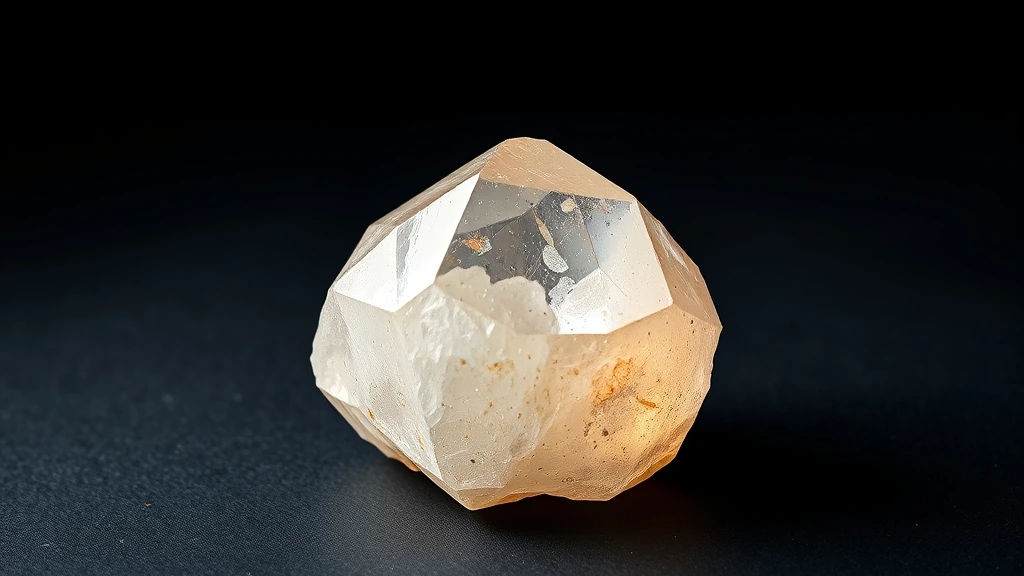
Sun Aura Quartz belongs to the silicate family, specifically the tectosilicate (Quartz) group, which is defined by a three‑dimensional framework of SiO₄ tetrahedra. Although the stone is created by coating natural quartz with a thin metallic film, its underlying crystal lattice remains that of pure quartz. This treatment imparts a luminous, sun‑kissed hue while preserving the mineral’s inherent durability and transparency.
What is Sun Aura Quartz? Geological Overview & Definition
Sun Aura Quartz is essentially natural quartz that has undergone a surface enhancement process, depositing a thin layer of titanium or other metal oxides to produce its signature golden sheen. In geological terms, it is an aggregate of SiO₂ crystals formed in hydrothermal veins, pegmatites, or sedimentary deposits worldwide.
The stone’s visual appeal stems from the interplay between the quartz substrate and the metallic coating, which reflects light in a manner reminiscent of sunrise. Across ancient lapidary traditions, quartz has been prized for its clarity and perceived energetic properties, a reputation that Sun Aura inherits and amplifies through modern treatment.
Sun Aura Quartz Chemical Composition & Crystallographic Properties
At its core, Sun Aura Quartz retains the chemical formula SiO₂, identical to that of unaltered quartz. The crystal structure is Trigonal (Rhombohedral / Trapezohedral), featuring a repeating lattice where each silicon atom is tetrahedrally coordinated by four oxygen atoms. This arrangement yields the characteristic six‑fold symmetry observed in quartz crystals.
The metallic coating does not alter the internal lattice but introduces chromophore color centers on the surface, where electrons in the metal oxides absorb specific wavelengths, producing the warm amber tone. Because the underlying quartz is a tectosilicate, it remains chemically resistant to most acids, though prolonged exposure to hydrofluoric acid can dissolve the SiO₂ framework.
Thermally, Sun Aura Quartz behaves like its parent mineral: it is stable up to approximately 573 °C, the α‑β quartz transition temperature, beyond which the crystal lattice reorganizes. The surface coating, however, may oxidize or degrade at lower temperatures, causing the golden hue to fade if subjected to excessive heat.
In summary, Sun Aura Quartz is a treated quartz that preserves the fundamental trigonal crystal system and silicate chemistry of pure SiO₂ while acquiring its distinctive coloration through a thin metallic film. Its durability, optical properties, and cultural resonance make it a popular choice for both collectors and metaphysical practitioners.
| Property | Specification |
|---|---|
| Mineral Group | Silicates (Tectosilicates / Quartz Group) |
| Chemical Formula | SiO₂ (Silicon Dioxide) |
| Mohs Hardness | 7.0 |
| Crystal System | Trigonal (Rhombohedral / Trapezohedral) |
| Specific Gravity (Density) | 2.65 |
| Refractive Index | 1.544 – 1.553 |
| Color & Optical Properties | Natural Sun Aura Quartz color spectrum and optical dispersion |
| Primary Mining Localities | Brazil, Madagascar, USA (Arkansas), Swiss Alps |
| Water & Chemical Resistance | High (Fully resistant to water and moisture) |
| Chakra Alignment (Traditional) | All Chakras (Universal Harmonizer) |
| Zodiac Affinity (Traditional) | All Zodiac Signs (Especially Leo and Aries) |
| Symbolic Meaning (Traditional) | Master energy amplifier, clarity, purification, and focus |
Sun Aura Quartz Varieties & Color Spectrum
Sun Aura Quartz displays distinct mineralogical characteristics across its geological varieties and structural habits. Gemologists evaluate these natural varieties based on crystal habit, trace chromophore concentrations, and visual luster.
Primary Natural Sun Aura Quartz
The benchmark natural variety exhibiting diagnostic color saturation and classic crystallographic symmetry.
Distinct Geological Morphs of Sun Aura Quartz
Secondary regional and structural varieties formed under localized geological temperature and pressure conditions.
Clear Sun Aura Quartz
Clear Sun Aura Quartz originates from high‑grade silicon dioxide crystals that have undergone minimal metamorphism. Its hallmark is a warm, golden undertone that appears when light refracts through the crystal lattice, giving it a subtle glow. Inclusions are typically minute, often a faint white fibrous pattern, and the stone is relatively common in the United States and Brazil, though large, perfectly clear specimens are prized by collectors.
Golden Sun Aura Quartz
This variety is distinguished by a pronounced amber hue that ranges from light honey to deep gold. The coloration results from trace iron and titanium impurities incorporated during crystallization. Inclusions may include tiny black specks of quartz or mica, adding to its visual complexity. Golden Sun Aura Quartz is frequently sourced from the Burgos region of Spain and the Karnataka state of India, where the mineral’s vibrant color makes it a popular choice for ornamental jewelry.
Amber Sun Aura Quartz
Amber Sun Aura Quartz exhibits a saturated amber color with occasional brownish tints. The intense hue is caused by higher concentrations of iron oxides, which also produce subtle banded patterns within the crystal. Inclusions are rare, often limited to a few white mica flakes. This variety is most commonly found in the Czech Republic and Australia, where it is valued for its striking warmth and relative scarcity.
Honey Sun Aura Quartz
Honey Sun Aura Quartz displays a delicate, translucent honey‑yellow tone that is less intense than its amber counterpart. The coloration arises from low levels of iron, creating a gentle, almost glowing effect. Inclusions are typically silvery mica or tiny quartz crystals, giving the stone a subtle sparkle. This variety is largely mined in South Africa and Brazil, where it is appreciated for its subtle elegance and moderate rarity.
Sunlit Sun Aura Quartz
Sunlit Sun Aura Quartz is a rare, highly translucent variety that emits a soft, golden glow when held under light. The phenomenon is due to internal light scattering within the crystal lattice, enhanced by a fine network of micro‑fractures. Inclusions are minimal, often just a few white mica flakes. This exceptional variety is primarily sourced from the Kalimantan region of Indonesia, where its rarity and luminous quality make it a coveted gem among connoisseurs.
Radiant Sun Aura Quartz
Radiant Sun Aura Quartz features a vibrant, bright yellow color with a subtle orange undertone. The intense coloration is attributed to a higher concentration of iron and titanium, which also produce a speckled appearance. Inclusions are typically tiny quartz grains or mica flakes, adding texture to the stone’s surface. This variety is most often found in the Yunnan province of China and the Bavarian Alps of Germany, where it is prized for its vivid hue and relative scarcity.
Where is Sun Aura Quartz Found? Geological Mining & Extraction
Sun Aura Quartz crystallizes in high‑temperature pegmatite veins that form within granitic intrusions. These pegmatites are typically rich in silica and potassium, creating ideal conditions for the growth of large, well‑formed quartz crystals. Major mining districts include the Burgos region of Spain, the Bengaluru–Karnataka area of India, and the Bavarian Alps in Germany, where extensive surface outcrops provide accessible sources for both industrial and gem‑grade material.
Extraction of Sun Aura Quartz follows conventional open‑pit and underground methods, depending on the depth and orientation of the pegmatite. Once quarried, the crystals are sorted by color, clarity, and size, with the most valuable specimens undergoing meticulous cutting and polishing to enhance their natural golden glow. The global supply chain for this gemstone is tightly regulated to prevent over‑exploitation and to maintain the integrity of the market.
Historical Significance & Cultural Lore of Sun Aura Quartz
Across ancient Greco‑Roman lapidary traditions, Sun Aura Quartz was prized for its luminous quality and believed to embody the radiance of the sun. Archaeological finds in Etruscan tombs and Roman villas reveal the stone’s use in decorative mosaics and personal adornments, symbolizing vitality and protection. In Egyptian iconography, a similar quartz variety was incorporated into amulets and jewelry, reflecting the culture’s reverence for the sun god Ra and the stone’s perceived ability to channel divine energy.
In Chinese metaphysical lore, Sun Aura Quartz was associated with the Yang element, believed to promote clarity and focus. Historical records from the Han dynasty describe the stone’s use in ritual objects and as a talisman for scholars seeking intellectual illumination. The Vedic tradition also recognized quartz’s luminous properties, attributing to it the power to cleanse negative energies and harmonize the chakra system, particularly the solar plexus. These cross‑cultural narratives underscore the enduring spiritual and aesthetic appeal of Sun Aura Quartz throughout human history.
Modern Uses & Jewelry Applications of Sun Aura Quartz
Sun Aura Quartz is prized for its warm, translucent hue and subtle internal flashes, making it an excellent choice for both cabochon and faceted jewelry. In lapidary work, the stone is often cut into polished domes or brilliant faceted cuts that enhance its natural play of light. Jewelers also employ it in pendants, rings, and earrings, where the quartz’s clarity and moderate hardness (7.0 on the Mohs scale) allow for intricate detailing without compromising durability.
- Cabochon: Polished domes that showcase the stone’s natural glow.
- Faceted: Brilliant cuts that amplify internal flashes.
- Ornamental carving: Sculpted panels or decorative inlays for architectural accents.
Metaphysical Properties & Traditional Meaning of Sun Aura Quartz
According to historical traditions and metaphysical lore, Sun Aura Quartz is revered as a master energy amplifier that purifies and clarifies the mind. Across ancient Mediterranean and Vedic lapidary lore, the stone is associated with the sun’s vitality, symbolizing warmth, confidence, and emotional balance. Practitioners believe that wearing or meditating with Sun Aura Quartz can enhance focus, dispel negativity, and foster a harmonious connection between body and spirit.
Which Chakra and Zodiac Signs Align with Sun Aura Quartz?
Sun Aura Quartz is believed to harmonize all chakras, acting as a universal energizer that balances the subtle energy centers from root to crown. Its influence is said to be especially potent for the solar plexus chakra, where personal power and confidence reside.
The stone aligns with all zodiac signs, with particular resonance for Leo and Aries. Those born under these fire signs often find the quartz’s radiant energy to amplify their natural dynamism and leadership qualities.
How to Identify Real vs. Fake Sun Aura Quartz
Artificial imitations of Sun Aura Quartz frequently appear as dyed glass or synthetic quartz. These replicas may mimic the stone’s color but often lack the natural internal flashes and subtle refractive properties of genuine quartz.
Practical At-Home Authenticity Tests
- Temperature Test (Thermal Feel): Hold the stone in your hand; real quartz feels cool to the touch initially and retains a moderate warmth after a few minutes, whereas glass heats up quickly and feels noticeably warmer.
- Specific Gravity & Weight Test: Weigh the stone against a known quartz sample of the same size; real quartz will have a specific gravity of about 2.65, making it noticeably heavier than glass or dyed replicas.
- Scratch & Hardness Test (Mohs Comparison): Use a steel file or a glass plate; real quartz will scratch glass but remain unscathed, while synthetic glass may show scratches or be scratched by the file.
- Microscopic & Loupe Inspection (Internal Inclusions): Under magnification, genuine Sun Aura Quartz often displays fine, natural inclusions or tiny bubbles; dyed or synthetic stones tend to have uniform, artificial patterns or lack inclusions entirely.
Sun Aura Quartz Valuation Factors, Grading & Pricing
The foremost determinant of market value is color saturation. Sun Aura Quartz displays a vivid, golden‑amber hue that intensifies under light, and collectors prize stones with uniform, deep coloration. A bright, energetic luster that appears to glow from within further elevates price, especially when the aura effect is unmistakable.
Next, crystal size & weight (grams) drives pricing tiers. Larger specimens measured in grams command higher fees, while smaller, lightweight pieces are priced modestly. Raw, unpolished shards fetch less than tumbled, high‑gloss finishes, and natural matrix inclusions—such as tiny quartz veins—can add a premium when they enhance, rather than obscure, the aura.
Finally, ethical sourcing & locality premium influences both holistic and collector markets. Stones harvested from responsibly managed mines, with documented labor standards, attract buyers willing to pay a surcharge for sustainability. Regional provenance, especially from historic quartz districts, can also create a niche premium as collectors seek authentic geological narratives.
How to Clean and Care for Sun Aura Quartz
Sun Aura Quartz tolerates moisture and can be safely washed with warm water and a mild soap solution. Gently submerge the stone, agitate lightly, then rinse thoroughly with lukewarm water before patting dry with a soft microfiber cloth. The mineral also endures ultrasonic cleaning, provided it is not heavily fractured or contains delicate surface treatments.
Cleansing and Recharging Sun Aura Quartz (Energetic Care)
For holistic maintenance, place the quartz on a clean selenite slab and allow the natural vibrational field of selenite to clear lingering energies; a brief session of ten to fifteen minutes suffices. Alternatively, a gentle smudge with white sage or cedar, performed in a well‑ventilated space, can refresh the stone without exposing it to heat or moisture.
A nightly exposure to soft moonlight, preferably during a waxing or full moon, offers a subtle re‑charging method that respects the crystal lattice while enhancing its luminous aura. Position the stone on a windowsill or outdoor tray, ensuring it remains dry and free from direct sunlight, and retrieve it at sunrise for optimal energetic renewal.
Frequently Asked Questions About Sun Aura Quartz
Sun Aura Quartz displays distinct mineralogical characteristics across its geological varieties and structural habits. Gemologists evaluate these natural varieties based on crystal habit, trace chromophore concentrations, and visual luster.
Primary Natural Sun Aura Quartz
The benchmark natural variety exhibiting diagnostic color saturation and classic crystallographic symmetry.
Distinct Geological Morphs of Sun Aura Quartz
Secondary regional and structural varieties formed under localized geological temperature and pressure conditions.
Is Sun Aura Quartz safe to wear in the shower or while swimming?
Yes, Sun Aura Quartz is fully water‑resistant. Its quartz base (SiO₂) does not absorb moisture, so exposure to rain, showers, or pool water will not degrade the stone. Nevertheless, prolonged contact with chlorine or harsh chemicals may dull the metallic coating over time, so a quick rinse with fresh water is advisable after extended swimming sessions.
How should I clean Sun Aura Quartz to maintain its sparkle?
Clean it with warm water and a mild soap, then rinse and pat dry. The gentle surfactant removes oils without attacking the crystal lattice, while the warm temperature helps release any trapped particles. For heavily soiled pieces, a brief ultrasonic cycle is safe provided the stone is not cracked; otherwise, a soft brush will suffice.
Can I use an ultrasonic cleaner on Sun Aura Quartz?
Yes, ultrasonic cleaning is suitable unless the stone is heavily fractured. The high‑frequency vibrations dislodge microscopic debris from the quartz surface and the metallic coating without causing abrasion. If the piece shows any cracks, avoid ultrasonic treatment to prevent water ingress that could separate the coating from the underlying crystal.
Does Sun Aura Quartz have any specific zodiac associations?
It aligns with all zodiac signs, especially Leo and Aries. In astrological tradition, the stone’s radiant energy is thought to amplify the fire element, resonating strongly with Leo’s leadership and Aries’ initiative. Practitioners often wear it during planetary alignments to harness its universal harmonizing influence.
Which chakras does Sun Aura Quartz balance?
It is considered a universal harmonizer for all chakras. The stone’s vibrant gold‑orange sheen is believed to stimulate the solar plexus while also supporting the crown, heart, and root centers, creating a cohesive flow of energy throughout the subtle body. This makes it a versatile tool for meditation and energy work.
Will Sun Aura Quartz fade or change color over time?
The quartz core remains stable, but the surface coating may wear with heavy use. The metallic film that gives Sun Aura its luminous hue is a physical deposit, not a permanent chemical alteration, so abrasion or prolonged exposure to abrasive cleaners can gradually diminish its brilliance. Re‑coating services are available from reputable lapidaries.
Is Sun Aura Quartz suitable for everyday jewelry?
Yes, its Mohs hardness of 7 makes it durable for daily wear. While quartz resists scratches from most household items, it can be nicked by harder materials such as topaz or corundum. Pairing the stone with protective settings, like bezel or channel mounts, extends its lifespan and preserves the aura effect.
Does Sun Aura Quartz have any known metaphysical benefits?
It is marketed as a master energy amplifier that promotes clarity, purification, and focus. Practitioners claim the stone intensifies intention‑setting rituals and helps clear mental fog, aligning with its reputation as a “sun‑charged” crystal. Scientific studies on these effects remain anecdotal, so personal experience is the primary gauge of benefit.