
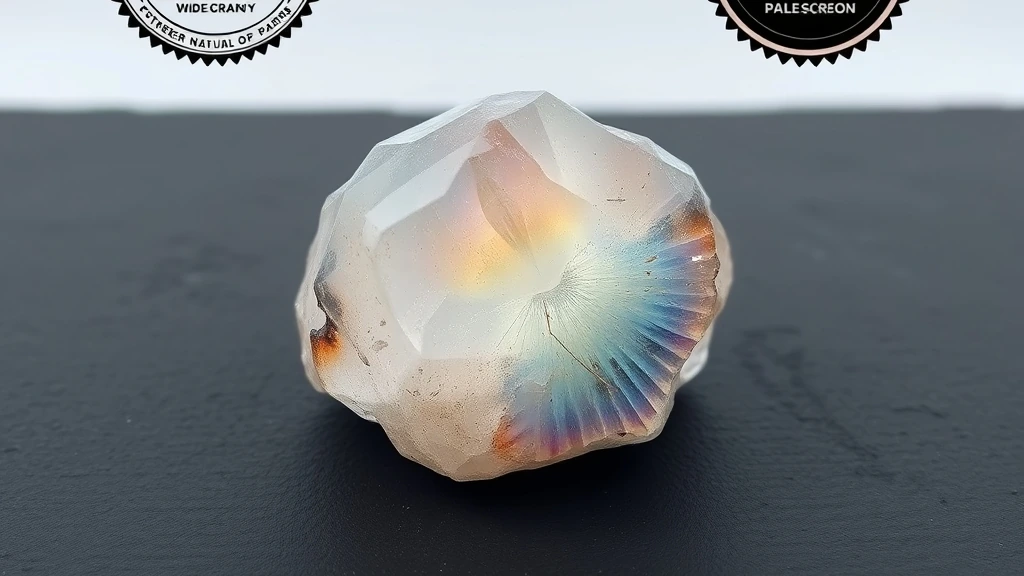
Aura quartz belongs to the tectosilicate subclass of the quartz group, a pervasive component of the Earth’s crust. Although the stone is artificially enhanced, its natural substrate is pure, crystalline quartz that forms in the trigonal (rhombohedral / trapezohedral) crystal system. This mineral crystallizes from hydrothermal solutions in pegmatites, veins, and alluvial deposits worldwide, providing the clear host that later receives its colorful coating.
What is Aura Quartz Gemstone? Geological Overview & Definition
Aura quartz is not a distinct mineral species but a surface‑treated quartz whose appearance is created by bonding a thin metallic film onto the crystal’s facets. The underlying quartz retains its hexagonal‑rhombohedral lattice, while the coating produces interference colors that shift with viewing angle, mimicking natural phenomena such as labradorescence.
In gemological terms, aura quartz is classified as a synthetic‑enhanced gemstone; its base is genuine quartz, yet the iridescent effect is entirely man‑made. Because the treatment does not alter the crystal structure, standard tests for quartz—such as specific gravity (≈2.65) and refractive index (≈1.54–1.55)—remain valid, allowing reliable identification in the field.
Aura Quartz Gemstone Chemical Composition & Crystallographic Properties
The chemical formula of aura quartz remains SiO₂, with no additional cations incorporated into the lattice. Any color observed originates from the metallic vapor deposition applied post‑growth, which creates nanometer‑scale layers that act as chromophore color centers on the crystal surface.
Aura quartz crystallizes in the trigonal (rhombohedral / trapezohedral) system, characterized by threefold rotational symmetry about the c‑axis and a hexagonal lattice that can be described by the space group P3₁21 or P3₂21. The unit cell parameters typically measure a ≈ 4.91 Å and c ≈ 5.40 Å, reflecting the tightly packed tetrahedral network of SiO₄ units.
Because the quartz framework is chemically robust, the stone is resistant to most acids, but prolonged exposure to hydrofluoric acid can dissolve the Si–O bonds. The metallic coating, however, is sensitive to heat; temperatures above ~300 °C can cause delamination or oxidation, permanently altering the iridescent effect.
Thermal expansion of quartz is anisotropic, with the c‑axis expanding slightly more than the a‑axis, a factor that influences the durability of the surface film during heating. Controlled annealing can sometimes improve coating adhesion, but excessive thermal cycling may induce micro‑cracks in the underlying quartz, compromising both clarity and structural integrity.
| Property | Specification |
|---|---|
| Mineral Group | Silicates (Tectosilicates / Quartz Group) |
| Chemical Formula | SiO₂ (Silicon Dioxide) |
| Mohs Hardness | 7.0 |
| Crystal System | Trigonal (Rhombohedral / Trapezohedral) |
| Specific Gravity (Density) | 2.65 |
| Refractive Index | 1.544 – 1.553 |
| Color & Optical Properties | Natural Aura Quartz Gemstone color spectrum and optical dispersion |
| Primary Mining Localities | Brazil, Madagascar, USA (Arkansas), Swiss Alps |
| Water & Chemical Resistance | High (Fully resistant to water and moisture) |
| Chakra Alignment (Traditional) | All Chakras (Universal Harmonizer) |
| Zodiac Affinity (Traditional) | All Zodiac Signs (Especially Leo and Aries) |
| Symbolic Meaning (Traditional) | Master energy amplifier, clarity, purification, and focus |
Quartz Varieties & Comprehensive Sub‑Types
Amethyst
Amethyst forms in hydrothermal veins within granitic pegmatites where iron impurities are irradiated, creating Fe⁴⁺ (FeO₄)⁴⁻ color centers that impart a violet to royal‑purple hue. The crystals grow as well‑developed macrocrystalline prisms, often displaying parallel banding that records subtle changes in temperature and fluid composition. With a Mohs hardness of 7.0, amethyst ranks among the most market‑stable quartz varieties, commanding premium prices for clear, deep‑colored stones used in chakra and third‑eye meditation practices.
Citrine
Citrine’s golden‑yellow to amber tones arise from natural Fe³⁺ inclusions, but most gem‑grade material is produced by heat‑treating amethyst, which converts the violet color centers to yellow. The resulting quartz retains the same trigonal crystal habit, yet often exhibits faint growth zoning that can be seen under magnification. Because naturally occurring citrine is scarce, the trade relies heavily on treated stones, making provenance verification a critical step for reputable dealers.
Rose Quartz
Rose quartz displays a soft pink to rose‑red color caused by microscopic fibrous inclusions of dumortierite‑like borosilicate minerals that scatter light. These inclusions produce a characteristic milky translucency and subtle conchoidal fracture patterns that are prized in ornamental carving. The variety is abundant in Brazil and Madagascar, where large, eye‑clean blocks are mined for the heart‑chakra market, though the most valuable pieces are those with uniform hue and minimal veining.
Smoky Quartz
Smoky quartz ranges from translucent brown to deep black, its color generated by natural radioactive irradiation of aluminum impurity centers within the SiO₂ lattice. The irradiation creates colorless to brown‑gray zones that often follow crystal growth directions, producing a distinctive smoky veil in polished cabochons. Because the coloration is stable and the stone is relatively common, smoky quartz is a staple grounding stone in both commercial jewelry and metaphysical circles.
Rutilated Quartz
Rutilated quartz is a clear rock crystal pierced by acicular rutile (TiO₂) needles that can appear golden, copper‑red, or black, forming striking star‑ray or needle‑cluster patterns. These rutile inclusions develop during slow crystallization in silica‑rich fluids, aligning parallel to the quartz’s c‑axis and creating a dramatic asterism when cut as a cabochon. High‑quality specimens with well‑distributed, clean rutile are highly sought after for both decorative and collector markets.
Strawberry Quartz
Strawberry quartz is a translucent to clear quartz host that contains red or orange specks of lepidocrocite, hematite, or goethite, giving it a “strawberry” appearance. The iron‑oxide inclusions are typically microscopic platelets that settle during crystal growth, producing a subtle flecked pattern visible under magnification. Though less common than other colored quartz, strawberry quartz commands niche interest for its unique aesthetic and is primarily sourced from Brazil and the United States.
Ametrine
Ametrine is a rare, naturally zoned quartz that displays distinct sectors of amethyst (purple) and citrine (golden yellow) within a single crystal lattice. This zoning results from variable iron oxidation states across the growth chamber, preserving both Fe⁴⁺ and Fe³⁺ color centers in separate zones. Almost exclusively mined at the Anahí mine in Bolivia, ametine’s dual‑color effect makes it a collector’s favorite and a high‑value item in the gemstone market.
Prasiolite (Green Quartz)
Prasiolite, or green quartz, is produced by controlled heat treatment of iron‑bearing amethyst, which reduces Fe⁴⁺ centers to Fe²⁺, yielding a translucent leek‑green color. The treatment creates uniform green zones that can be enhanced by additional annealing, resulting in a consistent hue prized for jewelry. While natural green quartz is exceedingly rare, treated prasiolite dominates the market, with major sources in Brazil, the United States, and Madagascar.
Comparative Summary – Gemologists differentiate these quartz varieties primarily by color‑origin mechanisms (irradiation, heat treatment, mineral inclusions) and inclusion morphology (fibrous dumortierite, rutile needles, iron‑oxide specks). Microscopic examination under polarized light reveals the specific color centers or inclusion patterns that define each type, while spectroscopic analysis confirms whether a stone is natural or treated, guiding accurate classification and valuation.
Where is Aura Quartz Gemstone Found? Geological Mining & Extraction
Aura quartz is not a natural mineral but a synthetic coating applied to clear quartz crystals harvested from pegmatitic host rocks worldwide. The base quartz is typically sourced from large, open‑pit mines in Brazil’s Minas Gerais region, as well as from deposits in Madagascar, the United States (Arkansas), and Zambia, where high‑clarity, inclusion‑free crystals are abundant.
The coating process occurs in specialized workshops where the raw quartz is laser‑etched or sandblasted to create a textured surface, then bonded with a resin‑based film infused with metallic pigments that produce the signature iridescent “aura.” After curing, the finished stones are sorted, graded, and shipped to global jewelry markets, with Brazil remaining the primary export hub due to its integrated mining‑coating infrastructure.
Historical Significance & Cultural Lore of Aura Quartz Gemstone
Although aura quartz is a modern invention (first marketed in the 1970s), its visual appeal quickly resonated with the New Age movement, which embraced the stone as a conduit for energy amplification and chakra alignment. Early promotional literature linked the shimmering layers to the ancient concept of a “protective aura,” echoing beliefs found in Egyptian and Hindu traditions that regarded quartz as a spiritual conduit.
Collectors and metaphysical practitioners have since incorporated aura quartz into contemporary rituals, from meditation grids to crystal healing layouts, citing anecdotal reports of heightened intuition and emotional balance. Its popularity endures in modern jewelry, where designers cite the stone’s rainbow‑like sheen as a symbol of unity and transformation.
Modern Uses & Jewelry Applications of Aura Quartz Gemstone
Aura quartz is most often cut as a cabochon to showcase its vibrant, iridescent surface, though skilled lapidaries also produce faceted stones for high‑shine settings. The stone’s relatively low hardness (Mohs 7) allows precise carving without fracturing, making it popular for ornamental pendants, beads, and decorative inlays. Designers favor its ability to diffract light, creating a “rainbow‑halo” effect that enhances contemporary and vintage pieces.
- Cabochon pendants – smooth domes that maximize the internal color play.
- Faceted rings and earrings – brilliant cuts that add sparkle while preserving the aura.
- Ornamental carvings – figurines, wall art, and crystal points for interior design.
Metaphysical Properties & Traditional Meaning of Aura Quartz Gemstone
According to historical traditions and metaphysical lore, aura quartz is regarded as a universal harmonizer, amplifying the wearer’s energy field and promoting emotional balance. It is believed to cleanse negative vibrations, foster inner clarity, and support creative inspiration, making it a favored talisman for meditation and artistic pursuits. The stone’s shimmering aura is said to reflect the soul’s highest aspirations, encouraging confidence and spiritual growth.
Which Chakra and Zodiac Signs Align with Aura Quartz Gemstone?
Aura quartz resonates with all chakras, acting as a conduit that synchronizes the root through the crown, thereby facilitating holistic energy flow. Practitioners describe it as a “bridge stone” that unifies the subtle body, supporting both grounding and transcendence in equal measure.
In astrological tradition, aura quartz aligns with all zodiac signs, with a particular emphasis on Leo and Aries due to their fiery, expressive natures. These signs are thought to benefit most from the stone’s ability to magnify personal power, courage, and leadership qualities, while still offering support to the remaining signs through its all‑encompassing vibrational field.
How to Identify Real vs. Fake Aura Quartz Gemstone
Artificial imitations of aura quartz include synthetic glass, leaded crystal, and dyed quartz that mimic the stone’s colorful sheen but lack its natural internal structure. Synthetic versions are often mass‑produced, exhibiting uniform coloration and an absence of the subtle inclusions typical of genuine material. Recognizing these differences helps collectors avoid costly misidentifications while preserving the integrity of their collections.
Practical At-Home Authenticity Tests
- Temperature Test (Thermal Feel): Real aura quartz feels cool to the touch initially and warms slowly, whereas glass or plastic warms quickly in the hand.
- Specific Gravity & Weight Test: Genuine aura quartz has a specific gravity of ~2.65; a simple water displacement test will reveal a noticeably heavier feel than glass (≈2.4).
- Scratch & Hardness Test (Mohs Comparison): Using a steel file (Mohs 5.5) will leave a faint mark on glass but not on aura quartz, which resists scratching up to Mohs 7.
- Microscopic & Loupe Inspection (Internal Inclusions): Under 10× magnification, natural aura quartz shows fine, wispy inclusions and subtle color zoning, while synthetic glass appears uniformly clear with no internal features.
Aura Quartz Gemstone Valuation Factors, Grading & Pricing
The primary driver of value is Color Saturation, which refers to the intensity of the metallic coating. High-grade specimens exhibit a uniform, vibrant tone without patchy or uneven application. Additionally, optical clarity and luster significantly impact desirability, as a brilliant, glassy finish enhances the stone’s overall visual appeal.
Carat Weight directly influences price, with larger stones commanding exponentially higher premiums due to rarity. Facet symmetry is crucial for maximizing light reflection, ensuring the aura effect appears consistent from all angles. The presence of matrix or internal inclusions can either detract from value or add unique character, depending on market preference.
Geographical Provenance Premium often elevates prices for stones from renowned mining regions with established reputations. Wholesale values typically range from modest sums to significant figures per carat, while retail prices reflect markup and brand prestige. Market trends show steady demand for high-quality, well-finished aura quartz in both jewelry and metaphysical sectors.
How to Clean and Care for Aura Quartz Gemstone
This gemstone is Highly Water Resistant, allowing for safe exposure to moisture without damaging the metallic coating. You can easily clean it using warm water and a mild, non-abrasive soap to remove oils and dirt. Gently rub the surface with a soft cloth or brush, then rinse thoroughly under running water.
The stone is Suitable for Ultrasonic Cleaning, provided it is not heavily fractured or internally stressed. However, always inspect the piece for cracks before placing it in an ultrasonic cleaner to prevent potential damage. Avoid harsh chemicals or abrasive cleaners, as these can degrade the delicate aura finish over time.
Cleansing and Recharging Aura Quartz Gemstone (Energetic Care)
For energetic maintenance, use Smoke Smudging with sage or palo santo to clear stagnant energy. Hold the stone in the smoke for a few minutes while setting your intention. This dry method is safe and effective, ensuring no moisture or heat affects the metallic coating.
Alternatively, place the gemstone on a Selenite Plate or under moonlight overnight to recharge its vibrational properties. These methods leverage natural energies without physical contact or liquid exposure. Regular, gentle recharging helps maintain the stone’s perceived energetic clarity and aesthetic luster.
Frequently Asked Questions About Aura Quartz Gemstone
Is aura quartz safe to wear while swimming or showering?
Yes, aura quartz is fully water‑resistant. Its silica‑based crystal lattice does not absorb moisture, so it can be worn in pools, hot tubs, or under a shower without damage. Routine exposure to water will not dull its iridescent coating, though prolonged contact with harsh chemicals should be avoided.
How should I clean aura quartz to maintain its rainbow sheen?
Clean it with warm water and a mild soap, then rinse and pat dry. The metallic vapor coating that creates the aura effect is stable, so gentle hand washing restores brilliance. For deeper grime, a short ultrasonic cycle is safe unless the stone has visible cracks.
Can I use an ultrasonic cleaner on aura quartz that has minor chips?
Yes, but only if the stone is intact; avoid ultrasonic cleaning on heavily fractured pieces. The high‑frequency vibrations can exacerbate existing fissures in the quartz substrate, potentially causing the coating to flake. Inspect the gem first and limit cleaning time to a few seconds.
Does aura quartz have any specific zodiac associations?
Aura quartz aligns with all zodiac signs, with a special affinity for Leo and Aries. In astrological tradition, its vibrational spectrum is said to amplify confidence and leadership—qualities prized by fire signs—while still offering universal support to every sign.
Which chakras does aura quartz activate or balance?
Aura quartz is considered a universal harmonizer, resonating with all chakras. Its multicolored energy field is believed to clear blockages from the root up through the crown, making it a versatile tool for meditation, energy work, and holistic healing.
Is aura quartz suitable for everyday jewelry, such as rings or bracelets?
Absolutely; its durability and water resistance make it ideal for daily wear. The hardness of quartz (7 on the Mohs scale) resists scratches, and the coating adheres strongly to the crystal surface, allowing the stone to retain its luminous aura under normal wear conditions.
Will exposure to sunlight fade the aura effect on quartz?
No, sunlight does not fade the aura coating; it remains stable under UV exposure. The thin metallic film that produces the rainbow colors is engineered to be UV‑stable, so indoor or outdoor wear will not diminish its visual impact over time.
How does aura quartz differ from natural quartz in terms of metaphysical properties?
Aura quartz combines the grounding qualities of clear quartz with an added layer of energetic amplification. The iridescent coating is said to enhance intuition, emotional balance, and spiritual connectivity, extending the classic clear quartz benefits across a broader spectrum of healing work.