
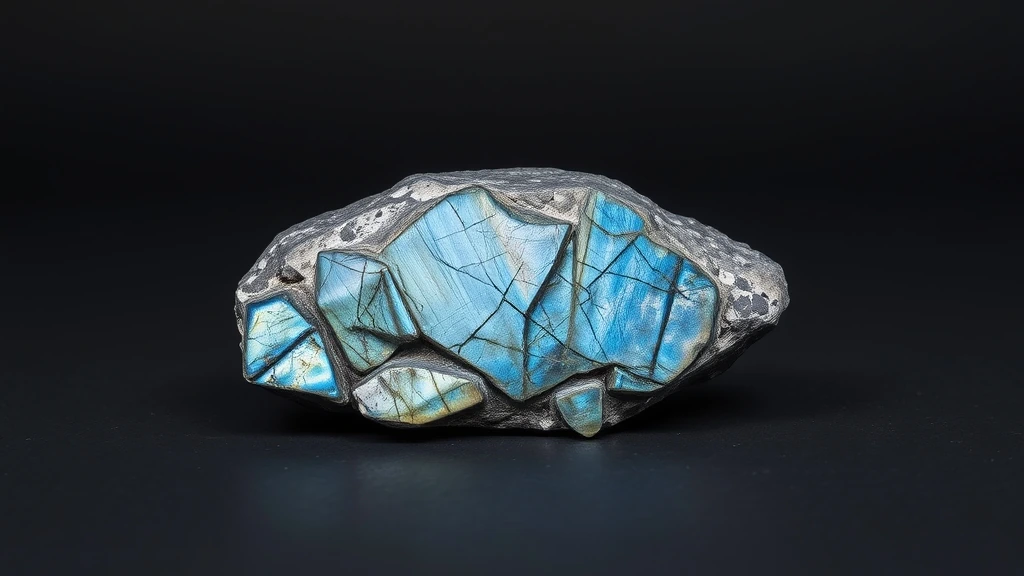
Labradorite belongs to the silicate family, specifically the Plagioclase Feldspar Group, which dominates the continental crust. Formed in slow‑cooling igneous bodies, it crystallizes as tabular lamellar plates that often exhibit a characteristic iridescent play of color known as labradorescence. The stone’s geological story intertwines deep‑earth magmatic processes with surface weathering that reveals its striking optical effects.
What is Labradorite Gemstone? Geological Overview & Definition
Labradorite is a feldspathic mineral that occurs in mafic to intermediate igneous rocks such as basalt, gabbro, and anorthosite. Its name derives from the Labrador Peninsula, where the first notable deposits were discovered in the early 19th century. The mineral’s distinctive labradorescence results from light diffraction within internal lamellae of differing refractive indices.
In gemological contexts, labradorite is prized for its play‑of‑color rather than a single hue, making each stone uniquely expressive. While it is not as hard as quartz, its 6 – 6.5 Mohs rating allows for setting in rings, pendants, and earrings with proper care. The gemstone’s translucency can range from milky to nearly transparent, enhancing its visual depth.
Labradorite Gemstone Chemical Composition & Crystallographic Properties
The idealized chemical formula (Ca,Na)(Al,Si)₄O₈ reflects a solid‑solution series between calcium‑rich anorthite and sodium‑rich albite. Cation substitution of Ca²⁺ ↔ Na⁺ creates subtle variations in lattice parameters, influencing the intensity of labradorescent colors. This substitution is a hallmark of the plagioclase feldspar series and governs the mineral’s density of 2.68 – 2.72 g/cm³.
Labradorite crystallizes in the triclinic crystal system, specifically as pinacoidal or tabular lamellar plates. Its unit cell lacks symmetry axes, resulting in three unequal axes intersecting at oblique angles. This low symmetry permits the formation of internal exsolution lamellae that act as chromophore color centers, scattering light to produce the famed iridescence.
The mineral is acid‑sensitive; exposure to strong acids can leach calcium and alter surface luster. However, mild cleaning with warm, soapy water preserves its optical qualities. Thermal stability is notable: heating above ~400 °C may cause irreversible loss of labradorescence as the lamellar structure recrystallizes.
Understanding these crystallographic and chemical nuances helps gem cutters maximize the stone’s visual performance while ensuring long‑term durability in jewelry applications.
| Property | Specification |
|---|---|
| Mineral Group | Silicates (Plagioclase Feldspar Group) |
| Chemical Formula | (Ca,Na)(Al,Si)₄O₈ (Plagioclase Feldspar) |
| Mohs Hardness | 6.0 – 6.5 |
| Crystal System | Triclinic (Pinacoidal / Tabular lamellar plates) |
| Specific Gravity (Density) | 2.68 – 2.72 |
| Refractive Index | 1.559 – 1.573 |
| Color & Optical Properties | Natural Labradorite Gemstone color spectrum and optical dispersion |
| Primary Mining Localities | Canada (Labrador Peninsula), Madagascar, Finland (Spectrolite), Norway, Australia |
| Water & Chemical Resistance | Moderate (Brief water contact is safe; avoid soaking or thermal shock) |
| Chakra Alignment (Traditional) | Throat and Third Eye Chakra |
| Zodiac Affinity (Traditional) | Sagittarius, Scorpio, Leo |
| Symbolic Meaning (Traditional) | Psychic awakening, auric shielding, inner strength, and transformative intuition |
Labradorite Gemstone Varieties & Color Spectrum
Spectrolite (Finland)
Spectrolite originates from the ancient Precambrian rapakivi granites of the Ylämaa region in Finland. Slow cooling within lamellar plagioclase plates produces a vivid iridescent play‑of‑color ranging from electric blues to vivid greens. The stone is prized for its minimal inclusions and high transparency, making it the most sought‑after commercial variety. Its rarity is amplified by limited mining licenses, driving global prices upward.
Rainforest Labradorite (Madagascar)
Formed in the high‑temperature mafic intrusions of Madagascar’s Ankaratra massif, this variety displays a dominant forest‑green flash interlaced with amber and copper tones. Microscopic titanium‑rich inclusions scatter light, creating a deep, earthy glow that differs from the classic blue‑white sheen. The material is relatively abundant locally but remains scarce on the international market due to export restrictions.
Blue Labradorite (Canada)
Extracted from the igneous complexes of the Canadian Shield, especially near Labrador and Quebec, this stone exhibits a cool, sapphire‑like blue that dominates the labradorescence. The crystal habit is typically tabular, with thin lamellae that amplify the blue hue through interference. While the deposits are extensive, high‑grade, eye‑clean pieces are limited, giving the blue variant a premium status among collectors.
Black Labradorite (Russia)
Found in the Kola Peninsula’s alkaline complexes, Black Labradorite is characterized by a deep charcoal base punctuated by occasional golden flashes. The dark matrix results from higher concentrations of iron‑bearing minerals and occasional magnetite inclusions. This variety is prized for its dramatic contrast and is less common in the gemstone market, often reserved for high‑end jewelry.
Peacock Labradorite (India)
Sourced from the Deccan Traps of central India, Peacock Labradorite showcases a rich peacock‑green iridescence with hints of teal and violet. The formation involves rapid cooling of sodium‑rich plagioclase within basaltic flows, trapping minute gas bubbles that act as light‑diffusing centers. Though the deposits are sizable, the most vivid specimens are scarce, making this variety a niche favorite among designers.
Aurora Labradorite (Australia)
Emerging from the Proterozoic granitic pegmatites of Western Australia, Aurora Labradorite displays a multicolored aurora borealis effect, shifting from pink to orange to violet under angled light. The phenomenon is linked to strain‑induced lattice distortions that alter the stone’s optical path. While the Australian mines produce moderate volumes, the most intense color displays are exceptionally rare, commanding premium prices at auction.
Where is Labradorite Gemstone Found? Geological Mining & Extraction
Labradorite crystallizes chiefly within trigonal to triclinic plagioclase feldspar hosted by mafic to intermediate igneous bodies, especially rapakivi granites and alkaline complexes. The mineral forms as thin, tabular plates that develop in pegmatitic veins where slow cooling allows the characteristic lamellar structure to align, producing the famed labradorescent effect.
Major extraction zones include the Labrador Peninsula (Canada), the Ylämaa region (Finland), the Kola Peninsula (Russia), and the Ankaratra massif (Madagascar). In each locale, miners employ selective hand‑sorting and low‑impact crushing to preserve the delicate lamellae, followed by flotation and hand‑picking to isolate gem‑quality pieces for the global market.
Historical Significance & Cultural Lore of Labradorite Gemstone
Ancient Inuit peoples of Arctic Canada revered labradorite as the “stone of the midnight sun,” embedding it in ceremonial pendants and carving it into tools that symbolized the aurora borealis. Archaeological digs at the L’Anse aux Meadows site have uncovered labradorite beads dating to the 12th century, indicating early trade networks that prized its mystical glow.
In Norse mythology, the stone was believed to protect warriors from the “evil eye,” a belief that migrated to medieval Europe where alchemists recorded its auric shielding properties in illuminated manuscripts. Across the Silk Road, traders marketed labradorite as a talisman for psychic awakening, linking its shimmering play‑of‑color to the activation of the throat and third‑eye chakras.
Modern Uses & Jewelry Applications of Labradorite Gemstone
Lapidaries primarily cut labradorite into smooth cabochons to maximize the visibility of its spectral flash, as faceting often obscures the interference colors. This opaque to translucent feldspar is also carved into ornamental plaques, beads, and inlays for high-end architectural and jewelry applications.
- Cabochon Cutting: The standard practice for showcasing labradorescence, the optical phenomenon where light reflects off internal lamellar structures.
- Faceted Cuts: Occasionally used for transparent varieties, though less common due to the stone’s inherent opacity and internal reflections.
- Ornamental Carving: Utilized in decorative arts, including cameos, architectural veneers, and intricate sculptural pieces.
- Beading & Inlays: Popular in artisan jewelry for creating vibrant, multicolored accents that contrast with precious metals.
Metaphysical Properties & Traditional Meaning of Labradorite Gemstone
According to historical traditions and metaphysical lore, labradorite is revered as a stone of psychic awakening and profound spiritual transformation. Practitioners believe it acts as a powerful auric shield, protecting the wearer from negative energies while enhancing intuitive clarity.
This gemstone is associated with inner strength and the ability to navigate life’s transformative phases with confidence. It is often used in meditation to deepen one’s connection to higher consciousness and to reveal hidden truths within the self.
Which Chakra and Zodiac Signs Align with Labradorite Gemstone?
In chakra theory, labradorite is primarily aligned with the Throat Chakra, promoting clear communication and the authentic expression of one’s creative voice. It also resonates strongly with the Third Eye Chakra, where it is believed to sharpen intuition and enhance psychic perception.
Astrologically, this stone is canonically linked to Sagittarius, Scorpio, and Leo. For Sagittarius, it supports adventurous exploration; for Scorpio, it aids in deep emotional transformation; and for Leo, it amplifies natural charisma and creative expression.
How to Identify Real vs. Fake Labradorite Gemstone
Artificial imitations of labradorite are common, including synthetic glass that mimics the spectral flash and dyed feldspar replicas designed to enhance color intensity. While natural labradorite displays a unique, multi-directional play of color, fakes often show uniform or artificially saturated hues that lack the stone’s natural depth.
Practical At-Home Authenticity Tests
- Temperature Test (Thermal Feel): Hold the stone in your palm for thirty seconds; genuine labradorite feels cool to the touch initially and warms slowly, whereas glass imitations may warm up more rapidly or feel different in thermal conductivity.
- Specific Gravity & Weight Test: Compare the stone’s weight to a similar-sized piece of glass; labradorite has a density of 2.68–2.72, making it slightly heavier than most glass substitutes, which typically range from 2.4 to 2.5.
- Scratch & Hardness Test (Mohs Comparison): Gently rub the stone against a piece of glass (Mohs 5.5); real labradorite, with a Mohs hardness of 6.0–6.5, should scratch the glass without being scratched itself.
- Microscopic & Loupe Inspection (Internal Inclusions): Examine the stone under a 10x loupe for natural lamellar inclusions and tiny mineral specks; synthetic glass often contains circular air bubbles or swirls, while dyed stones may show color concentrated in fractures.
Labradorite Gemstone Valuation Factors, Grading & Pricing
Market value hinges primarily on Color Saturation and the intensity of the spectral flash. High-grade specimens exhibit vibrant, multi-hued iridescence rather than dull, grayish tones. Uniformity across the stone’s surface significantly enhances desirability among collectors.
Carat Weight and facet symmetry directly influence the stone’s commercial appeal. Larger pieces with precise cuts maximize the visible play of color. The presence of matrix or inclusions can lower value if they obscure the optical display.
Geographical Provenance Premium often elevates prices for stones from renowned sources like Madagascar. Wholesale rates fluctuate based on global supply chains and demand. Retail prices typically reflect a substantial markup over wholesale benchmarks.
How to Clean and Care for Labradorite Gemstone
Due to its perfect cleavage planes, this feldspar requires gentle handling during maintenance. Immerse the stone briefly in warm, soapy water to remove surface oils. Avoid prolonged soaking or sudden temperature changes to prevent structural stress.
Ultrasonic vibrations are strictly prohibited for this mineral type. The mechanical energy can trigger internal lamellar fractures within the crystal structure. Use a soft brush for delicate areas to ensure safe cleaning.
Cleansing and Recharging Labradorite Gemstone (Energetic Care)
Safe energetic maintenance relies on dry methods that respect mineral solubility. Smoke smudging with sage or palo santo is a popular, non-invasive technique. This approach purifies the stone without exposing it to liquid elements.
Moonlight exposure and placement on a selenite plate are recommended for recharging. These methods align with traditional esoteric practices for restoring vibrational balance. Ensure the stone remains dry to preserve its physical integrity.
Frequently Asked Questions About Labradorite Gemstone
Is Labradorite safe to wear in the shower?
Brief water contact is generally safe, but prolonged soaking should be avoided. While the stone withstands rain or quick rinses, extended exposure to hot water can cause thermal shock. This stress may weaken the internal structure over time, leading to potential damage. Always pat the gem dry gently after accidental immersion to maintain its integrity and luster.
Can I clean Labradorite in an ultrasonic cleaner?
No, you must never use ultrasonic cleaners for this stone. Labradorite possesses perfect cleavage planes that are vulnerable to high-frequency vibrations. These vibrations can trigger internal lamellar fractures, permanently ruining the gem’s surface. Instead, clean it gently with warm soapy water and a soft brush to preserve its delicate optical properties.
Which zodiac signs are compatible with Labradorite?
Labradorite is traditionally aligned with Sagittarius, Scorpio, and Leo. These signs resonate with the stone’s energy of transformative intuition and inner strength. Wearing this feldspar may help these individuals harness their psychic potential. It serves as a supportive tool for navigating life’s complex emotional and spiritual landscapes with greater clarity.
What chakras does Labradorite activate?
This gemstone primarily activates the Throat and Third Eye Chakras. It is believed to enhance communication and psychic awakening by clearing energetic blockages. By stimulating these centers, Labradorite helps users access deeper levels of intuition. This alignment supports mental clarity and fosters a stronger connection to one’s inner wisdom.
How hard is Labradorite on the Mohs scale?
Labradorite rates between 6.0 and 6.5 on the Mohs hardness scale. This makes it durable enough for everyday jewelry, yet softer than quartz or topaz. Be cautious when handling the stone, as its triclinic crystal system includes cleavage planes. Avoid dropping it on hard surfaces to prevent chipping or breaking along these structural weaknesses.
What causes the colorful flashes in Labradorite?
The phenomenon is known as labradorescence, caused by light scattering within the stone. Internal lamellar plates reflect light at specific angles, creating vibrant blue, green, or gold hues. This optical effect is unique to certain plagioclase feldspars. The depth and color of the flash depend on the thickness and orientation of these microscopic layers.
What is the chemical composition of Labradorite?
Labradorite is a plagioclase feldspar with the formula (Ca,Na)(Al,Si)₄O₈. It forms through the intergrowth of anorthite and albite minerals. This specific chemical composition determines its physical properties, including density and refractive index. Understanding this structure helps gemologists identify genuine specimens and distinguish them from synthetic imitations or other feldspars.
How should I store my Labradorite jewelry?
Store Labradorite separately in a soft pouch or lined jewelry box. Although moderately hard, its cleavage planes make it susceptible to scratching from harder gems. Keep it away from direct sunlight to prevent potential fading of its labradorescence. Proper storage ensures the stone retains its vibrant colors and structural integrity for years to come.