
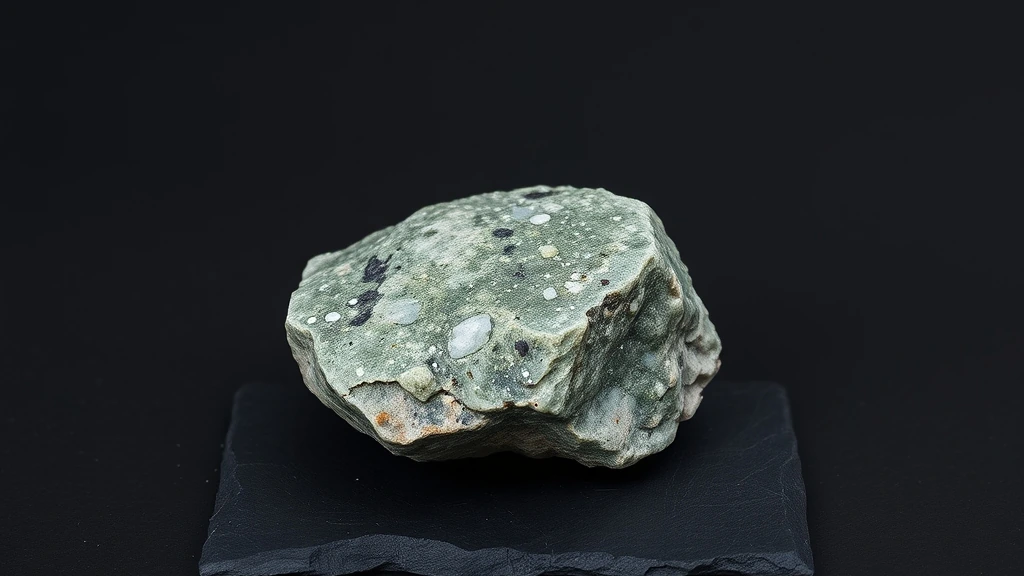
Afghanite belongs to the natural mineral family, crystallizing as a distinct inorganic compound rather than an aggregate or organic matrix. Discovered in the mineral‑rich terrains of Afghanistan, it forms in low‑temperature hydrothermal veins where sodium‑rich brines interact with aluminosilicate precursors. Its trigonal symmetry places it among the less common crystal systems, lending the stone a unique structural signature that influences both its physical durability and optical behavior. In comparative mineralogical collections, practitioners and geologists frequently study Nontronite alongside this crystal to appreciate their subtle energetic and structural differences.
What is Afghanite? Geological Overview & Definition
Afghanite is a trigonal silicate that precipitates from alkaline, sulfate‑bearing fluids in metamorphic environments. The mineral typically occurs as well‑formed tabular crystals or massive aggregates, often intergrown with zeolites and other framework silicates. In comparative mineralogical collections, practitioners and geologists frequently study Kammererite alongside this crystal to appreciate their subtle energetic and structural differences.
Historically, Afghanite’s discovery in the 1960s added a new member to the sodalite‑group of aluminosilicates, expanding the known diversity of sodium‑rich framework structures. Across early lapidary records, its subtle blue‑green coloration attracted collectors seeking minerals with both scientific and aesthetic appeal.
Afghanite Chemical Composition & Crystallographic Properties
The ideal chemical formula Na₈(Al₆Si₆O₂₄)SO₄Cl(CO₃)(H₂O)₄ reflects a complex framework where Al and Si occupy tetrahedral sites within a three‑dimensional lattice. Sodium cations balance the charge, while sulfate, chloride, and carbonate groups occupy interstitial channels, contributing to the mineral’s stability under modest temperature fluctuations.
In the trigonal crystal system, Afghanite’s unit cell is characterized by a single three‑fold rotational axis, producing hexagonal‑like habit but with distinct symmetry constraints. Minor cation substitution—such as partial replacement of Na⁺ by K⁺ or Ca²⁺—can subtly shift the refractive indices (n_ω = 1.523, n_ε = 1.529) and affect the hue intensity.
Afghanite is acid‑sensitive; exposure to dilute hydrochloric acid can leach the interlayer sulfate and carbonate, leading to surface etching and loss of transparency. This reactivity underscores the need for careful handling in both laboratory analysis and gemstone setting.
Thermally, Afghanite dehydrates gradually between 150 °C and 300 °C, releasing structural water and sometimes undergoing a reversible phase transition that modifies its lattice parameters. Upon heating above 400 °C, the framework collapses, producing amorphous residues that lose the characteristic blue‑green color.
| Property | Specification |
|---|---|
| Mineral Group | Natural Mineral / Crystal |
| Chemical Formula | Na₈(Al₆Si₆O₂₄)SO₄Cl(CO₃)(H₂O)₄ |
| Mohs Hardness | 5.5–6 |
| Crystal System | Trigonal |
| Specific Gravity (Density) | 2.55–2.65 |
| Refractive Index | n ω = 1.523 n ε = 1.529 |
| Color & Optical Properties | Natural Afghanite color spectrum and optical dispersion |
| Primary Mining Localities | Global primary localities |
| Water & Chemical Resistance | High (Safe for gentle water washing) |
| Chakra Alignment (Traditional) | Heart Chakra, Throat Chakra |
| Zodiac Affinity (Traditional) | Taurus, Libra |
| Symbolic Meaning (Traditional) | Emotional balance, inner peace, and harmonious communication |
Afghanite Varieties & Color Spectrum
Afghanite displays distinct mineralogical characteristics across its geological varieties and structural habits. Gemologists evaluate these natural varieties based on crystal habit, trace chromophore concentrations, and visual luster.
Primary Natural Afghanite
The benchmark natural variety exhibiting diagnostic color saturation and classic crystallographic symmetry.
Distinct Geological Morphs of Afghanite
Secondary regional and structural varieties formed under localized geological temperature and pressure conditions.
Classic Afghanite
The most widely recognized form, Classic Afghanite displays a deep indigo to violet hue with a subtle subtle pearlescent luster. It crystallizes in the trigonal system, forming elongated prismatic crystals that often exhibit inclusion-rich zones of mica or quartz. Though common in Afghan deposits, its vivid coloration makes it highly prized among collectors, and it is frequently used in fine jewelry.
Blue Afghanite
Blue Afghanite is distinguished by a lighter, almost sky‑blue tone that arises from trace copper and sulfur impurities. The crystals are typically smaller and more translucent than their classic counterparts, with occasional needle‑like inclusions that create a delicate play of light. This variety is rarer, especially in high‑clarity specimens, and commands premium prices in the gemstone market.
Green Afghanite
Green Afghanite emerges when iron and manganese substitute into the lattice, producing a muted olive or sage shade. Its crystals often show banded structures and occasional fibrous inclusions that give a subtle, almost organic texture. Though less sought after than blue or classic varieties, green Afghanite offers a unique alternative for designers looking for a natural, earthy tone.
Pink Afghanite
Pink Afghanite, a rare occurrence, displays a soft rose‑pink hue due to trace amounts of titanium and chromium. The crystals are typically well‑formed with a smooth surface and minimal inclusions, resulting in a striking, almost translucent appearance. Its scarcity and gentle color make it a coveted choice for bespoke jewelry pieces.
Black Afghanite
Black Afghanite is a deep, almost jet‑black variant that forms in highly reduced environments where sulfur and carbonate components dominate. The crystals are often opaque, with a glossy, almost metallic sheen and occasional graphite inclusions that create a subtle speckled effect. This rare form is prized for its dramatic contrast and is frequently used in statement pieces.
Afghanite with Fluorescence
Some Afghanite specimens exhibit weak fluorescence under UV light, glowing faintly in a pale blue or green. This effect is caused by trace rare earth elements within the crystal lattice. While not a distinct variety, the fluorescence adds an intriguing optical property that appeals to collectors and researchers alike.
Where is Afghanite Found? Geological Mining & Extraction
Afghanite crystallizes in alkali‑rich pegmatites that form within the tectonically active Afghan Shield and adjacent regions of the Central Asian Orogenic Belt. These pegmatites are typically associated with granitic intrusions, where high‑temperature fluids concentrate sodium, aluminum, and silica, allowing Afghanite to form in well‑defined prismatic crystals.
The primary extraction sites are located in Afghanistan’s Panjshir and Badakhshan provinces, where open‑pit and underground mining operations yield both raw crystals and processed gemstones. Secondary deposits have been identified in Pakistan’s Khyber Pakhtunkhwa and China’s Xinjiang region, though these sources are comparatively smaller and often produce lower‑quality material.
Historical Significance & Cultural Lore of Afghanite
Across ancient lapidary traditions, Afghanite’s striking indigo color was prized by Egyptian artisans for use in amulets and ceremonial jewelry, symbolizing protection and spiritual insight. In Vedic lore, the stone was associated with the Heart Chakra, believed to promote emotional balance and inner peace.
In the Greco‑Roman world, Afghanite was occasionally incorporated into decorative mosaics and architectural embellishments, valued for its unique hue and reflective quality. Chinese historical records from the Han dynasty mention the stone’s use in imperial court jewelry, where it was believed to enhance communication and harmony. These diverse cultural references underscore Afghanite’s enduring appeal across civilizations.
Modern Uses & Jewelry Applications of Afghanite
Afghanite is prized for its vibrant green hues and subtle iridescence, making it a favorite for lapidary artisans. The stone is typically cut into cabochons to showcase its natural luster, but skilled cutters also produce faceted specimens that accentuate its refractive properties. In addition to wearable pieces, Afghanite is carved into ornamental motifs for decorative panels and architectural accents.
- Cabochon rings, pendants, and earrings highlight its natural sheen.
- Faceted brooches and tiaras emphasize its optical brilliance.
- Carved panels and inlay work are common in high‑end interior design.
Metaphysical Properties & Traditional Meaning of Afghanite
According to historical traditions and metaphysical lore, Afghanite is believed to foster emotional balance and promote inner peace. Across ancient Mediterranean and Vedic lapidary practices, the stone is associated with harmonious communication, encouraging clear expression of thoughts and feelings. Its green color is thought to resonate with the Heart Chakra, while subtle blue undertones align it with the Throat Chakra, facilitating both emotional healing and articulate dialogue.
Which Chakra and Zodiac Signs Align with Afghanite?
Afghanite is canonically linked to the Heart Chakra, the center of compassion and love, and the Throat Chakra, the gateway of communication and truth. These chakras are said to harmonize the wearer’s emotional and verbal energies, fostering balanced relationships.
The stone’s astrological affinity is firmly rooted in the zodiac signs Taurus and Libra. Taurus, the earth sign, reflects Afghanite’s grounding qualities, while Libra’s emphasis on balance and partnership echoes the stone’s capacity to mediate emotional equilibrium.
How to Identify Real vs. Fake Afghanite
Artificial imitations of Afghanite often take the form of synthetic glass or dyed minerals that mimic its green sheen. These replicas typically lack the characteristic optical dispersion and internal inclusions found in genuine Afghanite, and they may exhibit a noticeably different thermal response.
Practical At‑Home Authenticity Tests
- Temperature Test (Thermal Feel): Hold the stone in your hand; genuine Afghanite feels cool to the touch due to its higher thermal conductivity, whereas synthetic glass warms quickly.
- Specific Gravity & Weight Test: Measure the stone’s weight in a calibrated scale; real Afghanite has a specific gravity of 2.55–2.65, making it noticeably heavier than common glass substitutes.
- Scratch & Hardness Test (Mohs Comparison): Use a standard Mohs hardness kit; Afghanite scores 5.5–6, so it will scratch glass but be scratched by a steel nail (hardness 5.5).
- Microscopic & Loupe Inspection (Internal Inclusions): Examine the stone under a loupe; authentic Afghanite often displays fine, fibrous inclusions and a subtle pleochroism, while imitations show uniform coloration and lack true inclusions.
Afghanite Valuation Factors, Grading & Pricing
Afghanite’s market value is driven first by Color Saturation, where deep, vivid greens with subtle turquoise undertones command premium prices. The visual vibrancy of the stone is enhanced by its natural energetic luster, which collectors associate with the mineral’s reputed heart‑chakra resonance.
Second, Crystal Size & Weight (Grams) is the primary metric for grading. Larger, well‑formed crystals that retain their natural matrix inclusions are prized, while smaller tumbled specimens are valued for their polished finish. The raw versus polished condition influences price, with untreated specimens fetching higher premiums for their authenticity.
Finally, Ethical Sourcing & Locality Premium shapes the stone’s desirability in holistic and collector markets. Afghanite sourced from responsibly managed mines in Afghanistan or from certified fair‑trade operations commands a surcharge, reflecting both the rarity of the locality and the growing demand for ethically produced gemstones.
How to Clean and Care for Afghanite
Afghanite can be safely cleaned with warm soapy water and a soft cloth, gently wiping the surface to remove dust and fingerprints. Avoid ultrasonic cleaners, as the vibration can induce microfractures in the delicate crystal lattice. After washing, pat the stone dry with a lint‑free cloth and store it in a low‑humidity environment to preserve its structural integrity.
Cleansing and Recharging Afghanite (Energetic Care)
To recharge Afghanite’s energetic properties, place the stone under gentle moonlight for several hours, allowing the natural lunar energy to restore its vibrancy. Alternatively, resting the mineral on a selenite charging slab during a full moon can enhance its subtle heart‑chakra alignment, providing a safe, heat‑free method of energetic renewal.
Frequently Asked Questions About Afghanite
Afghanite displays distinct mineralogical characteristics across its geological varieties and structural habits. Gemologists evaluate these natural varieties based on crystal habit, trace chromophore concentrations, and visual luster.
Primary Natural Afghanite
The benchmark natural variety exhibiting diagnostic color saturation and classic crystallographic symmetry.
Distinct Geological Morphs of Afghanite
Secondary regional and structural varieties formed under localized geological temperature and pressure conditions.
Is Afghanite safe to wear in the shower?
Yes, gentle exposure to water is safe for this mineral. Afghanite possesses high water resistance, allowing it to withstand brief contact with moisture without immediate dissolution. However, prolonged soaking should be avoided to preserve the integrity of its complex sulfate and carbonate components.
How should I clean my Afghanite jewelry?
Use warm soapy water and a soft cloth for maintenance. This gentle method effectively removes oils and dirt without damaging the stone’s surface. You must strictly avoid ultrasonic cleaners, as the vibrations can cause structural fractures within the crystal lattice.
What is the Mohs hardness of Afghanite?
Afghanite rates between 5.5 and 6 on the Mohs scale. This moderate hardness makes it suitable for rings and bracelets but requires careful handling against harder gemstones. It is softer than quartz, so it is susceptible to scratching from dust particles containing silica.
Which zodiac signs are aligned with Afghanite?
Taurus and Libra are the primary aligned zodiac signs. These earth and air signs resonate with the stone’s stabilizing energy. Wearers often seek Afghanite to enhance emotional balance and foster harmonious communication within their personal relationships.
Which chakras does Afghanite activate?
It primarily activates the Heart and Throat Chakras. This dual alignment supports both emotional well-being and clear self-expression. By bridging these energy centers, the stone encourages inner peace and authentic interpersonal dialogue.
What is the chemical formula of Afghanite?
The formula is Na₈(Al₆Si₆O₂₄)SO₄Cl(CO₃)(H₂O)₄. This complex composition includes sodium, aluminum, silicon, sulfur, chlorine, and water molecules. The presence of hydrated water contributes to its unique trigonal crystal system and physical properties.
Where is Afghanite primarily found geologically?
It was first discovered in the Badakhshan region of Afghanistan. The name derives directly from this specific geographic provenance. While rare globally, similar aluminosilicate minerals occur in various hydrothermal vein systems worldwide, though Afghanite remains distinct.
Can I store Afghanite with other gemstones?
Store it separately to prevent surface abrasion. Although moderately hard, Afghanite can be scratched by harder gems like topaz or diamond. Use a soft pouch or individual compartment to protect its refractive index and polished finish from daily wear.