
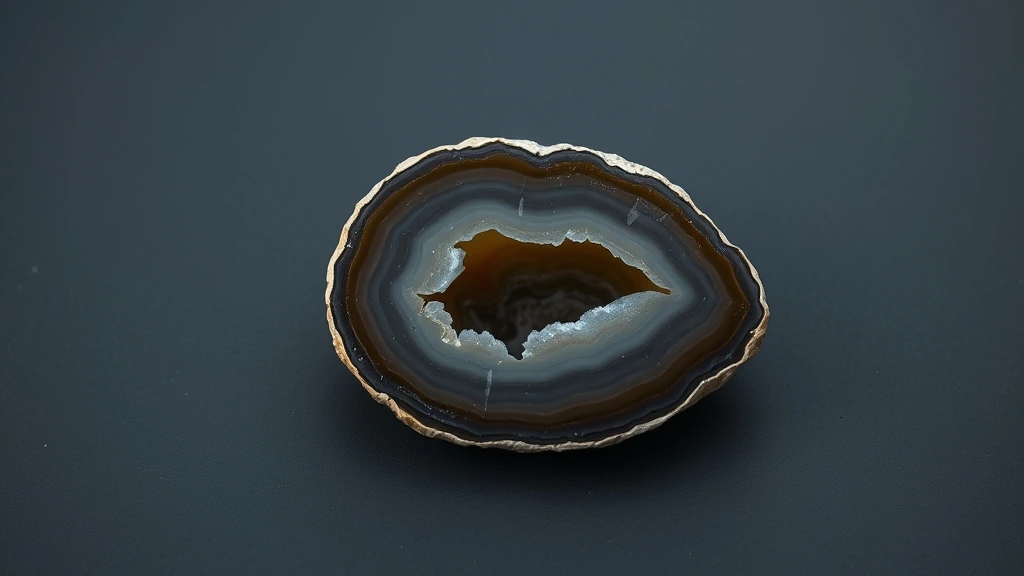
Agate geodes belong to the silicate family, specifically the chalcedony subgroup of cryptocrystalline quartz. Formed in volcanic cavities, they consist of concentric layers of microcrystalline silica that fill the void over millions of years. The aggregate’s banded patterns arise from variations in impurity content and growth conditions, linking each specimen to its unique geological history.
What is Agate Geode? Geological Overview & Definition
An agate geode is a rounded cavity within volcanic or sedimentary rock that has been lined with layered chalcedony, a microcrystalline form of quartz. The interior cavity may remain hollow or be partially filled with mineral‑rich fluids that precipitate as concentric bands, creating the characteristic multicolored patterns prized by collectors.
Geologically, agate geodes develop when silica‑rich solutions infiltrate voids left by gas bubbles or lava flow interiors. As the solution cools, silica polymerizes into fibrous aggregates, preserving the original cavity shape while producing a durable, glass‑like exterior that resists weathering.
Agate Geode Chemical Composition & Crystallographic Properties
The primary constituent of agate is SiO₂, but as a cryptocrystalline aggregate it lacks a single, well‑defined lattice; instead, it comprises countless intergrown quartz microcrystals. These microcrystals adopt the trigonal crystal system, forming fibrous aggregates that give agate its characteristic translucency and conchoidal fracture.
Cation substitution is minimal in pure agate, yet trace amounts of iron, manganese, or titanium can replace silicon within the silica framework, creating subtle color variations. Such substitutions act as chromophore centers, absorbing specific wavelengths and producing the familiar reds, yellows, and blues seen in banded patterns.
Agate is chemically stable but reacts to strong acids; concentrated hydrofluoric acid can dissolve the silica network, while dilute acids have negligible effect. Thermal exposure above 600 °C can induce recrystallization, converting the microcrystalline fabric toward macrocrystalline quartz and potentially altering the banding.
The aggregate’s density ranges from 2.60 to 2.65 g/cm³, and its refractive index lies between 1.544 and 1.553, reflecting the tightly packed silica fibers. These physical properties, combined with its trigonal microstructure, contribute to agate’s durability and its long‑standing use in jewelry and ornamental objects.
| Property | Specification |
|---|---|
| Mineral Group | Silicates (Chalcedony / Cryptocrystalline Quartz) |
| Chemical Formula | SiO₂ (Silicon Dioxide) |
| Mohs Hardness | 6.5 – 7.0 |
| Crystal System | Trigonal (Microcrystalline / Cryptocrystalline fibrous aggregates) |
| Specific Gravity (Density) | 2.60 – 2.65 |
| Refractive Index | 1.544 – 1.553 |
| Color & Optical Properties | Natural Agate Geode color spectrum and optical dispersion |
| Primary Mining Localities | Brazil, Uruguay, Turkey, India, Madagascar |
| Water & Chemical Resistance | High (Safe for gentle warm water and mild soap; avoid harsh acids and chlorine) |
| Chakra Alignment (Traditional) | Root Chakra and Sacral Chakra |
| Zodiac Affinity (Traditional) | Gemini, Virgo, Taurus |
| Symbolic Meaning (Traditional) | Grounding, emotional balance, physical endurance, and protection |
Agate Geode Varieties & Color Spectrum
Agate Geode displays distinct mineralogical characteristics across its geological varieties and structural habits. Gemologists evaluate these natural varieties based on crystal habit, trace chromophore concentrations, and visual luster.
Primary Natural Agate Geode
The benchmark natural variety exhibiting diagnostic color saturation and classic crystallographic symmetry.
Distinct Geological Morphs of Agate Geode
Secondary regional and structural varieties formed under localized geological temperature and pressure conditions.
Banded Agate (Chrysoprase‑type)
Banded agate displays alternating layers of silica and iron‑rich inclusions, forming striking concentric patterns. The mineral crystallizes in a trigonal system, producing fibrous aggregates that give the stone its characteristic banding. These geodes are most commonly found in volcanic ash deposits, where silica-rich fluids precipitate around a nucleus. Though widely available, the finest specimens with vivid, continuous bands are prized by collectors.
Fire Agate (Petrified Wood Agate)
Fire agate derives its name from the luminous, amber‑like glow produced by fossilized plant material trapped within the silica matrix. The inclusions are typically charcoal or amber fragments, giving the stone a warm, orange‑red hue. This variety forms in sedimentary basins where organic matter is rapidly buried and silica replaces the voids. Due to the rarity of well‑preserved organic inclusions, high‑quality fire agate is a coveted gem in the trade.
Rainbow Agate (Opalescent Agate)
Rainbow agate exhibits a subtle play of light, with iridescent flashes of color that shift as the stone is turned. The effect arises from micro‑fractures filled with silica gel and fine iron oxides, creating a natural opalescence. These geodes form in hydrothermal veins where silica precipitates in thin layers. While common in many regions, the most vivid rainbow agates are sourced from the volcanic terrains of Brazil and the Philippines.
Blue Agate (Cyanite‑rich Agate)
Blue agate contains trace amounts of cyanite or other blue‑colored iron oxides, producing a deep azure tone. The stone’s fibrous structure allows the blue inclusions to appear as streaks or swirls, giving it a distinctive visual signature. This variety is typically found in granite pegmatites where hydrothermal fluids carry iron and manganese. Blue agate is relatively scarce, especially in high‑clarity forms, making it a sought‑after specimen.
Red Agate (Hematite‑infused Agate)
Red agate incorporates hematite or goethite inclusions, imparting a warm, reddish hue that ranges from subtle pink to deep burgundy. The mineral’s formation involves silica deposition around a hematite nucleus in volcanic or sedimentary environments. The presence of iron oxides also enhances the stone’s refractive index, giving it a subtle sparkle. Red agate is moderately common, yet the most vivid, richly pigmented samples are prized by lapidarists.
Green Agate (Chlorite‑rich Agate)
Green agate is distinguished by the presence of chlorite or other green‑colored iron‑manganese minerals, creating a muted, forest‑green appearance. The stone’s fibrous aggregates allow the green inclusions to appear as delicate veining. Green agate typically forms in metamorphic settings where silica infiltrates pre‑existing green mineral veins. Though less common than other colors, high‑quality green agate is valued for its subtle elegance.
Where is Agate Geode Found? Geological Mining & Extraction
Agate geodes are predominantly hosted in silica‑rich pegmatites and volcanic ash beds, where hydrothermal fluids precipitate microcrystalline quartz around a nucleus. The fibrous aggregates form within cavities created by volcanic gases or by the dissolution of pre‑existing minerals, producing the characteristic geode structure.
Primary extraction regions include the Brazilian Serra do Mar, the Philippine Cordillera, and the United States’ Nevada–Utah basin. In these locales, miners employ a combination of open‑pit and underground techniques to access the silica veins, followed by careful hand‑cutting to preserve the delicate banding and inclusions that define each variety.
Historical Significance & Cultural Lore of Agate Geode
Across ancient lapidary traditions, agate geodes were revered for their layered beauty and perceived protective qualities. The Greeks and Romans used agate as a talisman against misfortune, while Egyptian artisans incorporated it into amulets and jewelry, believing it to guard the wearer’s heart. In Vedic texts, agate was associated with the Root Chakra, symbolizing grounding and stability, and was often embedded in ceremonial objects. Chinese geomancers also prized agate for its supposed ability to balance emotional energies, integrating it into feng shui practices. These diverse cultural references underscore agate’s enduring significance as both a decorative gemstone and a metaphysical symbol.
Modern Uses & Jewelry Applications of Agate Geode
Lapidaries primarily process agate geodes into polished cabochons, which best display the stone’s intricate banding and internal cavities. The high Mohs hardness of 6.5 to 7.0 allows for durable faceting, though the cryptocrystalline structure often limits optical brilliance. Artisans also carve large geode sections into ornamental bowls, bookends, and decorative wall pieces.
- Cabochon Cutting: Smooth, domed shapes that highlight the natural banded patterns and internal crystal formations without faceting.
- Ornamental Carving: Large geode halves are sanded and polished to reveal the hollow interior lined with quartz crystals.
- Jewelry Components: Sliced sections are used in pendants, earrings, and rings, often set in silver or gold to complement the earthy tones.
Metaphysical Properties & Traditional Meaning of Agate Geode
According to historical traditions and metaphysical lore, agate has long been revered for its grounding properties and ability to promote emotional balance. Ancient Mediterranean and Vedic texts describe the stone as a protective talisman that stabilizes the wearer’s energy field. Practitioners believe the layered structure of the geode mirrors the complexity of human emotional layers.
The stone is traditionally associated with physical endurance and resilience during times of stress or change. In universal lapidary lore, agate serves as a shield against negative influences and promotes mental clarity. Its earthy composition connects the wearer to the physical realm, fostering a sense of security and stability.
Which Chakra and Zodiac Signs Align with Agate Geode?
In chakra theory, agate geodes are primarily aligned with the Root Chakra and the Sacral Chakra. The Root Chakra connection stems from the stone’s strong grounding energy, which anchors the individual to the physical world. Meanwhile, the Sacral Chakra association supports creative flow and emotional regulation, helping to balance the body’s water elements.
Astrologically, agate is considered a powerful stone for Taurus, Gemini, and Virgo. For Taurus, it reinforces stability and practicality, while for Gemini, it helps focus the mind and reduce mental restlessness. Virgo benefits from the stone’s purifying qualities, which support their natural desire for order and precision.
How to Identify Real vs. Fake Agate Geode
Artificial imitations of agate geodes are common, often made from synthetic glass or dyed quartz to mimic natural banding. These fakes may lack the subtle color variations and internal crystal formations found in genuine specimens. Understanding the physical properties of natural silicon dioxide is essential for distinguishing authentic geodes from manufactured replicas.
Practical At-Home Authenticity Tests
- Temperature Test (Thermal Feel): Hold the stone against your cheek or wrist. Genuine agate feels cool to the touch initially and warms slowly, whereas plastic imitations warm up almost instantly.
- Specific Gravity & Weight Test: Natural agate has a density of 2.60 to 2.65. It should feel noticeably heavier than a similarly sized piece of glass or plastic, which typically has a lower specific gravity.
- Scratch & Hardness Test (Mohs Comparison): Use a steel file (Mohs 5.5) or a copper coin (Mohs 3.5). Genuine agate (Mohs 6.5-7.0) will not be scratched by these tools, while glass or plastic may show faint marks or chips.
- Microscopic & Loupe Inspection (Internal Inclusions): Examine the stone with a 10x loupe. Natural agates often contain tiny mineral inclusions, fluid-filled cavities, or irregular banding. Synthetic glass may show air bubbles or perfectly uniform, artificial color distribution.
Agate Geode Valuation Factors, Grading & Pricing
The market value of an agate geode hinges first on Color Saturation. Stones with vivid, evenly distributed hues command higher prices, as their natural energetic luster appeals to collectors seeking both aesthetic beauty and metaphysical resonance.
Second, Crystal Size & Weight (Grams) drives pricing. Larger, heavier specimens—especially those that retain their raw, unpolished surface—are prized for their dramatic presence. Tumbled polish can enhance appeal, but the presence of natural matrix inclusions adds character and can increase value if the inclusions are distinctive and well‑displayed.
Finally, Ethical Sourcing & Locality Premium influences the market. Provenance from renowned, responsibly mined localities such as Brazil, Uruguay, or Turkey adds a premium, while transparent supply chains reassure buyers concerned with environmental stewardship and fair labor practices., while transparent supply chains reassure buyers concerned with environmental stewardship and fair labor practices.
How to Clean and Care for Agate Geode
Gentle physical cleaning of a solid agate geode is best performed with warm soapy water. Use a mild dish soap diluted in lukewarm water, and a soft microfiber cloth to wipe the surface. Avoid harsh acids, chlorine, or ultrasonic cleaners, especially if the specimen has been dyed, heavily fractured, or treated, as these methods can damage the crystal structure or surface finish.
Cleansing and Recharging Agate Geode (Energetic Care)
For energetic renewal, place the agate geode in a quiet, shaded area and allow it to absorb gentle moonlight for several hours. This low‑intensity exposure helps restore its natural vibrational balance without subjecting the crystal lattice to heat.
Alternatively, keep the stone on a selenite charging slab or a clean, dry surface during a herbal smudging session. The subtle aroma of sage or palo santo can cleanse residual energies, while the selenite slab provides a non‑thermal, conductive field that encourages the agate to realign with its grounding properties.
Frequently Asked Questions About Agate Geode
Agate Geode displays distinct mineralogical characteristics across its geological varieties and structural habits. Gemologists evaluate these natural varieties based on crystal habit, trace chromophore concentrations, and visual luster.
Primary Natural Agate Geode
The benchmark natural variety exhibiting diagnostic color saturation and classic crystallographic symmetry.
Distinct Geological Morphs of Agate Geode
Secondary regional and structural varieties formed under localized geological temperature and pressure conditions.
Is agate safe to wear in the shower?
Yes, agate tolerates gentle warm water and mild soap. Its silicon dioxide composition (SiO₂) is chemically stable, so routine exposure to shower water does not degrade the stone. However, avoid harsh acids, chlorine, or prolonged soaking to prevent surface etching, especially on dyed or treated specimens.
How should I clean a solid agate geode?
Warm, soapy water with a soft brush is ideal. The microcrystalline quartz structure resists most household cleaners, allowing you to gently scrub away dirt without harming the surface. Rinse with lukewarm water, pat dry with a lint‑free cloth, and store away from extreme temperature swings.
Can I use an ultrasonic cleaner on my agate?
Generally avoid ultrasonic cleaning for agate geodes. While solid agate can survive mild ultrasonic action, the vibrations may fracture dyed, heavily cracked, or heat‑treated pieces. Opt for manual cleaning to preserve the stone’s integrity and any delicate color enhancements.
What is the typical hardness of agate on the Mohs scale?
Agate ranks between 6.5 and 7.0. This hardness reflects its cryptocrystalline quartz framework, making it resistant to scratches from most everyday metals but still vulnerable to harder materials like diamonds or corundum. Proper handling prevents accidental abrasion.
Which zodiac signs are most associated with agate?
Gemini, Virgo, and Taurus are the aligned signs. In astrological tradition, these earth and air signs are believed to benefit from agate’s grounding energy, enhancing mental clarity for Gemini, practical organization for Virgo, and stability for Taurus.
Which chakras does agate primarily influence?
Root Chakra and Sacral Chakra are the primary correspondences. The stone’s stabilizing vibrations are said to anchor the wearer to the physical world (Root) and stimulate creative flow and emotional balance (Sacral), supporting both security and vitality.
Is agate suitable for everyday jewelry?
Yes, its durability and water resistance make it ideal for daily wear. With a density of 2.60–2.65 g/cm³ and a refractive index of 1.544–1.553, agate maintains its luster under normal conditions. Still, avoid exposure to strong chemicals or high‑impact activities that could chip the surface.
How can I tell if an agate geode is natural or dyed?
Examine color zoning and perform a spot test with a drop of mild acid. Natural agate shows banded, concentric patterns with subtle color transitions, while dyed stones often display unnaturally uniform hues. A faint fizz from diluted acetic acid may indicate surface treatment, prompting gentler cleaning methods.