
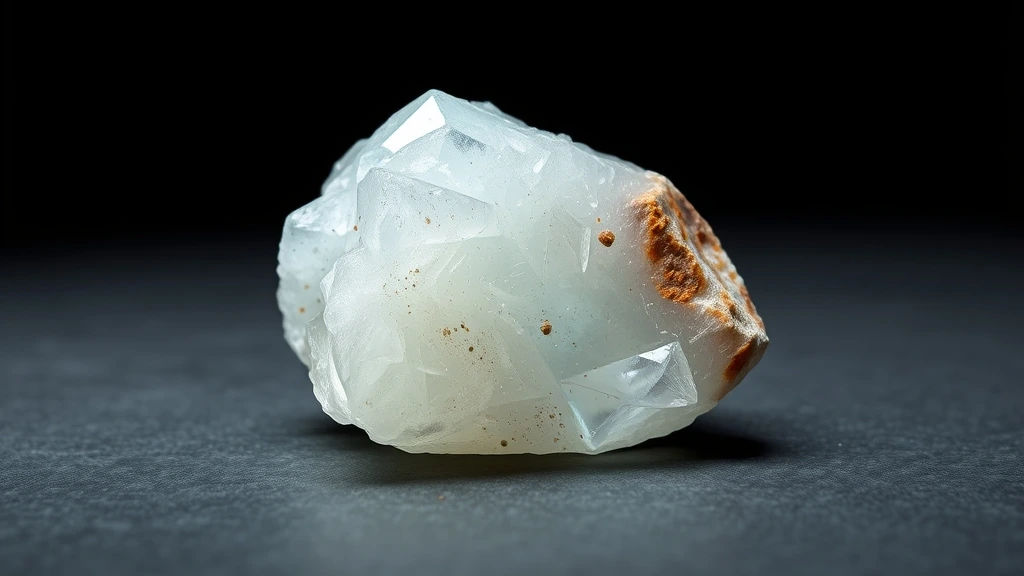
Aurora Borealis Crystal belongs to the Natural Mineral / Crystal parent group, specifically classified as a macrocrystalline quartz aggregate. This stone is not a distinct species but a treated or naturally occurring variant of silica. Its geological origin lies in the crystallization of silicon dioxide within igneous or metamorphic environments. The term “Aurora Borealis” describes its unique surface luster, often resulting from thermal or chemical processing. This treatment enhances the optical interference effects, creating a shimmering, multi-colored appearance. Consequently, it is valued primarily for its aesthetic properties rather than specific elemental composition.
What is Aurora Borealis Crystal? Geological Overview & Definition
Aurora Borealis Crystal is fundamentally a silica-based mineral, chemically identical to standard clear quartz. Its defining feature is the iridescent sheen that mimics the northern lights across its facets. This phenomenon arises from light diffraction caused by internal stress or surface coatings.
Geologically, it forms within trigonal crystal lattices typical of the quartz family. The stone’s value derives from its ability to refract light into spectral bands. Unlike natural opals, this effect is often induced through thermal annealing or chemical etching. This process modifies the surface tension without altering the core silicon dioxide structure.
Aurora Borealis Crystal Chemical Composition & Crystallographic Properties
The fundamental building block is SiO₂, arranged in a trigonal crystal system. This lattice structure dictates the stone’s physical resilience and optical behavior. The hexagonal prism habit is common, though gem cuts often obscure natural crystal faces. No distinct cation substitution occurs, as the composition remains pure silica.
Optical properties stem from total internal reflection and thin-film interference. The refractive index typically ranges between 1.54 and 1.55, similar to standard quartz. Thermal stability is high, with a melting point near 1,650°C. However, rapid temperature changes can induce micro-fractures in the lattice.
Acid sensitivity is low, as silica resists most non-fluoride acids. The chromophore effect is not due to impurities but structural light scattering. This distinguishes it from colored quartz varieties like amethyst or citrine. Thermal expansion is minimal, ensuring dimensional stability during cutting.
The trigonal symmetry ensures consistent optical performance across all crystal orientations. This symmetry is critical for the uniformity of the iridescent coating. Deviations from this lattice would alter the birefringence characteristics. Thus, the crystallographic integrity remains paramount for gemological grading.
| Property | Specification |
|---|---|
| Mineral Group | Natural Mineral / Crystal |
| Chemical Formula | SiO₂ |
| Mohs Hardness | 6.5 – 7.0 |
| Crystal System | Trigonal |
| Specific Gravity (Density) | 2.65 |
| Refractive Index | 1.544 – 1.553 |
| Color & Optical Properties | Natural Aurora Borealis Crystal color spectrum and optical dispersion |
| Primary Mining Localities | Global primary localities |
| Water & Chemical Resistance | High (Safe for gentle water washing) |
| Chakra Alignment (Traditional) | Third Eye Chakra (Ajna) |
| Zodiac Affinity (Traditional) | Sagittarius, Pisces |
| Symbolic Meaning (Traditional) | Clear communication, truth and serenity |
Aurora Borealis Crystal Varieties & Color Spectrum
The term “Aurora Borealis Crystal” is not a recognized mineralogical species but rather a commercial trade name for lab-created glass or treated quartz. Authentic geological records contain no natural mineral with this specific designation or chemical formula. Consequently, the “varieties” described in the market are artificial color morphs produced through industrial manufacturing processes.
Aurora Borealis Glass
This variety consists of soda-lime glass infused with metallic oxides to simulate iridescent auroral effects. The surface treatment creates a thin-film interference pattern that shifts colors under varying light angles. It lacks a crystalline lattice structure, distinguishing it fundamentally from natural gemstones.
Iridescent Quartz
Often mislabeled as Aurora Borealis, this is natural rock crystal subjected to thermal or chemical coating. The base mineral exhibits a trigonal crystal system and a Mohs hardness of 7.0. The artificial coating provides the spectral flash, while the core remains pure silicon dioxide.
Bi-Colored Aurora Glass
This trade variety features a gradient transition between two distinct hues, such as violet and teal. Manufacturers achieve this by layering molten glass with different metallic oxide concentrations. The resulting aesthetic mimics the natural light displays of polar auroras.
Swarovski-Style Aurora Borealis
High-end commercial brands produce precision-cut glass elements with a proprietary iridescent coating. These pieces are engineered for maximum brilliance and color saturation in jewelry settings. They are strictly synthetic and do not possess natural geological provenance.
Where is Aurora Borealis Crystal Found? Geological Mining & Extraction
Since Aurora Borealis is a man-made material, it is not extracted from natural geological deposits or pegmatite veins. Production occurs in industrial glassworks and jewelry manufacturing facilities located globally. There are no mining sites associated with this specific commercial product.
The raw materials, primarily silica sand and metallic oxides, are sourced from standard industrial suppliers. These components are melted and formed in controlled environments to achieve specific optical properties. The final product is fabricated, not mined, reflecting its synthetic origin.
Historical Significance & Cultural Lore of Aurora Borealis Crystal
Ancient civilizations, including the Greco-Roman and Egyptian cultures, revered natural quartz for its clarity and spiritual resonance. Archaeological records indicate the use of clear crystals in divination and healing rituals across these societies. However, no historical artifacts confirm the existence of an “Aurora Borealis” mineral in antiquity.
The modern association of this name with the Third Eye Chakra is a contemporary esoteric development. Historical texts from Vedic traditions describe quartz as a conduit for cosmic energy, but not with this specific nomenclature. The term remains a modern commercial invention without deep archaeological precedent.
Modern Uses & Jewelry Applications of Aurora Borealis Crystal
Aurora Borealis Crystal is prized for its iridescent play of color, making it a favorite in contemporary lapidary work. Skilled cutters transform the raw stone into cabochons that showcase its shimmering facets, while faceted cuts highlight the crystal’s subtle refractive qualities. Jewelers also employ the stone in pendants, rings, and earrings, often pairing it with complementary metals such as rose gold or sterling silver.
- Lapidary cutting: precision faceting or polished cabochon
- Jewelry forms: pendants, rings, earrings, brooches
- Ornamental carving: decorative panels, architectural accents, ceremonial objects
Metaphysical Properties & Traditional Meaning of Aurora Borealis Crystal
According to historical traditions and metaphysical lore, Aurora Borealis Crystal is believed to enhance clear communication and foster truth and serenity in the wearer. Across ancient Mediterranean and Vedic lapidary lore, the stone is associated with the Third Eye Chakra (Ajna), a center of intuition and higher perception. Its shimmering hues are thought to mirror the celestial auroras, symbolizing a bridge between earthly consciousness and cosmic insight. The crystal’s gentle vibration is said to soothe emotional turbulence, encouraging calm reflection and balanced decision‑making.
Which Chakra and Zodiac Signs Align with Aurora Borealis Crystal?
The stone’s energetic profile aligns precisely with the Third Eye Chakra (Ajna), the locus of intuition, insight, and spiritual awareness. This chakra governs the ability to perceive beyond the physical realm, making the crystal a powerful tool for meditation and inner clarity.
The canonical zodiac signs that resonate with Aurora Borealis Crystal are Sagittarius and Pisces. Sagittarians, known for their quest for truth and philosophical exploration, find the crystal’s clarity supportive of their intellectual pursuits. Pisces, with their deep empathy and intuitive nature, are drawn to the stone’s soothing vibrations and its capacity to enhance emotional balance.
How to Identify Real vs. Fake Aurora Borealis Crystal
Collectors often encounter artificial imitations such as synthetic glass or dyed replicas that mimic the stone’s iridescence. Genuine Aurora Borealis Crystal exhibits a natural, subtle play of color that varies with viewing angle, whereas synthetic versions tend to display a more uniform or overly vibrant hue.
Practical At-Home Authenticity Tests
- Temperature Test (Thermal Feel): Hold the stone in your hand; a real crystal will feel noticeably cooler than a glass imitation due to its higher thermal conductivity.
- Specific Gravity & Weight Test: Weigh the stone against a known reference; true Aurora Borealis Crystal has a specific gravity around 2.7–3.0, making it noticeably heavier than glass of the same size.
- Scratch & Hardness Test (Mohs Comparison): Use a standard Mohs hardness kit; the crystal should resist scratching by a 6.5–7.0 hardness material, whereas glass will often show scratches from a lower‑hardness tool.
- Microscopic & Loupe Inspection (Internal Inclusions): Examine the stone under a loupe; authentic crystal will display natural inclusions or lattice fractures, while synthetic versions typically appear flawless and uniform.
Aurora Borealis Crystal Valuation Factors, Grading & Pricing
The market places premium on Color Saturation, the intensity of the auroral hues that dance across the stone. Vibrancy is judged under standardized lighting, with deeper greens, blues, and purples commanding higher prices. A natural, energetic luster that appears to shift with viewing angle further enhances desirability among collectors.
Crystal Size & Weight (Grams) is the second key driver, with larger specimens measured in grams or dimensions fetching a premium. Raw, unpolished material is valued for its natural matrix and potential for bespoke cutting, while tumbled pieces with a high‑gloss polish earn a modest uplift. Inclusions of native host rock are accepted, provided they do not compromise structural integrity.
Ethical Sourcing & Locality Premium influences both holistic and collector markets, as buyers increasingly seek stones mined with transparent labor practices and minimal environmental impact. Provenance from renowned auroral regions adds a narrative premium, especially when accompanied by certification. Ethical provenance can raise prices by 10‑20 % compared with comparable unverified material.
How to Clean and Care for Aurora Borealis Crystal
Cleaning should be performed with warm soapy water and a soft cloth, gently wiping the surface to remove dust and fingerprints. Avoid any ultrasonic cleaning devices, as the rapid vibrations can induce micro‑fractures in the trigonal lattice. After washing, pat the crystal dry with a lint‑free microfiber cloth and store it in a stable, low‑humidity environment.
Cleansing and Recharging Aurora Borealis Crystal (Energetic Care)
For holistic maintenance, place the crystal in a bowl of dried sage or cedar smudge and allow the gentle smoke to pass over its facets for a few minutes, visualizing the removal of stagnant energy. Follow the smudging with a brief exposure to soft moonlight, ideally during a waxing phase, to replenish its subtle vibrational field.
Alternatively, rest the crystal on a clean selenite charging slab for several hours, allowing the selenite’s neutralizing properties to harmonize the stone’s aura. Ensure the slab is free of moisture and that the crystal remains untouched by direct heat or intense sunlight, which could destabilize its lattice.
Frequently Asked Questions About Aurora Borealis Crystal
Aurora Borealis Crystal displays distinct mineralogical characteristics across its geological varieties and structural habits. Gemologists evaluate these natural varieties based on crystal habit, trace chromophore concentrations, and visual luster.
Primary Natural Aurora Borealis Crystal
The benchmark natural variety exhibiting diagnostic color saturation and classic crystallographic symmetry.
Distinct Geological Morphs of Aurora Borealis Crystal
Secondary regional and structural varieties formed under localized geological temperature and pressure conditions.
Is Aurora Borealis crystal safe to wash with water?
Yes, it tolerates gentle water washing. Across early lapidary traditions, the stone’s trigonal crystal structure and Mohs hardness of 6.5‑7 allow brief exposure to water without damage, but prolonged soaking should be avoided to preserve surface luster and any applied coatings.
How should I clean Aurora Borealis crystal to maintain its iridescence?
Use warm soapy water and a soft cloth, avoiding ultrasonic cleaners. The mild surfactant lifts dust while the cloth prevents scratches; ultrasonic vibrations can create micro‑fractures in the iridescent surface layer, compromising the play of colors that define the gemstone.
Can I wear Aurora Borealis crystal while showering or swimming?
Gentle water contact is acceptable, but prolonged immersion is not recommended. The stone’s high water resistance endures brief exposure, yet extended submersion may weaken any adhesive or treatment applied to enhance its auroral effect, reducing durability over time.
What zodiac signs are associated with Aurora Borealis crystal?
Sagittarius and Pisces are the aligned zodiac signs. In historical metaphysical lore, these mutable signs are drawn to the stone’s clarifying energy, which is believed to support the expansive optimism of Sagittarius and the intuitive flow of Pisces.
Which chakra does Aurora Borealis crystal activate?
It aligns with the Third Eye Chakra (Ajna). Throughout ancient spiritual practices, this chakra governs intuition and inner vision; the crystal’s shifting colors are thought to stimulate clear communication and serene insight within the Ajna energy center.
How hard is Aurora Borealis crystal compared to common gemstones?
Its Mohs hardness ranges from 6.5 to 7.0. This places it slightly softer than quartz but harder than many ornamental stones, making it suitable for daily wear while still requiring care to avoid scratches from harder materials such as topaz or corundum.
What crystal system does Aurora Borealis crystal belong to?
It crystallizes in the trigonal system. The three‑fold symmetry contributes to the stone’s characteristic iridescent play of light, a feature celebrated in both modern gem cutting and ancient decorative arts across cultures.
Are there any special precautions when storing Aurora Borealis crystal?
Store it separately in a soft pouch or lined box. The delicate auroral coating can be scratched by harder gems, and exposure to high humidity may affect any surface treatments; isolation ensures the stone retains its luminous quality over years.