
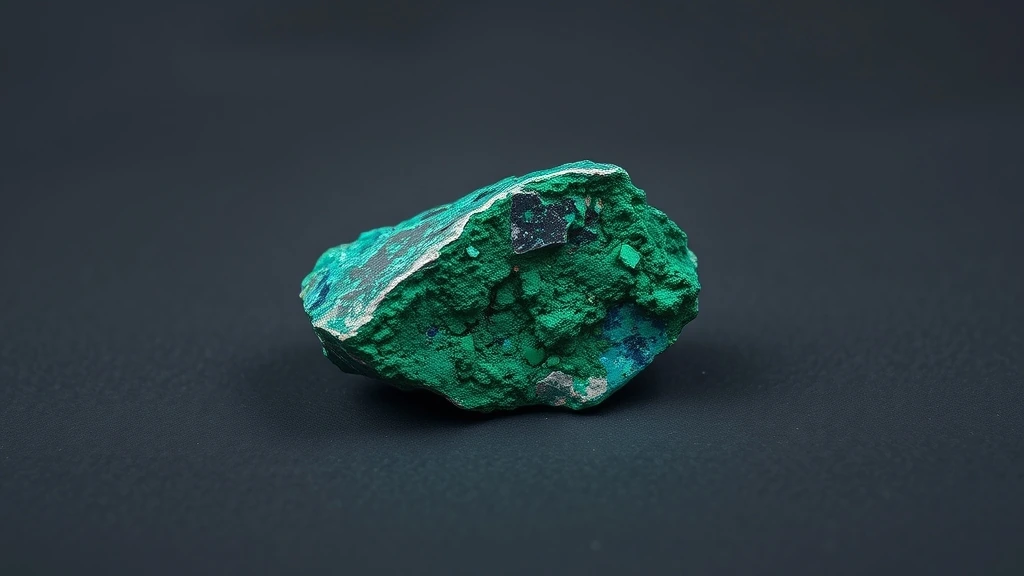
The mineral is classified within the carbonate family, specifically the basic copper carbonates that form under oxidizing conditions in the supergene zones of copper ore deposits. It crystallizes in the monoclinic system, producing prismatic crystals or botryoidal, banded aggregates that often intergrow, creating the striking blue‑green zonation prized by lapidaries. These aggregates develop where copper‑rich solutions precipitate sequentially, first forming azurite and later altering to malachite, preserving both mineral phases in a single specimen.
What is Azurite-malachite? Geological Overview & Definition
Azurite‑malachite refers to a naturally occurring intergrowth of two basic copper carbonates that share the same monoclinic crystal system but differ in hue and crystal habit. The blue azurite component forms deep, royal‑blue plates, while the green malachite component appears as botryoidal or fibrous masses, together creating a distinctive banded or mottled appearance.
In geological terms, this assemblage is a secondary supergene mineral, precipitating from copper‑bearing solutions that percolate through oxidized zones of sulfide ore bodies. The process records a progressive alteration sequence: azurite forms first under relatively dry conditions, then gradually converts to malachite as water activity increases, preserving both phases in a single rock‑like aggregate.
Azurite-malachite Chemical Composition & Crystallographic Properties
Both azurite and malachite share the formula Cu₂CO₃(OH)₂, yet subtle differences in crystal lattice parameters give rise to their distinct colors. The monoclinic (prismatic or botryoidal banded aggregates) structure features layers of CuO₆ octahedra linked by carbonate groups, allowing limited cation substitution by Fe²⁺ or Zn²⁺ that can shift hue toward darker blues or olive greens.
The mineral is highly acid‑sensitive; exposure to dilute acids dissolves the carbonate matrix, releasing carbon dioxide and copper ions, which is why azurite‑malachite specimens must be handled without acidic cleaning agents. The vivid blues arise from Cu²⁺ charge‑transfer transitions within the carbonate lattice, while the greens stem from similar transitions modified by crystal field splitting in malachite’s more hydrated layers.
Thermally, azurite dehydrates to malachite at temperatures around 200 °C, a reversible process that can be observed in laboratory heating experiments. This transformation explains why many museum specimens display a gradient from blue to green, reflecting natural thermal and humidity fluctuations over geological time.
| Property | Specification |
|---|---|
| Mineral Group | Carbonates (Basic Copper Carbonate) |
| Chemical Formula | Cu₂CO₃(OH)₂ (Basic Copper Carbonate) |
| Mohs Hardness | 3.5 – 4.0 |
| Crystal System | Monoclinic (Prismatic or botryoidal banded aggregates) |
| Specific Gravity (Density) | 3.60 – 4.05 |
| Refractive Index | 1.655 – 1.909 |
| Color & Optical Properties | Natural Azurite-malachite color spectrum and optical dispersion |
| Primary Mining Localities | DR Congo (Katanga), Namibia, Australia, Russia (Ural) |
| Water & Chemical Resistance | CAUTION: Toxic Copper Content (Keep away from hot, acidic, or saline water) |
| Chakra Alignment (Traditional) | Heart Chakra (Anahata) |
| Zodiac Affinity (Traditional) | Scorpio, Capricorn, Taurus |
| Symbolic Meaning (Traditional) | Deep emotional transformation, psychic barrier, and heart healing |
Azurite‑malachite Varieties & Color Spectrum
Azurite-malachite displays distinct mineralogical characteristics across its geological varieties and structural habits. Gemologists evaluate these natural varieties based on crystal habit, trace chromophore concentrations, and visual luster.
Primary Natural Azurite-malachite
The benchmark natural variety exhibiting diagnostic color saturation and classic crystallographic symmetry.
Distinct Geological Morphs of Azurite-malachite
Secondary regional and structural varieties formed under localized geological temperature and pressure conditions.
Classic Azurite
Classic Azurite forms as deep blue prismatic crystals within copper‑rich veins. The mineral often displays black or green inclusions of malachite, giving a striking banded appearance. Its high refractive index (1.655–1.909) enhances brilliance, but the softness (Mohs 3.5–4.0) makes it fragile for jewelry. Classic Azurite is prized in fine lapidary work and is relatively common in the United States and Brazil.
Malachite‑Dominant Veins
Malachite‑dominant veins exhibit a vivid green matrix with occasional blue Azurite nodules. The green coloration arises from copper carbonate hydroxide, while the blue inclusions indicate recent secondary oxidation. These veins are typically found in the Monoclinic crystal system, producing botryoidal aggregates. Rarity increases when the green is a uniform emerald hue, as seen in some Mexican deposits.
Banded Azurite‑Malachite
Banded Azurite‑Malachite displays alternating layers of blue and green, often with a white quartz interlayer. The banding results from fluctuating copper concentrations during hydrothermal activity. These specimens are highly sought after for decorative panels and are most frequently sourced from the Sierra de la Culebra in Spain. Their unique visual signature makes them a collector’s item.
Dark Azurite (Black Azurite)
Dark Azurite, also called black Azurite, appears as a deep indigo with black inclusions of malachite or hematite. The black coloration is due to iron impurities, giving the stone a dramatic contrast. This variety is rarer, found mainly in the Kashmir region of India, and is valued for its intense, almost mystical appearance.
Green‑Blue Hybrid (Azure‑Malachite)
The Green‑Blue Hybrid, or Azure‑Malachite, combines a green matrix with scattered blue veins. The hybridization occurs when copper carbonate hydroxide precipitates in a fluctuating pH environment. These specimens are prized for their subtle color gradients and are typically mined in the Sierra Madre of Mexico. Their rarity lies in the precise balance of green and blue hues.
Rare White‑Azurite
White‑Azurite is an uncommon variant where the blue crystals are overlaid with a translucent white quartz rim. The white rim indicates a later-stage silica deposition, creating a halo effect. This variety is extremely rare, found only in the Bergamo region of Italy, and is highly valued for its unique optical play.
Where is Azurite‑malachite Found? Geological Mining & Extraction
Azurite and malachite typically form in oxidized zones of copper‑bearing porphyry and pegmatite deposits. The minerals crystallize from hydrothermal fluids that migrate through fractures, depositing copper carbonate hydroxide as secondary minerals. Major global sources include the Cochise and San Juan districts in the United States, the Sierra Madre in Mexico, and the Kashmir region of India.
Extraction often involves open‑pit or underground mining of the host copper ore, followed by hydrothermal leaching to isolate the carbonate minerals. Artisanal miners in Brazil and Zambia also process low‑grade copper ores to recover Azurite and malachite, which are then sold to lapidary workshops worldwide.
Historical Significance & Cultural Lore of Azurite‑malachite
Across ancient lapidary traditions, Azurite and malachite were prized for their vivid hues and were used in jewelry, amulets, and decorative inlays. The Greeks associated malachite with the goddess Athena, while the Romans employed Azurite in mosaics and as a pigment in frescoes. Egyptian artisans incorporated malachite into sarcophagi and amulets, believing it protected the heart and soul.
In Vedic and Chinese lore, malachite was thought to guard against negative energies, while Azurite was used in talismans to enhance emotional balance. Archaeological finds from the Mesoamerican civilization reveal malachite beads in burial sites, indicating its symbolic importance. These cultural narratives underscore the enduring spiritual and aesthetic value of Azurite‑malachite across civilizations.
Modern Uses & Jewelry Applications of Azurite-malachite
Lapidaries primarily cut azurite-malachite into cabochons due to its relatively low Mohs hardness of 3.5 to 4.0. Faceting is rare because the mineral’s brittleness makes it prone to chipping during the precise grinding required for gemstones. Most high-quality specimens are instead carved into ornamental objects, beads, or polished stones for decorative inlays.
- Cabochon Cutting: Smooth, domed shapes highlight the mineral’s striking banded patterns without risking structural failure.
- Ornamental Carvings: Skilled artisans sculpt detailed figures, vases, and architectural elements from large, stable blocks.
- Beads and Pendants: Small, drilled pieces are strung into necklaces or used as focal points in mixed-media jewelry.
- Lapidary Inlays: Thin slices are embedded in wood or metal for decorative boxes and tabletops.
Metaphysical Properties & Traditional Meaning of Azurite-malachite
According to historical traditions and metaphysical lore, this copper carbonate is revered for its capacity to facilitate deep emotional transformation. Ancient Mediterranean and Vedic practitioners often associated the stone’s vibrant blue-green hues with the flow of spiritual energy and mental clarity. It is believed to act as a psychic barrier, shielding the wearer from negative influences while promoting inner peace.
In contemporary spiritual practice, the stone is frequently used to support heart healing and emotional balance. Practitioners suggest that holding the mineral during meditation helps release suppressed feelings and fosters a deeper connection to one’s intuition. The duality of its colors symbolizes the integration of masculine and feminine energies within the psyche.
Which Chakra and Zodiac Signs Align with Azurite-malachite?
Within the framework of chakra theory, azurite-malachite is primarily aligned with the Heart Chakra (Anahata). This connection stems from the mineral’s traditional association with love, compassion, and emotional resilience. By balancing this energy center, the stone is thought to encourage open-heartedness and facilitate the release of past emotional traumas.
Astrologically, the mineral resonates strongly with the signs of Scorpio, Capricorn, and Taurus. Scorpios appreciate its transformative power, while Capricorns value its grounding nature. Taurus finds comfort in its earthy stability and aesthetic beauty, making it a versatile talisman for these three zodiacal archetypes.
How to Identify Real vs. Fake Azurite-malachite
The market is saturated with artificial imitations, including synthetic glass, dyed howlite, and plastic replicas designed to mimic the mineral’s distinctive banding. These fakes often feature uniform colors and lack the natural irregularities found in genuine specimens. Understanding the physical properties of real azurite-malachite is essential for distinguishing authentic stones from these convincing counterfeits.
Practical At-Home Authenticity Tests
- Temperature Test (Thermal Feel): Genuine azurite-malachite feels cool to the touch initially and warms slowly, whereas plastic or glass imitations may feel warmer or heat up more rapidly due to different thermal conductivity.
- Specific Gravity & Weight Test: Real specimens have a density of 3.60 to 4.05, making them feel significantly heavier than their size suggests. Plastic or lightweight glass fakes will often feel unnaturally light when held in the hand.
- Scratch & Hardness Test (Mohs Comparison): With a Mohs hardness of 3.5 to 4.0, the mineral can be scratched by a steel knife or a copper penny. If the stone resists scratching from these tools, it is likely a harder imitation like glass or quartz.
- Microscopic & Loupe Inspection (Internal Inclusions): Using a 10x loupe, look for natural banding and internal fractures. Fakes often display trapped air bubbles, swirl marks, or perfectly uniform color distribution that lacks the organic complexity of natural mineral formation.
Azurite-malachite Valuation Factors, Grading & Pricing
Color Saturation drives market demand, as deep azure‑blue azurite veins transitioning to vivid emerald‑green malachite command premium prices. Collectors assess the visual vibrancy of the banded pattern, rewarding specimens that display sharp, uninterrupted hues without fading. Natural energetic luster, perceived as an inner glow, further distinguishes high‑value pieces from treated or bleached counterparts.
Crystal Size & Weight (Grams) influences pricing tiers, with larger, intact aggregates fetching higher bids than fragmented shards. Buyers compare raw versus tumbled polish quality, noting that a smooth, mirror‑like finish enhances visual depth while preserving the mineral’s delicate surface. Natural matrix inclusions such as calcite or quartz are accepted, but excessive fractures or powdery zones reduce the gram‑based valuation.
Ethical Sourcing & Locality Premium shape collector preferences, especially when stones originate from historically renowned copper districts like the Democratic Republic of Congo or Arizona. Provenance documentation assures ethical sourcing, confirming that mining adhered to labor‑rights standards and minimized environmental impact. Specimens from celebrated localities often command a surcharge, reflecting both cultural heritage and the rarity of responsibly obtained material.
How to Clean and Care for Azurite-malachite
Azurite-malachite is a soft copper carbonate mineral; it must never be soaked, rinsed, or exposed to ultrasonic or steam cleaning. Gently dust the surface with a completely dry, soft microfiber cloth or a camel‑hair brush to remove loose debris, taking care not to apply pressure that could dislodge fragile crystals. Store the piece in a low‑humidity environment, ideally within a sealed display case lined with acid‑free fabric, to guard against moisture‑induced degradation.
Cleansing and Recharging Azurite-malachite (Energetic Care)
For holistic maintenance, place the specimen near a smoldering bundle of sage or cedar, allowing the gentle herbal smoke to drift across the surface without direct flame contact. This dry smudging method is believed to clear stagnant energies while respecting the mineral’s sensitivity to heat and moisture.
Alternatively, lay the stone on a polished selenite slab under soft moonlight for several hours, permitting lunar photons to replenish its subtle vibrational field. Avoid direct sunlight or any intense heat source, as excessive thermal energy can fracture the crystal lattice and diminish both aesthetic and energetic qualities.
Frequently Asked Questions About Azurite-malachite
Azurite-malachite displays distinct mineralogical characteristics across its geological varieties and structural habits. Gemologists evaluate these natural varieties based on crystal habit, trace chromophore concentrations, and visual luster.
Primary Natural Azurite-malachite
The benchmark natural variety exhibiting diagnostic color saturation and classic crystallographic symmetry.
Distinct Geological Morphs of Azurite-malachite
Secondary regional and structural varieties formed under localized geological temperature and pressure conditions.
Is azurite-malachite safe to wear in the shower?
No, you should never expose this stone to hot, acidic, or saline water. The toxic copper content makes it highly susceptible to chemical alteration and surface degradation. Moisture and heat accelerate the breakdown of the basic copper carbonate structure, leading to permanent discoloration and loss of luster.
How should I clean my azurite-malachite jewelry?
Use a dry, soft microfiber cloth or a gentle soft brush for dusting only. As a soft copper carbonate mineral, it must never be soaked in water or exposed to liquid cleaners. Avoid ultrasonic and steam cleaners entirely, as these methods will cause irreversible damage to the delicate crystal lattice and surface finish.
What are the primary chemical components of this mineral?
Azurite-malachite is a basic copper carbonate with the formula Cu₂CO₃(OH)₂. This composition results in a monoclinic crystal system that often forms prismatic or botryoidal banded aggregates. The high copper content is responsible for its distinctive deep blue and vibrant green coloration found in geological specimens worldwide.
Which zodiac signs are aligned with azurite-malachite?
This stone is traditionally associated with Scorpio, Capricorn, and Taurus. In historical metaphysical lore, these earth and water signs resonate with the mineral’s grounding properties. The deep emotional transformation energy is believed to support individuals born under these astrological signs during periods of significant personal change.
Which chakra does azurite-malachite primarily activate?
It is specifically aligned with the Heart Chakra (Anahata). This connection supports heart healing and emotional balance within the energetic body. Practitioners believe the stone helps clear blockages in this center, facilitating a deeper sense of compassion and spiritual connection without involving other chakras.
Can I use ultrasonic cleaners on azurite-malachite?
Absolutely not, as this soft mineral is strictly incompatible with ultrasonic and steam cleaners. The vibrations and heat can shatter the delicate botryoidal banded aggregates or cause the surface to craze. Always opt for dry cleaning methods to preserve the integrity of the monoclinic crystal structure and prevent physical damage.
What is the Mohs hardness of azurite-malachite?
It ranges from 3.5 to 4.0 on the Mohs scale. This relative softness means the stone is prone to scratching and abrasion from harder minerals or daily wear. Careful handling is required to maintain the refractive index appearance and prevent the formation of permanent micro-scratches on the polished surface.
Why does azurite-malachite have such distinct banded colors?
The banded appearance results from alternating layers of azurite and malachite during formation. These prismatic or botryoidal aggregates form in oxidized copper ore deposits where water percolates through rock. The density varies between 3.60 and 4.05, reflecting the specific mineralogical composition of each distinct band within the specimen.