
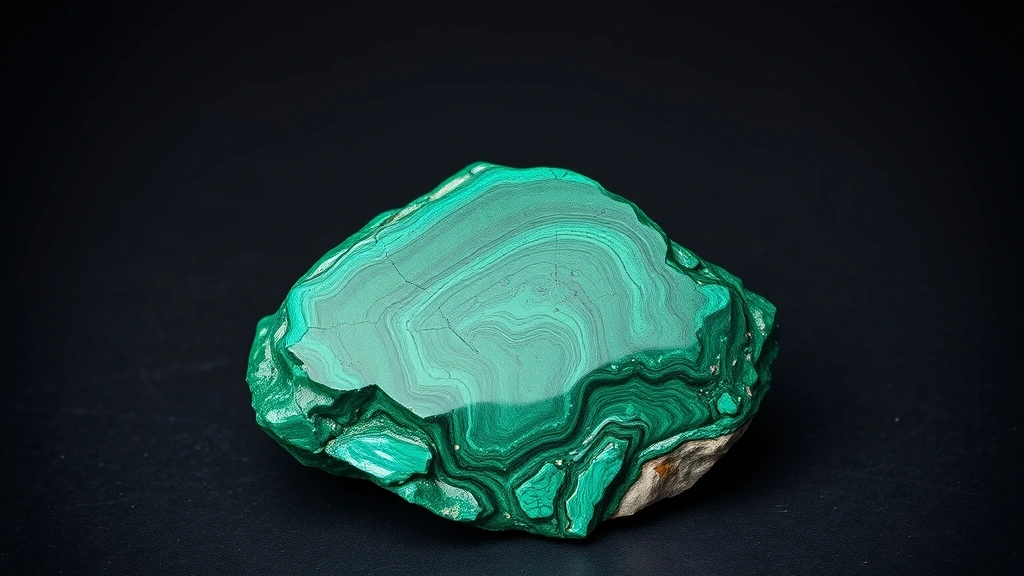
Malachite belongs to the carbonate mineral group, specifically forming as a secondary mineral in the oxidized zones of copper deposits. It frequently occurs alongside azurite, another copper carbonate, within the same geological environments. This stone forms through the weathering of primary copper sulfide ores, creating distinctive banded patterns. Its geological origin is strictly tied to hydrothermal activity and surface oxidation processes.
What is Malachite Gemstone? Geological Overview & Definition
Malachite is defined as a secondary copper mineral that forms in the supergene enrichment zones of copper deposits. It typically appears as botryoidal masses, drusy crusts, or fibrous aggregates rather than large single crystals. The banded structure results from alternating layers of varying copper concentrations during precipitation.
Geologically, it is a key indicator of oxidized copper ore bodies, often found in arid or semi-arid climates. The mineral’s formation is driven by the reaction of groundwater with copper-bearing rocks. This process creates the characteristic deep green coloration that defines its visual identity.
Malachite Gemstone Chemical Composition & Crystallographic Properties
Malachite crystallizes in the monoclinic system, though it rarely forms distinct prismatic crystals. Instead, it predominantly occurs as botryoidal banded aggregates or fibrous masses. The internal lattice structure is defined by a specific arrangement of copper and carbonate ions. This structural complexity contributes to its unique optical properties.
The chemical formula Cu₂CO₃(OH)₂ indicates a basic copper carbonate structure with hydroxyl groups. The chromophore responsible for its intense green color is the copper ion (Cu²⁺). This cation creates specific electronic transitions that absorb light in the red and blue spectra. No significant cation substitution occurs in pure malachite, maintaining its stoichiometric integrity.
Malachite is highly sensitive to acidic environments, which can dissolve the carbonate component. Thermal behavior is limited by its low Mohs hardness and chemical instability. Heating can cause decomposition, releasing water and carbon dioxide. Consequently, it requires careful handling to preserve its structural and aesthetic integrity.
| Property | Specification |
|---|---|
| Mineral Group | Carbonates (Basic Copper Carbonate) |
| Chemical Formula | Cu₂CO₃(OH)₂ (Basic Copper Carbonate) |
| Mohs Hardness | 3.5 – 4.0 |
| Crystal System | Monoclinic (Prismatic or botryoidal banded aggregates) |
| Specific Gravity (Density) | 3.60 – 4.05 |
| Refractive Index | 1.655 – 1.909 |
| Color & Optical Properties | Natural Malachite Gemstone color spectrum and optical dispersion |
| Primary Mining Localities | DR Congo (Katanga), Namibia, Australia, Russia (Ural) |
| Water & Chemical Resistance | CAUTION: Toxic Copper Content (Keep away from hot, acidic, or saline water) |
| Chakra Alignment (Traditional) | Heart Chakra (Anahata) |
| Zodiac Affinity (Traditional) | Scorpio, Capricorn, Taurus |
| Symbolic Meaning (Traditional) | Deep emotional transformation, psychic barrier, and heart healing |
Malachite Gemstone Varieties & Color Spectrum
Malachite exhibits a diverse range of visual characteristics, primarily defined by its distinct banding patterns and structural formations. The mineral’s appearance is heavily influenced by the specific geological conditions during its formation within oxidized copper deposits. Understanding these variations is essential for accurate gemological identification and valuation.
Banded Malachite
Banded malachite features concentric rings of varying green shades, created by periodic changes in mineral deposition. This banded structure is the most commercially desirable form for cabochon cutting and ornamental use. The alternating light and dark bands provide a striking visual contrast that enhances its aesthetic appeal.
Botryoidal Malachite
Botryoidal malachite forms rounded, grape-like clusters that often resemble moss or cauliflower in texture. These botryoidal aggregates typically lack distinct banding and offer a more uniform, deep green appearance. This variety is highly prized for its organic, sculptural quality in lapidary work.
Fibrous Malachite
Fibrous malachite consists of fine, hair-like crystals that radiate from a central point or form dense tufts. This fibrous habit often results in a velvety or silky luster when polished. It is less common in high-quality gem material due to its delicate structural integrity.
Massive Malachite
Massive malachite appears as large, solid blocks without visible crystal structure or distinct banding. This massive form is frequently found in large deposits and is ideal for carving into statues or decorative objects. Its uniform coloration makes it a popular choice for artistic applications.
Where is Malachite Gemstone Found? Geological Mining & Extraction
Malachite primarily occurs in the oxidized zones of copper deposits, where groundwater interacts with primary sulfide minerals. It typically forms in veins and cavities within host rocks such as limestone, dolomite, or granite. The mineral is often associated with azurite and other secondary copper minerals in these geological settings.
Major global sources include the Ural Mountains in Russia, the Democratic Republic of Congo, and Arizona in the United States. The Ural Mountains remain historically significant for producing high-quality, banded specimens. Modern extraction focuses on both gem-quality material and industrial copper ore processing byproducts.
Historical Significance & Cultural Lore of Malachite Gemstone
Ancient civilizations, including the Egyptians and Romans, valued malachite for its vibrant green color and protective properties. It was commonly used in funerary artifacts and jewelry, symbolizing fertility and protection against evil spirits. Archaeological findings reveal its widespread use in amulets and decorative objects across multiple cultures.
Throughout history, malachite has been associated with emotional healing and spiritual balance in various esoteric traditions. It was believed to absorb negative energy and promote clarity of thought. This enduring legacy continues to influence its popularity in contemporary metaphysical practices.
Modern Uses & Jewelry Applications of Malachite Gemstone
Due to its Mohs hardness of 3.5 – 4.0, malachite is primarily cut into smooth, polished cabochons rather than faceted gems. This approach preserves the stone’s distinctive banded patterns and prevents chipping during wear. Lapidaries often use it for ornamental carvings, inlays, and architectural accents due to its vibrant green coloration.
- Cabochon Cutting: The most common form, showcasing the natural concentric banding and eye-like patterns.
- Ornamental Carving: Used for small sculptures, beads, and decorative panels in Art Deco and Victorian jewelry.
- Inlay Work: Frequently set into silver or gold frames to protect the soft surface from abrasion.
- Architectural Accents: Historically used in decorative tiles and interior design elements for its striking visual impact.
Metaphysical Properties & Traditional Meaning of Malachite Gemstone
According to historical traditions and metaphysical lore, malachite is revered as a stone of deep emotional transformation and protection. Practitioners believe it acts as a psychic barrier, shielding the wearer from negative energies and emotional toxicity. This mineral is often associated with facilitating heart healing and encouraging the release of stored grief.
The stone’s intense green hue resonates with the Heart Chakra (Anahata), promoting balance and compassion. Traditional healers suggest that malachite helps users confront difficult truths, fostering spiritual attributes of clarity and resilience. It is considered a powerful tool for navigating significant life changes and emotional upheavals.
Which Chakra and Zodiac Signs Align with Malachite Gemstone?
Malachite is canonically aligned with the Heart Chakra (Anahata), which governs love, compassion, and emotional equilibrium. This connection stems from the stone’s vibrant green color, which mirrors the energy center’s traditional hue. By stimulating this chakra, malachite is believed to enhance interpersonal relationships and self-acceptance.
In astrological practice, this mineral is specifically linked to Scorpio, Capricorn, and Taurus. These earth and water signs benefit from malachite’s grounding yet transformative energy. Scorpios appreciate its depth, Capricorns value its stability, and Taurus resonates with its natural beauty. No other zodiac signs are traditionally associated with this specific stone.
How to Identify Real vs. Fake Malachite Gemstone
Artificial imitations of malachite are common due to the stone’s popularity and relatively low cost. Counterfeiters often use synthetic glass, dyed jasper, or plastic composites to mimic the natural banded appearance. These fakes may look convincing to the untrained eye but lack the specific mineralogical properties of genuine basic copper carbonate.
Practical At-Home Authenticity Tests
- Temperature Test (Thermal Feel): Genuine malachite feels cool to the touch initially and warms slowly. Plastic imitations tend to feel warmer immediately and do not retain cold temperatures as effectively as natural stone.
- Specific Gravity & Weight Test: Real malachite has a density of 3.60 – 4.05, making it feel significantly heavier than its size suggests. Glass or plastic replicas are often lighter, so comparing weight against a similarly sized known stone can reveal discrepancies.
- Scratch & Hardness Test (Mohs Comparison): With a Mohs hardness of 3.5 – 4.0, malachite can be scratched by a steel knife or a copper coin. If the stone resists scratching from these tools, it is likely a harder material like glass or quartz.
- Microscopic & Loupe Inspection (Internal Inclusions): Under a 10x loupe, genuine malachite displays distinct, irregular banding and may contain small mineral inclusions. Synthetic glass often shows uniform, bubble-like inclusions or perfectly symmetrical patterns that appear artificial.
Malachite Gemstone Valuation Factors, Grading & Pricing
Color Saturation is the foremost driver of price. Deep, vivid greens with even tone command the highest premiums, while muted or uneven hues reduce value. Luster and optical clarity also matter; a polished surface that reflects light without cloudiness enhances desirability. Collectors seek stones that display a uniform, rich chroma across the entire piece.
Carat Weight influences market price but is secondary to color quality. Larger malachite pieces are rarer, yet heavy stones with poor matrix patterns or asymmetrical facets fetch lower offers. Symmetrical cutting that respects the natural banding maximizes visual impact and resale value. Inclusions of quartz or calcite are tolerated when they add decorative contrast rather than detract from overall brilliance.
Geographical Provenance Premium can add 15‑30 % to a stone’s price, especially when sourced from classic localities such as the Democratic Republic of Congo, Zambia, or the Russian Urals. Provenance documentation reassures buyers of ethical mining and authenticity, driving higher wholesale and retail rates. Market trends show steady demand for responsibly sourced malachite, with prices rising modestly each year as supply tightens.
How to Clean and Care for Malachite Gemstone
Malachite is a soft copper carbonate mineral. Never soak it in water, and keep it strictly away from ultrasonic and steam cleaners, as moisture can dissolve the surface and damage the stone’s luster. Use a soft, lint‑free cloth to gently wipe away dust, applying only light pressure to avoid scratching. Store the gemstone in a padded, airtight pouch separate from harder minerals to prevent abrasion.
Cleansing and Recharging Malachite Gemstone (Energetic Care)
Because malachite is water‑sensitive, dry energetic cleansing is safest. Pass the stone through smoke smudging from sage or palo santo, allowing the gentle ash to clear lingering negative energies without introducing moisture.
For recharging, place the gemstone on a selenite plate or under moonlight for several hours; both methods restore vibrational balance while respecting the mineral’s solubility limits.
Frequently Asked Questions About Malachite Gemstone
Is malachite safe to wear in the shower?
No, you should strictly avoid exposing malachite to hot water, steam, or acidic shower products. The mineral’s basic copper carbonate structure is chemically unstable when subjected to heat or moisture. Prolonged exposure can cause the vibrant green bands to fade or degrade. Always remove jewelry before bathing to preserve its integrity.
Can I clean malachite in an ultrasonic cleaner?
Absolutely not, as ultrasonic vibrations and steam cleaners will permanently damage this soft mineral. Malachite has a Mohs hardness of only 3.5 to 4.0, making it highly susceptible to physical shock. Instead, use a dry, soft cloth for gentle dusting. Never submerge the stone in liquid solutions of any kind.
Which zodiac signs are compatible with malachite?
Malachite is traditionally aligned with Scorpio, Capricorn, and Taurus. These earth and water signs resonate with the stone’s grounding and transformative energies. Taurus appreciates its stability, while Scorpio connects with its depth. Capricorn benefits from its disciplined, protective qualities during challenging periods.
Which chakra does malachite activate?
Malachite is primarily associated with the Heart Chakra (Anahata). This energy center governs love, compassion, and emotional balance. The stone’s vibrant green color mirrors the heart’s frequency, promoting emotional transformation. It helps clear blockages and fosters a sense of inner peace and healing.
What is the chemical composition of malachite?
Malachite is a basic copper carbonate with the formula Cu₂CO₃(OH)₂. This composition gives it its distinctive, bright green coloration. It typically forms in the oxidized zones of copper ore deposits. The monoclinic crystal system often manifests as botryoidal, banded aggregates rather than distinct geometric crystals.
How hard is malachite on the Mohs scale?
Malachite rates between 3.5 and 4.0 on the Mohs hardness scale. This makes it a relatively soft gemstone that scratches easily. You must handle it with care to avoid surface abrasions. Its density ranges from 3.60 to 4.05, contributing to its substantial feel in the hand.
Does malachite have a high refractive index?
Yes, malachite exhibits a high refractive index ranging from 1.655 to 1.909. This property contributes to its strong luster and visual depth. The banded structure creates unique light reflections that enhance its aesthetic appeal. Jewelers often cut it into cabochons to maximize this optical effect.
Is malachite toxic to humans?
Malachite contains copper, which can be toxic if ingested or absorbed in large quantities. While safe for external jewelry use, you must keep it away from open wounds. Toxic copper content requires caution during handling. Avoid wearing it if you have a known copper allergy or sensitive skin.