
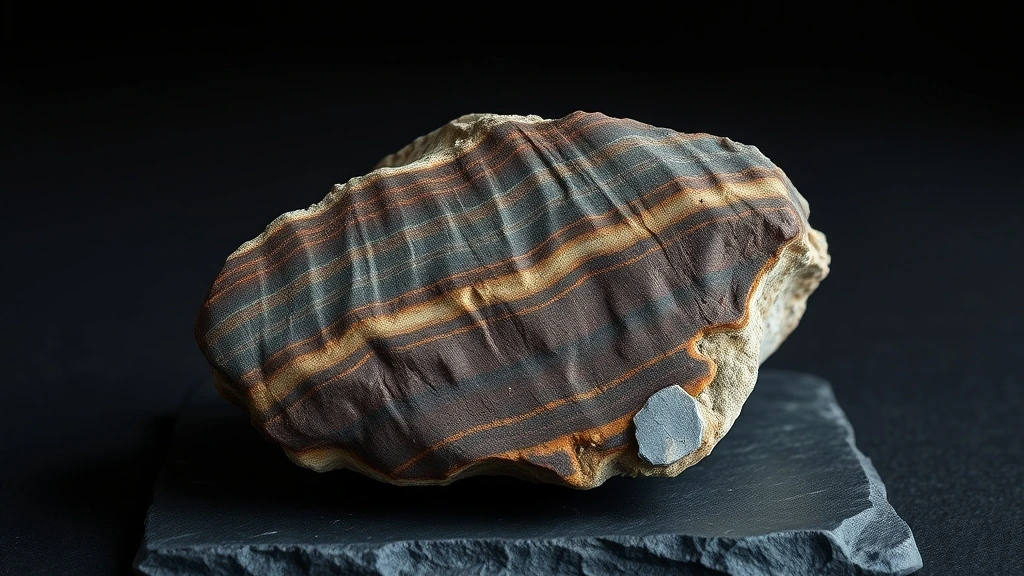
Banded Iron Formation is a sedimentary rock that records ancient oceanic chemistry. It belongs to the broader Natural Mineral / Crystal group, yet it is not a single mineral species but an aggregate of iron oxides, silicates, and occasionally organic matter. The rhythmic layering reflects periodic changes in seawater oxygenation and microbial activity during the Precambrian and early Paleozoic eras.
What is Banded Iron Formation? Geological Overview & Definition
Banded Iron Formation is a sedimentary rock characterized by alternating layers of iron‑rich minerals and silica‑rich chert. These strata record ancient fluctuations in atmospheric oxygen and microbial metabolism, providing a window into early Earth history. The iron layers are typically composed of hematite or magnetite, while the chert layers are primarily silica (SiO₂). BIFs are most abundant in Precambrian strata, especially in the Canadian Shield and the Baltic Shield.
Banded Iron Formation Chemical Composition & Crystallographic Properties
The mineral constituents of BIFs crystallize in the Trigonal system, a subset of the hexagonal crystal family. Hematite (α‑Fe₂O₃) adopts a rhombohedral lattice with space group R3̅c, while magnetite (Fe₃O₄) crystallizes in the cubic system; however, the overall rock is dominated by the trigonal symmetry of its iron oxide layers. Cation substitution occurs mainly between Fe²⁺ and Fe³⁺ within the lattice, influencing magnetic properties and color. The iron oxides are acid‑resistant, but prolonged exposure to strong acids can leach Fe²⁺, altering the rock’s hue. Chromophore color centers arise from Fe²⁺–Fe³⁺ charge transfer, giving BIFs their characteristic reds and browns. Upon heating, the iron oxides undergo phase transitions: hematite can transform to magnetite at ~800 °C, while chert recrystallizes into quartz. These thermal behaviors are critical for understanding metamorphic overprints in ancient terranes.
| Property | Specification |
|---|---|
| Mineral Group | Natural Mineral / Crystal |
| Mohs Hardness | 6.5 – 7.0 |
| Crystal System | Trigonal |
| Color & Optical Properties | Natural Banded Iron Formation color spectrum and optical dispersion |
| Primary Mining Localities | Global primary localities |
| Water & Chemical Resistance | High (Safe for gentle water washing) |
| Chakra Alignment (Traditional) | Third Eye Chakra (Ajna) |
| Zodiac Affinity (Traditional) | Cancer, Pisces |
| Symbolic Meaning (Traditional) | Clear communication, truth and serenity |
Banded Iron Formation Varieties & Color Spectrum
Banded iron formations (BIFs) are sedimentary rocks characterized by alternating layers of iron-rich and silica-rich minerals. These ancient deposits typically exhibit a trigonal crystal system in their primary iron oxide components. The visual appeal stems from the rhythmic banding created by varying oxidation states during deposition.
Cape Type BIFs
The Cape Type BIFs, found primarily in South Africa, display distinct red and grey banding patterns. These layers consist of hematite and chert, forming a striking visual contrast. The red bands indicate oxidized iron, while the grey layers represent reduced silica-rich material.
Superior Type BIFs
Superior Type BIFs, located in North America, feature thicker and more continuous iron bands. These formations often contain magnetite alongside silica, creating a darker, more uniform appearance. The banding in these deposits is typically less rhythmic than in Cape Type examples.
Pilbara Type BIFs
Pilbara Type BIFs from Australia are known for their fine-grained, laminated structure. These rocks often exhibit a micaceous texture due to the presence of fine clay minerals. The banding is extremely thin, requiring magnification to appreciate the full geological detail.
Hamersley Basin BIFs
The Hamersley Basin in Western Australia hosts some of the most extensive BIF deposits globally. These formations are characterized by goethite and limonite overburden on older hematite cores. The weathering process creates a rusty orange surface layer over the darker interior rock.
Superior Group Chert
Superior Group Chert varieties emphasize the silica-rich bands within the BIF structure. These rocks are valued for their cryptocrystalline quartz composition and smooth fracture surfaces. The interbedded iron oxides provide subtle color variations within the white or grey matrix.
Pilbara Chert
Pilbara Chert is distinguished by its high purity and fine lamination. This variety often contains microfossils and stromatolite structures, adding biological interest to the mineralogical profile. The silica bands are exceptionally hard and resistant to weathering, preserving intricate details.
Where is Banded Iron Formation Found? Geological Mining & Extraction
Banded iron formations are predominantly hosted in Precambrian sedimentary basins across several continents. These ancient deposits are typically found in stable cratonic regions where tectonic activity was minimal during deposition. The host rocks often include shale and dolomite, which help preserve the delicate banding structures.
Primary extraction occurs in major mining districts such as the Pilbara Craton in Australia and the Superior Province in North America. Open-pit mining is the standard method for accessing these massive, near-surface deposits. The extracted material is processed to separate iron oxides from silica for industrial and ornamental use.
Historical Significance & Cultural Lore of Banded Iron Formation
Ancient civilizations utilized the iron-rich bands of BIFs as a primary source for early smelting and tool production. Archaeological evidence from Mesopotamia and the Indus Valley reveals the use of these ores in bronze-age metallurgy. The distinct banding was often interpreted as a record of primordial geological processes by early natural philosophers.
In Vedic traditions, the rhythmic layering of these rocks was sometimes associated with cosmic order and cyclical time. The Egyptian use of iron from meteorites and terrestrial sources highlights the material’s prestige in ritual contexts. The enduring appeal of BIFs lies in their unique combination of geological age and aesthetic regularity.
Modern Uses & Jewelry Applications of Banded Iron Formation
Banded iron formation (BIF) is prized for its striking, layered appearance, making it a favorite in lapidary circles. Artisans cut it into smooth cabochons for pendants and earrings, while others facet it to accentuate the natural banding. The stone’s moderate hardness (6.5–7.0 on the Mohs scale) allows for precise carving, producing ornamental pieces such as carved figurines and decorative panels.
- Cabochon cuts emphasize the vivid color bands.
- Faceted stones reveal subtle light play across layers.
- Carved ornaments showcase the stone’s structural elegance.
Metaphysical Properties & Traditional Meaning of Banded Iron Formation
According to historical traditions and metaphysical lore, BIF is associated with clear communication, truth, and serenity. Across ancient Mediterranean and Vedic lapidary lore, the stone is believed to calm emotional turbulence and enhance intellectual clarity. Its banded structure is seen as a visual metaphor for the integration of dualities, fostering balance between the material and the spiritual realms.
Which Chakra and Zodiac Signs Align with Banded Iron Formation?
The stone aligns with the Third Eye Chakra (Ajna), a center of intuition and insight. This correspondence encourages the wearer to develop perceptive awareness and inner vision.
The canonical zodiac signs associated with BIF are Cancer and Pisces. These water signs resonate with the stone’s calming properties, supporting emotional healing and compassionate empathy.
How to Identify Real vs. Fake Banded Iron Formation
Artificial imitations of BIF often appear as synthetic glass or dyed quartz, lacking the natural banding and mineral inclusions of authentic specimens. Synthetic replicas may exhibit uniform coloration and a smooth, glassy texture that differs from the stone’s characteristic earthy feel.
Practical At-Home Authenticity Tests
- Temperature Test (Thermal Feel): Hold the stone in your hand; a genuine BIF will feel cool due to its iron content, whereas glass will warm quickly.
- Specific Gravity & Weight Test: Compare the stone’s weight to a known quartz sample of similar size; BIF typically feels heavier.
- Scratch & Hardness Test (Mohs Comparison): Use a steel nail or quartz crystal; BIF should resist scratching, matching its 6.5–7.0 hardness.
- Microscopic & Loupe Inspection (Internal Inclusions): Under magnification, authentic BIF displays fine iron oxide inclusions and layered textures, unlike the uniform surface of synthetic glass.
Banded Iron Formation Valuation Factors, Grading & Pricing
The Color Saturation of a Banded Iron Formation (BIF) specimen drives its market appeal; deeper reds, rich ochres, and striking band contrast signal high visual vibrancy. Collectors prize a natural energetic luster that appears to shimmer when light catches the iron‑rich layers, enhancing perceived rarity. Specimens with uniform, vivid hues command premium prices, while muted or weathered tones are priced lower.
Crystal Size & Weight (Grams) is the second key metric, with larger, heavier pieces offering greater presence on display. Raw, unpolished BIF retains its geological authenticity and often sells for less than a tumbled, high‑gloss polish that reveals the banding’s full brilliance. Natural matrix inclusions such as quartz veins or fossil fragments add character, but excessive fracture or fragmentation reduces value.
The Ethical Sourcing & Locality Premium reflects growing collector demand for responsibly mined material. Specimens sourced from historically significant iron‑formation belts—such as the Precambrian ranges of Western Australia or the Lake Superior region—carry a provenance premium. Transparent supply chains, minimal environmental impact, and fair‑trade practices further elevate price, especially in holistic markets that value both aesthetic and metaphysical integrity.
How to Clean and Care for Banded Iron Formation
Cleaning Banded Iron Formation is straightforward: gently wash the piece in warm soapy water, using a soft cloth to remove surface dust without abrasive pressure. Rinse briefly with clean lukewarm water and pat dry with a lint‑free microfiber towel, ensuring no water remains trapped in band crevices. Ultrasonic cleaners should be avoided, as the rapid vibrations can cause micro‑fractures in the delicate iron‑oxide layers.
Cleansing and Recharging Banded Iron Formation (Energetic Care)
For holistic upkeep, place the specimen in a quiet space and allow gentle moonlight to bathe it for a few hours, a practice believed to refresh its subtle energetic field without thermal stress. Alternatively, a brief session of herbal smudging—using sage or cedar—can clear lingering static, provided the smoke is diffused and the stone is not exposed to direct flame.
Resting the BIF on a clean selenite charging slab for a short period each month is another safe method to renew its vibrational balance; the selenite’s neutral lattice imparts a subtle, non‑invasive energy boost. These dry, low‑impact techniques honor both the mineral’s physical integrity and its metaphysical reputation.
Frequently Asked Questions About Banded Iron Formation
Banded Iron Formation displays distinct mineralogical characteristics across its geological varieties and structural habits. Gemologists evaluate these natural varieties based on crystal habit, trace chromophore concentrations, and visual luster.
Primary Natural Banded Iron Formation
The benchmark natural variety exhibiting diagnostic color saturation and classic crystallographic symmetry.
Distinct Geological Morphs of Banded Iron Formation
Secondary regional and structural varieties formed under localized geological temperature and pressure conditions.
Is banded iron formation safe to wear in the shower?
Yes, it tolerates gentle water exposure. The mineral’s trigonal crystal structure and moderate hardness (6.5‑7) allow safe rinsing with lukewarm water, but prolonged soaking or harsh detergents should be avoided to preserve surface luster.
How should I clean banded iron formation jewelry?
Use warm soapy water and a soft cloth, then pat dry. This method removes oils without stressing the stone; ultrasonic cleaners are discouraged because rapid vibrations can induce micro‑fractures in the layered iron‑rich matrix.
Can ultrasonic cleaners be used on banded iron formation?
No, ultrasonic cleaning is not recommended. The high‑frequency waves may cause delamination within the alternating iron‑oxide bands, leading to visible cracks that compromise both appearance and structural integrity.
What zodiac signs are associated with banded iron formation?
Cancer and Pisces are the aligned signs. In astrological tradition, these water signs are thought to resonate with the stone’s calming energy, supporting emotional flow and intuitive insight.
Which chakra does banded iron formation activate?
It is linked to the Third Eye Chakra (Ajna). This center governs perception and inner vision, and the stone’s deep, earthy tones are believed to enhance mental clarity and spiritual awareness.
Does banded iron formation have good durability for everyday wear?
Its Mohs hardness of 6.5‑7 offers solid wear resistance. While tougher than many ornamental stones, it can still be scratched by harder materials like quartz or diamond, so storage apart from such gems is advisable.
Is banded iron formation prone to staining or discoloration?
It is relatively resistant to staining. The iron‑oxide layers provide natural protection, yet prolonged contact with acidic substances (e.g., citrus juices or perfume) may cause slight surface dulling over time.
Can banded iron formation be set in metal without risk of damage?
Yes, it can be securely set in most precious metals. Jewelers typically use bezel or channel settings that distribute stress evenly, minimizing the chance of fracture in the stone’s layered structure.