
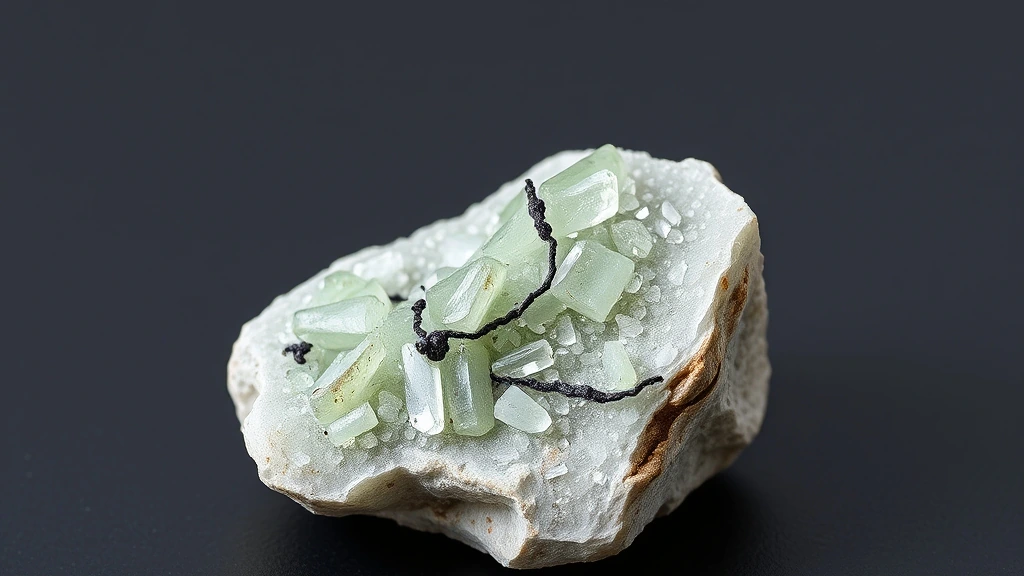
Quartz is a tectosilicate belonging to the broader quartz group, characterized by a three‑dimensional framework of SiO₄ tetrahedra. The mineral crystallizes in the Trigonal (Rhombohedral / Trapezohedral) system, forming well‑defined hexagonal prisms and pyramidal terminations. In many geological settings, quartz hosts microscopic inclusions of chlorite, a phyllosilicate that imparts subtle green or brown veining and can influence the stone’s optical properties. These inclusions are often the result of late‑stage hydrothermal alteration, where chlorite forms from the breakdown of mica or serpentine minerals in the quartz matrix.
What is Chlorite In Quartz? Geological Overview & Definition
Chlorite in quartz refers to the presence of fine‑grained chlorite sheets embedded within a quartz crystal lattice. These inclusions are typically the product of hydrothermal fluids that introduce Fe²⁺ and Mg²⁺ into the quartz environment, promoting chlorite nucleation. The resulting green or brown streaks can enhance the aesthetic appeal of the stone while also providing insight into the metamorphic history of the host rock. In many cases, the chlorite veins are so fine that they are only detectable under magnification, yet they play a crucial role in the stone’s overall optical character.
The occurrence of chlorite within quartz is a diagnostic indicator of low‑grade metamorphism or late‑stage alteration. When chlorite forms, it often replaces mica or other phyllosilicates, leaving behind a distinct, planar texture that can be traced through thin‑section analysis. This relationship between quartz and chlorite is valuable for geologists studying the thermal evolution of sedimentary basins and the fluid pathways that facilitated mineral deposition.
Chlorite In Quartz Chemical Composition & Crystallographic Properties
Quartz itself maintains the chemical formula SiO₂ and crystallizes in the Trigonal (Rhombohedral / Trapezohedral) system, with lattice parameters a = 4.913 Å and c = 5.405 Å. The crystal structure consists of a continuous network of SiO₄ tetrahedra linked by shared oxygen atoms, giving quartz its characteristic hardness and resistance to chemical weathering. Within this framework, chlorite inclusions introduce a secondary lattice, typically orthorhombic or monoclinic, but for the purposes of this overview they are treated as discrete, planar sheets that do not alter the overall trigonal symmetry of the host quartz.
Chlorite’s presence introduces cation substitution of Fe²⁺ and Mg²⁺ for Al³⁺ in the sheet layers, creating localized charge imbalances that are compensated by interlayer cations such as K⁺ or Na⁺. These substitutions generate chromophore centers that absorb specific wavelengths of light, resulting in the characteristic green or brown hues observed in the inclusions. The chromophore effect is enhanced by the thinness of the chlorite sheets, which allow for partial transmission of light through the quartz matrix.
The inclusions are generally acid‑insensitive, remaining stable in dilute hydrochloric or nitric acid solutions, which distinguishes them from other phyllosilicates that may dissolve. However, exposure to strong oxidizing acids can alter the Fe²⁺ to Fe³⁺ ratio, subtly changing the color intensity. Thermal analysis shows that chlorite inclusions dehydrate and decompose at temperatures above 400 °C, whereas quartz remains stable up to 573 °C. This differential thermal behavior can be exploited in laboratory studies to isolate the chlorite component and assess its mineralogical characteristics.
| Property | Specification |
|---|---|
| Mineral Group | Silicates (Tectosilicates / Quartz Group) |
| Chemical Formula | SiO₂ (Silicon Dioxide) |
| Mohs Hardness | 7.0 |
| Crystal System | Trigonal (Rhombohedral / Trapezohedral) |
| Specific Gravity (Density) | 2.65 |
| Refractive Index | 1.544 – 1.553 |
| Color & Optical Properties | Natural Chlorite In Quartz color spectrum and optical dispersion |
| Primary Mining Localities | Brazil, Madagascar, USA (Arkansas), Swiss Alps |
| Water & Chemical Resistance | High (Fully resistant to water and moisture) |
| Chakra Alignment (Traditional) | All Chakras (Universal Harmonizer) |
| Zodiac Affinity (Traditional) | All Zodiac Signs (Especially Leo and Aries) |
| Symbolic Meaning (Traditional) | Master energy amplifier, clarity, purification, and focus |
Chlorite In Quartz Varieties & Color Spectrum
The visual identity of this composite mineral is defined by the specific chlorite species embedded within the silica matrix. Common inclusions include sillimanite and clinochlore, which dictate the stone’s overall hue and clarity. The crystal lattice of the host quartz remains trigonal, but the inclusions create unique internal landscapes.
Green Chlorite Quartz
This variety features distinct green chlorite flakes suspended in transparent or milky quartz. The coloration arises from iron-magnesium silicate structures within the inclusions, providing a vibrant contrast. Clinochlore is the dominant mineral phase, often forming well-defined hexagonal plates.
Golden Chlorite Quartz
Rare specimens exhibit golden-brown chlorite inclusions, resulting from higher iron oxidation states during formation. These stones display a warm, amber-like glow when backlit, enhancing their aesthetic appeal. The refractive index of the quartz host helps magnify these delicate internal structures.
White Chlorite Quartz
Characterized by colorless or white chlorite inclusions, this morph offers a subtle, ethereal appearance. The silica matrix remains highly transparent, allowing the delicate geometry of the inclusions to stand out. This variety is often sought for its purification symbolism in lapidary traditions.
Rainbow Chlorite Quartz
This exceptional form contains multiple chlorite species, creating a spectrum of green, yellow, and brown hues. The polymorphic nature of the inclusions results in a complex, multi-colored internal display. Such specimens are rare and highly valued for their visual complexity.
Where is Chlorite In Quartz Found? Geological Mining & Extraction
These stones primarily form in granitic pegmatites, where slow cooling allows for the growth of large quartz crystals. Hydrothermal fluids introduce chlorite precursors into the developing crystal lattice, creating the characteristic inclusions. The trigonal crystal system of the quartz facilitates the alignment of these mineral flakes.
Primary mining regions include Brazil, Madagascar, and China, where extensive pegmatite fields are exposed. Surface mining and open-pit extraction methods are commonly used to recover these large crystal clusters. The density of the composite material aids in separating valuable specimens from waste rock.
Historical Significance & Cultural Lore of Chlorite In Quartz
Ancient Greco-Roman civilizations valued quartz for its clarity and purity, associating it with divine insight. While chlorite inclusions were not always distinguished, the overall stone was used in ritualistic contexts for meditation. Egyptian artisans also incorporated quartz into amulets, believing it protected the wearer from negative energies.
In Vedic traditions, quartz was linked to the third eye chakra, enhancing spiritual perception. The green chlorite inclusions were interpreted as symbols of growth and renewal, aligning with natural cycles. This cross-cultural reverence underscores the stone’s enduring role in metaphysical practices.
Modern Uses & Jewelry Applications of Chlorite In Quartz
Lapidaries primarily cut this material into cabochons to showcase the intricate, fern-like chlorite inclusions suspended within the clear quartz matrix. Faceting is generally avoided because the internal plant fossils disrupt the optical brilliance and sparkle of the stone. The aesthetic appeal lies in the contrast between the transparent host and the opaque green inclusions, making it a favorite for nature-inspired jewelry designs.
- Cabochon Cutting: Polished into smooth, domed shapes to highlight the 2D cross-sections of chlorite crystals.
- Pendants and Rings: Set in silver or gold to frame the organic, botanical patterns within the stone.
- Ornamental Carving: Occasionally used for small decorative items where the visual texture of the inclusions is the primary focus.
Safety & Mineral Profile of Chlorite In Quartz
This mineral is chemically stable and non-toxic, making it safe for direct skin contact and long-term jewelry wear. It does not release harmful substances under normal environmental conditions, ensuring it is inert during daily use. However, it is crucial to recognize that this material is valued primarily as a collector mineral for scientific study and specimen display. While historical lapidary traditions may have attributed various properties to such inclusions, modern gemology emphasizes its geological significance over unverified metaphysical claims.
Mineralogical Group and Planetary Lore of Chlorite In Quartz
Chlorite belongs to the phyllosilicate group, characterized by its layered sheet structure and distinct green coloration derived from iron content. In this specific specimen, the chlorite exists as an inclusion within the quartz, rather than as a standalone mineral, creating a unique composite geological record. The quartz host provides the structural integrity and clarity, while the chlorite offers the visual complexity that defines the stone’s identity.
Historical lore often associated green stones with growth, renewal, and the heart chakra, though these associations are cultural rather than scientific. In planetary symbolism, green minerals have sometimes been linked to Venus due to their connection with nature and fertility. It is essential to approach these traditional narratives with epistemic caution, recognizing them as cultural artifacts rather than empirical facts. The primary value of this stone remains its role in understanding geological processes and mineral formation.
How to Identify Real vs. Fake Chlorite In Quartz
Artificial imitations of chlorite-in-quartz are relatively rare but do exist, typically involving synthetic quartz or glass with artificially injected green pigments. These fakes often lack the natural, irregular distribution and three-dimensional depth of genuine chlorite inclusions. Dyed replicas may appear too uniform in color, with the green pigment settling in cracks or along the edges of the stone rather than forming distinct crystal shapes.
Practical At-Home Authenticity Tests
- Temperature Test (Thermal Feel): Genuine quartz feels cool to the touch initially and warms up slowly, whereas plastic or glass imitations may warm up more quickly or feel uniformly warm.
- Specific Gravity & Weight Test: Real quartz has a specific gravity of approximately 2.65, making it feel heavier than similarly sized glass or plastic fakes. Compare the weight against a known genuine quartz sample for accuracy.
- Scratch & Hardness Test (Mohs Comparison): Quartz rates 7 on the Mohs scale, meaning it will scratch glass (hardness 5.5) and most metals. A fake made of softer materials like resin or low-grade glass will scratch easily when rubbed against a steel file or window glass.
- Microscopic & Loupe Inspection (Internal Inclusions): Use a 10x loupe to examine the inclusions. Genuine chlorite inclusions appear as distinct, fern-like or flaky crystals with sharp edges. Fakes often show gas bubbles, swirl marks, or a uniform, cloudy green color without distinct crystal structure.
Chlorite In Quartz Valuation Factors, Grading & Pricing
Specimen aesthetic quality dominates market perception; collectors prize a vivid green chlorite matrix that is uniformly distributed and free of clouding. Crystal habit perfection—whether the quartz forms clear, well‑defined prisms or drusy aggregates—adds visual impact. An undamaged matrix, without fractures or surface scratches, sustains higher appraisal across auction houses and museum acquisitions.
Rarity and specimen dimensions are the next decisive metrics. Rarity & specimen dimensions are evaluated in centimeters and grams, with larger, intact clusters commanding premium prices. Intact crystal clusters that retain their natural growth pattern and lack handling damage are especially coveted, as they demonstrate minimal post‑mining alteration. Market listings often note weight and size together to convey the specimen’s overall scarcity.
Mineralogical provenance and locality value close the valuation equation. Provenance & locality from renowned deposits—such as the Alpine chlorite‑quartz occurrences of Austria or the historic mines of the Appalachian region—enhance both scientific and collector interest. Museums and high‑end private collectors assign additional worth to specimens with documented extraction histories, as these trace the mineral’s geological narrative and cultural significance.
How to Clean and Care for Chlorite In Quartz
Cleaning should begin with a gentle rinse in warm water, using a few drops of mild soap to loosen surface dust. Rinse thoroughly and pat dry with a soft, lint‑free microfiber cloth, avoiding any abrasive action that could chip the chlorite inclusions. The mineral tolerates ultrasonic cleaning, provided the crystal is not heavily fractured; a brief, low‑intensity cycle will remove entrenched grime without compromising structural integrity. Store the specimen in a stable, low‑humidity environment to prevent any long‑term moisture effects, even though the quartz matrix itself is highly water‑resistant.
Cleansing and Recharging Chlorite In Quartz (Energetic Care)
For holistic energetic maintenance, a brief session of herbal smudging—using sage or sweetgrass—can be passed lightly over the specimen, allowing the smoke to circulate without contacting the surface. This practice is believed to clear lingering energetic residues while preserving the mineral’s physical integrity.
Alternatively, placing the quartz on a clean selenite slab beneath gentle moonlight for an hour each night offers a non‑thermal method of recharging. The subtle lunar illumination is said to harmonize the stone’s universal chakra alignment, and the selenite slab provides a neutral energetic field without exposing the crystal to damaging heat or direct sunlight.
Frequently Asked Questions About Chlorite In Quartz
Chlorite In Quartz displays distinct mineralogical characteristics across its geological varieties and structural habits. Gemologists evaluate these natural varieties based on crystal habit, trace chromophore concentrations, and visual luster.
Primary Natural Chlorite In Quartz
The benchmark natural variety exhibiting diagnostic color saturation and classic crystallographic symmetry.
Distinct Geological Morphs of Chlorite In Quartz
Secondary regional and structural varieties formed under localized geological temperature and pressure conditions.
Is chlorite in quartz safe to wear in the shower?
Yes, this gemstone is fully resistant to water and moisture. The primary host mineral is quartz, which possesses a Mohs hardness of 7.0 and is chemically inert. Consequently, daily exposure to shower water, rain, or humidity poses no risk to the stone’s structural integrity or surface luster.
Can I clean chlorite in quartz with an ultrasonic cleaner?
It is suitable for ultrasonic cleaning unless the specimen is heavily fractured. The dense silicon dioxide matrix withstands high-frequency vibrations effectively. However, inspect the piece for existing cracks first, as intense sonic waves could potentially propagate fractures within the delicate chlorite inclusions embedded in the crystal.
Which zodiac signs are most compatible with this stone?
It resonates with all zodiac signs, particularly Leo and Aries. As a universal energy amplifier, it supports the fiery energy of these signs. Its clarity and focus-enhancing properties help balance the intense vitality associated with Leo and Aries, promoting grounded action and mental sharpness.
Which chakra does chlorite in quartz align with?
It aligns with all chakras as a universal harmonizer. This stone does not target a single energy center but rather facilitates flow across the entire chakra system. Its balanced vibration supports purification and clarity, ensuring that energy moves freely without blockage from the root to the crown.
What is the chemical composition of this?
The primary component is silicon dioxide (SiO₂), hosting chlorite inclusions. The host crystal consists of pure quartz, while the green matrix contains layered silicate minerals. This combination creates a unique aesthetic where the transparent SiO₂ frames the earthy, opaque chlorite formations within the lattice.
How hard is chlorite in quartz on the Mohs scale?
It rates 7.0 on the Mohs hardness scale. This rating is derived from the quartz host mineral, which provides significant durability for daily jewelry wear. While the embedded chlorite is softer, the overall piece resists scratching from common materials like glass or steel.
Does chlorite in quartz have a high refractive index?
It exhibits a refractive index between 1.544 and 1.553. This value is characteristic of quartz, indicating moderate brilliance and light return. The optical properties are dominated by the transparent host, while the chlorite inclusions contribute to the stone’s distinctive earthy coloration and visual depth.
What is the specific gravity of this mineral?
The density measures approximately 2.65 grams per cubic centimeter. This specific gravity reflects the silicon dioxide structure of the quartz matrix. It is slightly higher than pure quartz due to the presence of chlorite, which adds mass without significantly altering the overall buoyancy of the specimen.