
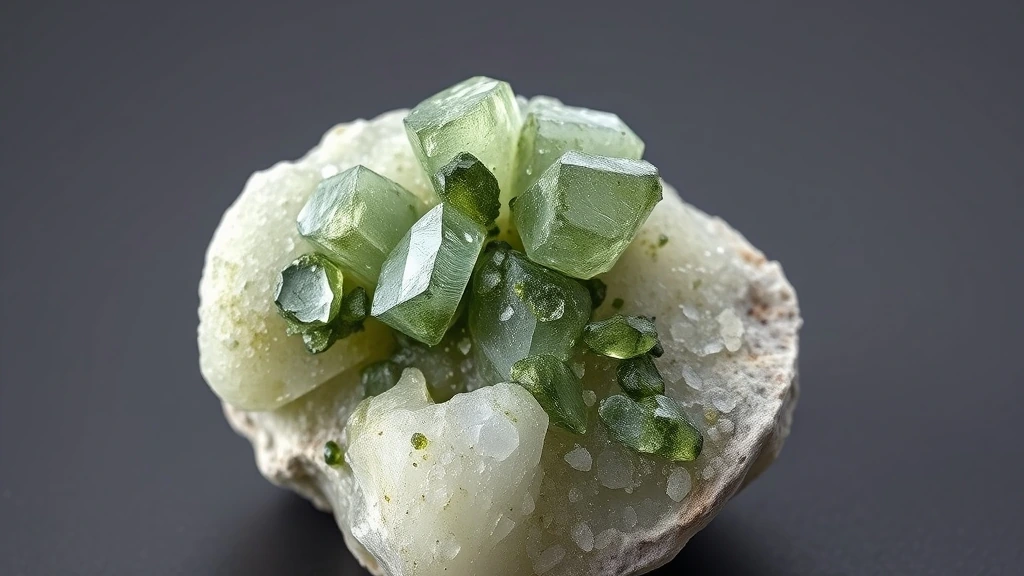
Chlorite on quartz is classified as a silicate aggregate, specifically a tectosilicate belonging to the quartz group. The gemstone derives from the intergrowth of crystalline quartz with chlorite, a phyllosilicate that forms in low‑temperature metamorphic environments. This combination yields a unique visual effect, where the transparent quartz matrix highlights the greenish lamellae of chlorite, creating a striking contrast appreciated by collectors and gemologists alike.
What is Chlorite On Quartz? Geological Overview & Definition
Chlorite on quartz is not a single mineral species but an aggregate of quartz (SiO₂) and chlorite (Mg₃Si₂O₅(OH)₄) crystals. The chlorite component typically forms thin, plate‑like lamellae that are intergrown with the quartz lattice, giving the stone its characteristic greenish sheen.
The formation of this composite occurs in low‑grade metamorphic terrains where chlorite replaces mica or other phyllosilicates under moderate temperatures and pressures. The resulting intergrowths are often preserved in pegmatitic veins or altered volcanic rocks, where quartz crystallizes around chlorite sheets, producing the distinctive “chlorite on quartz” appearance.
Chlorite On Quartz Chemical Composition & Crystallographic Properties
The quartz component of chlorite on quartz crystallizes in the Trigonal (Rhombohedral / Trapezohedral) system, with lattice parameters a ≈ 4.913 Å and c ≈ 5.405 Å. Its crystal structure is characterized by a continuous network of SiO₄ tetrahedra, giving quartz its renowned hardness and optical clarity.
Chlorite, in contrast, adopts a monoclinic lattice, but its lamellar sheets are oriented parallel to the quartz crystal faces. The chlorite sheets contain magnesium and iron cations that substitute for each other, creating chromophore centers responsible for the green coloration. These substitutions also influence the mineral’s acid sensitivity, as chlorite can react with dilute acids, producing effervescence due to the release of CO₂ from carbonate inclusions.
Thermal behavior of chlorite on quartz is notable: heating above 300 °C causes chlorite to dehydrate, losing hydroxyl groups and transforming into serpentine or talc phases, while quartz remains stable up to 573 °C. This differential stability is exploited in laboratory analyses to confirm the presence of chlorite through differential thermal analysis.
The composite’s optical properties are governed by the quartz matrix’s refractive indices (nα = 1.544, nγ = 1.553). The embedded chlorite lamellae introduce birefringence and slight pleochroism, which can be observed under polarized light microscopy. These characteristics make chlorite on quartz a valuable specimen for studying mineral intergrowths and metamorphic processes.
| Property | Specification |
|---|---|
| Mineral Group | Silicates (Tectosilicates / Quartz Group) |
| Chemical Formula | SiO₂ (Silicon Dioxide) |
| Mohs Hardness | 7.0 |
| Crystal System | Trigonal (Rhombohedral / Trapezohedral) |
| Specific Gravity (Density) | 2.65 |
| Refractive Index | 1.544 – 1.553 |
| Color & Optical Properties | Natural Chlorite On Quartz color spectrum and optical dispersion |
| Primary Mining Localities | Brazil, Madagascar, USA (Arkansas), Swiss Alps |
| Water & Chemical Resistance | High (Fully resistant to water and moisture) |
| Chakra Alignment (Traditional) | All Chakras (Universal Harmonizer) |
| Zodiac Affinity (Traditional) | All Zodiac Signs (Especially Leo and Aries) |
| Symbolic Meaning (Traditional) | Master energy amplifier, clarity, purification, and focus |
Chlorite On Quartz Varieties & Color Spectrum
Chlorite On Quartz displays distinct mineralogical characteristics across its geological varieties and structural habits. Gemologists evaluate these natural varieties based on crystal habit, trace chromophore concentrations, and visual luster.
Primary Natural Chlorite On Quartz
The benchmark natural variety exhibiting diagnostic color saturation and classic crystallographic symmetry.
Distinct Geological Morphs of Chlorite On Quartz
Secondary regional and structural varieties formed under localized geological temperature and pressure conditions.
Green‑Veined Quartz
Formed when chlorite precipitates from low‑temperature hydrothermal fluids within quartz veins, this variety displays delicate, translucent green filaments that intersect a clear to milky matrix. The chlorite inclusions are typically micaceous, giving a subtle shimmer that intensifies under angled light. Occurring most frequently in the Brazilian Minas Gerais region, it is considered moderately rare due to the precise fluid chemistry required for simultaneous quartz and chlorite crystallization.
Mica‑Streaked Quartz
In this type, fine‑grained chlorite crystals align parallel to quartz growth bands, producing a distinctive mica‑like streak across the stone’s surface. The visual signature includes a soft, olive‑green sheen that contrasts with the host quartz’s high refractive index of 1.544‑1.553. Primary localities include the Appalachian pegmatites of the United States, where tectonic uplift exposes the mineral assemblage, making the material prized by collectors for its layered aesthetic.
Chlorite‑Infused Amethyst
When chlorite infiltrates amethyst, the resulting stone exhibits a deep violet base overlaid by pale green veining, creating a dual‑tone effect prized in high‑end jewelry. The chlorite forms under metamorphic conditions where silica‑rich fluids encounter iron‑bearing mafic rocks, imparting a trigonal crystal habit to the inclusions. Notable sources are the Zambian Kafubu deposits, where the rarity of this combined coloration commands premium market values.
Forest‑Green Quartz
Characterized by a uniform, dense green coloration, forest‑green quartz derives its hue from a high concentration of finely disseminated chlorite particles throughout the quartz lattice. The stone’s Mohs hardness of 7.0 ensures durability, while its density remains near 2.65 g/cm³, matching that of pure quartz. Significant occurrences are reported from the Ural Mountains of Russia, where ancient metamorphic belts foster extensive chlorite‑quartz intergrowths, rendering the variety both abundant and highly sought after for ornamental carving.
Emerald‑Tinted Quartz (Chlorite‑Rich)
This variety displays a vivid emerald hue, the result of chlorite crystals that have partially replaced quartz at the crystal edges, creating a gradient from clear core to saturated green periphery. The transition zone often reveals chlorite’s characteristic platy habit, producing a subtle iridescence under polarized light. Major deposits are found in the Canadian Shield, especially in Ontario’s Sudbury region, where impact‑related hydrothermal systems concentrate chlorite within quartz host rocks, making the stones relatively scarce on the global market.
Chilean Green Quartz
Unique to the Atacama Desert’s oxidized volcanic terrains, Chilean green quartz incorporates chlorite that has undergone mild oxidation, imparting a bright, almost neon green tint. The mineral assemblage forms in arid, high‑altitude pegmatites where rapid cooling traps chlorite inclusions before they can recrystallize. This regional trade variety is prized for its striking color intensity and is exported primarily to Asian gemstone markets, where its rarity and distinctive hue command high prices.
Where is Chlorite On Quartz Found? Geological Mining & Extraction
Chlorite‑bearing quartz typically occurs in pegmatitic veins and metamorphic schists where low‑grade hydrothermal fluids introduce iron‑magnesium silicates into silica‑rich environments. The mineral assemblage is often associated with mica, feldspar, and tourmaline, and extraction involves careful hand‑sorting to preserve the delicate chlorite veining that would be destroyed by bulk crushing.
Key mining districts include Brazil’s Minas Gerais, the Appalachian foothills of the United States, and the Ural Mountains of Russia, each offering distinct geological settings that influence the stone’s color spectrum. In these locales, artisanal miners employ selective panning and hand‑picking techniques, while larger operations use controlled blasting to expose quartz veins before processing the ore through gravity‑separation tables to isolate the chlorite‑infused crystals.
Historical Significance & Cultural Lore of Chlorite On Quartz
Across ancient lapidary traditions, chlorite‑infused quartz was valued for its purported ability to harmonize all chakras, a belief recorded in early Vedic texts that described the stone as a conduit for divine clarity. Egyptian artisans incorporated green‑veined quartz into funerary amulets, believing the chlorite’s soothing hue could guide the soul through the Duat, while Greco‑Roman healers prescribed the mineral for purification rituals aimed at balancing bodily humors.
In Chinese Daoist alchemy, the stone appeared in imperial inventories as a “jade of the heavens,” used in meditative practices to focus chi and amplify spiritual insight. Archaeological finds from the Han dynasty reveal polished chlorite‑on‑quartz beads set in bronze necklaces, underscoring the gemstone’s status as a master energy amplifier in early East Asian metaphysical lore.
Modern Uses & Jewelry Applications of Chlorite On Quartz
Lapidary artisans favor chlorite‑on‑quartz for its striking green‑gray matrix contrasting the clear quartz host, often shaping it into cabochons that showcase a silky sheen. Faceted cuts are less common but can highlight the mineral’s subtle pleochroism when light penetrates the thin chlorite layers. Ornamental carving exploits the stone’s relative softness, allowing intricate motifs without fracturing the quartz backbone.
- Cabochon pendants and brooches emphasize the natural veining.
- Faceted beads provide a muted sparkle for high‑end necklaces.
- Carved cameos and intaglios exploit the fine grain of chlorite.
- Inlay work pairs chlorite‑on‑quartz with metals for decorative panels.
Safety & Mineral Profile of Chlorite On Quartz
Handling chlorite‑on‑quartz poses no toxic risk; the mineral is chemically stable, resistant to acids, and does not release hazardous fumes under normal conditions. Because the chlorite component is softer (Mohs ≈ 2–3) than quartz, care should be taken to avoid surface abrasion during cleaning. This specimen is prized by collectors for its scientific value and display appeal, not for crystal‑healing practices, which lack empirical support. Historical lapidary lore occasionally linked the stone to “universal harmonization,” yet modern usage emphasizes safety and accurate identification above metaphysical claims.
Mineralogical Group and Planetary Lore of Chlorite On Quartz
Chlorite‑on‑quartz belongs to the phyllosilicate group, where chlorite sheets intergrow with quartz’s framework silicate structure, creating a composite that records low‑grade metamorphic conditions. In mineral classification, it is catalogued as a composite mineral aggregate, reflecting the intimate intergrowth of two distinct crystal systems—trigonal quartz and monoclinic chlorite.
Across ancient lapidary traditions, green‑tinged quartz was associated with Earth’s regenerative forces and, in some astrological texts, linked to the planet Mars for its vigor and to Venus for its soothing hue. While such symbolism persists in cultural narratives, contemporary mineralogy treats the specimen purely as a geological record, with no proven influence on zodiac or chakra energies.
How to Identify Real vs. Fake Chlorite On Quartz
Imitations of chlorite‑on‑quartz often employ dyed glass, synthetic quartz, or resin infused with green pigments to mimic the characteristic veining. These substitutes lack the true intergrowth of chlorite sheets and typically exhibit uniform coloration or bubble inclusions not found in natural specimens. Recognizing authentic material requires close visual and tactile examination, as well as simple physical tests.
Practical At-Home Authenticity Tests
- Temperature Test (Thermal Feel): Natural quartz feels cool to the touch and retains that coolness longer than glass or resin, which quickly equilibrates to ambient temperature.
- Specific Gravity & Weight Test: Genuine chlorite‑on‑quartz has a density near 2.65 g/cm³; a heftier feel suggests a higher‑density glass or synthetic quartz, while a noticeably lighter stone may be resin.
- Scratch & Hardness Test (Mohs Comparison): Quartz resists scratching by a steel file (Mohs ≈ 7), whereas glass (≈ 5.5) or resin will show surface marks; a gentle scratch revealing a softer green layer may indicate chlorite.
- Microscopic & Loupe Inspection (Internal Inclusions): Under 10× magnification, natural specimens display fine, irregular chlorite lamellae and occasional mineral inclusions, while fakes often show uniform bubbles, streaks, or a lack of true mineral intergrowth.
Chlorite On Quartz Valuation Factors, Grading & Pricing
Specimen aesthetic quality is the foremost determinant of value. Crystal habit perfection—the degree to which the chlorite platelets form regular, flat sheets—directly influences visual appeal. A pristine, unblemished quartz matrix that showcases the green chlorite without veining or inclusions further elevates the specimen’s desirability.
Rarity and specimen dimensions play a crucial role in market pricing. Larger, intact crystal clusters measured in centimeters and grams command higher prices, especially when the specimen remains free from handling damage. The absence of fractures or surface wear preserves the structural integrity that collectors prize.
Mineralogical provenance and locality add significant value in both scientific and museum collector markets. Specimens sourced from renowned deposits—such as the Burgess Shale or the Sierra Madre—carry a historical pedigree that enhances their scholarly importance. Provenance documentation, including precise geographic coordinates and geological context, is essential for establishing authenticity and market worth.
How to Clean and Care for Chlorite On Quartz
Cleaning Chlorite On Quartz is straightforward and gentle. The specimen can be easily cleaned with warm water and mild soap; a soft brush or cloth may be used to remove surface dust. If the sample is free of heavy fractures, it is also suitable for ultrasonic cleaning, which removes microscopic debris without compromising the crystal lattice. After cleaning, allow the specimen to air dry completely before storage.
Cleansing and Recharging Chlorite On Quartz (Energetic Care)
To recharge the energetic properties of Chlorite On Quartz, place the specimen in a soft, dry environment and expose it to gentle moonlight for several hours. This natural illumination helps restore vibrational balance without subjecting the crystal to heat or light damage. Alternatively, resting the mineral on a selenite charging slab allows subtle energetic transfer, enhancing clarity and focus while preserving the structural integrity of the chlorite sheets.
Frequently Asked Questions About Chlorite On Quartz
Chlorite On Quartz displays distinct mineralogical characteristics across its geological varieties and structural habits. Gemologists evaluate these natural varieties based on crystal habit, trace chromophore concentrations, and visual luster.
Primary Natural Chlorite On Quartz
The benchmark natural variety exhibiting diagnostic color saturation and classic crystallographic symmetry.
Distinct Geological Morphs of Chlorite On Quartz
Secondary regional and structural varieties formed under localized geological temperature and pressure conditions.
What is chlorite on quartz and how does it form?
Chlorite on quartz is a decorative mineral pattern where chlorite veins overlay a quartz host. The chlorite, a green phyllosilicate, infiltrates fractures in quartz during hydrothermal alteration, creating striking banding that is prized in lapidary art. This process preserves the crystal structure of both minerals.
Is chlorite on quartz safe to wear in the shower?
Yes, chlorite on quartz is fully resistant to water and moisture. The quartz matrix shields the chlorite, preventing any leaching or degradation. It can be worn in wet environments without risk of damage, making it suitable for everyday jewelry.
How should I clean my chlorite on quartz jewelry?
Clean it with warm water and mild soap, or use an ultrasonic cleaner if the piece is not heavily fractured. A gentle wash removes surface oils and dirt, while ultrasonic cleaning offers deeper cleaning without harming the mineral. Avoid harsh chemicals that could dull the green veins.
Can chlorite on quartz be used in jewelry that is exposed to sunlight?
Yes, it tolerates sunlight exposure well. The quartz core protects the chlorite from UV degradation, so the green veins remain vibrant over time. However, prolonged direct sunlight may cause slight fading, so moderate exposure is recommended.
Which zodiac signs are most associated with chlorite on quartz?
All Zodiac Signs are aligned, especially Leo and Aries. In metaphysical lore, the stone is believed to enhance leadership, courage, and vitality, traits traditionally linked to these fire signs. Its universal appeal makes it suitable for any birth chart.
Does chlorite on quartz correspond to any specific chakra?
It harmonizes all Chakras as a universal harmonizer. The stone is thought to promote balance across the entire energy system, supporting clarity, purification, and focus. This makes it a versatile tool for meditation and holistic practices.
Is chlorite on quartz durable enough for everyday wear?
Yes, it is durable with a Mohs hardness of 7.0. The quartz host provides structural strength, while the chlorite veins add aesthetic depth. Regular care keeps it looking sharp, and its resistance to scratching makes it suitable for daily use.
Can I polish chlorite on quartz to enhance its appearance?
Polishing is possible but should be done carefully. A fine abrasive can bring out the green veins, but excessive pressure may damage the chlorite layers. Using a low‑grade polish and gentle strokes preserves the natural beauty while improving luster.