
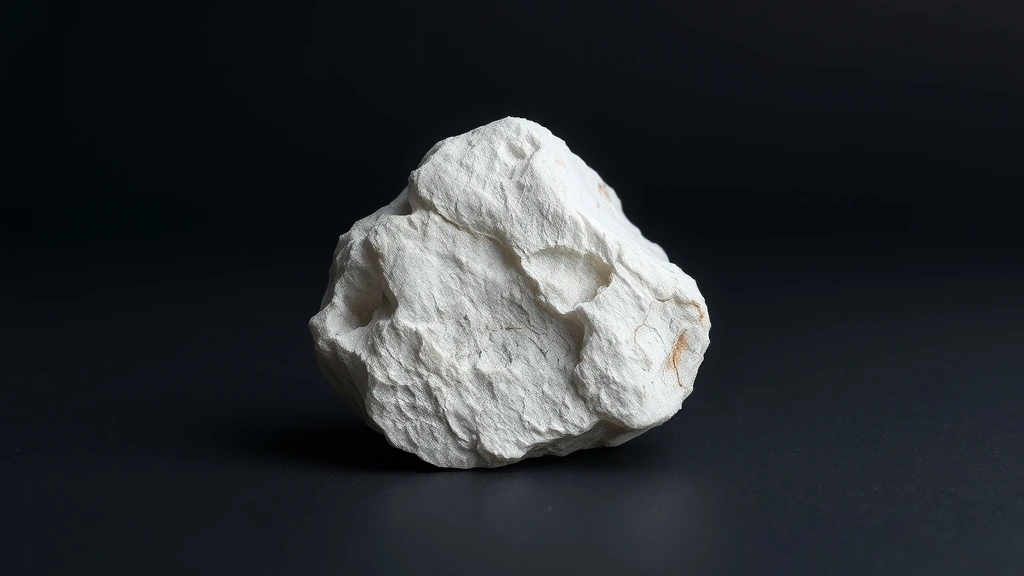
Clinoptilolite is a member of the zeolite family, forming in low‑temperature, alkaline hydrothermal environments such as volcanic tuff and sedimentary basins. Its porous framework traps water molecules, giving it a characteristic high specific surface area and a distinctive fibrous or fibrous‑crystalline habit. The mineral is prized for its adsorption properties and has been used historically in water purification and as a catalyst support.
What is Clinoptilolite Zeolite? Geological Overview & Definition
Clinoptilolite is a triclinic zeolite that crystallizes in the *P1* space group. It is typically found as fibrous aggregates or as a fine‑grained matrix within tuffaceous rocks. The mineral’s framework consists of AlO₄ and SiO₄ tetrahedra linked by shared oxygen atoms, creating a cage‑like structure that accommodates exchangeable cations. In natural settings, sodium, calcium, and potassium occupy these sites, allowing the mineral to undergo ion‑exchange processes.
The mineral’s name derives from the Greek words for “clino” (slanting) and “pteron” (wing), reflecting its characteristic fibrous, wing‑like crystals. Clinoptilolite is widely distributed, with notable deposits in the United States, Turkey, and the Caucasus region. Its occurrence in volcanic ash beds and sedimentary layers makes it a key indicator of past hydrothermal activity.
Clinoptilolite Zeolite Chemical Composition & Crystallographic Properties
The stoichiometric formula Na(Ca,Na)Al₄Si₁₂O₃₂·20H₂O reveals a framework rich in aluminum and silicon, balanced by sodium and calcium cations. The triclinic lattice allows for slight distortions, giving the mineral a low symmetry that influences its optical anisotropy. The water molecules within the pores are loosely bound, making the mineral sensitive to dehydration at temperatures above 200 °C.
Cation substitution is common; potassium or magnesium can replace sodium or calcium, respectively, without altering the overall framework. This substitution affects the mineral’s density (2.18–2.26 g cm⁻³) and refractive index (1.48–1.50). Acidic solutions can leach exchangeable cations, leading to a gradual collapse of the pore structure and a loss of the characteristic fibrous morphology.
Chromophore color centers arise from trace iron or manganese incorporated into the framework, producing pale green to gray hues. These centers are stabilized by the high water content and can be altered by thermal treatment, which removes water and changes the oxidation state of the transition metals. Clinoptilolite’s thermal behavior is thus closely tied to its hydration state, making it a useful probe in geothermometry and in industrial applications where temperature stability is critical.
| Property | Specification |
|---|---|
| Mineral Group | Natural Mineral / Crystal |
| Chemical Formula | Na(Ca,Na)Al₄Si₁₂O₃₂·20H₂O |
| Mohs Hardness | 4.0 – 4.5 |
| Crystal System | Triclinic |
| Specific Gravity (Density) | 2.18 – 2.26 |
| Refractive Index | 1.48 – 1.50 |
| Color & Optical Properties | Natural Clinoptilolite Zeolite color spectrum and optical dispersion |
| Primary Mining Localities | Global primary localities |
| Water & Chemical Resistance | Sensitive (Avoid prolonged water soaking) |
| Chakra Alignment (Traditional) | Crown Chakra, Heart Chakra |
| Zodiac Affinity (Traditional) | Pisces, Virgo, Aquarius |
| Symbolic Meaning (Traditional) | Detoxification, spiritual purification, and mental clarity |
Clinoptilolite Zeolite Varieties & Color Spectrum
Clinoptilolite exhibits a diverse range of visual characteristics depending on its geological environment and impurity content. The mineral typically forms in trachytic volcanic tuffs and basaltic flows, where it crystallizes within vesicles. Its appearance is heavily influenced by the specific cation exchange processes that occur during diagenesis.
White Clinoptilolite
This is the most commercially prevalent variety, characterized by its pristine, chalky-white to cream-colored appearance. It forms in high-purity silica-rich environments with minimal iron or manganese contamination. The fibrous crystal habit often creates a soft, felt-like texture when viewed under magnification.
Green Clinoptilolite
Distinctive green hues arise from the presence of iron-bearing inclusions or associated chlorite minerals. This variety is frequently found in oxidized volcanic deposits where groundwater interaction alters the crystal lattice. The color intensity varies from pale sage to deep olive, depending on the concentration of ferric ions.
Grey Clinoptilolite
Grey morphs typically indicate higher levels of organic carbon inclusions or mixed aluminosilicate content. These specimens often originate from marine-influenced volcanic sequences where sedimentary layers interbedded with tuffs. The microporous structure remains consistent, but the visual opacity increases significantly.
Pink Clinoptilolite
Rare pink varieties result from trace amounts of manganese or cobalt substituting within the aluminosilicate framework. This coloration is exceptionally uncommon and usually associated with hydrothermal alteration zones near intrusive igneous bodies. The subtle pastel tones make these specimens highly sought after by collectors.
Where is Clinoptilolite Zeolite Found? Geological Mining & Extraction
Clinoptilolite predominantly occurs in Cenozoic volcanic ash deposits and associated tuffaceous sediments worldwide. Major commercial deposits are located in the United States, particularly in Wyoming and Montana, where extensive mining operations extract large volumes. These regions feature thick sequences of volcaniclastic rocks that provide ideal conditions for zeolite formation.
Additional significant sources include Iceland, Germany, and China, where the mineral is often found in basaltic lava flows and pyroclastic materials. Extraction methods typically involve open-pit mining followed by crushing and washing to remove host rock debris. The high porosity of the mineral allows for efficient separation from heavier silicate minerals during processing.
Historical Significance & Cultural Lore of Clinoptilolite Zeolite
While zeolites were formally classified in the eighteenth century, their use as natural adsorbents dates back to ancient civilizations. In ancient Egyptian and Greco-Roman contexts, porous volcanic minerals were utilized for water purification and medicinal applications. Archaeological evidence suggests these materials were valued for their ability to absorb impurities from liquids and soils.
Throughout Vedic and Chinese traditional practices, similar porous stones were incorporated into ritualistic cleansing ceremonies and agricultural soil amendments. Historical texts reference the use of volcanic tuffs to enhance crop yields and purify drinking water. This enduring legacy highlights the mineral’s practical significance in early human technological development.
Modern Uses & Jewelry Applications of Clinoptilolite Zeolite
Clinoptilolite is prized for its translucent, pale green to gray hues, making it suitable for cabochon and faceted jewelry. Lapidaries often polish the mineral into smooth, rounded shapes that highlight its subtle luster, while more intricate faceting can accentuate its natural crystal faces. In ornamental carving, the material’s softness allows artisans to sculpt delicate motifs, yet its durability ensures long‑lasting pieces.
- Cabochon beads for necklaces and earrings
- Faceted rings and pendants that showcase internal clarity
- Carved pendants or figurines for decorative display
Metaphysical Properties & Traditional Meaning of Clinoptilolite Zeolite
According to historical traditions and metaphysical lore, Clinoptilolite is revered for its detoxification qualities, believed to cleanse both body and spirit. Across ancient Mediterranean and Vedic lapidary lore, the stone is associated with emotional balance, encouraging the release of negative feelings and fostering mental clarity. Its gentle energy is said to support the Heart Chakra, promoting compassion, while its subtle vibrational frequency aligns with the Crown Chakra, facilitating spiritual connection.
Which Chakra and Zodiac Signs Align with Clinoptilolite Zeolite?
Clinoptilolite is traditionally linked to the Heart Chakra, where it is thought to heal emotional wounds and enhance love. Simultaneously, it resonates with the Crown Chakra, encouraging higher consciousness and spiritual insight.
The stone’s astrological affinity is firmly rooted in the signs of Pisces, Virgo, and Aquarius. Those born under these signs are believed to benefit from Clinoptilolite’s calming influence and its capacity to foster intellectual clarity and compassionate empathy.
How to Identify Real vs. Fake Clinoptilolite Zeolite
Artificial imitations of Clinoptilolite often appear as synthetic glass or dyed minerals, lacking the natural porosity and subtle color variations of authentic specimens. These replicas may exhibit a uniform, overly glossy surface and a density that does not match the true mineral.
Practical At-Home Authenticity Tests
- Temperature Test (Thermal Feel): Hold the stone in your hand; genuine Clinoptilolite feels cool to the touch, whereas glass or synthetic substitutes remain at room temperature.
- Specific Gravity & Weight Test: Measure the stone’s weight in water; real Clinoptilolite will sink with a specific gravity around 2.2, while glass typically shows a higher density.
- Scratch & Hardness Test (Mohs Comparison): Use a known Mohs scale reference; Clinoptilolite should scratch materials softer than 4.0 but be scratched by harder stones like quartz (7.0).
- Microscopic & Loupe Inspection (Internal Inclusions): Under magnification, authentic Clinoptilolite displays fine, fibrous inclusions and a porous network, whereas synthetic replicas appear uniformly clear with no internal structure.
Clinoptilolite Zeolite Valuation Factors, Grading & Pricing
The market value of clinoptilolite is first driven by color saturation; specimens with a deep, uniform green or blue hue command higher prices due to their visual vibrancy and perceived energetic luster.
Next, crystal size and weight (grams) play a decisive role. Larger, heavier samples that retain a natural matrix and exhibit a smooth, tumbled polish are prized over smaller, raw fragments, with collectors favoring polished pieces that showcase the mineral’s inherent texture.
Finally, ethical sourcing and locality premium influences pricing in holistic and collector circles. Provenance from responsibly mined deposits—such as those in the Mediterranean basin or the Caucasus—adds a premium, reflecting both environmental stewardship and the mineral’s cultural significance.
How to Clean and Care for Clinoptilolite Zeolite
To preserve the structural integrity of clinoptilolite, wipe the specimen briefly with a damp cloth and dry immediately; avoid prolonged contact with water and never use ultrasonic cleaners, as vibration can fracture the delicate lattice.
For energetic care, gently smudge the stone with sage or palo santo, then place it under soft moonlight for a few hours; alternatively, rest the zeolite on a selenite slab to allow subtle charge transfer. These dry, low‑heat methods respect the mineral’s sensitivity while supporting its metaphysical properties.
Frequently Asked Questions About Clinoptilolite Zeolite
Clinoptilolite Zeolite displays distinct mineralogical characteristics across its geological varieties and structural habits. Gemologists evaluate these natural varieties based on crystal habit, trace chromophore concentrations, and visual luster.
Primary Natural Clinoptilolite Zeolite
The benchmark natural variety exhibiting diagnostic color saturation and classic crystallographic symmetry.
Distinct Geological Morphs of Clinoptilolite Zeolite
Secondary regional and structural varieties formed under localized geological temperature and pressure conditions.
Is Clinoptilolite safe to wear in the shower?
No, avoid prolonged water soaking due to its porous structure. The mineral’s zeolitic framework can absorb moisture, potentially weakening its physical integrity over time. Brief exposure to rain is generally harmless, but submersion in baths or showers should be strictly avoided to preserve the stone’s structural stability and aesthetic appearance.
How should I clean Clinoptilolite jewelry?
Wipe briefly with a damp cloth and dry immediately. Never use ultrasonic cleaners or submerge the piece in liquid, as this risks structural fractures within the delicate crystal lattice. A soft, dry microfiber cloth is the safest daily maintenance tool to remove surface dust without compromising the mineral’s natural finish.
What is the Mohs hardness of Clinoptilolite?
It ranges from 4.0 to 4.5 on the Mohs scale. This moderate hardness makes it susceptible to scratching from common minerals like quartz or topaz. Owners should store pieces separately to prevent abrasion and handle them with care to maintain the smoothness of the polished surface during regular wear.
Which zodiac signs are aligned with Clinoptilolite?
Pisces, Virgo, and Aquarius are the primary aligned signs. These water and earth elements resonate with the stone’s detoxification properties, supporting mental clarity and emotional balance. Individuals born under these signs may find the mineral particularly effective for enhancing their innate intuitive and analytical capabilities.
Which chakras does Clinoptilolite activate?
It primarily activates the Crown Chakra and Heart Chakra. This dual alignment facilitates spiritual purification and emotional healing, bridging higher consciousness with compassionate energy. Practitioners often use this zeolite to clear energetic blockages, promoting a sense of inner peace and heightened spiritual awareness during meditation.
What is the chemical formula of Clinoptilolite?
The formula is Na(Ca,Na)Al₄Si₁₂O₃₂·20H₂O. This composition highlights its nature as a hydrated aluminosilicate with significant water content. The presence of sodium and calcium ions within the triclinic crystal system contributes to its unique adsorption capabilities and geological formation characteristics.
Can I use ultrasonic cleaners on Clinoptilolite?
Absolutely not, as ultrasonic vibrations can cause structural fractures. The intense sound waves may disrupt the delicate zeolite framework, leading to permanent damage or cracking. Stick to gentle manual cleaning with a damp cloth to ensure the mineral’s internal structure remains intact and visually pristine for long-term enjoyment.
What are the primary esoteric benefits of Clinoptilolite?
It is renowned for detoxification, spiritual purification, and mental clarity. Ancient lapidary traditions associate this mineral with cleansing negative energies and enhancing cognitive focus. Its porous structure is believed to absorb impurities, making it a popular choice for those seeking holistic wellness and energetic renewal in their daily practices.