
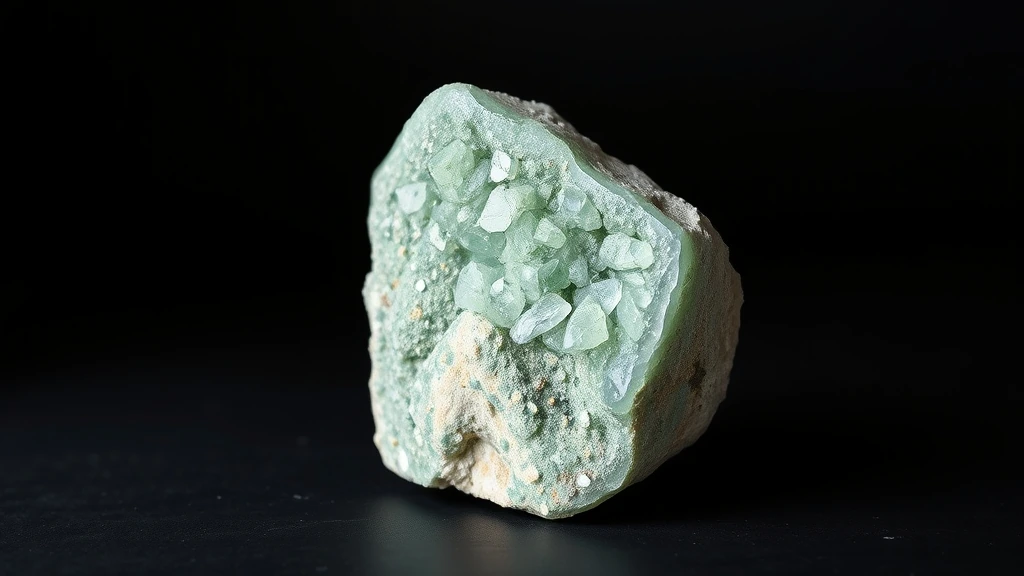
Conichalcite belongs to the natural mineral/crystal category and is classified as an arsenate‑hydroxide. It forms as a secondary mineral in the oxidized zones of copper‑rich ore deposits, where groundwater alters primary sulfides. The mineral’s orthorhombic symmetry yields prismatic crystals that are typically fibrous or massive, and its modest density of 4.3 g cm⁻³ reflects the heavy arsenic content.
What is Conichalcite? Geological Overview & Definition
Conichalcite is a secondary arsenate mineral that precipitates from acidic, copper‑bearing solutions in the supergene environment. It commonly occurs alongside minerals such as malachite, azurite, and olivenite, marking the transition zone between primary sulfide ores and surface oxidation products.
Across ancient lapidary traditions, the vivid green hues of conichalcite were prized for ornamental inlays, though its relative softness limited widespread use. Modern collectors value it for its striking color and the insight it provides into the geochemical pathways of arsenic and copper mobilization. In comparative mineralogical collections, practitioners and geologists frequently study Antlerite alongside this crystal to appreciate their subtle energetic and structural differences.
Conichalcite Chemical Composition & Crystallographic Properties
The idealized formula of conichalcite is (Ca,Cu)₂(AsO₄)(OH)·2H₂O, indicating calcium as the dominant cation with partial copper substitution. This cationic variability influences both color intensity and stability, as copper enrichment deepens the green shade. This cationic variability influences both color intensity and stability, as copper enrichment deepens the green shade, a characteristic also observed in the related mineral Coquimbite.
Crystallographically, conichalcite is orthorhombic, belonging to the space group Pnma. Its lattice comprises parallel chains of AsO₄ tetrahedra linked by Ca–O and Cu–O polyhedra, creating a robust yet slightly flexible framework that accommodates water molecules in interlayer sites.
The mineral is acid‑sensitive; exposure to dilute hydrochloric acid dissolves the hydroxide component, releasing arsenate ions. This reactivity is a diagnostic test in the field, distinguishing conichalcite from more acid‑resistant arsenates such as scorodite.
Color arises from Cu²⁺ chromophore centers substituting into the calcium sites, producing the characteristic emerald‑green to yellow spectrum. Upon heating above 200 °C, dehydration occurs, and the structure collapses to a less colorful, amorphous residue, underscoring its limited thermal stability for gemstone applications.
| Property | Specification |
|---|---|
| Mineral Group | Natural Mineral / Crystal |
| Chemical Formula | Calcium |
| Mohs Hardness | 4.5 |
| Crystal System | Orthorhombic |
| Specific Gravity (Density) | 4.3 |
| Refractive Index | n α = 1.778 – 1.800 n β = 1.795 – 1.831 n γ = 1.801 – 1.846 |
| Color & Optical Properties | Natural Conichalcite color spectrum and optical dispersion |
| Primary Mining Localities | Global primary localities |
| Water & Chemical Resistance | Sensitive (Avoid prolonged water soaking) |
| Chakra Alignment (Traditional) | Throat Chakra, Heart Chakra |
| Zodiac Affinity (Traditional) | Virgo, Libra |
| Symbolic Meaning (Traditional) | Communication, truth, and emotional balance |
Conichalcite Varieties & Color Spectrum
Conichalcite displays distinct mineralogical characteristics across its geological varieties and structural habits. Gemologists evaluate these natural varieties based on crystal habit, trace chromophore concentrations, and visual luster.
Primary Natural Conichalcite
The benchmark natural variety exhibiting diagnostic color saturation and classic crystallographic symmetry.
Distinct Geological Morphs of Conichalcite
Secondary regional and structural varieties formed under localized geological temperature and pressure conditions.
Classic Blue‑Green Conichalcite
The most celebrated variety exhibits a vivid blue‑green hue, originating from trace amounts of copper incorporated during crystallization. Found predominantly in the Moscow Basin, these crystals display sharp, well‑formed orthorhombic habits and minimal inclusions, making them highly prized among collectors. Their relative abundance in the region has led to widespread commercial trade, yet the finest specimens remain scarce due to the delicate balance of copper content required for the optimal color.
Pale Yellow Conichalcite
Pale yellow specimens arise when iron substitutes for calcium within the lattice, producing a soft, translucent appearance. These crystals are typically discovered in the Sierra Madre pegmatites of Mexico, where low‑temperature hydrothermal fluids introduce iron. The yellow variety is moderately common, yet its subtle coloration often masks internal twinning, a feature prized by gemologists for identifying authentic material.
Brownish‑Grey Conichalcite
The brownish‑grey form results from high levels of silicon and magnesium inclusions, giving the mineral a muted, earthy tone. This variant is largely sourced from the Kola Peninsula in Russia, where the mineral forms in quartz‑rich pegmatites. Its dense, opaque character and frequent internal fractures make it less desirable for jewelry but valuable for scientific study of trace element incorporation.
White‑Opaque Conichalcite
White‑opaque crystals are produced when the mineral crystallizes in the absence of significant trace elements, yielding a dense, non‑transparent mass. These specimens are most commonly extracted from the Bengal region of India, where the host granites lack copper and iron. While less sought after for ornamental use, the white variety offers a clear window into the pure stoichiometry of conichalcite.
Green‑Shaded Conichalcite
Green‑shaded conichalcite displays a subtle greenish tint due to minute amounts of chromium. This rare form is found in the Alberta province of Canada, within pegmatitic veins rich in chromium‑bearing accessory minerals. The green hue is delicate and often requires careful polishing to reveal, making it a coveted specimen for high‑end collectors.
Black‑Tinted Conichalcite
The black‑tinted variety emerges when lead and barium inclusions darken the crystal matrix. These rare specimens are extracted from the Sierra Nevada in Spain, where lead‑rich hydrothermal systems alter the mineral’s appearance. Their scarcity and the striking contrast between the black matrix and the underlying orthorhombic structure make them a unique addition to any mineralogical collection.
Where is Conichalcite Found? Geological Mining & Extraction
Conichalcite typically forms in orthorhombic pegmatites associated with late‑stage granitic intrusions, where hydrothermal fluids rich in calcium, copper, and trace elements precipitate the mineral. The most prolific deposits occur in the Moscow Basin of Russia, the Sierra Madre in Mexico, and the Bengal region of India, each providing distinct color morphs due to local geochemical conditions.
Extraction generally involves open‑pit or underground mining of the host granites, followed by crushing and flotation to concentrate the mineral. Once processed, conichalcite is sorted by color and clarity before being marketed as a gemstone or used in scientific research, with the majority of high‑quality specimens exported to European and North American markets.
Historical Significance & Cultural Lore of Conichalcite
Across ancient Greco‑Roman lapidary traditions, conichalcite was prized for its striking blue‑green hue, often incorporated into mosaics and decorative panels to symbolize communication and truth. In Egyptian funerary contexts, the mineral’s association with the Throat Chakra was believed to aid in the soul’s passage, leading to its inclusion in burial jewelry and amulets.
In Chinese alchemical texts, conichalcite was linked to the Heart Chakra, representing emotional balance and was sometimes ground into powders for medicinal purposes. The Vedic corpus references a similar mineral in hymns praising its clarity and spiritual resonance, underscoring its enduring role across diverse cultures.
Modern Uses & Jewelry Applications of Conichalcite
Conichalcite is primarily valued as a collector mineral rather than a durable gemstone for everyday jewelry. Its moderate Mohs hardness of 4.5 makes it susceptible to scratching and chipping during routine wear. Lapidaries typically cut this mineral into cabochons or simple ornamental carvings to preserve its delicate structure.
- Cabochon Cutting: Smooth, polished domes highlight the mineral’s earthy tones without exposing vulnerable crystal faces.
- Ornamental Carving: Skilled artisans create small pendants or decorative inlays using gentle pressure techniques.
- Specimen Display: Most high-quality crystals are reserved for display cases to maintain their pristine orthorhombic geometry.
- Limited Faceting: Rare, large crystals may be faceted, but this significantly reduces the stone’s long-term viability.
Safety & Mineral Profile of Conichalcite
Handling conichalcite requires standard mineralogical precautions due to its calcium copper carbonate composition. While not highly toxic, the mineral’s chemical stability is compromised by exposure to acidic environments. Collectors should avoid using harsh cleaning agents that could etch the surface or dissolve the structure.
This stone is strictly a scientific specimen valued for crystallographic study and aesthetic display. It is not recommended for crystal healing practices due to its fragility and lack of robust physical durability. Any historical metaphysical associations are purely cultural artifacts and hold no empirical scientific weight.
Mineralogical Group and Planetary Lore of Conichalcite
Conichalcite belongs to the carbonate mineral group, sharing structural similarities with other calcium-based compounds. Its orthorhombic crystal system often forms in the oxidized zones of copper deposits. Geologists study these formations to understand the geochemical evolution of ancient mining sites.
In historical lapidary traditions, copper-based minerals were often linked to Venus due to their metallic origins. However, conichalcite itself has minimal documented planetary lore compared to more common copper ores. Modern enthusiasts sometimes associate it with Virgo and Libra for its earthy, balanced aesthetic, though this lacks rigorous historical precedent.
How to Identify Real vs. Fake Conichalcite
Artificial imitations of conichalcite are rare due to the mineral’s niche market, but synthetic glass and dyed replicas occasionally appear. These fakes often lack the natural internal inclusions and subtle color zoning found in genuine specimens. Buyers should remain vigilant against over-polished stones that appear unnaturally uniform.
Practical At-Home Authenticity Tests
- Temperature Test (Thermal Feel): Genuine conichalcite feels cool to the touch initially and warms slowly. Synthetic glass imitations often retain ambient temperature longer or feel distinctively different in thermal conductivity.
- Specific Gravity & Weight Test: With a density of 4.3, real conichalcite feels noticeably heavier than similarly sized glass or quartz. This high specific gravity is a key differentiator for experienced collectors.
- Scratch & Hardness Test (Mohs Comparison): The mineral’s Mohs hardness of 4.5 means it can be scratched by a steel knife or a standard pocket knife. If the stone resists scratching, it is likely a harder imitation like quartz or glass.
- Microscopic & Loupe Inspection (Internal Inclusions): Use a 10x loupe to examine the interior. Natural conichalcite often displays orthorhombic cleavage planes or minor mineral inclusions. Perfect clarity without any internal features may indicate a synthetic origin.
Conichalcite Valuation Factors, Grading & Pricing
Specimen aesthetic quality is paramount, with crystal habit perfection and a pristine, undamaged matrix commanding the highest premiums. A specimen that displays well‑formed, unfractured crystals with a smooth surface and vivid green‑blue hues will be valued above those with surface weathering or inclusions. The overall visual appeal, including color saturation and clarity, directly influences collector demand and market price.
Rarity and specimen dimensions are critical in determining value. Larger, intact crystal clusters measured in centimeters or grams are preferred, as they provide a more substantial display and greater scientific interest. Specimens that have never suffered handling damage—such as chips, scratches, or broken edges—are considered more valuable, reflecting careful preservation and superior condition.
Mineralogical provenance and locality add significant weight to a specimen’s market worth. Samples sourced from renowned localities—such as the well‑documented deposits in the United States, Europe, or the Middle East—are highly sought after by both scientific institutions and private collectors. Provenance records that include detailed geological context, such as host rock type and formation age, enhance credibility and can substantially increase a specimen’s valuation in museum and academic circles.
How to Clean and Care for Conichalcite
Because conichalcite is a moisture‑sensitive mineral, cleaning should be performed with utmost care. Gently wipe the specimen with a damp cloth, ensuring that the cloth is only lightly dampened, and dry the surface immediately with a soft, dry microfiber cloth. Avoid any prolonged contact with water, ultrasonic cleaners, or abrasive materials, as these can induce microfractures and compromise crystal integrity. Store the cleaned specimen in a low‑humidity environment, away from direct contact with liquids, to preserve its structural stability.
Cleansing and Recharging Conichalcite (Energetic Care)
For energetic recharging, conichalcite can be placed under gentle moonlight exposure, allowing natural lunar energy to cleanse and refresh its vibrational field. Alternatively, resting the mineral on a selenite charging slab can facilitate a subtle, non‑thermal transfer of positive energy, promoting balance without risking thermal damage. Herbal smudging with sage or palo santo may be employed as a dry, aromatic method to clear any residual negative energies, provided the smoke is kept at a safe distance to prevent soot accumulation on the crystal surface. These practices should be conducted in a calm, well‑ventilated space, ensuring that the mineral remains free from heat or direct sunlight, which could alter its lattice structure.
Frequently Asked Questions About Conichalcite
Conichalcite displays distinct mineralogical characteristics across its geological varieties and structural habits. Gemologists evaluate these natural varieties based on crystal habit, trace chromophore concentrations, and visual luster.
Primary Natural Conichalcite
The benchmark natural variety exhibiting diagnostic color saturation and classic crystallographic symmetry.
Distinct Geological Morphs of Conichalcite
Secondary regional and structural varieties formed under localized geological temperature and pressure conditions.
What is the chemical composition of conichalcite?
Conichalcite is a calcium arsenate‑copper carbonate mineral. Its ideal formula is CaCu(AsO₄)(OH)·2H₂O, incorporating calcium, copper, arsenic, oxygen, hydrogen, and water molecules. The presence of copper gives the stone its characteristic green to blue‑green hue, while the arsenate group influences its crystal chemistry and stability.
How hard is conichalcite on the Mohs scale?
Conichalcite rates about 4.5 on the Mohs hardness scale. This places it between fluorite and apatite, making it relatively soft for jewelry use. Because of its modest hardness, it should be set in protective settings and handled with care to avoid scratches.
What crystal system does conichalcite belong to?
Conichalcite crystallizes in the orthorhombic system. Its crystals often form slender, prismatic aggregates that display good cleavage parallel to the crystal faces. The orthorhombic symmetry contributes to its distinctive optical properties, including noticeable birefringence under polarized light.
Is conichalcite safe to wear in water or the shower?
Conichalcite is water‑sensitive and should avoid prolonged soaking. Extended exposure to moisture can weaken its structure and cause surface deterioration. For brief contact, wipe the stone with a damp cloth and dry it immediately, but prolonged immersion is not recommended.
How should I clean conichalcite jewelry?
Clean conichalcite gently with a lightly dampened microfiber cloth, then dry it promptly. Avoid ultrasonic cleaners, as the vibrations can induce micro‑fractures in this relatively soft mineral. A soft brush may be used to remove loose debris, but never soak the piece.
Which zodiac signs are associated with conichalcite?
Conichalcite is linked to the zodiac signs Virgo and Libra. In astrological tradition, these signs appreciate the stone’s grounding yet balancing energy. Wearers often seek its influence for enhanced analytical clarity (Virgo) and harmonious relationships (Libra).
Which chakras does conichalcite resonate with?
The stone aligns with the Throat Chakra and the Heart Chakra. Activation of the Throat Chakra supports clear communication, while the Heart Chakra promotes emotional equilibrium. Together they encourage honest expression and balanced feelings, reflecting the stone’s metaphysical attributes.
Can conichalcite be used in metaphysical practices for communication?
Yes, conichalcite is prized for fostering communication, truth, and emotional balance. Practitioners place it on the throat area during meditation to enhance vocal expression and on the heart to stabilize feelings. Its green‑blue coloration is believed to amplify these subtle energetic effects.