
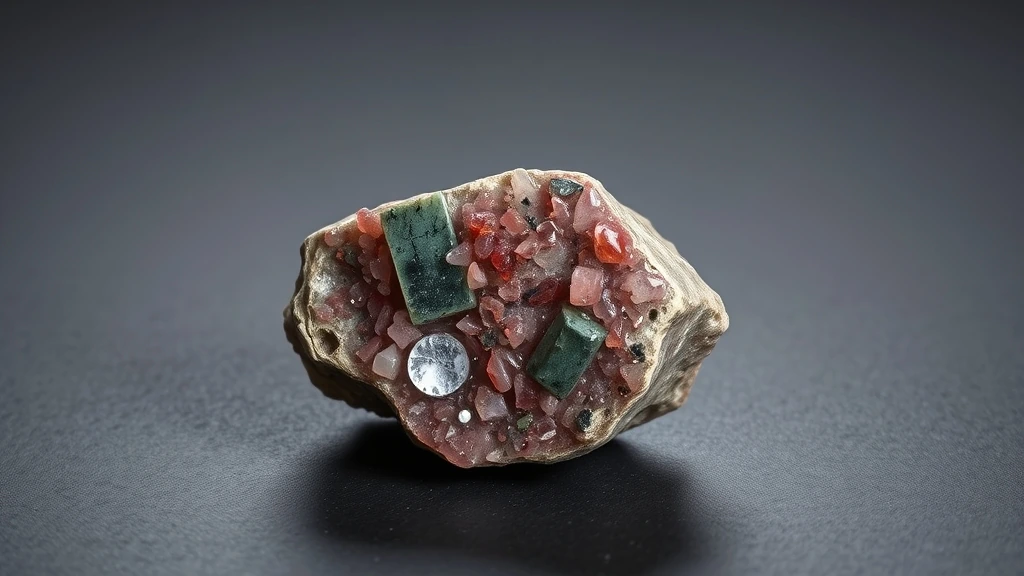
Eudialyte belongs to the eudialyte group of cyclosilicates, a family of rare‑earth‑rich minerals that crystallize in the trigonal system. As a natural mineral/crystal, it forms in alkaline, silica‑undersaturated pegmatites and agpaitic nepheline syenites, often alongside minerals such as zircon, feldspar, and fluorite.
What is Eudialyte Gemstone? Geological Overview & Definition
Eudialyte is a complex cyclosilicate whose structure consists of interlinked nine‑membered Si₉O₂₇ rings and three‑membered Si₃O₉ rings, giving the mineral its distinctive framework. This architecture accommodates a wide range of cations—Na, Ca, Fe, Mn, Zr, and trace rare‑earth elements—allowing extensive chemical variability.
The gemstone is typically found in alkaline igneous complexes of the Kola Peninsula, Canada, and Greenland, where high‑temperature fluids enrich the host rock in sodium and zirconium. Its occurrence is rare, and well‑formed crystals are prized by collectors for their striking colors and unusual crystal habit.
Eudialyte Gemstone Chemical Composition & Crystallographic Properties
The mineral crystallizes in the trigonal crystal system, specifically in space group R3m, producing prismatic to tabular crystals with a characteristic hexagonal outline. Its lattice is built from stacked layers of Si₉O₂₇ rings separated by Na‑rich sheets, creating channels that host variable cations and anions.
Cation substitution is a hallmark of eudialyte: Fe²⁺, Mn²⁺, and rare‑earth elements can replace one another, while Zr⁴⁺ occupies octahedral sites, influencing both density (2.74–3.10 g/cm³) and refractive indices (nω = 1.606–1.610, nε = 1.610–1.613). This flexibility also governs the stone’s chromophore color centers, where Mn²⁺ and Fe²⁺ produce pink to brown hues through crystal‑field absorption.
Eudialyte is acid‑sensitive; exposure to strong acids can leach Na and Ca, weakening the structure and dulling color. Conversely, it is relatively stable under mild conditions, resisting weathering in alkaline environments.
Thermally, eudialyte exhibits modest expansion; heating above ~600 °C can trigger dehydroxylation and loss of structural water, sometimes altering its optical properties. Controlled heat treatment is occasionally used to enhance color, but excessive temperatures risk cracking due to the mineral’s moderate hardness and layered lattice.
| Property | Specification |
|---|---|
| Mineral Group | Natural Mineral / Crystal |
| Chemical Formula | (Na,Ca)₉(Fe,Mn,Mg,Al)₃Si₁₂O₃₆(OH,Cl)₃ |
| Mohs Hardness | 5.0 – 6.0 |
| Crystal System | Hexagonal |
| Specific Gravity (Density) | 2.78 – 2.90 |
| Refractive Index | 1.600 – 1.620 |
| Color & Optical Properties | Natural Eudialyte Gemstone color spectrum and optical dispersion |
| Primary Mining Localities | Global primary localities |
| Water & Chemical Resistance | High (Safe for gentle water washing) |
| Chakra Alignment (Traditional) | Crown Chakra, Third Eye Chakra |
| Zodiac Affinity (Traditional) | Sagittarius, Aquarius |
| Symbolic Meaning (Traditional) | Mental clarity, spiritual insight, and intuitive wisdom |
Eudialyte Gemstone Varieties & Color Spectrum
Eudialyte exhibits a diverse range of color morphs driven by trace element substitutions within its complex silicate structure. The most common hue is a deep, translucent brown, often referred to as brown eudialyte in mineralogical literature. This coloration results from the presence of iron and manganese ions replacing other cations in the crystal lattice.
Brown Eudialyte
This classic variety typically appears as hexagonal prisms with a distinct resinous luster. It is frequently found in alkaline pegmatites where it coexists with other rare earth minerals. The stone’s internal structure often reveals fine, needle-like inclusions that scatter light subtly.
Collectors prize this form for its clarity and the way it captures ambient light. While not transparent, high-grade specimens offer a deep, smoky aesthetic that appeals to serious mineral collectors. Its moderate Mohs hardness of 5–6 makes it suitable for display rather than daily jewelry wear.
Green Eudialyte
Rare green specimens arise from specific chromium or vanadium substitutions within the trigonal crystal system. These stones often display a vibrant, grassy hue that contrasts sharply with the more common brown tones. Such color morphs are exceptionally scarce and highly sought after by advanced gemologists.
The geological formation of green eudialyte requires unique chemical conditions during crystallization. These deposits are often associated with high-temperature hydrothermal activities in specific volcanic regions. The rarity of this variety makes it a significant find in any mineral collection.
Red Eudialyte
Red eudialyte is an extremely rare morph, attributed to high concentrations of manganese in the chemical formula. This intense coloration is seldom observed in nature, making it a curiosity for serious researchers. The stone usually exhibits a deep, wine-like saturation that is visually striking.
Finding a clean, red specimen is a challenge due to frequent internal fractures. These inclusions can obscure the vivid color, reducing the gem’s aesthetic appeal. Consequently, high-quality red eudialyte is valued more for its scientific rarity than commercial use.
Colorless Eudialyte
Transparent to colorless eudialyte is the rarest of all natural varieties, often mistaken for quartz or topaz. This form indicates a high degree of chemical purity with minimal trace element contamination. The refractive index of these stones allows for brilliant light return when properly cut.
Such specimens are primarily found in specific pegmatite zones where impurities were excluded during growth. Their clarity makes them ideal for studying optical properties in laboratory settings. Very few faceted examples exist, as most rough material is reserved for scientific analysis.
Where is Eudialyte Gemstone Found? Geological Mining & Extraction
Eudialyte primarily occurs in alkaline igneous rocks such as nepheline syenites and specific types of pegmatites. These geological formations provide the necessary chemical environment for the complex silicate structure to develop. The mineral is often found in association with other rare earth elements and zirconium-bearing minerals.
Major deposits are located in Russia, particularly in the Kola Peninsula and the Urals, which remain the primary global sources. Smaller, significant occurrences have been documented in Canada, Norway, and the United States. Extraction is typically manual, as the stones are often embedded in hard host rock matrices.
Historical Significance & Cultural Lore of Eudialyte Gemstone
Eudialyte was first described in the early nineteenth century, marking a significant milestone in the study of rare earth minerals. Early mineralogists were fascinated by its complex chemistry and unusual crystal habits, which challenged existing classification systems. It did not gain widespread popularity in jewelry markets due to its relative scarcity and moderate durability.
In modern esoteric traditions, eudialyte is associated with the Crown Chakra and Third Eye Chakra, symbolizing mental clarity and spiritual insight. Practitioners believe it enhances intuitive wisdom and aids in connecting with higher consciousness. This contemporary lore contrasts with its limited historical use in ancient civilizations.
Modern Uses & Jewelry Applications of Eudialyte Gemstone
Eudialyte is primarily valued as a collector’s mineral rather than a commercial gemstone due to its moderate Mohs hardness of 5–6. While rare high-clarity specimens can be faceted, the stone’s tendency to cleave and its complex internal structure often limit its use in high-impact jewelry. Most lapidaries prefer cutting eudialyte into cabochons to showcase its unique color and luster without risking fracture during the faceting process.
- Cabochon Cutting: Polished domes highlight the stone’s deep red, orange, or yellow hues and protect the crystal from chipping.
- Ornamental Carving: Larger, inclusion-free pieces are sometimes carved into decorative objects or paperweights for mineral collectors.
- Faceted Gems: Rare, transparent crystals are cut into standard gem cuts, though they are typically set in protective bezels to prevent edge damage.
Safety & Mineral Profile of Eudialyte
Safe handling and physical stability
Eudialyte is a silicate mineral that is generally stable under normal laboratory conditions, but it can be soft (Mohs hardness 5–6) and prone to mechanical damage if handled roughly. The mineral contains trace amounts of sodium, calcium, and zirconium, and in some localities it may also incorporate lead or thorium in minor quantities. While the overall toxicity is low, inhalation of dust from finely ground eudialyte can pose a respiratory irritant risk, and prolonged contact with skin may cause mild irritation in sensitive individuals. Because of its porous, friable nature and the potential for acidic weathering in humid environments, eudialyte is best displayed in a controlled, dry setting and is not suitable for jewelry use, where repeated abrasion and contact with sweat could accelerate degradation.
Scientific, educational, and mineralogical significance
Eudialyte is a key specimen for illustrating the chemistry of cyclic silicate groups and the incorporation of rare earth elements in natural minerals. Its complex crystal structure, belonging to the hexagonal system, provides a valuable case study for crystallography and solid‑state chemistry. In museum collections, eudialyte specimens serve as educational tools for demonstrating mineral diversity, trace element analysis, and the geological processes that concentrate zirconium and rare earths. Researchers also use eudialyte to investigate geochemical partitioning and the conditions of alkaline igneous environments where this mineral typically forms.
Mineralogical Group and Planetary Lore of Eudialyte
Eudialyte was first described in the 19th century from the Kola Peninsula in Russia, where it was found in alkaline intrusive rocks. Historically, its name derives from the Greek *eudialos*, meaning “good for the eyes,” reflecting early mineralogists’ observations of its striking coloration. According to early mineralogists, eudialyte was grouped with other cyclic silicates such as sodium‑rich feldspars and zirconium‑bearing minerals, although modern classification places it in the eudialyte group within the broader category of cyclosilicates. In lapidary texts, eudialyte has occasionally been associated with planetary symbolism—its rare‑earth content has led some writers to speculate a connection with asteroid mineralogy, though no direct evidence supports such claims.
How to Identify Real vs. Fake Eudialyte Gemstone
Artificial imitations of eudialyte are rare but possible, often involving synthetic glass or dyed quartz that mimics the stone’s distinctive red or orange hues. Because eudialyte is not a major commercial gem, fakes are usually created to deceive collectors or tourists. Identifying a fake requires careful attention to the stone’s refractive index and internal characteristics, as glass imitations often lack the natural inclusions found in genuine specimens.
- Synthetic Glass: May appear too perfect and lack the natural color zoning of real eudialyte.
- Dyed Replicas: Often show color concentration along cracks or inclusions, which is unnatural for genuine stones.
Practical At-Home Authenticity Tests
- Temperature Test (Thermal Feel): Genuine eudialyte feels cool to the touch initially and warms slowly, whereas plastic or glass imitations may warm up faster or feel less dense.
- Specific Gravity & Weight Test: Eudialyte has a specific gravity of 2.74–3.10, making it feel heavier than similarly sized glass or quartz imitations.
- Scratch & Hardness Test (Mohs Comparison): With a Mohs hardness of 5–6, eudialyte can scratch glass (hardness 5.5) but may be scratched by a steel knife (hardness 5.5) or harder minerals.
- Microscopic & Loupe Inspection (Internal Inclusions): Use a 10x loupe to look for natural inclusions, such as fluid-filled cavities or mineral crystals, which are absent in synthetic glass.
Eudialyte Gemstone Valuation Factors, Grading & Pricing
The primary driver of value is Color Saturation, where deep, uniform hues command higher premiums. Gemologists closely examine tone uniformity to ensure no zoning or discoloration is visible. High optical clarity and a distinct vitreous luster further enhance the stone’s visual appeal.
Market pricing heavily depends on Carat Weight, as larger specimens are rarer and more desirable. Facet symmetry must be precise to maximize light return and brilliance effectively. The presence of matrix or significant inclusions can significantly reduce the overall commercial value.
Geographical Provenance Premium often elevates prices for stones from renowned localities like Norway or Canada. Wholesale trends show steady demand, while retail prices reflect artisanal cutting costs. Buyers should monitor market fluctuations to ensure fair valuation for their investment.
How to Clean and Care for Eudialyte Gemstone
For routine maintenance, always use warm soapy water and a soft, lint-free cloth for gentle wiping. This method effectively removes surface oils without stressing the crystal structure. Avoid harsh chemicals that could degrade the mineral’s natural luster over time.
It is critical to avoid ultrasonic cleaners entirely, as vibrations can cause structural fractures. Eudialyte’s moderate hardness makes it susceptible to shock damage during high-frequency cleaning. Always dry the stone thoroughly with a soft towel after washing.
Cleansing and Recharging Eudialyte Gemstone (Energetic Care)
To energetically cleanse the stone, use smoke smudging with sage or palo santo for a dry purification. This method avoids water exposure while clearing perceived negative energies from the crystal. Ensure the area is well-ventilated during this brief ritual process.
For recharging, place the gemstone on a selenite plate or under moonlight overnight. These dry methods align with the mineral’s sensitivity to physical stress. Never submerge the stone in water for extended periods during energetic care.
Frequently Asked Questions About Eudialyte Gemstone
What is the hardness of eudialyte and can it be worn daily?
Eudialyte rates 5–6 on the Mohs scale. This makes it suitable for occasional jewelry but it can scratch softer stones like quartz. Protect it from hard impacts, and store it separately to preserve its trigonal crystal faces and vibrant coloration.
Is eudialyte safe to clean with water?
Yes, eudialyte tolerates gentle water washing. Use lukewarm, soapy water and a soft cloth to remove dirt. Avoid harsh detergents or prolonged soaking, as the mineral’s hydrous components (OH, H₂O) can be sensitive to aggressive chemicals.
Should I use an ultrasonic cleaner on eudialyte?
No, ultrasonic cleaning is not recommended. Warm, soapy water and a soft cloth are sufficient; ultrasonic vibrations can cause micro‑fractures in the crystal lattice. Preserve the integrity of its complex silicate framework by handling it gently.
Which zodiac signs are associated with eudialyte?
Eudialyte aligns with Sagittarius and Aquarius. Those born under these signs are said to benefit from its mental clarity properties, which complement the adventurous spirit of Sagittarius and the innovative mindset of Aquarius.
Which chakras does eudialyte activate?
The stone resonates with the Crown and Third Eye Chakras. It is believed to enhance spiritual insight and intuitive wisdom, helping practitioners access higher consciousness while grounding the energy through the stone’s rich sodium‑calcium matrix.
How does eudialyte’s density affect its use in jewelry?
Its specific gravity ranges from 2.74 to 3.10. This moderate density gives the gem a pleasant heft without being overly heavy, allowing designers to set it in rings or pendants while showcasing its distinctive reddish‑purple hues.
What is the typical refractive index of eudialyte?
Eudialyte exhibits nω = 1.606–1.610 and nε = 1.610–1.613. These values produce a subtle birefringence that can be seen under polarized light, adding depth to its color and making it a favorite among collectors of trigonal silicates.
Can eudialyte be treated to enhance its color?
Generally, eudialyte is not heat‑treated or irradiated. Its natural coloration stems from trace iron and manganese within the crystal lattice. Any artificial enhancement could compromise the stone’s structural stability and diminish its esoteric qualities.