
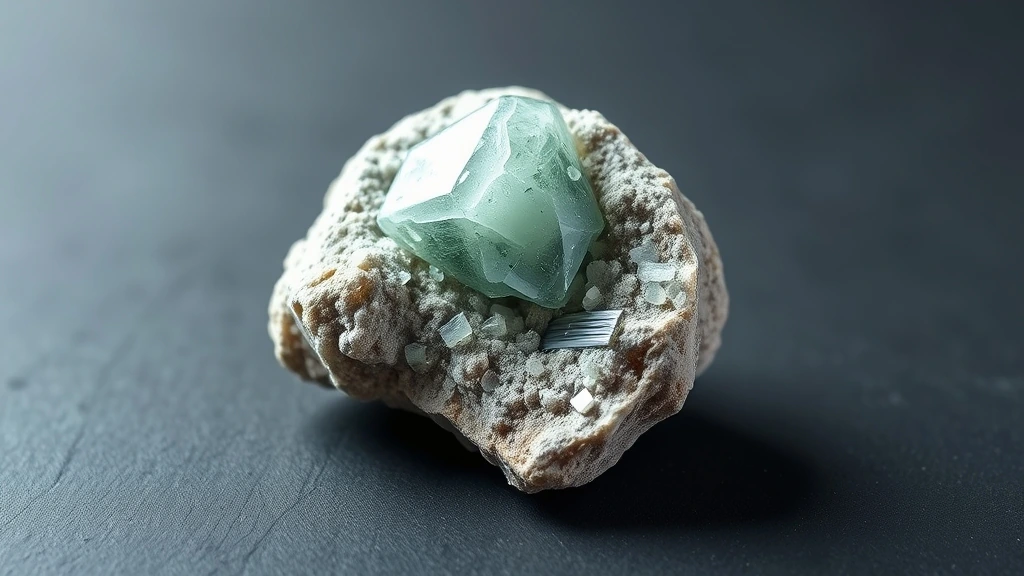
Glauberite belongs to the broader class of sulfate minerals and is recognized as a distinct natural mineral rather than an aggregate rock. It crystallizes in the monoclinic system, forming prismatic or fibrous crystals that often display a translucent to opaque appearance. The mineral’s low density, around 2.75–2.85 g cm⁻³, and its modest refractive indices contribute to its subtle optical properties.
What is Glauberite? Geological Overview & Definition
Glauberite is a sulfate mineral first described in the 19th century, named after the German chemist Johann Rudolf Glauber. It typically forms in evaporitic settings, such as saline lake beds or salt domes, where it precipitates from sulfate‑rich brines. The mineral’s crystal habit is often fibrous or prismatic, reflecting its monoclinic symmetry.
In geological terms, Glauberite is classified as a secondary evaporite that can occur as an alteration product of other sulfate minerals. Its presence is an indicator of highly saline, reducing environments, and it is often associated with minerals such as gypsum, anhydrite, and mirabilite.
Glauberite Chemical Composition & Crystallographic Properties
The chemical formula Na₂Ca(SO₄)₂ shows that sodium and calcium occupy distinct lattice sites within the sulfate framework. In the monoclinic lattice, the unit cell parameters a, b, and c are unequal, with β slightly greater than 90°, giving the crystal a characteristic skewed geometry.
Cation substitution in Glauberite is limited; however, trace amounts of magnesium or potassium can replace calcium or sodium, subtly altering the mineral’s color and density. The crystal structure is highly acid‑sensitive; exposure to dilute acids can dissolve the sulfate groups, leading to rapid surface degradation.
Chromophore color centers arise from trace iron or manganese impurities, producing the mineral’s pale yellow to greenish tones. These centers are stabilized by the sulfate lattice and can be altered by irradiation or thermal treatment.
Thermal behavior of Glauberite shows dehydration at temperatures above 200 °C, where it loses water of crystallization if present, and decomposition to sodium sulfate and calcium oxide at higher temperatures. The mineral remains stable up to about 400 °C under inert conditions, after which it begins to decompose irreversibly.
| Property | Specification |
|---|---|
| Mineral Group | Natural Mineral / Crystal |
| Chemical Formula | Na₂ Ca(SO₄ )₂ |
| Mohs Hardness | 2.5–3 |
| Crystal System | Monoclinic |
| Specific Gravity (Density) | 2.75–2.85 |
| Refractive Index | n α = 1.507 – 1.515 n β = 1.527 – 1.535 n γ = 1.529 – 1.536 |
| Color & Optical Properties | Natural Glauberite color spectrum and optical dispersion |
| Primary Mining Localities | Global primary localities |
| Water & Chemical Resistance | High (Safe for gentle water washing) |
| Chakra Alignment (Traditional) | Heart Chakra, Crown Chakra |
| Zodiac Affinity (Traditional) | Virgo, Libra |
| Symbolic Meaning (Traditional) | Emotional balance, purification, and spiritual clarity |
Glauberite Varieties & Color Spectrum
Glauberite displays distinct mineralogical characteristics across its geological varieties and structural habits. Gemologists evaluate these natural varieties based on crystal habit, trace chromophore concentrations, and visual luster.
Primary Natural Glauberite
The benchmark natural variety exhibiting diagnostic color saturation and classic crystallographic symmetry.
Distinct Geological Morphs of Glauberite
Secondary regional and structural varieties formed under localized geological temperature and pressure conditions.
Classic White–Cream
The most common form of glauberite displays a translucent white to cream hue, often with faint pale yellow streaks. It crystallizes in the monoclinic system, forming small, prismatic crystals that can be translucent to opaque. Inclusions of gypsum or anhydrite give it a subtle speckled appearance, and its rarity is moderate, making it a staple in mineral collections worldwide.
Yellow‑Ochre
This variety exhibits a bright yellow to ochre coloration, resulting from trace iron and manganese impurities. The crystals are typically well‑formed, with a smooth, glassy luster. Yellow‑ochre glauberite is relatively uncommon, prized by collectors for its vivid color and the contrast it provides against the more common white specimens.
Pale Blue‑Grey
A rare, pale blue‑grey variant appears when the mineral incorporates trace amounts of copper. The crystals are often translucent with a subtle blue tinge, and they may show fibrous inclusions of quartz. Due to its scarcity, pale blue‑grey glauberite commands high prices in the gem trade and is often sought after for its unique chromatic appeal.
Pink‑Red
The pink‑red form of glauberite is caused by iron oxide inclusions, giving the mineral a delicate rosy hue. Crystals are usually small and translucent, with a slightly pearlescent sheen. This variety is exceptionally rare, found only in a handful of localities, and is highly valued by gemologists for its striking color.
Green‑ish Tincture
A greenish tint arises when trace amounts of chromium are present. The crystals are typically opaque, with a dull, earthy luster. Green‑ish glauberite is extremely uncommon, often discovered as inclusions within larger sulfate deposits, and is prized for its unusual hue.
Brown‑ish Variant
The brownish variety results from high concentrations of iron and magnesium. Its crystals are opaque, with a dull, matte finish. Although not as sought after as the more colorful forms, the brown‑ish variant is notable for its geological significance, indicating a distinct formation environment.
Where is Glauberite Found? Geological Mining & Extraction
Glauberite crystallizes in sulfate-rich pegmatites and evaporitic deposits, often associated with gypsum, anhydrite, and halite. The mineral is typically found in the upper layers of evaporite sequences where saline waters have evaporated, leaving behind sulfate-rich brines that precipitate glauberite crystals. Extraction occurs primarily through open‑pit mining or solution mining, depending on the deposit’s depth and accessibility.
The most prolific regions include the Sahara Basin in Algeria, the Bavarian area of Germany, and the Karakoram region of Pakistan. In these locales, glauberite is often mined as a by‑product of salt and gypsum extraction, with the mineral being recovered from the waste streams or directly from the pegmatitic veins. The global supply remains modest, with most specimens originating from these well‑studied deposits.
Historical Significance & Cultural Lore of Glauberite
Across ancient Greco‑Roman lapidary traditions, glauberite was valued for its translucent appearance and was occasionally fashioned into small ornamental beads. Its association with the Crown Chakra in early metaphysical lore led to its use in amulets intended to promote spiritual clarity. In Egyptian funerary contexts, fragments of glauberite were occasionally found within burial chambers, suggesting a symbolic role in the afterlife rituals.
In Chinese alchemical texts, glauberite was referenced as a component of certain salt‑based elixirs, believed to aid in purification and emotional balance. The mineral’s presence in Vedic manuscripts, where it was described as a “soul‑cleansing stone,” further underscores its long‑standing cultural significance. These historical accounts collectively illustrate glauberite’s enduring appeal across diverse civilizations, spanning from practical uses in metallurgy to symbolic roles in spiritual practices.
Modern Uses & Jewelry Applications of Glauberite
Glauberite’s modest Mohs hardness (2.5–3) limits it to careful lapidary work, yet its translucent to pearly luster makes it attractive for delicate pieces. Artisans often cut it into smooth cabochons that showcase its subtle internal sheen, while low‑angle faceting can produce a gentle sparkle without risking fracture. Ornamental carving of small beads, pendants, and inlays is popular, especially when paired with harder gemstones for structural support.
- Cabochon pendants highlighting the stone’s creamy translucency
- Low‑angle faceted earrings that emphasize subtle fire
- Inlaid decorative boxes and watch dials for a vintage aesthetic
- Small carved beads for mala strands or ceremonial jewelry
Metaphysical Properties & Traditional Meaning of Glauberite
According to historical traditions and metaphysical lore, Glauberite is regarded as a conduit for emotional balance and purification of the spirit. Across ancient Mediterranean lapidary practices, the stone was believed to calm turbulent feelings, fostering inner peace and clarity. In broader Vedic-inspired gemstone symbolism, it is associated with the heart’s capacity to give and receive love, while also supporting the mind’s quest for higher insight.
Which Chakra and Zodiac Signs Align with Glauberite?
In contemporary crystal healing frameworks, Glauberite resonates strongly with the Heart Chakra, encouraging compassionate communication and emotional openness. Simultaneously, its subtle energy aligns with the Crown Chakra, aiding meditation and the pursuit of spiritual clarity. Practitioners place the stone on the chest or crown during meditation to harmonize these centers.
Astrologically, Glauberite is linked to Virgo and Libra, signifying analytical precision and harmonious balance. Virgo’s earth‑element focus on refinement mirrors the stone’s cleansing qualities, while Libra’s air‑element emphasis on equilibrium reflects its role in stabilizing relationships and inner peace. Wearing Glauberite during key planetary transits is thought to amplify these zodiacal influences.
How to Identify Real vs. Fake Glauberite
Artificial imitations of Glauberite often include dyed quartz, low‑cost glass, or synthetic resin that mimics its pale hue. These substitutes lack the mineral’s characteristic low hardness and specific gravity, and they may display a glossy surface rather than the natural pearly luster. Careful visual and tactile examination can usually reveal the differences before purchase.
Practical At-Home Authenticity Tests
- Temperature Test (Thermal Feel): Genuine Glauberite feels cool to the touch and retains that coolness longer than glass or plastic, which quickly equilibrates to hand temperature.
- Specific Gravity & Weight Test: With a density of 2.75–2.85 g/cm³, Glauberite feels noticeably heavier than glass of similar size; a simple water displacement test can confirm the specific gravity range.
- Scratch & Hardness Test (Mohs Comparison): Using a copper coin (hardness ~3) or a fingernail, a real Glauberite will be scratched easily, whereas harder imitations will resist.
- Microscopic & Loupe Inspection (Internal Inclusions): Under 10× magnification, natural Glauberite often shows fine, parallel striations or minute crystal growths, while glass shows uniform bubbles and no crystalline texture.
Glauberite Valuation Factors, Grading & Pricing
Vibrant color saturation is the foremost driver of market value. Deep, uniform shades of pale yellow to bright orange signal minimal alteration and attract collectors seeking visual impact. Specimens that display a natural, energetic luster without surface weathering command premium prices in both raw and polished forms.
The crystal size & weight (grams) directly influences pricing tiers. Larger, intact monoclinic prisms weighing several grams are rarer and fetch higher offers, especially when the surface is polished to a glassy finish. Conversely, small fragments or heavily matrix‑filled pieces are priced lower, reflecting the added labor required to isolate usable portions.
Buyers increasingly weigh ethical sourcing & locality premium when assessing Glauberite. Specimens extracted from historically documented mines in Italy or Spain, with transparent provenance records, attract higher bids from collectors focused on sustainable practices. Ethical compliance can add a noticeable surcharge, reinforcing the mineral’s appeal in holistic and high‑end markets.
How to Clean and Care for Glauberite
Glauberite should be gently dusted with a completely dry, soft microfiber cloth or a camel‑hair brush to remove surface particles. Because the mineral is water‑soluble, any exposure to moisture can cause dissolution or surface damage, so avoid all forms of liquid cleaning. Store the specimen in a low‑humidity environment, preferably in a sealed display case with silica desiccant to maintain structural integrity. Ultrasonic cleaners are strictly prohibited, as the vibrations can fracture the delicate crystal lattice.
Cleansing and Recharging Glauberite (Energetic Care)
For holistic maintenance, place the stone in a clean, dry area and pass gentle herbal smoke—such as sage or cedar—over it, allowing the aromatic vapors to drift across the surface without direct contact. This method respects the mineral’s sensitivity while promoting energetic renewal in line with traditional lapidary practices.
Alternatively, expose Glauberite to soft moonlight for several hours or rest it on a clean selenite slab overnight. Both approaches provide a non‑thermal means of recharging the stone’s purported emotional balance and spiritual clarity without risking thermal shock or lattice disruption.
Frequently Asked Questions About Glauberite
Glauberite displays distinct mineralogical characteristics across its geological varieties and structural habits. Gemologists evaluate these natural varieties based on crystal habit, trace chromophore concentrations, and visual luster.
Primary Natural Glauberite
The benchmark natural variety exhibiting diagnostic color saturation and classic crystallographic symmetry.
Distinct Geological Morphs of Glauberite
Secondary regional and structural varieties formed under localized geological temperature and pressure conditions.
Is Glauberite safe to wear in the shower?
Yes, it is safe for gentle water washing due to its high water resistance. Unlike highly soluble sulfates, Glauberite maintains structural integrity during brief exposure to moisture. However, prolonged submersion or harsh chemical soaps should be avoided to preserve surface luster. Always dry the stone immediately after contact with water to prevent any potential residue buildup on the monoclinic crystal faces.
How should I clean my Glauberite jewelry?
Use warm soapy water and a soft cloth for routine maintenance. This gentle method effectively removes oils and dust without stressing the mineral’s delicate lattice structure. Avoid abrasive materials that could scratch the surface, as the stone possesses a relatively low Mohs hardness of 2.5 to 3. Regular, careful cleaning ensures the stone retains its natural clarity and visual appeal over time.
Can I put Glauberite in an ultrasonic cleaner?
No, you must avoid ultrasonic cleaners to prevent structural fractures. The high-frequency vibrations can exploit natural cleavage planes, causing irreversible damage to the gemstone. Instead, opt for manual cleaning with a soft brush and mild soap. This approach respects the stone’s physical limitations while ensuring thorough hygiene without risking crystal lattice integrity.
What is the chemical composition of Glauberite?
Glauberite is a sodium calcium sulfate with the formula Na₂Ca(SO₄)₂. This unique combination of cations and anions defines its specific physical and optical properties. The presence of both sodium and calcium distinguishes it from other sulfate minerals like barite or celestine. Understanding this chemical formula is essential for accurate identification and proper care of the specimen.
Which zodiac signs are aligned with Glauberite?
Virgo and Libra are the primary zodiac signs associated with this stone. These earth and air signs resonate with the mineral’s qualities of balance and purification. Virgo appreciates the stone’s grounding nature, while Libra connects with its harmonizing energy. Wearing Glauberite may support personal alignment with these astrological influences and their corresponding elemental attributes.
Which chakras does Glauberite activate?
It primarily activates the Heart Chakra and Crown Chakra. These energy centers relate to emotional balance and spiritual clarity, respectively. The stone’s gentle vibration supports the flow of energy between these upper chakras. Practitioners often use it to enhance spiritual clarity and foster a sense of inner peace during meditation practices.
What is the hardness of Glauberite on the Mohs scale?
Glauberite ranks between 2.5 and 3 on the Mohs hardness scale. This indicates a relatively soft mineral that is susceptible to scratching by common materials like copper or steel. Care must be taken to store it separately from harder gemstones. Its low hardness requires protective settings in jewelry to prevent surface abrasion during daily wear.
What crystal system does Glauberite belong to?
Glauberite crystallizes in the monoclinic system. This structural arrangement influences its cleavage patterns and optical properties. The crystals often form in prismatic or tabular habits, displaying distinct angles. Recognizing the monoclinic symmetry helps gemologists identify the stone and understand its behavior under stress or heat treatment.