
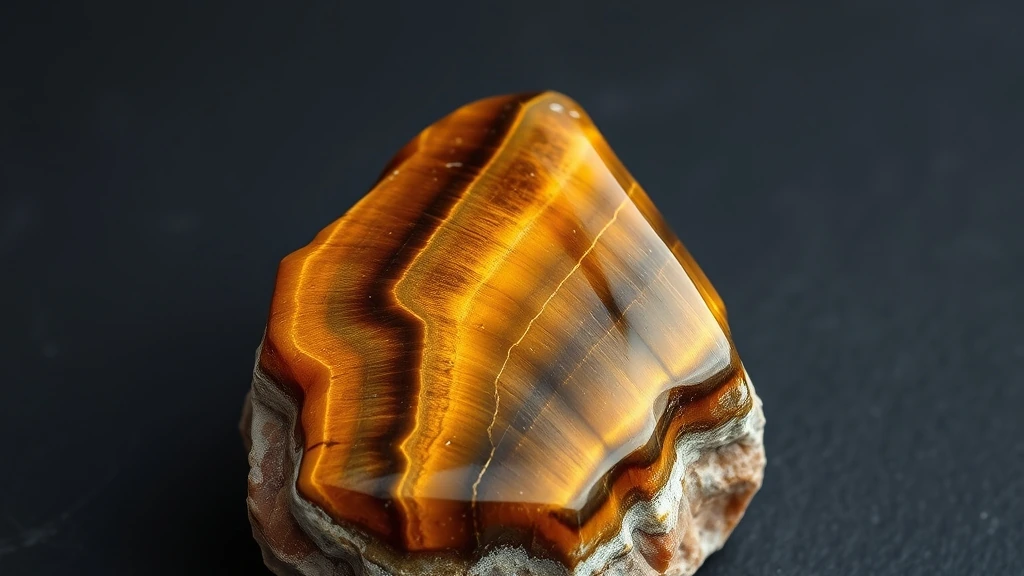
Golden Tiger’s Eye belongs to the quartz group, a natural mineral aggregate formed through complex geological processes. It is not a single crystal but a fibrous silica structure that has undergone secondary alteration. This stone represents a unique intersection of chalcedony and crocidolite, creating its distinctive optical properties. Its formation involves the replacement of blue asbestos fibers with chalcedony, resulting in a banded, cat’s-eye effect.
What is Golden Tiger’s Eye? Geological Overview & Definition
Golden Tiger’s Eye is a chatoyant gemstone formed within silica-rich geological environments. It originates from the replacement of crocidolite fibers by chalcedony, a process driven by hydrothermal activity. This transformation preserves the fibrous structure while altering the chemical composition to pure silica. The result is a stone with a silky luster and parallel banding patterns.
The gemstone displays a golden-brown hue due to iron impurities within the silica matrix. Its optical phenomenon, known as chatoyancy, occurs when light reflects off the aligned fibers. This effect creates a moving band of light across the polished surface. Geologists classify it as a variety of quartz, distinct from its precursor mineral.
Golden Tiger’s Eye Chemical Composition & Crystallographic Properties
The primary chemical composition is silicon dioxide (SiO₂), arranged in a trigonal crystal system. Unlike single crystals, this stone is an aggregate of microcrystalline quartz fibers. The lattice structure consists of SiO₄ tetrahedra linked in a disordered, fibrous pattern. This arrangement contributes to its high Mohs hardness and chemical stability.
Coloration arises from iron oxide inclusions, specifically hematite and goethite, within the silica matrix. These chromophores absorb specific wavelengths of light, producing the characteristic golden tones. The stone is generally acid-resistant, though prolonged exposure to strong acids may affect surface luster. Thermal behavior is stable, with no significant phase changes at standard jewelry temperatures.
| Property | Specification |
|---|---|
| Mineral Group | Natural Mineral / Crystal |
| Chemical Formula | SiO₂ |
| Mohs Hardness | 6.5 – 7.0 |
| Crystal System | Trigonal |
| Specific Gravity (Density) | 2.60 – 2.65 |
| Refractive Index | 1.530 – 1.543 |
| Color & Optical Properties | Natural Golden Tiger’s Eye color spectrum and optical dispersion |
| Primary Mining Localities | Global primary localities |
| Water & Chemical Resistance | High (Safe for gentle water washing) |
| Chakra Alignment (Traditional) | Sacral Chakra (Svadhishthana) |
| Zodiac Affinity (Traditional) | Sagittarius, Pisces |
| Symbolic Meaning (Traditional) | Spiritual awareness and universal harmony |
Golden Tiger’s Eye Varieties & Color Spectrum
Golden Tiger’s Eye displays distinct mineralogical characteristics across its geological varieties and structural habits. Gemologists evaluate these natural varieties based on crystal habit, trace chromophore concentrations, and visual luster.
Primary Natural Golden Tiger’s Eye
The benchmark natural variety exhibiting diagnostic color saturation and classic crystallographic symmetry.
Distinct Geological Morphs of Golden Tiger’s Eye
Secondary regional and structural varieties formed under localized geological temperature and pressure conditions.
Classic Golden Tiger’s Eye
The most widely recognized variety, Classic Golden Tiger’s Eye, forms in orthoclase feldspar pegmatites through the replacement of quartz by iron‑rich mica. Its hallmark is a silky chatoyancy that produces a golden‑brown banding reminiscent of a tiger’s eye. This variety is abundant in South Africa and Australia, making it the staple of the global trade.
Black Tiger’s Eye (Black Tiger’s Eye)
Black Tiger’s Eye derives from a high‑iron, low‑silica quartz matrix, giving it a deep charcoal hue with subtle golden lusters. The inclusions are primarily iron oxides, creating a darker, more dramatic visual signature. Though rarer than its golden counterpart, it is prized by collectors for its intense contrast.
Red Tiger’s Eye (Red Tiger’s Eye)
Formed in feldspar‑rich granites with significant iron content, Red Tiger’s Eye displays a warm, reddish‑brown banding. Its inclusions are iron‑oxide needles that produce a subtle red‑gold shimmer. This variety is scarce, especially in the United States, where it is often sourced from the Appalachian region.
Blue Tiger’s Eye (Blue Tiger’s Eye)
Blue Tiger’s Eye is a rare, cyan‑tinted variant that occurs in quartz veins with trace amounts of copper. The copper inclusions give the stone a faint blue sheen, while the chatoyancy remains prominent. It is predominantly found in the Philippines and is highly sought after for its unique color.
Green Tiger’s Eye (Green Tiger’s Eye)
Green Tiger’s Eye forms in granite pegmatites enriched with chlorite and serpentine. The greenish tint arises from these mineral inclusions, creating a subtle, moss‑like hue. This variety is uncommon, with notable deposits in Brazil and Madagascar.
Golden Tiger’s Eye (Mosaic)
Mosaic Golden Tiger’s Eye combines multiple color bands—gold, amber, and brown—within a single specimen. The interlocking bands result from layered quartz and feldspar growth during crystallization. Though not a distinct mineral, its complex patterning makes it a favorite among gem enthusiasts.
Where is Golden Tiger’s Eye Found? Geological Mining & Extraction
Golden Tiger’s Eye is typically extracted from orthoclase‑rich pegmatite formations, where quartz replaces feldspar through hydrothermal processes. The most prolific mining regions include the Kalahari Basin in South Africa, the Kangaroo Valley in Australia, and the Appalachian region of the United States, each providing distinct geological signatures.
Extraction involves open‑pit and underground mining, followed by crushing, sieving, and hand‑sorting to isolate the chatoyant grains. Modern processing emphasizes minimal environmental impact, employing water‑based washing systems and dust suppression techniques to preserve both the stone and surrounding ecosystems.
Historical Significance & Cultural Lore of Golden Tiger’s Eye
Across ancient lapidary traditions, Golden Tiger’s Eye was revered for its protective qualities. In Greco‑Roman culture, it was believed to ward off the evil eye, while Egyptian artisans incorporated it into amulets for travelers. Chinese lore attributed the stone to the celestial tiger, symbolizing strength and resilience.
Vedic texts describe Tiger’s Eye as a stone that balances the Sacral Chakra (Svadhishthana), promoting spiritual awareness and universal harmony. Archaeological findings, such as a 2,000‑year‑old burial in the Indus Valley, reveal its use as both a decorative and metaphysical object, underscoring its enduring cultural significance.
Modern Uses & Jewelry Applications of Golden Tiger’s Eye
Golden Tiger’s Eye is prized for its silky sheen and subtle banding, making it a favorite in contemporary lapidary work. Craftsmen often employ cabochon polishing to enhance its luster, while some pieces feature delicate faceting to accentuate the stone’s natural play of light. In addition, ornamental carving of small figurines and decorative panels showcases the gemstone’s warm amber tones.
- Cabochon and polished beads for necklaces, bracelets, and rings
- Faceted cabochons for earrings and pendants
- Carved ornamental panels for home décor and ceremonial objects
Metaphysical Properties & Traditional Meaning of Golden Tiger’s Eye
According to historical traditions and metaphysical lore, Golden Tiger’s Eye is believed to balance emotional energies and foster courage in the face of adversity. Across ancient Mediterranean and Vedic lapidary lore, the stone is associated with spiritual awareness, encouraging practitioners to cultivate inner harmony and resilience. Its golden hue is thought to symbolize the sun’s life‑giving energy, while the subtle tiger‑like stripes represent the dynamic flow of personal power.
Which Chakra and Zodiac Signs Align with Golden Tiger’s Eye?
The stone is traditionally linked to the Sacral Chakra (Svadhishthana), the center of creativity, sexuality, and emotional balance. This alignment is believed to enhance fluidity in personal expression and emotional well‑being.
The celestial correspondences of Golden Tiger’s Eye include the zodiac signs Sagittarius and Pisces. Those born under these signs are thought to resonate strongly with the stone’s energetic qualities, finding support in its grounding and intuitive properties.
How to Identify Real vs. Fake Golden Tiger’s Eye
Artificial imitations of Golden Tiger’s Eye often consist of dyed glass, polymer composites, or synthetic quartz engineered to mimic the stone’s banding. These replicas lack the natural internal structure and optical properties of genuine specimens, making them distinguishable through careful testing.
Practical At-Home Authenticity Tests
- Temperature Test (Thermal Feel): Hold the stone in your hand; real quartz feels cool to the touch due to its thermal conductivity, whereas glass or polymer remains warmer.
- Specific Gravity & Weight Test: Weigh the stone against a known quartz sample of the same size; genuine Golden Tiger’s Eye should be heavier, reflecting its higher specific gravity.
- Scratch & Hardness Test (Mohs Comparison): Use a reference mineral of known hardness (e.g., a steel file or a quartz crystal); the stone should resist scratching, confirming a hardness of 6.5–7.0.
- Microscopic & Loupe Inspection (Internal Inclusions): Examine the stone under a loupe; authentic specimens display characteristic fibrous inclusions and subtle banding, while synthetic versions often show uniform patterns or artificial fractures.
Golden Tiger’s Eye Valuation Factors, Grading & Pricing
The foremost driver of market value is color saturation. Stones that display a deep, uniform golden to amber hue with a vivid chatoyant band are prized for their visual vibrancy. A natural energetic luster that appears to move across the surface under light adds a premium, while faded or uneven tones reduce price. Collectors often compare the intensity to the original quartz matrix to gauge authenticity.
Crystal size and weight (grams) play a critical role in pricing. Larger specimens measured in grams command higher rates, especially when the stone is free of fractures and retains a solid, unbroken form. Raw material fetched at the quarry fetches less than a well‑polished tumbled piece, because the latter showcases the characteristic silky sheen without additional processing costs. Natural matrix inclusions, when subtle, can enhance the stone’s story and sometimes its value, whereas conspicuous cracks lower it.
The final component is ethical sourcing and locality premium. Buyers increasingly favor stones harvested with transparent labor practices and minimal environmental impact, often paying a surcharge for responsibly mined material. Historical sources such as South African and Brazilian deposits carry a reputation that can influence collector demand, while newly discovered locales may command a novelty premium. Holistic markets also reward provenance that aligns with traditional metaphysical narratives, adding a layer of cultural desirability.
How to Clean and Care for Golden Tiger’s Eye
Gentle cleaning with warm soapy water and a soft cloth is safe for Golden Tiger’s Eye, provided the water is not abrasive and the cloth is non‑abrasive. Rinse the stone briefly in lukewarm water, then pat dry with a microfiber towel to avoid water spots. Ultrasonic cleaners should be avoided, as the rapid vibrations can create micro‑fractures in the quartz lattice. Regular cleaning removes surface oils and restores the stone’s natural luster without compromising structural integrity.
Cleansing and Recharging Golden Tiger’s Eye (Energetic Care)
Across ancient lapidary traditions, placing the stone on a clean selenite slab under moonlight is a gentle method to restore its energetic balance. The soft lunar illumination is believed to cleanse subtle vibrations without exposing the mineral to heat or harsh light.
Herbal smudging with sage or cedar, performed at a safe distance, offers a dry, aromatic way to clear lingering energies. The smoke passes over the stone, allowing it to absorb the purifying essence while remaining untouched by moisture or temperature extremes.
Frequently Asked Questions About Golden Tiger’s Eye
Golden Tiger’s Eye displays distinct mineralogical characteristics across its geological varieties and structural habits. Gemologists evaluate these natural varieties based on crystal habit, trace chromophore concentrations, and visual luster.
Primary Natural Golden Tiger’s Eye
The benchmark natural variety exhibiting diagnostic color saturation and classic crystallographic symmetry.
Distinct Geological Morphs of Golden Tiger’s Eye
Secondary regional and structural varieties formed under localized geological temperature and pressure conditions.
What is the chemical composition of Golden Tiger’s Eye?
Golden Tiger’s Eye is a variety of quartz with the formula SiO₂. This silicate mineral crystallizes in the trigonal system, giving it a characteristic fibrous texture that produces the chatoyant effect prized in jewelry.
How hard is Golden Tiger’s Eye on the Mohs scale?
Its hardness ranges from 6.5 to 7.0 on the Mohs scale. This makes it durable enough for everyday wear, though it can still scratch softer stones like talc or gypsum, so careful handling is advisable.
Is Golden Tiger’s Eye safe to clean in the shower?
Yes, it is highly water‑resistant and safe for gentle washing with water. A mild soap solution and a soft cloth will keep the stone clean without compromising its structural integrity or luster.
Can I use an ultrasonic cleaner on Golden Tiger’s Eye?
No, avoid ultrasonic cleaners; instead use warm soapy water and a soft cloth. Ultrasonic vibrations can cause micro‑fractures in the fibrous quartz, leading to surface damage over time.
Which zodiac signs are associated with Golden Tiger’s Eye?
The stone aligns with Sagittarius and Pisces. In astrological traditions, it is believed to support the adventurous spirit of Sagittarius and the intuitive nature of Pisces.
Which chakra does Golden Tiger’s Eye correspond to?
It corresponds exclusively to the Sacral Chakra (Svadhishthana). This chakra governs creativity, sensuality, and emotional balance, and the stone is thought to enhance these qualities.
Does Golden Tiger’s Eye have any special care instructions for jewelry?
Store it separately from softer gemstones and avoid harsh chemicals. The fibrous structure can be weakened by prolonged exposure to acids or strong detergents, so a dry, soft cloth is ideal for routine cleaning.
What metaphysical properties are attributed to Golden Tiger’s Eye?
It is believed to promote spiritual awareness and universal harmony. In many cultural traditions, the stone is used to balance emotional energy and foster confidence, reflecting its historical use in protective amulets and talismans.