
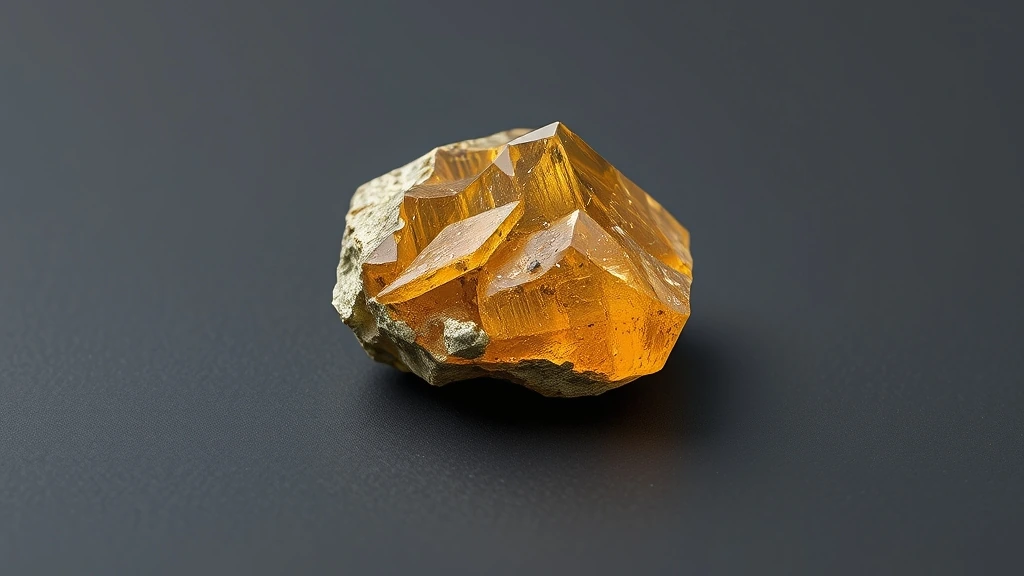
Golden tourmaline belongs to the broader tourmaline group, a natural mineral family characterized by a complex borosilicate framework that accommodates a wide range of cations. Its structure is built from rings of SiO₄ tetrahedra linked to BO₃ triangles, creating a robust three‑dimensional lattice that tolerates extensive elemental substitution. The gemstone’s golden coloration arises from trace amounts of iron and manganese occupying specific sites, while its durability makes it suitable for both ornamental and collector’s pieces.
What is Golden Tourmaline? Geological Overview & Definition
Golden tourmaline is a trigonal borosilicate that forms in granitic pegmatites, metamorphic schists, and hydrothermal vein environments. The mineral’s crystal habit typically presents as elongated, striated prisms with a pseudo‑hexagonal outline, reflecting the symmetry of its trigonal lattice.
In the tourmaline supergroup, the Y‑site accommodates a variety of cations such as Na, Ca, and K, while the X‑site hosts Al, Fe²⁺, Mg, or Mn²⁺, which together dictate the stone’s hue. The presence of Fe³⁺ and Mn³⁺ as chromophore agents imparts the characteristic golden to amber tones, distinguishing it from its pink, green, or blue counterparts.
Golden Tourmaline Chemical Composition & Crystallographic Properties
The crystal structure of golden tourmaline conforms to the trigonal space group R3m, featuring a six‑fold screw axis that governs its elongated prism morphology. Its lattice consists of interconnected SiO₄ tetrahedra and BO₃ triangles, forming channels that host the variable X, Y, and Z cation sites.
Cation substitution is extensive: Fe²⁺/Fe³⁺ and Mn²⁺/Mn³⁺ replace Al in the X‑site, while Na, Ca, or K occupy the Y‑site, creating a solid‑solution series that influences both color and physical properties. This flexibility also renders the mineral acid‑sensitive, as strong acids can leach loosely bound cations from the channels, leading to surface etching.
The golden hue originates from charge‑transfer transitions between Fe²⁺–Fe³⁺ and Mn²⁺–Mn³⁺ pairs, acting as chromophore centers within the crystal field. Upon heating, these charge‑transfer bands may shift, sometimes producing a deeper amber or fading to a paler yellow, a behavior exploited in heat‑treatment enhancement.
Thermally, golden tourmaline is stable up to approximately 600 °C before structural breakdown occurs, at which point the borate framework collapses and the mineral may recrystallize into other borosilicates. Its hardness of 6.5 – 7.0 on the Mohs scale reflects the strong covalent bonding within the silicate‑borate network, contributing to its resistance against scratching and abrasion.
| Property | Specification |
|---|---|
| Mineral Group | Natural Mineral / Crystal |
| Mohs Hardness | 6.5 – 7.0 |
| Crystal System | Trigonal |
| Color & Optical Properties | Natural Golden Tourmaline color spectrum and optical dispersion |
| Primary Mining Localities | Global primary localities |
| Water & Chemical Resistance | High (Safe for gentle water washing) |
| Chakra Alignment (Traditional) | Root Chakra (Muladhara) |
| Zodiac Affinity (Traditional) | Aries, Scorpio |
| Symbolic Meaning (Traditional) | Emotional balance, compassion and inner peace |
Golden Tourmaline Varieties & Color Spectrum
Golden tourmaline encompasses a diverse range of yellow to gold-hued elbaite species, distinguished by trace element substitutions. The color spectrum varies significantly based on the specific chromophores present within the crystal lattice. These variations create distinct market categories with varying levels of rarity and desirability among collectors.
Imperial Gold Tourmaline
This prized variety exhibits a rich, saturated golden-yellow hue often described as “imperial” in gemological trade. Its color arises from the presence of iron and manganese ions substituting within the borosilicate structure. High-quality specimens display excellent transparency and a warm, honeyed luster that commands premium prices.
Citrine-Confused Gold Tourmaline
While visually similar to heated amethyst, this natural golden tourmaline lacks the thermal alteration history of its quartz counterpart. Distinguishing features include a higher refractive index and characteristic striations on prism faces. Gemologists rely on these optical properties to differentiate it from treated quartz stones in the market.
Pale Lemon Tourmaline
This lighter variety features a soft, lemon-yellow coloration that is often more abundant than its deeper golden counterparts. It typically forms in large, well-crystallized pegmatite pockets where fluid conditions favored slower growth rates. The stone’s delicate hue makes it popular for intricate jewelry settings and everyday wear.
Orange-Gold Hybrid Tourmaline
Positioned between pure yellow and orange, this transitional variety showcases a vibrant sunset-like appearance. The color gradient results from a complex interplay of chromium and iron impurities during crystallization. Such hybrid tones are highly sought after for their unique warmth and dynamic visual appeal.
Deep Amber Tourmaline
Characterized by a rich, amber-brown undertone mixed with golden highlights, this variety offers a sophisticated, earthy aesthetic. The darker saturation is often associated with higher concentrations of transition metal ions in the host rock. Its depth of color provides a striking contrast against white gold or platinum settings.
Where is Golden Tourmaline Found? Geological Mining & Extraction
Golden tourmaline primarily forms in alkaline pegmatites, which are coarse-grained igneous rocks resulting from the final stages of magma crystallization. These deposits typically occur in regions with significant tectonic activity, such as the eastern United States and Brazil. The slow cooling process allows large, gem-quality crystals to develop within the granite host rock.
Major mining regions include Minas Gerais in Brazil, which yields the most commercially significant stones globally. Other notable sources include Madagascar, Nigeria, and the historic mines of Maine and California. Extraction involves careful hand-picking to preserve the integrity of the crystal lattice and minimize fractures during the cutting process.
Historical Significance & Cultural Lore of Golden Tourmaline
Ancient civilizations revered tourmaline for its perceived protective qualities, often incorporating it into amulets and ceremonial objects. In Greco-Roman lore, the stone was believed to ward off evil spirits and promote emotional stability during times of conflict. Archaeological evidence suggests that early lapidaries valued its durability and vibrant color for intricate inlay work in jewelry.
Vedic traditions associated the golden hues of tourmaline with solar energy and the Muladhara chakra, linking it to grounding and vitality. Chinese imperial records mention similar stones as symbols of wealth and prosperity, often reserved for high-ranking officials. These cross-cultural narratives highlight the mineral’s enduring role in spiritual and material wealth throughout history.
Modern Uses & Jewelry Applications of Golden Tourmaline
Lapidaries primarily cut golden tourmaline into faceted gemstones to maximize its warm, honeyed brilliance and optical dispersion. The stone’s moderate hardness allows for precise faceting, though care is required to avoid cleavage planes during the shaping process.
- Faceted Cuts: Oval, cushion, and emerald cuts are popular for showcasing the stone’s rich yellow-to-orange hues.
- Cabochons: Smooth, polished domes are used for vintage-style jewelry or when the stone contains significant inclusions.
- Ornamental Carving: Larger, transparent specimens are occasionally carved into beads, pendants, or decorative objects for collectors.
Carat, Quality Grades & Value Factors of Golden Tourmaline
The primary driver of value is color saturation, where deep, vivid yellow or orange tones command significantly higher prices than pale or brownish shades. Stones with a pure, warm hue free from green or red secondary colors are considered top-grade. The 4Cs framework applies strictly, with color and clarity often outweighing cut in determining market desirability for this specific variety.
Clarity is the second critical factor, as golden tourmaline frequently contains internal inclusions known as “jardin.” Eye-clean specimens are rare and highly prized, while those with visible inclusions are graded lower. Carat weight also impacts value exponentially; larger stones over five carats with good color and clarity are exceptionally scarce. Durability is good for daily wear, but the stone’s Mohs hardness of 6.5 to 7.0 requires protection from hard impacts to prevent chipping.
Zodiac and Astrological Lore of Golden Tourmaline
In traditional astrological correspondence, golden tourmaline is strongly aligned with Aries and Scorpio. For Aries, the stone’s fiery yellow energy is believed to enhance courage and drive, supporting the sign’s natural dynamism. Scorpio, associated with depth and transformation, finds resonance in the stone’s grounding qualities, which are thought to aid in emotional release.
Historically, tourmaline varieties have been linked to the Root Chakra (Muladhara), representing stability and physical vitality. Ancient lapidary traditions often associated yellow tourmaline with the sun, symbolizing warmth and life force. This connection reinforces its use in meditation practices aimed at fostering emotional balance and inner peace.
How to Identify Real vs. Fake Golden Tourmaline
Artificial imitations of golden tourmaline include synthetic glass, dyed quartz, and lab-created beryl. Glass imitations often exhibit perfect clarity and high refractive index, lacking the natural inclusions found in genuine stones. Dyed quartz may show color concentration along cracks, a telltale sign of artificial enhancement.
Practical At-Home Authenticity Tests
- Temperature Test (Thermal Feel): Genuine tourmaline feels cool to the touch initially and warms slowly, whereas glass imitations tend to warm up faster due to lower thermal conductivity.
- Specific Gravity & Weight Test: Tourmaline has a density of approximately 3.06 g/cm³. A stone that feels significantly lighter than a similarly sized quartz or glass piece may be a lightweight synthetic.
- Scratch & Hardness Test (Mohs Comparison): With a Mohs hardness of 6.5–7.0, real tourmaline will scratch glass (hardness 5.5) but may be scratched by quartz (hardness 7.0). If the stone is easily scratched by a steel knife (hardness 5.5), it is likely a soft imitation.
- Microscopic & Loupe Inspection (Internal Inclusions): Use a 10x loupe to look for natural inclusions such as fluid-filled cavities or needle-like inclusions. Perfect clarity with no internal features often indicates synthetic glass or high-quality lab-created material.
Golden Tourmaline Valuation Factors, Grading & Pricing
The market value of Golden Tourmaline hinges first on color saturation; a deep, uniform amber to golden hue with minimal zoning commands the highest premiums. Uniformity of hue across the stone’s surface, coupled with optical clarity and a bright luster, further elevates its desirability.
Second, carat weight and facet symmetry play decisive roles. Larger specimens with precise, symmetrical facets that meet the four‑C grading standards—cut, clarity, color, and carat—are prized by collectors and investors alike. The meticulous lapidary work required to highlight the stone’s natural brilliance directly influences its price.
Finally, geographical provenance premium and certified market value trends shape the final cost. Specimens sourced from renowned localities, such as the Himalayan or Brazilian deposits, often carry a higher market value, especially when accompanied by a reputable gemological certification. Current market analyses show a steady appreciation for well‑graded Golden Tourmaline, reflecting its growing popularity in high‑end jewelry.
How to Clean and Care for Golden Tourmaline
Gentle cleaning of Golden Tourmaline is achieved by rinsing the stone in warm soapy water and wiping it with a soft cloth. This method preserves the crystal’s structural integrity while removing surface oils and dust. Ultrasonic cleaners should be avoided, as the vibration can induce micro‑fractures in the mineral’s lattice.
Cleansing and Recharging Golden Tourmaline (Energetic Care)
To recharge the energetic properties of Golden Tourmaline, place the stone in a quiet, dimly lit area and expose it to gentle moonlight for a few hours. Alternatively, resting the crystal on a selenite charging slab during the night allows subtle electromagnetic fields to cleanse and amplify its vibrational energy. Herbal smudging with sage or palo santo can be performed around the stone, ensuring the smoke does not linger directly on the surface. These dry, low‑energy practices maintain the integrity of the crystal while supporting its metaphysical benefits.
Frequently Asked Questions About Golden Tourmaline
Golden Tourmaline displays distinct mineralogical characteristics across its geological varieties and structural habits. Gemologists evaluate these natural varieties based on crystal habit, trace chromophore concentrations, and visual luster.
Primary Natural Golden Tourmaline
The benchmark natural variety exhibiting diagnostic color saturation and classic crystallographic symmetry.
Distinct Geological Morphs of Golden Tourmaline
Secondary regional and structural varieties formed under localized geological temperature and pressure conditions.
Is Golden Tourmaline safe to wear in the shower?
Yes, Golden Tourmaline is water‑resistant and can be safely washed with gentle water.
The crystal’s robust structure allows it to withstand mild moisture without losing color or integrity. For best care, rinse with lukewarm water and pat dry with a soft cloth, avoiding harsh chemicals that could dull its surface.
Can I clean Golden Tourmaline with an ultrasonic cleaner?
No, ultrasonic cleaners should be avoided to prevent structural fractures.
Instead, use warm soapy water and a soft cloth for cleaning. Ultrasonic vibration can induce micro‑cracks in the trigonal lattice, compromising the stone’s durability and clarity over time.
Does Golden Tourmaline have any special care instructions for cleaning?
Use warm soapy water and a soft cloth; dry immediately after washing.
Gentle agitation is sufficient to remove dirt. Avoid abrasive scrubbers or harsh detergents, as they can scratch the polished surface and reduce the gemstone’s natural luster.
Which zodiac signs are associated with Golden Tourmaline?
Aries and Scorpio are the zodiac signs linked to Golden Tourmaline.
In astrological traditions, these signs are believed to resonate with the stone’s energetic properties, enhancing courage and transformation for those born under these constellations.
Which chakra does Golden Tourmaline correspond to?
Golden Tourmaline aligns with the Root Chakra (Muladhara).
This connection supports grounding, stability, and a sense of safety, helping wearers to feel more centered and balanced in daily life.
Is Golden Tourmaline suitable for everyday jewelry?
Yes, Golden Tourmaline is durable enough for daily wear.
Its Mohs hardness of 7.0–7.5 provides good resistance to scratches, and its natural color stability ensures it remains vibrant through routine use, making it a suitable choice for pendants and bracelets, though caution is advised for rings due to its cleavage.
Can I use Golden Tourmaline in a humid environment?
Yes, the stone tolerates humidity well due to its water‑resistant nature.
Unlike moisture‑sensitive minerals, Golden Tourmaline does not absorb water, so it remains unaffected by damp conditions, making it suitable for use in bathrooms or tropical climates.
Does Golden Tourmaline have any metaphysical properties?
It is believed to promote emotional balance, compassion, and inner peace.
Across ancient lapidary traditions, the stone is thought to soothe emotional turbulence, fostering a calm and compassionate mindset while grounding the wearer’s energy.