
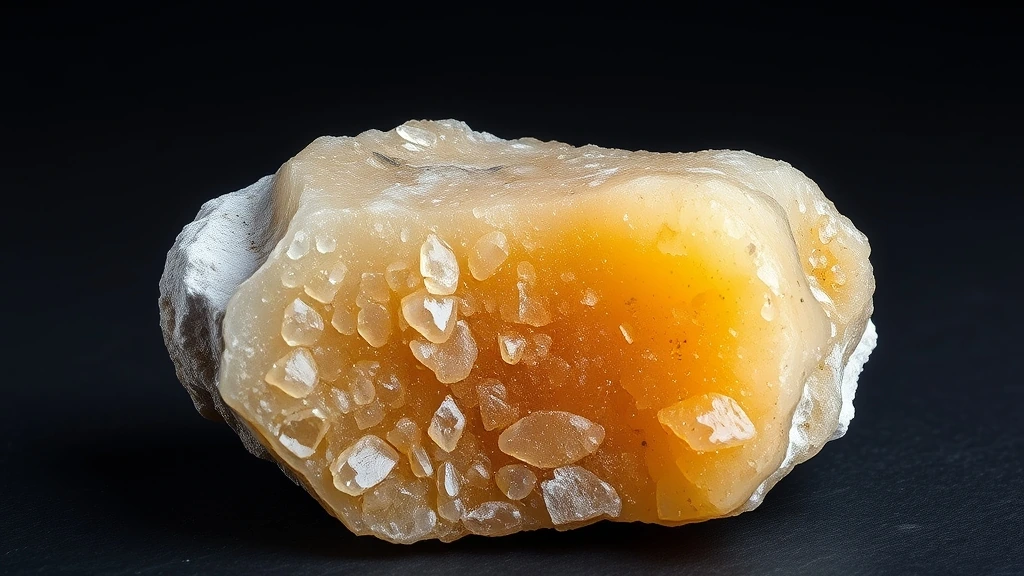
Honey calcite belongs to the extensive carbonate mineral family, serving as a distinct color variant of the ubiquitous mineral calcite. As a natural mineral crystal, it forms through the precipitation of calcium carbonate from aqueous solutions over geological time. Its classification emphasizes its crystalline structure rather than organic origin, distinguishing it from amorphous materials. This stone represents a specific chromatic expression within the broader trigonal crystal system, valued for its aesthetic warmth and geological consistency.
What is Honey Calcite? Geological Overview & Definition
Honey calcite is primarily defined by its warm amber to golden hues, resulting from trace impurities within the crystal lattice. It typically forms in metamorphic or sedimentary environments, where calcium-rich fluids interact with host rocks. Geologists identify it by its characteristic rhombic cleavage, which allows the mineral to split into geometric shapes. This physical property distinguishes it from other yellowish minerals like citrine or topaz.
The stone’s geological significance lies in its role as a diagnostic indicator of specific formation conditions. It often occurs in veins or nodules, showcasing the precipitation dynamics of ancient fluid systems. Understanding its origin helps researchers reconstruct the paleoenvironmental history of the region. Consequently, honey calcite serves as both a gemological curiosity and a geological record of past chemical processes. In comparative mineralogical collections, practitioners and geologists frequently study Peanut Wood alongside this crystal to appreciate their subtle energetic and structural differences.
Honey Calcite Chemical Composition & Crystallographic Properties
Honey calcite crystallizes in the trigonal system, featuring a lattice where calcium ions are coordinated by carbonate groups. The chemical formula CaCO₃ reflects a stoichiometric balance essential for its structural integrity. This arrangement creates a stable framework that influences the mineral’s optical properties and cleavage patterns. The trigonal symmetry dictates how light interacts with the internal atomic arrangement. In comparative mineralogical collections, practitioners and geologists frequently study Dalmatian Stone alongside this crystal to appreciate their subtle energetic and structural differences.
The characteristic honey color arises from chromophore centers caused by trace elements like iron or manganese. These impurities substitute for calcium ions, altering the absorption spectrum of visible light. Such cation substitution is critical for determining the stone’s specific hue and saturation. Without these minor inclusions, the mineral would appear colorless or white.
Calcite exhibits isotropic behavior in certain optical contexts but is generally uniaxial positive. This property affects how the stone refracts light, creating a birefringence effect visible in thin sections. The refractive index ranges from 1.486 to 1.658, contributing to its glassy luster. These optical characteristics are vital for accurate gemological identification and grading.
The mineral is acid-sensitive, reacting with dilute hydrochloric acid to release carbon dioxide gas. This effervescence test is a standard diagnostic tool for confirming its carbonate identity. Thermal behavior reveals that calcite undergoes phase transitions at high temperatures, altering its crystal structure. Proper handling ensures the preservation of its delicate crystal faces and surface finish.
| Property | Specification |
|---|---|
| Mineral Group | Natural Mineral / Crystal |
| Chemical Formula | CaCO₃ |
| Mohs Hardness | 3.0 |
| Crystal System | Trigonal |
| Specific Gravity (Density) | 2.65 – 2.72 |
| Refractive Index | 1.486 – 1.658 |
| Color & Optical Properties | Natural Honey Calcite color spectrum and optical dispersion |
| Primary Mining Localities | Global primary localities |
| Water & Chemical Resistance | EXTREMELY SENSITIVE: Water Soluble / Moisture Sensitive! (Avoid liquids) |
| Chakra Alignment (Traditional) | Heart Chakra |
| Zodiac Affinity (Traditional) | Taurus, Virgo |
| Symbolic Meaning (Traditional) | Emotional balance, grounding, and gentle healing |
Honey Calcite Varieties & Color Spectrum
Honey Calcite displays distinct mineralogical characteristics across its geological varieties and structural habits. Gemologists evaluate these natural varieties based on crystal habit, trace chromophore concentrations, and visual luster.
Primary Natural Honey Calcite
The benchmark natural variety exhibiting diagnostic color saturation and classic crystallographic symmetry.
Distinct Geological Morphs of Honey Calcite
Secondary regional and structural varieties formed under localized geological temperature and pressure conditions.
Golden Honey Calcite
Formed in shallow marine limestone caverns, Golden Honey Calcite acquires its warm amber hue from trace iron oxide inclusions. The crystal habit is typically massive or botryoidal, displaying a silky luster that deepens under sunlight. Found chiefly in the United States (Illinois, Missouri) and parts of Mexico, it is moderately common but prized for its uniform color.
Amber‑Band Calcite
This variety exhibits translucent bands of honey‑yellow alternating with milky white, a pattern created by rhythmic precipitation of calcite layers during diagenesis. The banding is accentuated by microscopic fluid inclusions that scatter light, giving a subtle glow. Amber‑Band Calcite is most abundant in the karst deposits of the Czech Republic and the Balkans, where it is harvested for ornamental cabochons.
Honey‑Tinted Calcite with Fluorite Inclusions
In regions of the French Massif Central, calcite crystals incorporate minute fluorite specks, producing a honey‑colored matrix punctuated by violet‑blue flecks. The fluorite inclusions enhance the stone’s refractive contrast, making it a collector’s favorite. This morph is relatively rare, with limited commercial extraction due to the delicate nature of the inclusions.
Honey‑Scented Calcite from Namibia
Namibian deposits yield honey‑calcite that often contains fine sand‑grain inclusions, imparting a faint earthy aroma when rubbed. The mineral forms in evaporitic basins where high evaporation rates concentrate calcium carbonate. Its scented quality and deep golden tone make it a niche item in the global gemstone market, though the remote mining locations limit supply.
Honey‑Veined Calcite (Iranian Variety)
Iran’s Kerman province produces calcite with delicate honey‑colored veins intersecting a translucent base. These veins result from late‑stage hydrothermal fluids rich in manganese, which stain the crystal lattice. The veined pattern is highly sought after for high‑end jewelry, yet the limited number of active quarries renders the variety scarce.
Where is Honey Calcite Found? Geological Mining & Extraction
Honey Calcite typically occurs in carbonate host rocks such as limestone and dolostone, where low‑temperature hydrothermal fluids precipitate calcite crystals within voids and fissures. In many deposits, the mineral is associated with gypsum, barite, and minor sulfide minerals, creating a complex paragenesis that influences its color and clarity.
Major extraction zones include the Midwestern United States (Illinois, Missouri), the Czech Republic’s Bohemian Massif, the French Massif Central, and Namibia’s coastal evaporite basins. Mining is largely artisanal, employing hand‑picked methods to avoid damaging the fragile honey‑colored crystals, while larger operations use controlled blasting followed by careful sorting to preserve gem‑quality material.
Historical Significance & Cultural Lore of Honey Calcite
Across ancient lapidary traditions, honey‑calcite was valued for its warm glow and was incorporated into Egyptian amulets intended to invoke the sun god Ra’s protective warmth. Greco‑Roman writers such as Pliny the Elder described “sweet stone” used in mosaics and as a talisman for emotional balance, a belief that persisted into medieval alchemy.
In Vedic texts, the stone appears as “Shankha‑prashtha,” associated with the heart chakra and employed in meditation to foster grounding and gentle healing. Chinese mineralogists of the Han dynasty catalogued honey‑calcite among the “five precious stones,” attributing it the power to harmonize the body’s qi and to protect against emotional turbulence.
Modern Uses & Jewelry Applications of Honey Calcite
Honey calcite is frequently fashioned into cabochon or shallow‑faceted stones, allowing its warm amber hue to glow softly under light. Artisans favor the trigonal crystal habit for carving delicate pendants, earrings, and brooches that showcase its natural translucency. The mineral’s modest Mohs hardness of 3 makes it ideal for ornamental carving, though protective settings are recommended for everyday wear.
- Cabochon pendants highlighting the stone’s honey‑colored glow
- Faceted rings and earrings for subtle sparkle without excessive brilliance
- Carved beads, figurines, and decorative inlays for interior design
Metaphysical Properties & Traditional Meaning of Honey Calcite
According to historical traditions and metaphysical lore, honey calcite is associated with emotional balance and gentle grounding. Across ancient Mediterranean lapidary practices, the stone was believed to soothe agitation, fostering a calm heart and encouraging compassionate communication. Vedic references link its warm tone to the nurturing aspects of the earth element, promoting inner peace and the release of past emotional burdens.
Which Chakra and Zodiac Signs Align with Honey Calcite?
In the system of subtle energy centers, honey calcite resonates most strongly with the Heart Chakra, supporting love, forgiveness, and the integration of emotional experiences. Practitioners report that placing the stone on the chest area amplifies feelings of empathy and self‑acceptance, aligning the heart’s vibrational frequency with the stone’s soothing amber energy.
Astrologically, honey calcite is aligned with the Taurus and Virgo signs. Both earth‑signs value stability, practicality, and a deep connection to the material world, qualities that echo the stone’s grounding influence. Wearing honey calcite is thought to enhance the native’s innate reliability and capacity for patient, steady progress.
How to Identify Real vs. Fake Honey Calcite
Artificial imitations of honey calcite often include dyed quartz, synthetic glass, or resin composites that mimic its warm coloration but lack the mineral’s characteristic physical properties. These substitutes may feel heavier or display a uniform clarity absent in natural specimens. Recognizing these differences requires a combination of visual inspection and simple tactile tests.
Practical At-Home Authenticity Tests
- Temperature Test (Thermal Feel): Natural honey calcite absorbs heat quickly and feels cool to the touch, whereas glass or plastic replicas retain warmth longer.
- Specific Gravity & Weight Test: With a density of 2.65‑2.72 g/cm³, genuine honey calcite feels noticeably heavier than dyed quartz of similar size; a simple water displacement test can confirm the specific gravity.
- Scratch & Hardness Test (Mohs Comparison): Using a steel nail (hardness ~5.5) or a copper coin (hardness ~3), a real honey calcite will be scratched easily, while glass or synthetic stones may resist scratching.
- Microscopic & Loupe Inspection (Internal Inclusions): Under 10× magnification, natural honey calcite often shows fine, irregular fractures or minute calcite crystals, whereas synthetic glass appears uniformly clear with no internal features.
Honey Calcite Valuation Factors, Grading & Pricing
The market value of honey calcite is largely driven by color saturation. A deep, uniform amber hue with minimal veining signals superior natural energetic luster, commanding higher prices among collectors and holistic practitioners.
Crystal size and weight are the next decisive criteria. Larger specimens, measured in grams, retain more mass and display a richer visual presence. Raw, unpolished crystals often fetch a premium for their untouched matrix, whereas tumbled, lightly polished pieces appeal to those seeking a smoother aesthetic.
Ethical sourcing and locality also influence pricing. Specimens extracted from responsibly managed deposits, especially those with documented provenance, attract a locality premium in both holistic circles and the broader gem market.
How to Clean and Care for Honey Calcite
Honey calcite is highly sensitive to moisture; water and humidity dissolve the carbonate lattice, causing surface erosion. To preserve its integrity, gently dust the crystal with a completely dry, soft microfiber cloth or a camel‑hair brush. Store the specimen in a low‑humidity environment, away from liquids and direct contact with damp surfaces. Ultrasonic cleaning is strictly forbidden, as the vibration can introduce micro‑fractures and accelerate degradation.
Cleansing and Recharging Honey Calcite (Energetic Care)
For energetic renewal, place the crystal on a selenite charging slab under gentle moonlight for several hours. This method allows the crystal to absorb subtle lunar vibrations without exposure to heat or direct sunlight.
Alternatively, a brief herbal smudging session using sage or palo santo can cleanse residual energies. After smudging, allow the crystal to rest in a quiet, dry space for a few hours before handling, ensuring that no heat source or intense light is applied during the process.
Frequently Asked Questions About Honey Calcite
Honey Calcite displays distinct mineralogical characteristics across its geological varieties and structural habits. Gemologists evaluate these natural varieties based on crystal habit, trace chromophore concentrations, and visual luster.
Primary Natural Honey Calcite
The benchmark natural variety exhibiting diagnostic color saturation and classic crystallographic symmetry.
Distinct Geological Morphs of Honey Calcite
Secondary regional and structural varieties formed under localized geological temperature and pressure conditions.
What is the chemical composition of honey calcite?
Honey calcite is composed of calcium carbonate (CaCO₃). This formula places it in the carbonate mineral group, giving it a characteristic hardness of 3 on the Mohs scale and a density range of 2.65–2.72 g/cm³. Its trigonal crystal system often produces smooth, honey‑colored crystals prized in lapidary work.
Is honey calcite safe to wear in humid environments?
No, honey calcite is extremely sensitive to moisture and should not be exposed to humidity. Water can dissolve the calcium carbonate, leading to surface erosion or complete loss of the stone. Avoid wearing it in showers, pools, or high‑humidity rooms to preserve its integrity.
How should I clean honey calcite to avoid damage?
Use a dry, soft microfiber cloth or a gentle brush for cleaning. Avoid any liquid, soap, or ultrasonic cleaning, as moisture will dissolve the mineral. Light dusting with a soft brush removes surface particles without risking chemical degradation.
Can ultrasonic cleaning be used on honey calcite?
Ultrasonic cleaning is strictly forbidden for honey calcite. The high‑frequency vibrations and accompanying water exposure will dissolve the calcium carbonate, causing irreversible damage. Stick to dry cleaning methods to maintain the stone’s appearance.
Which zodiac signs are associated with honey calcite?
Honey calcite aligns with the zodiac signs Taurus and Virgo. These signs are believed to resonate with the stone’s grounding energy, supporting emotional balance and stability in daily life.
Which chakra does honey calcite correspond to?
Honey calcite corresponds exclusively to the Heart Chakra. Its warm, honey hue is thought to promote emotional healing, compassion, and inner peace, making it a favored stone for heart‑centered meditation practices.
Does honey calcite have any special metaphysical properties?
Honey calcite is reputed to aid emotional balance, grounding, and gentle healing. In esoteric traditions, it is used to calm the mind, encourage patience, and foster a sense of stability, especially for those seeking to strengthen their emotional resilience.
How does honey calcite differ from other calcite varieties in terms of durability?
Honey calcite is softer and more moisture‑sensitive than many calcite varieties. Its Mohs hardness of 3 and water solubility mean it is more prone to scratching and dissolution, requiring careful handling and storage away from moisture and abrasive surfaces.