
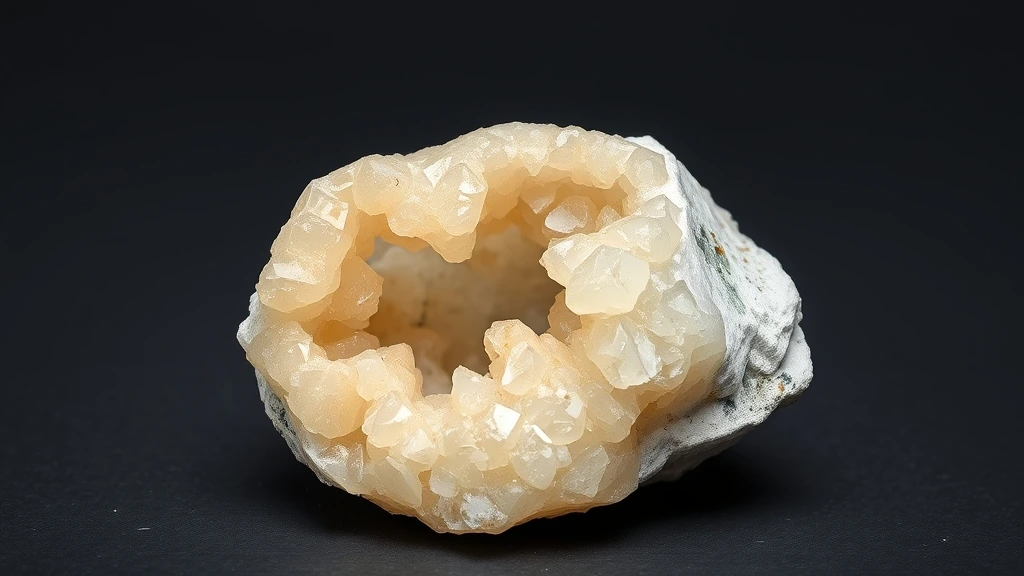
Honey Comb Calcite belongs to the Natural Mineral group, specifically classified as a polymorph of calcium carbonate. Its unique formation occurs within volcanic or hydrothermal environments, where gas bubbles create a spongy texture. This geological process results in a stone that is both visually striking and scientifically distinct from dense calcite varieties.
What is Honey Comb Calcite? Geological Overview & Definition
This mineral forms when calcium carbonate precipitates in gas-rich environments, trapping air pockets that define its porous surface. The resulting texture resembles a honeycomb, earning the stone its common name. Geologists identify it by its lightweight nature and characteristic hexagonal prisms. The same hexagonal crystal habit that gives honeycomb calcite its striking appearance is also a hallmark of Shattuckite, a copper‑silicate mineral prized for its vibrant turquoise hues.
Unlike dense calcite, this variety often appears in trigonal crystal habits with visible internal voids. These voids scatter light, creating a soft, glowing appearance rather than high clarity. It is frequently found in association with other volcanic minerals, indicating specific hydrothermal formation conditions. These voids scatter light, creating a soft, glowing appearance that mirrors the gentle translucence of Rhodochrosite China, another volcanic gem prized for its subtle, heart‑opening hues.
Honey Comb Calcite Chemical Composition & Crystallographic Properties
Honey Comb Calcite crystallizes in the trigonal system, displaying a lattice structure defined by calcium and carbonate ions. The calcium cation occupies specific sites within the unit cell, creating a stable yet brittle framework. This arrangement allows for the characteristic hexagonal cross-sections observed in polished specimens.
The stone’s warm coloration stems from iron impurities substituting within the crystal lattice, acting as chromophores. These trace elements absorb specific wavelengths of light, producing the signature honey tones. The acid sensitivity of calcite is pronounced, as it reacts vigorously with dilute hydrochloric acid to release carbon dioxide.
Thermal stability is limited, with the mineral undergoing structural changes at elevated temperatures. Prolonged heat exposure can cause decomposition into lime and carbon dioxide, altering the crystal integrity. Consequently, this mineral requires careful handling to preserve its delicate porous structure and aesthetic value.
| Property | Specification |
|---|---|
| Mineral Group | Natural Mineral / Crystal |
| Chemical Formula | CaCO₃ |
| Mohs Hardness | 6.5 – 7.0 |
| Crystal System | Trigonal |
| Specific Gravity (Density) | 2.71 |
| Refractive Index | 1.486 – 1.658 |
| Color & Optical Properties | Natural Honey Comb Calcite color spectrum and optical dispersion |
| Primary Mining Localities | Global primary localities |
| Water & Chemical Resistance | EXTREMELY SENSITIVE: Water Soluble / Moisture Sensitive! (Avoid liquids) |
| Chakra Alignment (Traditional) | Sacral Chakra (Svadhishthana) |
| Zodiac Affinity (Traditional) | Sagittarius, Pisces |
| Symbolic Meaning (Traditional) | Creativity, motivation and self-confidence |
Honey Comb Calcite Varieties & Color Spectrum
Honey Comb Calcite presents a diverse array of natural morphologies, distinguished primarily by its unique geometric voids. These formations arise from specific crystallization conditions that create intricate internal structures. The visual appeal lies in the interplay between the solid crystal matrix and the hollow cavities.
Golden Honey Comb Calcite
This variety exhibits a warm, amber hue derived from trace iron oxide impurities within the calcite lattice. The honeycomb structure consists of hexagonal voids that scatter light, enhancing the stone’s luminosity. It is the most commercially sought-after morph due to its vibrant color saturation.
Pale Yellow Honey Comb Calcite
Characterized by a soft, buttery tone, this form contains minimal ferric inclusions compared to its golden counterpart. The crystal faces remain highly reflective, offering a delicate aesthetic for lapidary work. Its subtler coloration appeals to collectors preferring understated elegance in mineral specimens.
White Honey Comb Calcite
This rare morph displays a translucent, milky-white appearance with distinct geometric hollows. The optical clarity allows light to penetrate the structure, creating a glowing effect. It is often found in association with quartz veins in metamorphic host rocks.
Orange Honey Comb Calcite
Featuring a deeper, rust-like saturation, this variety indicates higher concentrations of hydroxide minerals during formation. The trigonal symmetry is clearly visible in the regular spacing of the comb-like cavities. Such intense coloration is less common and commands a premium in the gem market.
Clear Honey Comb Calcite
This high-clarity specimen reveals the internal architecture with exceptional transparency. The void geometry appears as a delicate lattice within the solid crystal body. It is prized for its ability to demonstrate the crystallographic precision of the calcite system.
Green-Tinted Honey Comb Calcite
Occasionally, trace amounts of nickel or chromium impart a subtle greenish cast to the stone. This chromatic anomaly is rare and often associated with specific volcanic host environments. The lattice defects responsible for the color are distributed unevenly, creating unique patterns.
Where is Honey Comb Calcite Found? Geological Mining & Extraction
Honey Comb Calcite typically forms in hydrothermal veins and contact metamorphic zones where fluid dynamics create voids. The host rocks often include limestone, marble, or dolomite, which provide the necessary chemical environment. These geological settings allow for the development of the distinctive comb-like internal structures.
Primary extraction occurs in regions with significant carbonate bedrock, such as parts of China, Mexico, and the United States. Open-pit mining and underground shafts are used to access these deposits, requiring careful handling to preserve the fragile structures. The mineralogical purity of the extracted material depends heavily on the stability of the surrounding rock matrix.
Historical Significance & Cultural Lore of Honey Comb Calcite
Ancient civilizations revered calcite for its optical properties, often using it in early lens-making and ritualistic contexts. In Greco-Roman culture, the stone was associated with clarity of thought and was sometimes embedded in jewelry for protection. Archaeological findings suggest that polished calcite fragments were valued for their ability to manipulate light and focus the eye.
In Vedic traditions, calcite was linked to the sacral chakra, symbolizing creative energy and emotional balance. Historical texts describe its use in meditation aids to enhance spiritual insight and personal motivation. This enduring legacy highlights the stone’s role in both practical and metaphysical applications across diverse cultures.
Modern Uses & Jewelry Applications of Honey Comb Calcite
Honey Comb Calcite is prized for its distinctive honey‑comb pattern, making it a favorite for lapidary artisans. Skilled cutters transform the stone into elegant cabochons or finely faceted pieces that highlight the natural texture. The material also lends itself to ornamental carving, where the porous structure is accentuated in decorative panels and architectural accents.
- Cabochon and faceted jewelry pieces that showcase the honey‑comb motif
- Ornamental carvings for interior décor and ceremonial objects
- Custom mounts and settings that enhance the stone’s natural translucency
Metaphysical Properties & Traditional Meaning of Honey Comb Calcite
According to historical traditions and metaphysical lore, Honey Comb Calcite is believed to enhance creativity and foster self‑confidence. Across ancient Mediterranean and Vedic lapidary practices, the stone is associated with the Sacral Chakra (Svadhishthana), a center of emotional balance and artistic expression. Practitioners claim that wearing or meditating with this calcite encourages motivation, emotional resilience, and a harmonious flow of energy.
Which Chakra and Zodiac Signs Align with Honey Comb Calcite?
The stone aligns with the Sacral Chakra (Svadhishthana), the energetic hub governing creativity, sexuality, and emotional well‑being. This chakra’s vibration is believed to harmonize the wearer’s inner and outer worlds, promoting a balanced sense of self.
The canonical zodiac signs that resonate with Honey Comb Calcite are Sagittarius and Pisces. Those born under these signs are thought to benefit from the stone’s supportive qualities, enhancing their natural optimism and intuitive depth.
How to Identify Real vs. Fake Honey Comb Calcite
Artificial imitations of Honey Comb Calcite often appear as dyed glass or synthetic composites that lack the stone’s characteristic porosity and refractive properties. Genuine calcite displays a subtle, natural honey‑comb texture and a slightly translucent quality that artificial replicas cannot replicate.
Practical At-Home Authenticity Tests
- Temperature Test (Thermal Feel): Hold the stone in your hand; real calcite feels cool to the touch due to its thermal conductivity, whereas synthetic glass feels warmer.
- Specific Gravity & Weight Test: A genuine Honey Comb Calcite will weigh roughly 2.7–2.9 g/cm³; a lighter weight suggests a glass imitation.
- Scratch & Hardness Test (Mohs Comparison): Use a steel nail or glass plate; real calcite (Mohs 6.5–7.0) resists scratching, while glass is easily marked.
- Microscopic & Loupe Inspection (Internal Inclusions): Under magnification, true calcite shows natural, irregular inclusions and a honey‑comb pattern; synthetic versions exhibit uniform, artificial textures.
Honey Comb Calcite Valuation Factors, Grading & Pricing
The most prized specimens exhibit color saturation that ranges from deep amber to honey‑gold, with a natural energetic luster that reflects the mineral’s vibrancy. A richer hue and a more pronounced internal glow often command higher prices, as collectors seek stones that convey both aesthetic appeal and metaphysical potency.
Crystal size and weight (grams) remain the primary metrics for valuation, with larger, well‑formed crystals fetching premium prices. Raw, unpolished specimens are valued for their natural matrix inclusions, while tumbled or lightly polished pieces are prized for their smooth surfaces and ease of display. The absence of carat or tumbled polish and natural crystal geometry in calcite grading underscores the importance of mass and dimensional integrity over traditional gemological metrics.
Ethical sourcing and locality premium significantly influence market value, especially within holistic and collector circles. Stones extracted from responsibly managed deposits, with transparent supply chains, often carry a premium that reflects both ethical considerations and the rarity of the source locality. Provenance from renowned calcite regions can further elevate a specimen’s desirability and price point.
How to Clean and Care for Honey Comb Calcite
Water and moisture dissolve or damage this mineral. Never wash with water or liquid soap; clean strictly with a dry soft microfiber cloth. Ultrasonic cleaning is STRICTLY FORBIDDEN. Gently dust the specimen using a completely dry, soft microfiber cloth or camel‑hair brush, and store in a low‑humidity environment away from liquids.
Cleansing and Recharging Honey Comb Calcite (Energetic Care)
To cleanse the energetic charge of honey comb calcite, place the stone under gentle moonlight for a few hours, allowing the natural lunar energy to refresh its vibration. Alternatively, resting the calcite on a selenite charging slab can help dissipate any residual negative energies, as selenite’s conductive properties facilitate a harmonious energy flow. Herbal smudging with sage or palo santo can also be employed, ensuring the smoke does not linger on the crystal surface for extended periods.
The stone should never be exposed to domestic heating, ovens, heat guns, boiling, or direct intense sunlight, as such heat sources can disrupt the crystal lattice and diminish the calcite’s structural integrity.
Frequently Asked Questions About Honey Comb Calcite
Honey Comb Calcite displays distinct mineralogical characteristics across its geological varieties and structural habits. Gemologists evaluate these natural varieties based on crystal habit, trace chromophore concentrations, and visual luster.
Primary Natural Honey Comb Calcite
The benchmark natural variety exhibiting diagnostic color saturation and classic crystallographic symmetry.
Distinct Geological Morphs of Honey Comb Calcite
Secondary regional and structural varieties formed under localized geological temperature and pressure conditions.
Is honey comb calcite safe to wear in the shower?
No, it is not safe. Water instantly attacks the crystal lattice, causing the honey‑comb pattern to dissolve or become cloudy. Because honey comb calcite is extremely moisture‑sensitive, exposure to steam, rain, or pool water will permanently damage the stone’s optical clarity and structural integrity.
How should I clean my honey comb calcite jewelry?
Clean only with a dry, soft microfiber cloth. Gently wipe the surface to remove dust; avoid any liquid, even mild soap, as moisture will infiltrate the porous structure. A dry brush may be used for stubborn particles, but never introduce water or cleaning solutions.
Can I use an ultrasonic cleaner on honey comb calcite?
Never use an ultrasonic cleaner. The high‑frequency vibrations combined with any trace moisture will erode the calcite, breaking down the delicate honey‑comb cavities. This mineral’s water‑soluble nature makes ultrasonic cleaning strictly forbidden for preservation.
What zodiac signs are associated with honey comb calcite?
Sagittarius and Pisces are the aligned signs. In astrological gem lore, these fire and water signs are thought to resonate with the stone’s energetic properties, enhancing creativity and self‑confidence. Wearing the stone is believed to support the innate traits of these zodiac personalities.
Which chakra does honey comb calcite activate?
It is linked to the Sacral Chakra (Svadhishthana). This energy center governs passion, motivation, and emotional flow, and the stone’s warm amber hues are said to stimulate these qualities. Practitioners often place the crystal on the lower abdomen during meditation to balance this chakra.
Is honey comb calcite suitable for everyday wear?
It can be worn daily if protected from moisture. The mineral’s hardness of 6.5‑7.0 on the Mohs scale resists scratches, yet its porous honey‑comb texture makes it vulnerable to liquids. Store the piece in a dry pouch when not in use and avoid activities involving sweat or rain.
Does honey comb calcite have any special care requirements for travel?
Yes, keep it sealed in a moisture‑proof container. During transport, place the stone in a zip‑lock bag or padded jewelry box with a silica desiccant packet to absorb any humidity. This precaution prevents the water‑soluble calcite from reacting to ambient moisture in luggage.
What are the metaphysical benefits of honey comb calcite?
It is said to boost creativity, motivation, and self‑confidence. The stone’s vibrant orange‑brown pattern is believed to stimulate the sacral energy field, encouraging artistic expression and personal drive. Users often meditate with the crystal to amplify these esoteric qualities.