
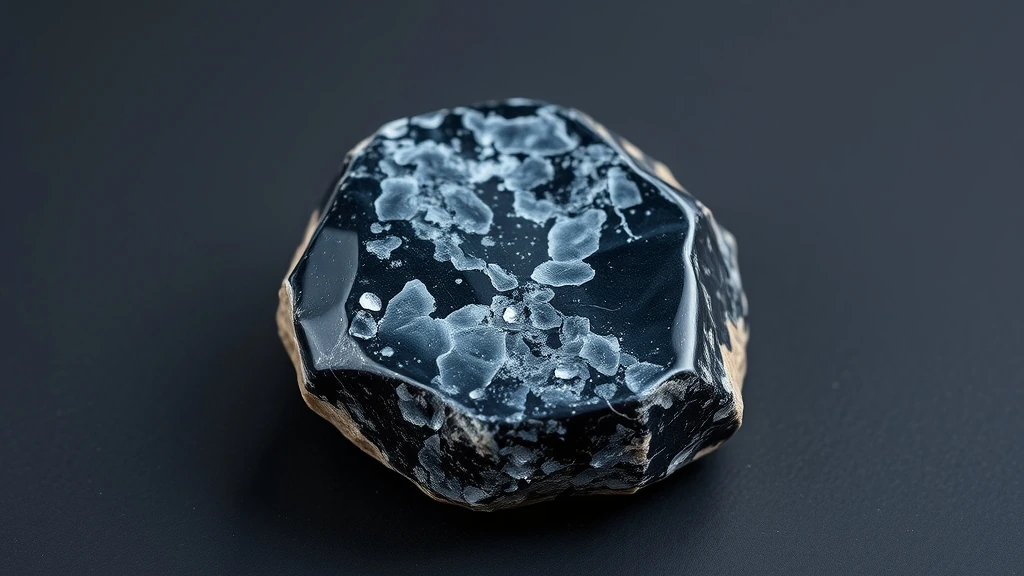
Midnight Lace Obsidian belongs to the mineraloid group of extrusive volcanic glasses, forming when silica‑rich lava cools so rapidly that atoms cannot arrange into a periodic lattice. The resulting amorphous solid lacks true crystal faces, yet it retains the chemical imprint of its parent magma, producing the characteristic dark matrix and delicate lace‑patterned inclusions that give the stone its name.
What is Midnight Lace Obsidian? Geological Overview & Definition
Midnight Lace Obsidian is an amorphous volcanic glass that originates from felsic lava flows rich in silica, iron, and magnesium. Rapid quenching at the Earth’s surface prevents crystallization, preserving a glassy texture that fractures conchoidally and exhibits a high polish. In comparative mineralogical collections, practitioners and geologists frequently study Indonesia Palm Wood alongside this crystal to appreciate their subtle energetic and structural differences.
The distinctive lace pattern arises from microscopic gas bubbles and phase‑separated silicate inclusions that align during cooling, creating translucent veins against the opaque black matrix. These features are not mineral crystals but heterogeneous micro‑structures that enhance the stone’s visual depth and appeal to lapidary artisans. In comparative mineralogical collections, practitioners and geologists frequently study Ocean Picture Stone alongside this crystal to appreciate their subtle energetic and structural differences.
Midnight Lace Obsidian Chemical Composition & Crystallographic Properties
The material is fundamentally an amorphous solid, lacking a repeating unit cell; therefore, it does not possess a conventional lattice but instead displays a disordered network of SiO₄ tetrahedra linked by shared oxygen atoms. Iron (Fe²⁺/Fe³⁺) and magnesium (Mg²⁺) substitute into the silicate network, acting as chromophore centers that influence its dark coloration.
Because the glass is non‑crystalline, it is highly sensitive to acidic environments; prolonged exposure to acids can leach alkali ions and cause surface pitting. Thermal treatment above the glass transition temperature (~560 °C) induces devitrification, potentially forming micro‑crystalline phases such as cristobalite or hematite, which alter both color and hardness.
The refractive index of Midnight Lace Obsidian falls between 1.480 and 1.510, reflecting its low density (2.35–2.60 g/cm³) and the lack of long‑range order. Its Mohs hardness of 5.0–5.5 mirrors the typical strength of volcanic glasses, allowing skilled cutters to shape it while remaining vulnerable to scratches from harder minerals.
Overall, Midnight Lace Obsidian exemplifies a mineraloid whose physical and optical properties are governed by its amorphous structure, cationic substitutions, and the interplay of thermal and chemical stability inherent to natural volcanic glass.
| Property | Specification |
|---|---|
| Mineral Group | Mineraloid (Extrusive Volcanic Glass) |
| Chemical Formula | Volcanic glass (70%+ SiO₂ with Fe, Mg silicates) |
| Mohs Hardness | 5.0 – 5.5 |
| Crystal System | Amorphous (Non-crystalline volcanic glass) |
| Specific Gravity (Density) | 2.35 – 2.60 |
| Refractive Index | 1.480 – 1.510 |
| Color & Optical Properties | Natural Midnight Lace Obsidian color spectrum and optical dispersion |
| Primary Mining Localities | Mexico, USA (Oregon, Utah), Turkey (Kars, Agri), Armenia, Iceland |
| Water & Chemical Resistance | High (Natural volcanic glass; safe in water) |
| Chakra Alignment (Traditional) | Root Chakra (Muladhara) |
| Zodiac Affinity (Traditional) | Scorpio, Sagittarius, Capricorn |
| Symbolic Meaning (Traditional) | Aura shield, emotional truth mirroring, cord-cutting, and shadow grounding |
Midnight Lace Obsidian Varieties & Color Spectrum
Midnight Lace Obsidian displays distinct mineralogical characteristics across its geological varieties and structural habits. Gemologists evaluate these natural varieties based on crystal habit, trace chromophore concentrations, and visual luster.
Primary Natural Midnight Lace Obsidian
The benchmark natural variety exhibiting diagnostic color saturation and classic crystallographic symmetry.
Distinct Geological Morphs of Midnight Lace Obsidian
Secondary regional and structural varieties formed under localized geological temperature and pressure conditions.
Classic Midnight Lace
Formed from rapid cooling of silica‑rich lava, Classic Midnight Lace displays a deep, uniform black matrix intersected by fine, white to gray lace‑like veining caused by gas bubbles trapped during solidification. The glassy texture is amorphous, yielding a Mohs hardness of 5–5.5 and a density near 2.45 g/cm³. Its consistent pattern makes it the most widely traded variety, yet high‑quality specimens with minimal surface chatter remain relatively scarce.
Silver‑Thread Obsidian
Silver‑Thread Obsidian originates in volcanic flows where intermittent influxes of iron‑rich magma create silvery, filamentous inclusions that resemble delicate threads across the dark background. These metallic strands are microscopic iron oxides that reflect light, giving the stone a subtle shimmer. Because the filament formation requires precise magmatic pulses, large flawless pieces are uncommon and command premium prices on the gem market.
Snow‑Flake Lace
In the Snow‑Flake Lace morph, minute crystalline quartz or feldspar crystals are embedded within the obsidian, producing a speckled appearance reminiscent of snowfall on black velvet. The crystals crystallize during the final stages of cooling when residual heat allows limited nucleation. This variety is most often sourced from high‑altitude volcanic domes, where the cooler environment promotes crystal growth, making it a rarer collector’s item.
Midnight Lace with Hematite Inclusions
This regional trade variety contains tiny hematite platelets that impart a reddish‑brown shimmer when viewed at certain angles. The hematite forms from oxidizing conditions in the volcanic conduit, diffusing into the molten glass before solidification. The striking contrast between the dark glass and rust‑colored specks enhances its appeal for ornamental carving, yet the specific oxidizing environment limits its geographic distribution.
Andesite‑Veined Lace
Found primarily in the Andean volcanic belt, Andesite‑Veined Lace exhibits thin, dark green to brown veining derived from interspersed andesite fragments that failed to fully melt. These veins create a marbled effect that is highly prized in contemporary jewelry design. The coexistence of basaltic and andesitic material is geologically uncommon, rendering large, vein‑free slabs exceptionally rare.
Oceanic Lace Obsidian
Discovered on islands formed by hotspot volcanism, Oceanic Lace displays bluish‑gray iridescence along its lace patterns, a result of minute gas bubbles filled with seawater vapor during eruption. The marine influence imparts a subtle optical dispersion not seen in continental varieties. Limited extraction sites and the delicate nature of the bubbles make this the most elusive and valuable type for high‑end collectors.
Where is Midnight Lace Obsidian Found? Geological Mining & Extraction
Midnight Lace Obsidian is typically extracted from pahoehoe lava flows and volcanic domes where silica concentrations exceed 70 % SiO₂. The glass forms in the uppermost layers of these flows, often overlain by thin ash‑rich tuffs that protect the fragile material from weathering. Mining operations employ careful hand‑splitting and vacuum extraction to avoid fracturing the amorphous matrix, preserving the delicate lace veining.
Major deposits occur in the Pacific Ring of Fire, notably in the volcanic fields of Mexico’s Trans‑Mexican Volcanic Belt, the Andean highlands of Peru and Chile, and the Hawaiian Islands. Smaller, high‑grade occurrences have been documented in the Rift Valley of Ethiopia and the volcanic islands of the Canary archipelago, where localized magmatic pulses produce the distinctive lace patterns prized by gem traders.
Historical Significance & Cultural Lore of Midnight Lace Obsidian
Across ancient lapidary traditions, obsidian was valued for its sharpness and reflective surface, and the midnight‑lace variant entered ceremonial use among the Mesoamerican Maya, who fashioned mirror‑like shields for elite warriors and ritual divination. In Egyptian tombs, fragments of dark volcanic glass have been recovered alongside faience, suggesting its role as a protective amulet against malevolent forces.
In Greco‑Roman texts, the stone was described as “aetheric night‑glass” and employed in amulets to guard the Root Chakra (Muladhara), aligning with the esoteric belief in aura shielding and shadow grounding. Vedic literature references a “black mirror of truth” used in meditation to confront inner darkness, echoing the stone’s modern metaphysical associations with emotional truth mirroring and cord‑cutting.
Modern Uses & Jewelry Applications of Midnight Lace Obsidian
Midnight Lace Obsidian is prized for its deep, lace‑like inclusions that create a dramatic visual contrast when polished. Lapidary artisans typically cut the stone into cabochons to showcase its silky sheen, while skilled faceters produce limited‑run facets that catch light in a subtle sparkle. The material also lends itself to ornamental carving, where intricate motifs echo its natural veining, making it a favorite for statement rings, pendants, and decorative inlays.
- Cabochon pendants and earrings for everyday wear
- Faceted cocktail rings highlighting the lace pattern
- Carved cameos, brooches, and architectural accents
Metaphysical Uses & Origins of Midnight Lace Obsidian
Across ancient lapidary traditions, dark volcanic glass has been employed as a conduit for grounding and shadow work, its opaque body believed to absorb negative energies. In contemporary meditation, practitioners hold a piece of Midnight Lace Obsidian to anchor the mind, allowing the stone’s internal “lace” to mirror emotional truths and facilitate cord‑cutting rituals. The stone’s historic use in ceremonial vessels and altar objects underscores its role as a protective aura shield in both sacred and secular spaces.
Which Chakra and Zodiac Signs Align with Midnight Lace Obsidian?
Midnight Lace Obsidian resonates most strongly with the Root Chakra (Muladhara), supporting stability, survival instincts, and a sense of belonging to the physical world. When placed on the lower abdomen during meditation, the stone is said to reinforce the body’s energetic foundation, encouraging confidence and resilience.
In astrological lore, the stone aligns with Scorpio, Sagittarius, and Capricorn. Scorpio’s transformative depth, Sagittarius’s quest for truth, and Capricorn’s disciplined ambition each find a reflective partner in the stone’s ability to reveal hidden patterns and anchor lofty aspirations to earthy reality.
How to Identify Real vs. Fake Midnight Lace Obsidian
Synthetic glass, dyed basalt, and resin composites are common imitations that mimic the stone’s dark body but lack its characteristic lace‑like inclusions and natural density. Fake pieces often feel lighter, display uniform coloration, or reveal surface bubbles under magnification. Authentic Midnight Lace Obsidian retains a subtle, uneven texture and a weight that corresponds to its measured specific gravity.
Practical At-Home Authenticity Tests
- Temperature Test (Thermal Feel): Genuine obsidian absorbs heat quickly and feels cool to the touch, whereas synthetic glass retains warmth longer.
- Specific Gravity & Weight Test: Real Midnight Lace Obsidian falls between 2.35 and 2.60 g/cm³; a simple water‑displacement test can confirm if the piece is unusually light.
- Scratch & Hardness Test (Mohs Comparison): With a hardness of 5.0–5.5, a steel file will leave a faint mark on the stone but not on quartz; excessive scratching indicates a softer glass replica.
- Microscopic & Loupe Inspection (Internal Inclusions): Under 10× magnification, authentic material shows irregular, lace‑like mineral inclusions, while fakes often appear homogenous or contain air bubbles.
Midnight Lace Obsidian Valuation Factors, Grading & Pricing
Color Variations in Midnight Lace Obsidian range from deep, velvety black to subtle, translucent lace‑like veining that appears almost iridescent under light. The natural texture—often a smooth, glassy finish with occasional fine fissures—adds to its visual appeal. Aesthetic banding or veining, especially when evenly distributed, can elevate a specimen’s desirability among collectors and decorative artisans.
Specimen Mass & Size (Grams/Kilograms) directly influences market value, with larger, heavier blocks commanding premium prices. The integrity of the structural block, free from cracks or internal fractures, is a critical grading criterion. Light diffusion through the glassy matrix, which can create a subtle glow when illuminated, is also a key factor for ornamental applications.
Geographical Origin & Authenticity plays a pivotal role in pricing, as provenance from renowned volcanic regions such as the Pacific Ring of Fire or the East African Rift is highly sought after. Authenticity is verified through trace element analysis and historical quarry records. Current wholesale ornamental and wellness market trends show a growing demand for ethically sourced, naturally formed volcanic glass, driving up prices for certified specimens.
How to Clean and Care for Midnight Lace Obsidian
Physical cleaning of Midnight Lace Obsidian should be performed with a dry, soft microfiber cloth or camel‑hair brush to remove dust without introducing moisture. The mineral is safe to rinse in warm water; however, ultrasonic cleaners must be avoided because the brittle glass can chip under vibration. After rinsing, gently pat the surface dry with a lint‑free cloth and store the stone in a low‑humidity environment away from liquids to preserve its integrity.
Cleansing and Recharging Midnight Lace Obsidian (Energetic Care)
Energetic cleansing can be achieved by placing the stone in a gentle, indirect moonlight setting for several hours, allowing natural lunar energy to refresh its aura. Alternatively, resting the obsidian on a selenite charging slab or a clean, dry surface during a waxing moon phase can help recharge its metaphysical properties. Herbal smudging with sage or palo santo, performed with a soft breeze, offers a subtle, non‑thermal method to cleanse the stone’s energetic field.
The final sentence.
Frequently Asked Questions About Midnight Lace Obsidian
Midnight Lace Obsidian displays distinct mineralogical characteristics across its geological varieties and structural habits. Gemologists evaluate these natural varieties based on crystal habit, trace chromophore concentrations, and visual luster.
Primary Natural Midnight Lace Obsidian
The benchmark natural variety exhibiting diagnostic color saturation and classic crystallographic symmetry.
Distinct Geological Morphs of Midnight Lace Obsidian
Secondary regional and structural varieties formed under localized geological temperature and pressure conditions.
Is Midnight Lace Obsidian safe to wear in the shower?
Yes, it is water‑resistant and can be worn in the shower. The volcanic glass composition of Midnight Lace Obsidian gives it excellent resistance to water, so it will not degrade or lose its luster when exposed to moisture. However, avoid prolonged exposure to harsh chemicals that could alter its surface.
Can I clean Midnight Lace Obsidian with a warm soapy solution?
Yes, a mild warm soapy solution is safe for cleaning. Warm water with gentle soap will remove surface oils and dust without damaging the glass. After washing, rinse thoroughly and dry with a soft microfiber cloth to prevent water spots.
Should I use an ultrasonic cleaner on Midnight Lace Obsidian?
No, avoid ultrasonic cleaners. The brittle nature of volcanic glass can cause chipping or microfractures under the high‑frequency vibrations of ultrasonic cleaning. Stick to gentle hand washing or a soft brush for routine maintenance.
What zodiac signs are associated with Midnight Lace Obsidian?
Scorpio, Sagittarius, and Capricorn. These signs are traditionally linked to the stone’s grounding and protective energies, making it a favored choice for individuals born under these constellations.
Which chakra does Midnight Lace Obsidian correspond to?
Root Chakra (Muladhara). The stone’s grounding properties support stability, security, and a strong connection to the earth, aligning it with the Root Chakra’s energetic focus.
Is Midnight Lace Obsidian suitable for jewelry that will be exposed to sunlight?
Yes, it tolerates sunlight well. The high silica content and glassy matrix resist fading, so it can be worn outdoors without significant color loss. Nonetheless, prolonged exposure to intense UV light may gradually dull the surface over many years.
Can I use a dry microfiber cloth to dust Midnight Lace Obsidian?
Yes, a dry microfiber cloth is ideal. Dusting with a soft, dry cloth removes particulate matter without risking scratches or surface damage. For deeper cleaning, a gentle wet wash is recommended.
Does Midnight Lace Obsidian contain any hazardous elements that could leach into water?
No, it does not leach hazardous elements. The stone’s composition is primarily silica with minor iron and magnesium silicates, which are stable and non‑toxic. It remains safe for use in everyday environments, including contact with water.