
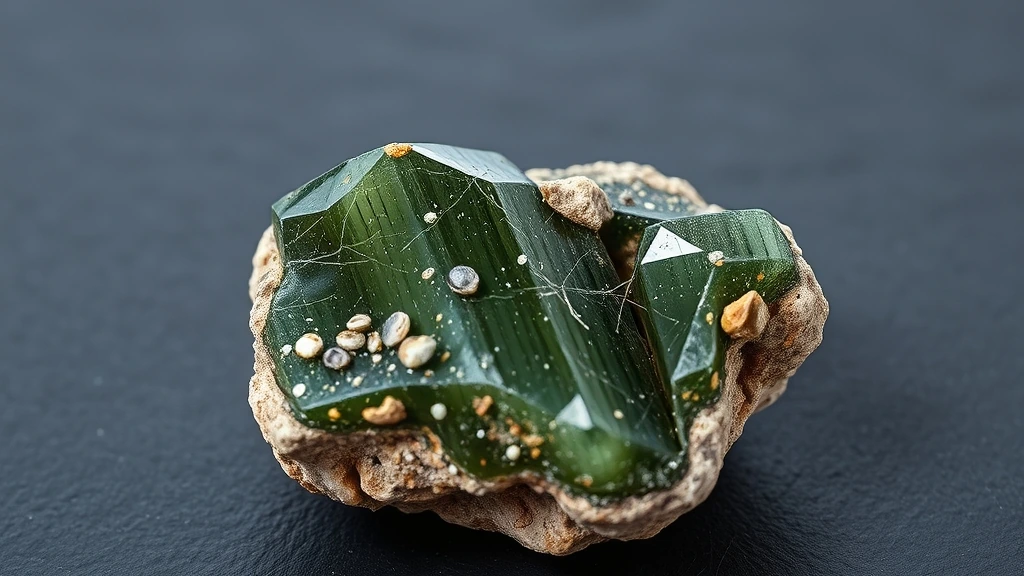
Olive green tourmaline belongs to the broader family of borosilicate minerals and is classified as a natural mineral crystal. Its crystals typically form in the trigonal system, growing in elongated, prismatic habits. The stone is prized for its subtle green tone, which arises from trace element substitutions within the tourmaline lattice. Historically, it has been valued in both Eastern and Western lapidary traditions for its understated elegance.
What is Olive Green Tourmaline? Geological Overview & Definition
Olive green tourmaline is a color variant of the tourmaline group, distinguished by its greenish tint that can range from pale sage to deeper olive. The green coloration is usually the result of chromophore centers formed by iron or manganese substitutions within the crystal lattice. These substitutions create electron traps that absorb certain wavelengths of light, giving the stone its characteristic hue. The mineral is typically found in pegmatitic environments, often associated with quartz and feldspar.
The stone’s trigonal crystal system means its lattice parameters are defined by a single axis of symmetry, with a 120° angle between the a-axes and a c-axis perpendicular to the basal plane. Tourmaline crystals are often elongated along the c-axis, producing the classic prismatic shape. The green variety is not a distinct mineral species but a color expression of the broader tourmaline group, which includes many other hues such as pink, blue, and black. Similarly, the striking blue‑gray bands of Hawk Eye, a variety of labradorite, showcase comparable prismatic elongation along its crystallographic axis, highlighting how subtle variations in lattice structure can produce distinct visual effects.
Olive Green Tourmaline Chemical Composition & Crystallographic Properties
Tourmaline’s general formula is (X)₃(T)₆O₁₈(OH)₆, where X can be Na, Ca, K, or Li; T can be Al, Fe, Mg, or Cr; and the remaining sites are occupied by B, Si, and O. In olive green tourmaline, the green color arises from Fe²⁺ or Mn²⁺ substituting for Al or Mg in the T sites, creating color centers that absorb red and orange light. The exact stoichiometry varies, so a single, fixed chemical formula cannot be assigned to all specimens. Instead, the mineral is best described as an aggregate of borosilicate crystals with variable cation substitutions.
The trigonal lattice is characterized by a rhombohedral unit cell, with lattice parameters typically a ≈ 10.5 Å and c ≈ 6.8 Å. The crystal structure allows for significant flexibility in cation placement, which accounts for the wide range of colors and physical properties seen in tourmaline. The green variety is generally acid-resistant, but prolonged exposure to strong acids can alter surface coloration by oxidizing iron or manganese centers. Thermal treatment can shift the green tone toward a more yellowish or brownish hue, as heat can modify the oxidation state of the chromophore ions.
| Property | Specification |
|---|---|
| Mineral Group | Natural Mineral / Crystal |
| Mohs Hardness | 6.5 – 7.0 |
| Crystal System | Trigonal |
| Color & Optical Properties | Natural Olive Green Tourmaline color spectrum and optical dispersion |
| Primary Mining Localities | Global primary localities |
| Water & Chemical Resistance | High (Safe for gentle water washing) |
| Chakra Alignment (Traditional) | Third Eye Chakra (Ajna) |
| Zodiac Affinity (Traditional) | Sagittarius, Pisces |
| Symbolic Meaning (Traditional) | Creativity, motivation and self-confidence |
Olive Green Tourmaline Varieties & Color Spectrum
Olive green tourmaline presents a complex chromatic landscape defined by trace element substitutions within its crystal lattice. The primary hue arises from the interplay of iron and manganese impurities, creating a distinct earthy tone. This specific coloration often blends with yellow or brown undertones, distinguishing it from pure green elbaite. Understanding these subtle shifts is crucial for accurate gemological identification and valuation.
Classic Olive Elbaite
This variety represents the standard commercial form found in major global deposits. Its color stems from iron-rich compositions that stabilize the olive hue under natural light. Crystals often exhibit strong pleochroism, shifting from brownish-green to yellowish-green depending on the viewing angle. Such stones are frequently cut into cabochons to maximize their luster and color saturation.
Iron-Rich Dark Olive
Darker specimens contain higher concentrations of ferrous iron, resulting in a deep, forest-like green appearance. These stones often display a velvety interior due to microscopic inclusions or internal reflections. The high density of iron atoms absorbs shorter wavelengths, leaving the longer green and yellow tones visible. This variety is prized for its intense, shadowy depth and robust visual presence.
Yellow-Green Transition Morphs
Some crystals exhibit a gradient where olive green merges seamlessly into bright yellow tones. This transition occurs due to varying manganese-to-iron ratios along the crystal growth axis. Lapidaries often select specific zones to highlight this dual-tone effect in faceted cuts. The resulting gemstone offers a unique, sunlit aesthetic that appeals to collectors seeking variety.
Bicolor Olive and Green
Rare bicolor specimens feature distinct zones of olive and pure green within a single crystal. This phenomenon results from zonal growth patterns where chemical conditions changed during formation. The boundary between colors is often sharp, creating a striking visual contrast. Such stones are highly sought after for their rarity and distinctive appearance in jewelry.
Where is Olive Green Tourmaline Found? Geological Mining & Extraction
Olive green tourmaline primarily forms in granitic pegmatites, which are coarse-grained igneous rocks rich in volatile elements. These deposits typically occur in regions with significant tectonic activity and ancient crustal formations. The slow cooling of magma allows large, well-formed crystals to develop within these pockets. Mining operations focus on extracting these pegmatite dikes to access the valuable gem-bearing zones.
Major global sources include Brazil, Nigeria, and Madagascar, each offering distinct quality characteristics. Brazilian deposits are renowned for producing large, clean crystals with vibrant coloration. Nigerian mines yield stones with unique inclusions that add character to the gem. Madagascar continues to be a prolific source, providing a steady supply of high-grade material for the international market.
Historical Significance & Cultural Lore of Olive Green Tourmaline
Ancient civilizations valued tourmaline for its diverse colors and perceived protective properties. In Greco-Roman lore, the stone was believed to ward off evil spirits and promote mental clarity. Egyptian artisans incorporated tourmaline into amulets, associating its green hues with fertility and rebirth. These early uses highlight the mineral’s enduring appeal across different cultural contexts.
Vedic traditions recognized the stone’s ability to enhance intuition and spiritual insight. The olive green variety was particularly linked to the third eye chakra, symbolizing wisdom and perception. Historical records indicate that traders exchanged tourmaline across vast distances, underscoring its high value. This widespread trade facilitated the spread of its metaphysical significance throughout ancient Eurasia.
Modern Uses & Jewelry Applications of Olive Green Tourgen
Olive green tourmaline is prized for its vivid, earthy hue, making it a favorite in contemporary lapidary work. Artisans often cut the stone into cabochons to showcase its silky translucency, while skilled faceters produce brilliant, multi‑facet pieces for high‑end rings. The mineral also lends itself to ornamental carving, appearing in pendants, brooches, and decorative inlays that highlight its natural chatoyancy.
- Cabochon pendants for pendant necklaces
- Faceted earrings and cocktail rings
- Carved cameos and intarsia panels
- Inlay work in luxury watch dials and decorative boxes
Carat, Quality Grades & Value Factors of Olive Green Tourgen
The market values olive green tourmaline primarily on the classic 4Cs: Color, Clarity, Cut, and Carat weight. Deep, uniform olive tones with minimal brown or gray undertones command premium prices, while a high degree of transparency and a clean internal structure boost clarity grades. Expert cutting that maximizes light return enhances brilliance, and stones above 2 carats often see exponential price jumps due to rarity.
Durability is a key consideration; with a Mohs hardness of 6.5–7.0, olive green tourmaline resists everyday wear but should be protected from harsh impacts. Industry grading follows GIA‑style criteria, assigning a color grade from “light” to “deep” and a clarity grade ranging from “included” to “eye‑clean.” Carat weight is measured to the nearest hundredth, and a well‑executed cut can elevate a modest stone to a collector’s item.
Zodiac and Astrological Lore of Olive Green Tourgen
Across ancient lapidary traditions, olive green tourmaline has been linked to the Sagittarius and Pisces zodiac signs, believed to amplify the adventurous spirit of the archer and the intuitive flow of the fish. In historical metaphysical lore, the stone was thought to guide travelers and dreamers, fostering optimism and a sense of boundless possibility.
The gemstone’s resonance with the Third Eye Chakra (Ajna) further underscores its reputation for enhancing intuition and inner vision. Practitioners of early Eastern mysticism placed the stone on the forehead during meditation, trusting its green energy to clear mental fog and inspire creative insight.
How to Identify Real vs. Fake Olive Green Tourgen
Artificial imitations of olive green tourmaline range from dyed quartz and glass to low‑cost synthetic tourmaline produced in laboratory furnaces. These substitutes often lack the stone’s characteristic pleochroism and internal fracture patterns, making careful examination essential for discerning authenticity.
Practical At-Home Authenticity Tests
- Temperature Test (Thermal Feel): Genuine tourmaline feels cool to the touch and retains that coolness longer than glass or plastic, which quickly warm to skin temperature.
- Specific Gravity & Weight Test: Olive green tourmaline has a specific gravity around 3.0–3.2; a heftier feel compared to similarly sized quartz suggests authenticity.
- Scratch & Hardness Test (Mohs Comparison): Using a steel file (hardness ~6.5), a real tourmaline will resist scratching, whereas glass or lower‑hardness imitations will show surface marks.
- Microscopic & Loupe Inspection (Internal Inclusions): Under 10× magnification, natural tourmaline displays fine, needle‑like inclusions and characteristic crystal growth lines, while synthetic or dyed stones often appear uniformly clear or exhibit bubble‑like inclusions.
Olive Green Tourmenine Valuation Factors, Grading & Pricing
Color saturation drives the premium for olive green tourmaline, with vivid, evenly distributed hue commanding the highest prices. Hue uniformity across the stone enhances visual impact, while flawless optical clarity and a high‑shine luster reduce the need for costly treatments. Gemologists grade these attributes using spectrophotometric analysis and visual comparison to reference stones.
Carat weight remains a pivotal metric, yet larger stones only fetch premium when paired with precise facet symmetry and adherence to the 4Cs lapidary standards. Well‑cut facets maximize light return, revealing the stone’s characteristic green‑olive glow without compromising structural integrity. Grading reports from accredited labs detail these parameters, influencing market confidence and resale value.
Geographical provenance adds a distinct premium, especially for specimens sourced from Brazil, Mozambique, or Afghanistan, where unique trace element signatures are verified by spectroscopy. Certified origin statements reassure buyers of ethical mining and consistent quality, driving certified gem market value trends upward. Seasonal auction data show that provenance‑linked stones often outpace comparable weights from lesser‑known locales.
How to Clean and Care for Olive Green Tourmaline
Gentle cleaning of olive green tourmaline is safely performed with warm soapy water and a soft cloth, ensuring surface grime is removed without scratching the crystal. After rinsing, pat the stone dry with a lint‑free microfiber towel to prevent water spots. Avoid ultrasonic cleaners, as the vibration can induce micro‑fractures in the crystal lattice.
Cleansing and Recharging Olive Green Tourmaline (Energetic Care)
For energetic maintenance, place the stone on a clean selenite charging slab overnight, allowing the neutral selenite to absorb and release any stagnant energy. This dry method respects the mineral’s structural integrity while restoring its vibrational clarity.
Alternatively, expose the tourmaline to gentle moonlight for several hours, preferably during a waning phase, to refresh its subtle green aura without subjecting it to heat. A brief herbal smudging with sage or cedar can also clear residual energies, provided the smoke is diffused and the stone is not wetted.
Frequently Asked Questions About Olive Green Tourmaline
Olive Green Tourmaline displays distinct mineralogical characteristics across its geological varieties and structural habits. Gemologists evaluate these natural varieties based on crystal habit, trace chromophore concentrations, and visual luster.
Primary Natural Olive Green Tourmaline
The benchmark natural variety exhibiting diagnostic color saturation and classic crystallographic symmetry.
Distinct Geological Morphs of Olive Green Tourmaline
Secondary regional and structural varieties formed under localized geological temperature and pressure conditions.
What is the typical hardness of olive green tourmaline?
Olive green tourmaline usually scores between 6.5 and 7.0 on the Mohs scale. This hardness makes it durable enough for everyday wear, yet it can still be scratched by harder minerals such as corundum or diamond. The trigonal crystal system contributes to its characteristic prismatic shapes.
Is olive green tourmaline safe to wash in the shower?
Yes, it is safe for gentle water washing. The stone’s structure tolerates mild moisture, so a quick rinse or a damp cloth will not damage it. Avoid prolonged soaking or harsh chemicals that could affect surface polish.
How should I clean olive green tourmaline to keep it looking bright?
Use warm soapy water and a soft cloth, then dry with a microfiber towel. Avoid ultrasonic cleaners, as vibrations can cause microfractures. Regular gentle cleaning preserves the stone’s natural luster and protects its refractive index.
Can I wear olive green tourmaline while swimming or during water sports?
Yes, it is water‑resistant and suitable for swimming. The stone’s density and crystal structure prevent water absorption, so it can be worn during light water activities without risk of damage or loss of clarity.
Which zodiac signs are associated with olive green tourmaline?
The stone is linked to Sagittarius and Pisces. In astrological traditions, these signs are believed to resonate with the stone’s energetic properties, enhancing intuition and emotional balance.
Which chakra does olive green tourmaline correspond to?
It aligns with the Third Eye Chakra (Ajna). This chakra governs insight and perception, and the stone is thought to stimulate clarity, intuition, and mental focus through its subtle vibrational energy.
Is olive green tourmaline suitable for children’s jewelry?
Yes, it is suitable for children’s jewelry. Its moderate hardness and water resistance make it durable enough for everyday wear, while its calming green hue is visually appealing and easy to maintain with simple cleaning.
Does olive green tourmaline have any special care instructions for long‑term storage?
Store it in a soft pouch or lined jewelry box away from direct sunlight. Prolonged exposure to intense light can fade the green tone, and a protective pouch prevents scratches from other gemstones. This practice preserves both the stone’s appearance and its structural integrity.