
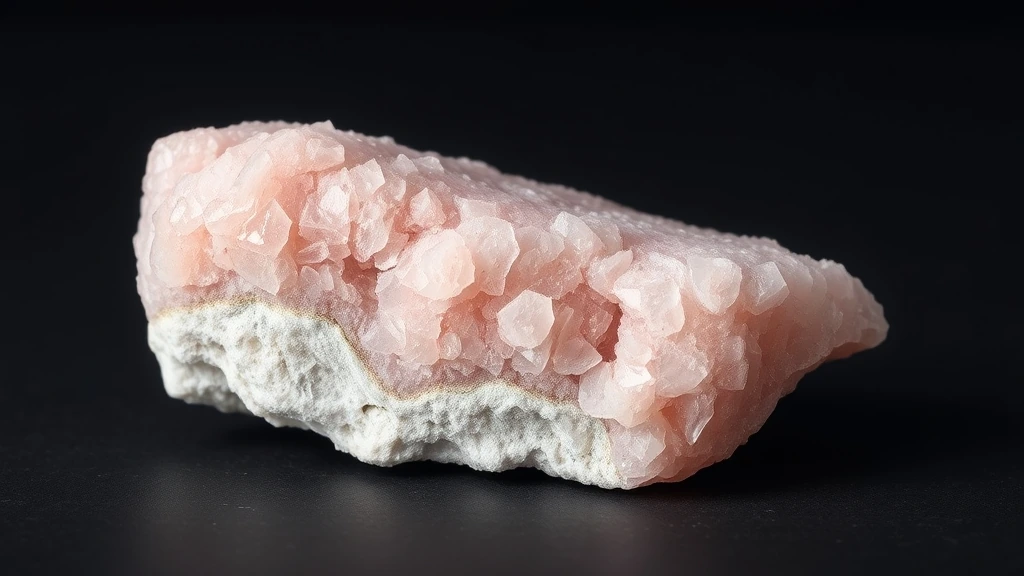
Halite represents the primary mineral constituent of the Halides group, specifically defined by its stoichiometric composition of sodium and chlorine. Geologically, it precipitates from evaporating saline solutions, forming vast sedimentary beds known as rock salt. Its classification remains strictly within the cubic system, distinguishing it from other halide minerals like fluorite. The pink variety arises from specific impurities rather than structural deviations. Understanding its parent group is essential for accurate gemological identification and handling.
What is Pink Halite? Geological Overview & Definition
Pink halite forms primarily in evaporite basins where ancient seas dried up, leaving behind concentrated salt deposits. These geological settings create ideal conditions for the crystallization of sodium chloride under high pressure and temperature. The mineral typically occurs in massive beds or well-formed cubic crystals, depending on the cooling rate. Its softness makes it susceptible to weathering, limiting its surface exposure. In comparative mineralogical collections, practitioners and geologists frequently study Orange Selenite alongside this crystal to appreciate their subtle energetic and structural differences.
The defining characteristic of this variety is its pink coloration, which results from trace impurities. Unlike pure white halite, these deposits contain specific mineral inclusions that alter light absorption. Gemologists identify it through its low hardness and cubic cleavage, which are diagnostic features. Proper identification ensures it is not confused with pink calcite or other soft minerals.
Pink Halite Chemical Composition & Crystallographic Properties
The crystal structure of pink halite is strictly isometric, forming perfect cubes with right-angle intersections. This cubic symmetry dictates its physical properties, including its cleavage and fracture patterns. The lattice consists of alternating sodium and chloride ions arranged in a face-centered cubic configuration. This arrangement provides high symmetry but low mechanical strength. In comparative mineralogical collections, practitioners and geologists frequently study Orange Kyanite alongside this crystal to appreciate their subtle energetic and structural differences.
The pink hue is attributed to color centers, often caused by trapped electrons or trace impurities. These defects in the crystal lattice absorb specific wavelengths of light, reflecting pink tones. Unlike transition metal substitutions, this mechanism involves electronic states within the halite structure. The presence of these centers does not alter the fundamental stoichiometry of the mineral.
Halite is highly sensitive to acidic environments and moisture, leading to rapid dissolution. Its low Mohs hardness of 2.0 to 2.5 makes it vulnerable to scratching and abrasion. Thermal stability is moderate, but high temperatures can cause structural degradation or melting. Careful handling is required to preserve its integrity during study or display.
| Property | Specification |
|---|---|
| Mineral Group | Halides (Sodium Chloride / Rock Salt) |
| Mohs Hardness | 2.0 – 2.5 |
| Crystal System | Isometric / Cubic (Cubic crystals or massive rock salt) |
| Color & Optical Properties | Natural Pink Halite color spectrum and optical dispersion |
| Primary Mining Localities | Pakistan (Khewra Salt Mine), USA, Poland (Wieliczka), Germany, Austria |
| Water & Chemical Resistance | EXTREMELY SENSITIVE: Highly Water-Soluble & Hygroscopic! (Never wash or expose to water/liquids) |
| Chakra Alignment (Traditional) | Root Chakra and Sacral Chakra |
| Zodiac Affinity (Traditional) | Taurus, Virgo, Capricorn |
| Symbolic Meaning (Traditional) | Purification, environmental energy clearing, grounding, and atmospheric balance |
Pink Halite Varieties & Color Spectrum
Pink halite occurs in diverse geological settings, ranging from deep marine evaporites to arid lake deposits. The hue intensity depends heavily on trace mineral impurities trapped during crystallization. Understanding these variations is essential for accurate gemological identification and valuation.
Himalayan Pink Salt
This variety originates from the ancient Tethys Sea, now buried beneath the Himalayan mountain range. Its distinctive pink to red coloration stems from trace amounts of iron oxide and other metallic impurities. The salt often exhibits a granular texture with visible striations from tectonic pressure.
Salar de Uyuni Halite
Found in Bolivia’s vast salt flat, this variety displays a soft, pastel pink hue. It forms in shallow, evaporating lake beds where mineral-rich waters concentrate over millennia. The crystals are typically massive rather than well-formed, creating a uniform, smooth appearance.
Australian Lake Salt
Derived from inland saline lakes, this halite features a delicate rose tint. The color arises from specific microbial activity and trace manganese compounds in the brine. It is often harvested in large, translucent blocks for industrial and decorative use.
Polish Kłodzko Halite
This European variety is known for its clear, pale pink to colorless appearance. It forms in ancient Permian salt domes, exhibiting high purity and transparency. The isometric crystal structure is often preserved in well-defined cubic forms.
Cheshire Old Mine Salt
Historically mined in England, this halite shows subtle pinkish or yellowish tints. The coloration results from organic matter and clay inclusions trapped during deposition. It is prized for its clarity and lack of significant impurities.
Where is Pink Halite Found? Geological Mining & Extraction
Pink halite deposits are primarily located in ancient evaporite basins and saline lake environments. These geological formations result from the evaporation of mineral-rich water bodies over millions of years. The isometric crystal system allows for the formation of large, stable salt masses.
Major extraction sites include the Khewra Salt Mine in Pakistan and the Salar de Uyuni in Bolivia. Mining methods vary from underground shafts to surface evaporation ponds. The extracted halite is processed for culinary, industrial, and gemstone applications.
Historical Significance & Cultural Lore of Pink Halite
Ancient civilizations valued halite for its preservative qualities and medicinal properties. In Greco-Roman traditions, salt was considered a sacred substance used in rituals and offerings. Egyptian tomb artifacts often included salt vessels, symbolizing purity and eternal life.
In Vedic texts, salt was revered for its ability to purify and balance bodily energies. Chinese dynasties used halite in alchemical processes and traditional medicine. Across these cultures, pink halite represented grounding and atmospheric stability.
Modern Uses & Jewelry Applications of Pink Halite
Pink halite is frequently cut into cabochons that showcase its soft blush hue, while skilled lapidaries also produce modestly faceted stones for pendant settings. Because the mineral is water‑soluble, designers favor sealed settings or protective coatings to preserve the gem’s integrity. Ornamental carving—often in the form of small figurines or decorative tiles—exploits the crystal’s cubic habit and natural translucency.
- Cabochon pendants and earrings with protective resin
- Simple brilliant or step cuts for minimalist rings
- Carved beads and miniature sculptures for interior décor
- Inlay work in jewelry boxes and decorative panels
Metaphysical Uses & Origins of Pink Halite
Across ancient lapidary traditions, pink halite has been prized for its purifying qualities, believed to absorb negative energies and restore balance to the surrounding atmosphere. Practitioners place the stone on altars during meditation, allowing its subtle vibration to ground the practitioner while stimulating the sacral region for creative flow. In architectural contexts, thin slabs have been embedded in walls of sacred spaces to promote environmental energy clearing and to maintain a harmonious indoor climate.
Which Chakra and Zodiac Signs Align with Pink Halite?
The stone resonates strongly with the Root Chakra, anchoring the individual to the physical world and fostering stability during stressful moments. Simultaneously, its gentle pink tone activates the Sacral Chakra, encouraging emotional expression and nurturing a sense of inner warmth.
Astrologically, pink halite is linked to the earth‑signs Taurus, Virgo, and Capricorn, each of which values practicality, perseverance, and grounded ambition. Those born under these signs often find the mineral’s stabilizing energy supportive of their innate drive for material and spiritual security.
How to Identify Real vs. Fake Pink Halite
Artificial imitations of pink halite include dyed quartz, colored glass, and synthetic halite crystals grown in laboratory conditions. These substitutes may mimic the stone’s hue but lack its characteristic solubility and low hardness, making them prone to chipping under modest stress. Careful observation of surface texture and weight can usually reveal the difference between genuine mineral and replica.
Practical At-Home Authenticity Tests
- Temperature Test (Thermal Feel): Genuine halite feels cool to the touch and retains that coolness longer than glass or quartz, which quickly equilibrate to ambient temperature.
- Specific Gravity & Weight Test: Halite’s specific gravity (~2.16) makes it noticeably lighter than most glass imitations; a simple weigh‑against‑water test can confirm the lower density.
- Scratch & Hardness Test (Mohs Comparison): With a hardness of 2.0‑2.5, pink halite is easily scratched by a fingernail or copper coin, whereas glass and quartz will resist such marks.
- Microscopic & Loupe Inspection (Internal Inclusions): Under 10× magnification, natural halite shows tiny cubic crystals and occasional fluid inclusions, while synthetic glass appears uniformly clear with no mineral inclusions.
Pink Halite Valuation Factors, Grading & Pricing
The color variations of pink halite dominate its market appeal, ranging from delicate blush tones to vivid rose hues. Natural translucency combined with subtle internal banding or veining can elevate a specimen’s aesthetic value, especially when the pink shade is uniformly distributed without artificial dye. Collectors prize specimens that display a seamless gradient, as this suggests minimal post‑mining alteration and a higher degree of geological authenticity.
Specimen mass and size are decisive in pricing, with larger blocks or hefty crystals commanding premium rates. A well‑preserved mass that retains its cubic integrity and resists fracturing showcases superior structural block integrity, allowing light to diffuse softly through the crystal lattice. Artisans who carve ornamental shapes without compromising the natural geometry add modest value, but the primary driver remains the raw weight measured in grams or kilograms.
Geographical origin and authenticity influence demand, as pink halite sourced from renowned evaporite basins in the United States, Germany, or the Mediterranean carries provenance prestige. Verified origin certificates reassure buyers that the crystal is natural and not artificially tinted, supporting higher wholesale prices in both ornamental and wellness markets. Trends show growing interest from interior designers and holistic practitioners, reinforcing the need for transparent sourcing and ethical trade practices.
How to Clean and Care for Pink Halite
Due to its highly hygroscopic and water‑soluble nature, WATER, LIQUID SOAPS, AND DAMP WIPING MUST BE STRICTLY AVOIDED; moisture directly dissolves and pits the salt crystal lattice. Clean exclusively with a dry soft microfiber cloth or camel‑hair brush, gently removing dust without applying pressure that could fracture the crystal. Store the specimen in a low‑humidity environment, preferably within a sealed display case or a desiccant‑lined drawer, to prevent atmospheric moisture absorption. Ultrasonic cleaning is STRICTLY FORBIDDEN, as the vibrations combined with any trace moisture will rapidly degrade the halite structure.
Cleansing and Recharging Pink Halite (Energetic Care)
Energetic cleansing can be performed by passing the crystal through a gentle herbal smudging ritual, using dry sage or cedar smoke while keeping the halite at least six inches away to avoid direct contact with moisture‑laden ash. The smoke is believed to lift residual energetic debris without introducing any liquid, preserving the crystal’s physical integrity while restoring its grounding properties.
Alternatively, expose the pink halite to soft moonlight on a clear night, placing it on a clean selenite slab for several hours to absorb lunar energy and rebalance its vibrational field. This method relies on natural, non‑thermal illumination and avoids any heat that could destabilize the crystal lattice, ensuring both physical preservation and energetic renewal.
Frequently Asked Questions About Pink Halite
Pink Halite displays distinct mineralogical characteristics across its geological varieties and structural habits. Gemologists evaluate these natural varieties based on crystal habit, trace chromophore concentrations, and visual luster.
Primary Natural Pink Halite
The benchmark natural variety exhibiting diagnostic color saturation and classic crystallographic symmetry.
Distinct Geological Morphs of Pink Halite
Secondary regional and structural varieties formed under localized geological temperature and pressure conditions.
What is pink halite and how does it form?
Pink halite is a hydrated form of sodium chloride that crystallizes in the cubic system, often appearing as delicate, pink‑tinged crystals. It forms in evaporitic environments where seawater or saline lakes slowly evaporate, leaving behind salt deposits that crystallize under low‑temperature conditions. The pink hue results from trace impurities such as iron or manganese.
Is pink halite safe to wear as jewelry?
No, pink halite should not be worn as jewelry. Its extremely low Mohs hardness (2.0–2.5) and high solubility in water make it prone to damage and dissolution when exposed to sweat, oils, or humidity. It is best displayed as a decorative specimen rather than a wearable stone.
How should I clean and store pink halite?
Clean pink halite with a dry soft microfiber cloth or a camel‑hair brush, and store it in a cool, dry place. Avoid any contact with water, liquid soaps, or damp environments, as moisture will dissolve the crystal lattice. Keep it away from direct sunlight to prevent fading or structural stress.
Can I use ultrasonic cleaning on pink halite?
Ultrasonic cleaning is strictly forbidden for pink halite. The high frequency and water content of ultrasonic baths will cause the salt crystals to dissolve and develop pits. Stick to dry cleaning methods only.
Does pink halite have any metaphysical or chakra associations?
Pink halite is associated with the Root Chakra and the Sacral Chakra. In esoteric traditions, it is believed to aid grounding, purification, and atmospheric balance, helping to absorb negative energy and promote emotional stability.
Which zodiac signs are linked to pink halite?
The zodiac signs Taurus, Virgo, and Capricorn are traditionally linked to pink halite. These signs are thought to resonate with the stone’s grounding properties and its capacity to foster stability and practical focus.
Is pink halite water‑soluble, and what happens if it gets wet?
Yes, pink halite is highly water‑soluble and hygroscopic. When exposed to moisture, it dissolves quickly, potentially leaving behind salt stains or damaging the crystal structure. Immediate drying with a dry cloth is essential if accidental contact occurs.
Can I use pink halite in a home décor setting near moisture?
Avoid placing pink halite near moisture sources such as bathrooms or kitchens. Even brief exposure to humidity can cause the crystal to dissolve or become pitted. Opt for a dry, climate‑controlled display area to preserve its integrity and appearance.