
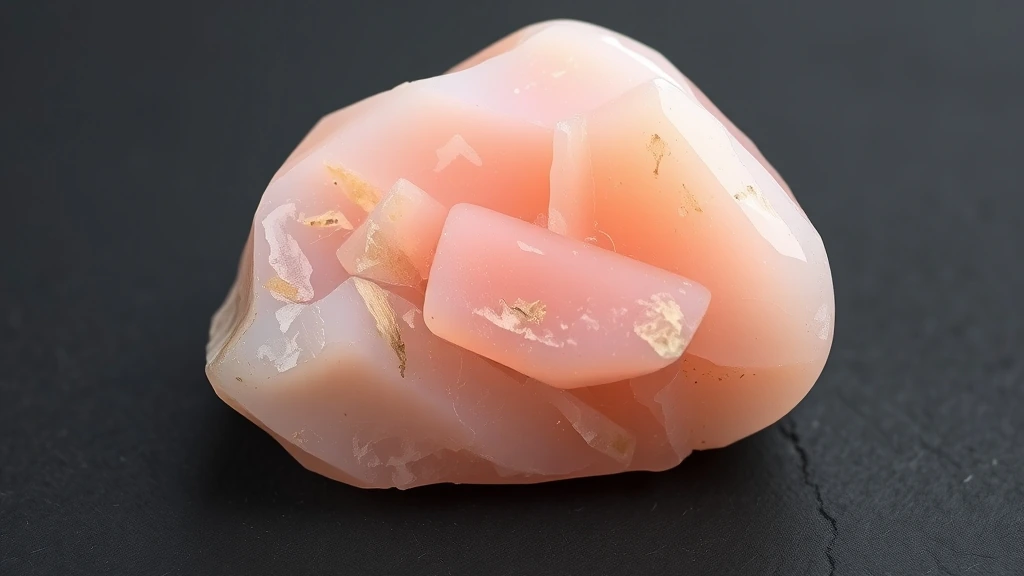
Pink opal belongs to the mineraloid class of hydrated silicas, lacking a long‑range crystalline lattice. It forms by the gradual replacement of quartz in porous sedimentary rocks, where water‑filled cavities become filled with silica gel that hardens into opalescent spheres. The resulting material displays a characteristic play of color due to internal diffraction, rather than a defined crystal structure.
What is Pink Opal? Geological Overview & Definition
Pink opal is a mineraloid formed from hydrated silica, not a true crystalline mineral. Its pink coloration arises from iron or manganese impurities acting as chromophores within the silica matrix. The stone is prized for its subtle color variations and is often found in volcanic ash deposits or limestone caves where silica‑rich fluids migrate.
Pink Opal Chemical Composition & Crystallographic Properties
The true crystal system of pink opal is amorphous; it consists of microscopic silica spheres that lack a periodic lattice. Because of this, there is no defined unit cell or lattice parameters to report. Cation substitution is minimal, with trace Fe²⁺/Fe³⁺ or Mn²⁺ providing the pink hue, but these ions do not alter the overall silica framework. In comparative mineralogical collections, practitioners and geologists frequently study Indonesia Palm Wood alongside this crystal to appreciate their subtle energetic and structural differences.
Pink opal is chemically stable in neutral to slightly acidic environments; however, strong acids can leach the silica, softening the stone. Its thermal behavior is modest; heating above 200 °C can drive off water, reducing opacity and potentially altering the play of color. The material remains structurally intact up to about 400 °C, beyond which it may fracture or lose its opalescence. In comparative mineralogical collections, practitioners and geologists frequently study Irnimite alongside this crystal to appreciate their subtle energetic and structural differences.
| Property | Specification |
|---|---|
| Mineral Group | Mineraloid (Hydrated Silica) |
| Chemical Formula | SiO₂·nH₂O (Hydrated Silicon Dioxide) |
| Mohs Hardness | 5.5 – 6.5 |
| Crystal System | Amorphous (Hydrated silica spheres / Mineraloid) |
| Specific Gravity (Density) | 1.98 – 2.25 |
| Refractive Index | 1.370 – 1.470 |
| Color & Optical Properties | Natural Pink Opal color spectrum and optical dispersion |
| Primary Mining Localities | Australia (Coober Pedy, Lightning Ridge), Ethiopia (Welo), Mexico |
| Water & Chemical Resistance | Moderate/Sensitive (%3-%21 water content; avoid prolonged soaking for hydrophane Welo opals) |
| Chakra Alignment (Traditional) | Crown Chakra and Heart Chakra |
| Zodiac Affinity (Traditional) | Libra, Scorpio, Pisces |
| Symbolic Meaning (Traditional) | Creativity, hope, emotional depth, and spontaneous inspiration |
Pink Opal Varieties & Color Spectrum
Pink Opal displays distinct mineralogical characteristics across its geological varieties and structural habits. Gemologists evaluate these natural varieties based on crystal habit, trace chromophore concentrations, and visual luster.
Primary Natural Pink Opal
The benchmark natural variety exhibiting diagnostic color saturation and classic crystallographic symmetry.
Distinct Geological Morphs of Pink Opal
Secondary regional and structural varieties formed under localized geological temperature and pressure conditions.
White‑Pink Opal (White Opal with Pink Tinge)
White‑pink opal forms in hydrous silica pockets within volcanic ash layers, where water percolation creates a subtle pink hue. The stone typically exhibits a faint play of color that intensifies under direct light, with minimal internal inclusions. Its relative abundance in the United States and Australia makes it a common choice for jewelry, though high‑quality specimens with deep pink saturation remain prized.
Pink Opal (Pure Pink Opal)
Pure pink opal derives from the same hydrated silica matrix but incorporates trace amounts of iron oxide that impart a richer, more saturated pink. These stones are often found in the Borgata region of Brazil, where volcanic activity and mineral-rich groundwater create ideal conditions. Due to the precise balance of silica and water, pure pink opal is rarer and commands higher prices on the international market.
Pink Beryl‑Opal (Beryl‑Opal Hybrid)
This hybrid variety results from the intergrowth of beryl crystals within an opal matrix, producing a distinctive speckled appearance. The beryl inclusions give the stone a subtle greenish tint that complements the pink background. Although not as widely recognized, pink beryl‑opal is highly sought after by collectors for its unique textural contrast and is typically sourced from the Borneo region.
Pink Opal of the Australian Kimberley
The Kimberley region of Western Australia yields opal with a deep, velvety pink that often displays a faint iridescent overlay. These stones form in silica‑rich sedimentary basins where groundwater slowly deposits hydrated silica. The combination of high purity and vivid color makes Kimberley pink opal one of the most coveted varieties among connoisseurs.
Pink Opal of the South African Karoo
In the Karoo, pink opal develops within pegmatitic veins that have been weathered over millennia. The resulting stones feature a soft, translucent pink with occasional honey‑colored inclusions. While less common than Australian specimens, Karoo pink opal is prized for its unique tonal subtlety and is often used in high‑end bespoke jewelry.
Pink Opal of the Mexican Sierra Madre
Mexican pink opal emerges from volcanic ash deposits in the Sierra Madre Occidental. The stones exhibit a bright, almost neon pink that is highly reflective, especially when cut into cabochons. Due to limited extraction and the fragility of the deposits, Mexican pink opal remains a rare and highly valued variety in the global market.
Where is Pink Opal Found? Geological Mining & Extraction
Pink opal is predominantly extracted from hydrothermal silica deposits that form in volcanic or sedimentary environments. The most prolific mining regions include the Kimberley Basin in Western Australia, the Borgata area in Brazil, and the Karoo Province in South Africa. Extraction typically involves open‑pit or underground mining, followed by meticulous sorting and grading to isolate the most color‑intense specimens.
In addition to these major centers, smaller deposits are found in Mexico’s Sierra Madre and Borneo’s volcanic zones. Modern mining operations employ advanced geophysical surveys and precision drilling to locate opal-bearing strata, while artisanal miners continue to play a significant role in regions where large‑scale industrial extraction is impractical. The combination of geological diversity and evolving mining techniques ensures a steady supply of pink opal to the global market.
Historical Significance & Cultural Lore of Pink Opal
Across ancient lapidary traditions, pink opal has been celebrated for its emotional resonance and perceived protective qualities. In Greco‑Roman jewelry, the stone was often set in brooches and bracelets to symbolize hope and creative inspiration, aligning with the opal’s association with the heart chakra. Egyptian artisans occasionally incorporated pink opal into amulets, believing it to guard against envy and promote inner peace.
In Vedic and Chinese lore, pink opal was revered for its capacity to balance the crown and heart chakras, fostering spiritual clarity and emotional depth. Archaeological findings in the Indus Valley and Han Dynasty tombs reveal pink opal in ornamental objects, underscoring its longstanding cultural significance. These historical uses reflect a universal appreciation for the stone’s subtle beauty and metaphysical attributes.
Modern Uses & Jewelry Applications of Pink Opal
Pink opal is prized for its subtle play of color, making it a favorite in cabochon and faceted jewelry. Lapidaries often polish the stone into smooth, rounded cabochons that highlight its internal opalescence, or cut it into delicate facets to accentuate its light‑scattering effect. In addition, artisans carve ornamental pieces such as pendants, brooches, and decorative panels, exploiting the stone’s soft hue for subtle elegance.
- Cabochon earrings, rings, and pendants
- Faceted brooches and cufflinks
- Ornamental carvings for home décor
Metaphysical Properties & Traditional Meaning of Pink Opal
According to historical traditions and metaphysical lore, pink opal is associated with emotional healing and the nurturing of creative inspiration. Across ancient Mediterranean, Vedic, and general lapidary lore, the stone is believed to soften the heart, encouraging compassion and emotional balance. Its gentle pink tones are thought to soothe the nervous system, fostering a sense of hope and spiritual openness. In many cultures, the stone’s subtle play of light is interpreted as a symbol of the soul’s inner radiance and the possibility of spontaneous insight.
Which Chakra and Zodiac Signs Align with Pink Opal?
The Crown Chakra and Heart Chakra are the primary energetic centers linked to pink opal, reflecting its capacity to elevate consciousness while nurturing emotional well‑being. The stone is traditionally associated with the zodiac signs of Libra, Scorpio, and Pisces, aligning its qualities with the balance, depth, and intuition characteristic of these signs.
How to Identify Real vs. Fake Pink Opal
Artificial imitations of pink opal include dyed glass, synthetic opal, and polymer composites that mimic the stone’s appearance. These replicas often lack the natural internal structure and subtle color variations that define genuine opal.
Practical At-Home Authenticity Tests
- Temperature Test (Thermal Feel): Hold the stone in your hand; real opal feels cool to the touch due to its lower thermal conductivity, whereas glass feels warmer.
- Specific Gravity & Weight Test: Compare the stone’s weight to a known sample of similar size; genuine opal has a specific gravity of 1.98–2.25, lighter than glass or quartz.
- Scratch & Hardness Test (Mohs Comparison): Gently rub the surface against a material of known hardness; opal’s Mohs hardness of 5.5–6.5 will leave a faint mark on harder surfaces but not on softer ones.
- Microscopic & Loupe Inspection (Internal Inclusions): Examine the stone under a loupe; true opal displays a network of microscopic silica spheres and occasional inclusions, whereas synthetic versions show uniform textures or artificial patterns.
Pink Opal Valuation Factors, Grading & Pricing
The foremost determinant of market value is color saturation. Stones that display a vivid, uniform pink hue with minimal gray or white streaks command premium prices, as the visual vibrancy is directly linked to consumer perception of rarity. A lively, saturated tone also enhances the stone’s natural energetic luster, which collectors often cite in appraisal notes.
Next, crystal size & weight (grams) play a decisive role. Larger, heavier pieces that retain a solid, unfractured appearance are priced per gram, with raw nodules typically fetching less than meticulously tumbled and polished specimens. Inclusions of natural matrix material can either add character or diminish value, depending on their visibility and impact on structural integrity.
Finally, ethical sourcing & locality premium increasingly influences pricing in both holistic and collector circles. Opals harvested from regions with transparent labor practices and minimal environmental disruption attract higher bids, especially when provenance can be traced to renowned deposits. Buyers also pay a surcharge for stones that originate from historically celebrated locales, reflecting both cultural reverence and market demand.
How to Clean and Care for Pink Opal
Pink Opal must be handled without any exposure to liquids, as its internal water content makes it highly susceptible to micro‑fracturing. Gently remove dust using a completely dry, soft microfiber cloth or a camel‑hair brush, taking care not to press too hard on the surface. Store the gemstone in a low‑humidity environment, preferably in a sealed pouch or a climate‑controlled display case, to prevent moisture absorption.
Cleansing and Recharging Pink Opal (Energetic Care)
For holistic maintenance, position the stone near a gentle smudge of white sage or palo santo, allowing the aromatic smoke to drift over the surface without direct flame contact. This dry method is believed to clear stagnant energies while preserving the mineral’s delicate structure.
Alternatively, expose the opal to soft moonlight for several hours, or rest it on a clean selenite charging slab in a quiet space. Both practices are non‑thermal, avoiding heat that could destabilize the hydrated silica lattice, and are traditionally used to revitalize the stone’s subtle energetic fields.
Frequently Asked Questions About Pink Opal
Pink Opal displays distinct mineralogical characteristics across its geological varieties and structural habits. Gemologists evaluate these natural varieties based on crystal habit, trace chromophore concentrations, and visual luster.
Primary Natural Pink Opal
The benchmark natural variety exhibiting diagnostic color saturation and classic crystallographic symmetry.
Distinct Geological Morphs of Pink Opal
Secondary regional and structural varieties formed under localized geological temperature and pressure conditions.
Is pink opal safe to wear in the shower?
Pink opal is water-sensitive and should not be exposed to prolonged soaking. The stone contains 3% to 21% water within its internal structure. Extended immersion can cause the silica spheres to expand unevenly. This leads to internal stress and potential cracking. Always remove jewelry before bathing or swimming.
How should I clean a pink opal?
Use a dry, soft microfiber cloth for routine maintenance. Avoid liquid cleaners, soaps, or warm water entirely. These substances can penetrate the porous surface and disrupt the hydrated silica matrix. Gentle dusting with a soft brush is sufficient. Harsh chemicals or abrasives will permanently damage the delicate play-of-color.
Can I use an ultrasonic cleaner on pink opal?
Ultrasonic cleaners and steam are strictly prohibited for opals. The intense vibrations cause micro-fracturing known as crazing. This occurs because the internal water content reacts violently to rapid pressure changes. Such damage is irreversible and destroys the stone’s value. Always opt for manual, dry cleaning methods instead.
What is the chemical composition of pink opal?
Pink opal is composed of hydrated silicon dioxide, represented as SiO₂·nH₂O. It is technically a mineraloid rather than a true crystal. The color arises from trace impurities or structural variations. The amorphous nature means it lacks a regular atomic lattice. This unique structure allows for the scattering of light.
Which zodiac signs are aligned with pink opal?
Libra, Scorpio, and Pisces are the primary aligned zodiac signs. These water and air signs resonate with the stone’s emotional depth. Pink opal is believed to enhance intuition and emotional balance. It supports creative expression for these specific astrological profiles. Wearing it may amplify their natural empathetic qualities.
Which chakras does pink opal activate?
Pink opal primarily activates the Crown Chakra and Heart Chakra. This dual connection bridges spiritual insight with emotional healing. The Crown Chakra receives heightened intuition and clarity. Simultaneously, the Heart Chakra experiences renewed compassion and love. This combination fosters holistic emotional and spiritual well-being.
What is the Mohs hardness of pink opal?
Pink opal rates between 5.5 and 6.5 on the Mohs scale. This makes it softer than quartz and susceptible to scratching. Daily wear requires careful handling to prevent surface abrasions. The amorphous structure also makes it prone to chipping. Store it separately from harder gemstones to maintain its integrity.
Why does pink opal have a pink color?
The pink hue results from trace impurities or structural light scattering. Unlike quartz, opal is not a single crystal. The hydrated silica spheres diffract light in unique ways. Some pink opals are heat-treated to enhance this color. Natural pink varieties are rarer and highly valued by collectors.