
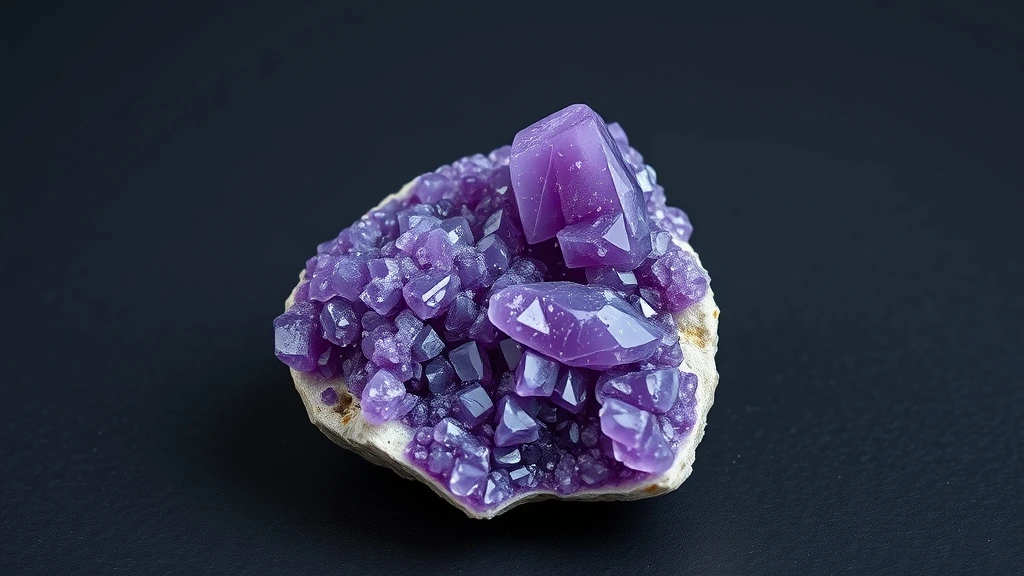
Purple aragonite belongs to the natural mineral group classified as a crystal, specifically a trigonal polymorph of calcium carbonate that forms through low‑temperature hydrothermal processes. Its formation often occurs in limestone caverns where mineral‑rich solutions precipitate, yielding fibrous or botryoidal aggregates prized for their striking color and translucency.
What is Purple Aragonite? Geological Overview & Definition
Purple aragonite is an aragonite variety whose violet coloration arises from trace manganese and iron ions substituting for calcium within the crystal lattice. Unlike its more common white counterpart, the purple hue is enhanced by exposure to natural radiation and subtle variations in fluid chemistry during growth.
In geological terms, aragonite crystallizes in the trigonal crystal system, producing elongated, columnar crystals that can intergrow into massive aggregates. These aggregates are often found in speleothems, marine sedimentary environments, and evaporite deposits, where they record paleo‑environmental conditions through their growth layers.
Purple Aragonite Chemical Composition & Crystallographic Properties
The mineral is essentially calcium carbonate (CaCO₃), but the lack of a fixed stoichiometric formula for the purple variety reflects its status as an aggregate of aragonite crystals with variable trace element content. Manganese (Mn²⁺) and iron (Fe³⁺) act as chromophore centers, absorbing specific wavelengths and imparting the characteristic purple shade.
Aragonite’s trigonal lattice (space group Pm1) consists of stacked carbonate groups oriented along the c‑axis, creating a tightly packed arrangement that differs from the rhombohedral calcite polymorph. This structural distinction yields a higher hardness and distinct cleavage planes, influencing how the stone fractures under stress.
The mineral is acid‑sensitive; exposure to dilute hydrochloric acid triggers effervescence as carbonate ions react to release CO₂ gas. This reaction is a diagnostic test for distinguishing aragonite from other silicate or oxide gemstones that remain inert in acid.
Thermally, purple aragonite is stable up to about 350 °C, beyond which it begins to decompose to calcite and releases water vapor. Heating can also cause the loss of color‑enhancing trace ions, gradually fading the violet hue and altering its optical properties.
| Property | Specification |
|---|---|
| Mineral Group | Natural Mineral / Crystal |
| Mohs Hardness | 6.5 – 7.0 |
| Crystal System | Trigonal |
| Color & Optical Properties | Natural Purple Aragonite color spectrum and optical dispersion |
| Primary Mining Localities | Global primary localities |
| Water & Chemical Resistance | High (Safe for gentle water washing) |
| Chakra Alignment (Traditional) | Third Eye Chakra (Ajna) |
| Zodiac Affinity (Traditional) | Capricorn, Taurus |
| Symbolic Meaning (Traditional) | Grounding, vitality and protection |
Purple Aragonite Varieties & Color Spectrum
Purple aragonite exhibits a diverse chromatic range driven by trace element substitutions within its crystal lattice. The most sought-after specimens display a deep violet hue, often resulting from iron impurities interacting with structural defects. These stones typically form in marine sedimentary environments, where calcium carbonate precipitates in distinct fibrous or prismatic habits.
Deep Violet Aragonite
This variety features a saturated, royal purple coloration that commands high value in the gem market. The intense hue arises from specific lattice distortions caused by manganese or iron trace elements. Specimens often exhibit a translucent to semi-transparent body, allowing light to penetrate and enhance the internal glow.
Lavender Aragonite
Characterized by a soft, pastel purple shade, this morph is highly prized for cabochon cutting. The delicate coloration suggests lower concentrations of chromophoric impurities compared to deeper violet stones. Fine fibrous inclusions are common, creating a silky luster that catches light beautifully.
Amethystine Aragonite
Resembling amethyst in its rich, wine-like purple tones, this rare variety is geologically distinct. It forms in hydrothermal veins where silica and calcium carbonate co-precipitate under specific pressure conditions. The vitreous luster and clarity make it a desirable alternative for collectors seeking unique purple minerals.
Lilac Aragonite
This pale, pinkish-purple variant is often found in shallow marine deposits with high organic content. The subtle hue results from complex interactions between organic matter and calcium carbonate during diagenesis. These stones are typically opaque to translucent, featuring a smooth, waxy surface finish.
Indigo Aragonite
Displaying a deep, bluish-purple tone, this variety is exceptionally rare in the global market. The indigo shade indicates the presence of cobalt or nickel trace elements within the crystal structure. Prismatic crystal formations are frequently observed, adding geometric interest to the stone’s aesthetic appeal.
Where is Purple Aragonite Found? Geological Mining & Extraction
Purple aragonite primarily occurs in marine limestone and dolomite formations, where calcium carbonate precipitates from seawater. These deposits are often found in shallow water environments with high biological activity, facilitating the growth of intricate crystal structures. The mineral frequently coexists with quartz and calcite, forming complex mineral assemblages in sedimentary basins.
Major extraction sites include regions in Mexico, China, and Madagascar, where aragonite deposits are abundant. Mining operations typically involve open-pit excavation or hand-picking from exposed outcrops to preserve crystal integrity. The fragile nature of aragonite requires careful handling during extraction to prevent fracturing and maintain gem-quality specimens.
Historical Significance & Cultural Lore of Purple Aragonite
Ancient civilizations valued aragonite for its metaphysical properties and aesthetic appeal, often incorporating it into ritualistic objects. In Greco-Roman traditions, purple-hued minerals were associated with royalty and spiritual insight, reflecting the stone’s deep violet coloration. Archaeological findings suggest that aragonite was used in amulets and jewelry to promote protection and clarity of mind.
In Vedic and Chinese lore, purple stones were linked to the third eye chakra, symbolizing intuition and wisdom. Historical texts describe the use of aragonite in meditative practices to enhance mental focus and spiritual connection. The mineral’s grounding energy was believed to balance vitality and provide protection against negative influences.
Modern Uses & Jewelry Applications of Purple Aragonite
Lapidaries typically cut purple aragonite into smooth cabochons to accentuate its delicate color zoning and translucent quality. Because the mineral exhibits a Mohs hardness of 6.5 to 7.0, it is durable enough for rings but requires careful handling during polishing to avoid chipping along cleavage planes.
- Cabochon Cutting: Preferred for maximizing the stone’s soft purple hue and internal banding patterns without risking fracture.
- Ornamental Carvings: Used in decorative boxes and small sculptures where the stone’s unique growth patterns are the primary aesthetic feature.
- Bead Jewelry: Commonly strung into necklaces and bracelets, often paired with silver settings to complement its cool-toned palette.
Metaphysical Properties & Traditional Meaning of Purple Aragonite
According to historical traditions and metaphysical lore, purple aragonite is revered for its capacity to foster grounding and deep spiritual protection. Ancient Mediterranean and Vedic lapidary texts often associate purple-hued calcite-group minerals with the stabilization of the etheric body and the enhancement of intuition.
Practitioners believe this stone resonates with the Third Eye Chakra, aiding in the development of psychic clarity and mental focus. It is frequently recommended for individuals seeking to balance vitality with protective energy, creating a shield against negative environmental influences while promoting emotional stability.
Which Chakra and Zodiac Signs Align with Purple Aragonite?
Purple aragonite is canonically aligned with the Third Eye Chakra (Ajna), which governs intuition, insight, and spiritual perception. This alignment suggests the stone helps clear mental fog and enhances the wearer’s ability to access higher states of consciousness and inner wisdom.
In astrological practice, this mineral is specifically associated with Capricorn and Taurus. These earth signs benefit from the stone’s grounding properties, which support their natural inclination toward stability, discipline, and tangible achievement in the material world.
How to Identify Real vs. Fake Purple Aragonite
Artificial imitations of purple aragonite often include synthetic glass, dyed quartz, or plastic replicas designed to mimic the stone’s distinctive banding. These fakes may lack the natural thermal properties and specific gravity of genuine aragonite, making them detectable through simple physical examination.
Practical At-Home Authenticity Tests
- Temperature Test (Thermal Feel): Genuine aragonite feels noticeably cool to the touch when first held, whereas plastic or glass imitations may warm up more quickly or feel neutral.
- Specific Gravity & Weight Test: Real aragonite has a density of approximately 2.95 g/cm³; it should feel heavier than a similarly sized piece of glass or plastic.
- Scratch & Hardness Test (Mohs Comparison): With a hardness of 6.5-7.0, aragonite can scratch window glass (Mohs 5.5) but will not scratch a steel knife blade (Mohs 5.5-6.5) easily, distinguishing it from softer fakes.
- Microscopic & Loupe Inspection (Internal Inclusions): Use a 10x loupe to look for natural growth lines or fluid inclusions; synthetic glass often contains tiny, spherical bubbles or swirls that are not found in natural mineral specimens.
Purple Aragonite Valuation Factors, Grading & Pricing
Color saturation dominates market perception; the deepest violet hues command premium prices. Collectors prize a vivid, uniform color saturation that reflects minimal post‑mining treatment and a natural, radiant luster. Stones with uneven or washed‑out tones are typically discounted, regardless of size or origin.
Crystal size and weight, expressed in grams, are the next decisive metric. Larger, well‑formed specimens that weigh more grams and display a smooth, high‑gloss polish fetch higher offers, while raw, unpolished material is priced lower. Natural matrix inclusions can add character, but excessive veining may reduce value in the tumbled market.
Ethical sourcing and locality premium increasingly influence buyer decisions. Stones harvested from responsibly managed mines, especially those with documented provenance in historic aragonite districts, earn a ethical sourcing premium among holistic practitioners and serious collectors. Transparent supply chains also mitigate the risk of counterfeit or treated material, reinforcing market confidence.
How to Clean and Care for Purple Aragonite
Gentle cleaning preserves both appearance and structural integrity. Use warm soapy water and a soft cloth to wipe the surface, ensuring any residue is removed without abrasion. After cleaning, pat the stone dry with a lint‑free microfiber towel and store it in a stable, low‑humidity environment.
Ultrasonic cleaners are contraindicated for Purple Aragonite, as the vibrations can create micro‑fractures that compromise the crystal lattice. Regular maintenance with the recommended soft‑cloth method will keep the stone’s natural luster intact while avoiding any risk of damage.
Cleansing and Recharging Purple Aragonite (Energetic Care)
For holistic upkeep, place the stone in a gentle stream of herbal smoke, such as sage or cedar, allowing the aromatic particles to drift over its surface for a few minutes. This dry smudging practice is believed to clear lingering energetic residues without exposing the mineral to moisture or heat.
Alternatively, rest the specimen on a clean selenite charging slab beneath moonlight for several hours. The cool, neutral energy of selenite combined with the subtle lunar illumination is thought to revitalize the stone’s vibrational field while preserving its physical structure.
Frequently Asked Questions About Purple Aragonite
Purple Aragonite displays distinct mineralogical characteristics across its geological varieties and structural habits. Gemologists evaluate these natural varieties based on crystal habit, trace chromophore concentrations, and visual luster.
Primary Natural Purple Aragonite
The benchmark natural variety exhibiting diagnostic color saturation and classic crystallographic symmetry.
Distinct Geological Morphs of Purple Aragonite
Secondary regional and structural varieties formed under localized geological temperature and pressure conditions.
Is purple aragonite safe to wear in the shower?
Yes, it tolerates gentle water exposure. High water resistance allows occasional shower wear, but prolonged soaking can weaken the crystal lattice over time. Rinse with lukewarm water, pat dry, and store away when not in use to preserve its vibrant hue and structural integrity.
How should I clean my purple aragonite jewelry?
Use warm soapy water and a soft cloth, avoiding ultrasonic devices. Gently rub the surface to lift dirt, then rinse and dry with a lint‑free microfiber. Ultrasonic vibrations can create micro‑fractures in the trigonal crystal system, compromising durability.
Can ultrasonic cleaners be used on purple aragonite?
No, ultrasonic cleaning is not recommended. The high‑frequency vibrations may induce stress points that lead to structural fractures in the aragonite lattice. Stick to manual cleaning with mild soap and a soft cloth to maintain the stone’s optical clarity.
What is the hardness of purple aragonite, and will it scratch easily?
Its Mohs hardness ranges from 6.5 to 7.0. This makes it relatively resistant to everyday scratches, yet still softer than quartz or sapphire. Avoid contact with harder gemstones such as diamond or topaz to prevent surface abrasion.
Which zodiac signs are associated with purple aragonite?
Capricorn and Taurus are the aligned signs. In astrological tradition, these earth signs are believed to benefit from the stone’s grounding energy, enhancing stability and practicality in personal endeavors.
Which chakra does purple aragonite activate?
It resonates with the Third Eye Chakra (Ajna). This center governs intuition and inner vision, and the stone’s purple hue is thought to amplify psychic perception and mental clarity during meditation.
Does purple aragonite have any known metaphysical properties?
Grounding, vitality, and protection are its primary esoteric keywords. Practitioners claim the stone anchors energetic flow, boosts physical stamina, and forms a shield against negative influences, especially when placed on the Ajna chakra during mindfulness practices.
Is purple aragonite suitable for everyday wear?
Yes, with proper care it can be worn daily. Its hardness and high water resistance make it durable for rings, pendants, or bracelets, provided you avoid harsh chemicals and extreme temperature shifts. Regular gentle cleaning will keep its luminous purple appearance intact.