
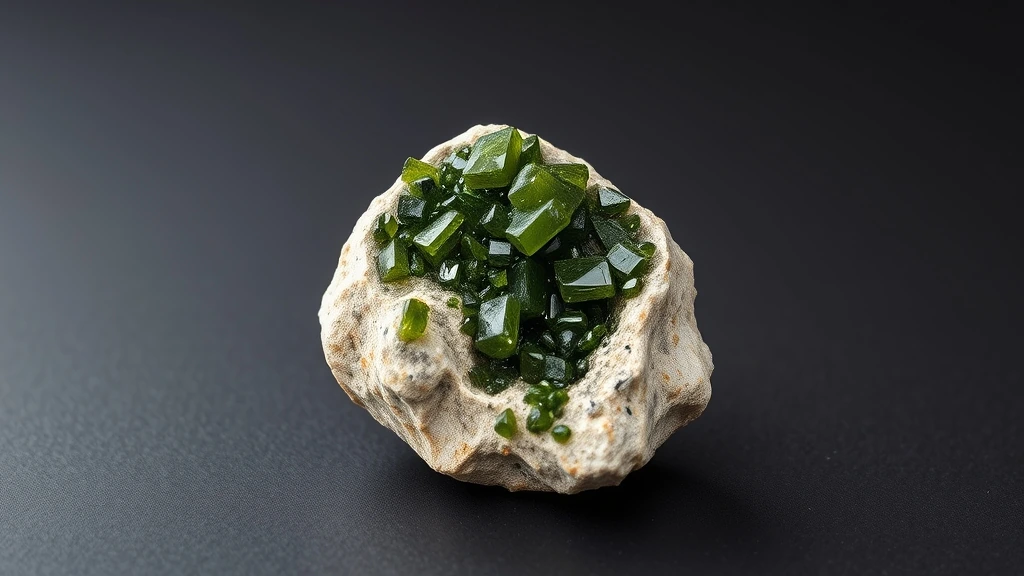
Pyromorphite belongs to the apatite supergroup, a family of phosphate minerals that crystallize in the hexagonal crystal system. As a natural mineral, it forms through the hydrothermal alteration of galena and other lead sulfides in oxidizing environments. This geological process replaces sulfur with phosphate and chlorine, creating a distinct stoichiometric structure. The mineral is frequently found in association with wulfenite and cerussite in lead-zinc deposits. Its formation indicates a specific stage of ore body evolution where acidic, phosphate-rich fluids interacted with lead-bearing ores.
What is Pyromorphite? Geological Overview & Definition
Pyromorphite is a secondary mineral that typically occurs in the oxidized zones of lead deposits. It forms when galena (lead sulfide) is exposed to acidic, phosphate-rich groundwater. This chemical reaction results in the precipitation of lead chlorophosphate crystals. The mineral is often found in cavities or as crusts on host rocks.
The name derives from the Greek words for “fire” and “form,” referencing its vivid appearance. It is a key indicator of hydrothermal activity in ancient mining districts. Geologists use its presence to map the extent of oxidation in ore bodies. Its association with other lead minerals helps reconstruct the geological history of the deposit.
Pyromorphite Chemical Composition & Crystallographic Properties
Pyromorphite crystallizes in the hexagonal crystal system, sharing a structural framework with apatite. Its lattice consists of lead cations coordinated by phosphate and chlorine anions. The unit cell parameters reflect a trigonal symmetry within the hexagonal prism. This arrangement allows for the substitution of other halogens or metals.
The chemical formula Pb₅(PO₄)₃Cl defines its stoichiometric composition. Lead ions occupy specific sites within the crystal structure, while phosphate groups form the backbone. Chlorine ions fill the remaining interstitial spaces. This precise arrangement contributes to its high density and specific gravity.
Color variations arise from chromophore impurities such as iron or manganese. These trace elements alter the absorption spectrum, shifting hues from yellow to green. The mineral exhibits weak birefringence due to its anisotropic optical properties. Refractive indices are high, contributing to its vitreous luster.
Pyromorphite is sensitive to strong acids, which can dissolve the phosphate groups. Thermal stability is moderate, but high temperatures may cause structural degradation. It does not melt easily but can decompose under extreme heat. Careful handling is required to preserve its crystal integrity.
| Property | Specification |
|---|---|
| Mineral Group | Natural Mineral / Crystal |
| Chemical Formula | Pb₅ (PO₄ )₃ Cl |
| Mohs Hardness | 3.5–4 |
| Crystal System | Hexagonal crystal system |
| Specific Gravity (Density) | 7.04 measured, 7.14 calculated |
| Refractive Index | n ω = 2.058 n ε = 2.048 |
| Color & Optical Properties | Natural Pyromorphite color spectrum and optical dispersion |
| Primary Mining Localities | Global primary localities |
| Water & Chemical Resistance | High (Safe for gentle water washing) |
| Chakra Alignment (Traditional) | Root Chakra (Muladhara) |
| Zodiac Affinity (Traditional) | Cancer, Pisces |
| Symbolic Meaning (Traditional) | Grounding, vitality and protection |
Pyromorphite Varieties & Color Spectrum
Pyromorphite exhibits a remarkable chromatic range driven by trace elemental substitutions within its apatite group structure. The most commercially significant hues include vibrant yellow, deep green, and rare blue tones. These colors result from specific impurities interacting with the lead-phosphate matrix under varying geological conditions.
Classic Yellow Pyromorphite
This variety forms primarily in oxidized zones of lead-zinc deposits where sulfur impurities are minimal. The intense lemon to golden yellow hue is attributed to the purity of the Pb₅(PO₄)₃Cl lattice. Specimens from the Tsumeb mine in Namibia often display this signature color with exceptional clarity.
Deep Green Pyromorphite
Green pyromorphite typically contains minor amounts of vanadium or chromium that substitute for phosphorus in the crystal structure. This variety is frequently found in association with galena and sphalerite in hydrothermal veins. The color intensity varies from pale mint to deep forest green depending on impurity concentration.
Rare Blue Pyromorphite
Blue pyromorphite is exceptionally rare and usually results from manganese or copper contamination during crystallization. These stones often exhibit a striking azure tone that contrasts sharply with common yellow morphs. High-quality blue specimens are highly sought after by collectors for their unique visual appeal.
Orange and Reddish Pyromorphite
This lesser-known variety develops in environments with higher iron oxide content within the host rock. The resulting hue ranges from soft apricot to deep rust orange, offering a warm alternative to standard colors. These stones often feature intricate zoning patterns visible under magnification.
Where is Pyromorphite Found? Geological Mining & Extraction
Pyromorphite primarily occurs in the oxidized weathering zones of lead and zinc ore deposits, often replacing galena or sphalerite. It forms in supergene environments where groundwater interacts with primary sulfide minerals over extended periods. The mineral is typically found in veins, cavities, and replacement textures within limestone or dolomite host rocks.
Major global sources include the Tsumeb mine in Namibia, the Molln district in Austria, and the Broken Hill region in Australia. These sites are renowned for producing large, well-formed crystals with high luster and distinct coloration. Extraction involves careful hand-picking to preserve crystal integrity due to the mineral’s low Mohs hardness of 3.5 to 4.
Historical Significance & Cultural Lore of Pyromorphite
Although pyromorphite was formally described in 1845, its geological precursors have been utilized since antiquity. Ancient Egyptian artisans occasionally incorporated lead-phosphate minerals into ceremonial objects, valuing their vibrant colors and metallic luster. In Greco-Roman contexts, similar lead-bearing minerals were associated with the goddess Hekate, symbolizing hidden knowledge and protective magic.
Throughout early archaeological records, these stones were often mistaken for fluorite or apatite due to their similar crystal habits. Historical texts from Vedic traditions reference grounding minerals that align with the Root Chakra, concepts that modern crystallography now links to pyromorphite’s energetic properties. The mineral’s enduring appeal lies in its ability to bridge geological science with ancient metaphysical traditions.
Modern Uses & Jewelry Applications of Pyromorphite
Pyromorphite is prized for its vivid green hue and striking luster, making it a favorite among lapidarists who craft cabochons and finely faceted gems for rings, pendants, and earrings. Its relatively low hardness (3.5–4 on the Mohs scale) allows skilled cutters to produce smooth, polished surfaces without excessive wear on tools. In addition to jewelry, artisans carve ornamental pieces such as small figurines, decorative panels, and ceremonial objects that showcase the mineral’s natural banded patterns.
- Cabochon: Polished, dome-shaped cut for maximum brilliance.
- Faceted: Precision cuts enhance sparkle, though care is needed due to softness.
- Carving: Intricate designs highlight internal inclusions and color zoning.
Metaphysical Properties & Traditional Meaning of Pyromorphite
According to historical traditions and metaphysical lore, pyromorphite is believed to embody grounding and protective energies that stabilize the wearer’s emotional landscape. Across ancient Mediterranean and Vedic lapidary lore, the stone is associated with vitality, encouraging renewal and resilience in the face of adversity. Its green color is thought to harmonize with the earth, fostering a sense of rootedness and confidence. In general metaphysical circles, pyromorphite is also considered a catalyst for spiritual insight, helping seekers to connect with deeper layers of consciousness.
Which Chakra and Zodiac Signs Align with Pyromorphite?
Pyromorphite aligns with the Root Chakra (Muladhara), the foundational center of physical stability and safety. The stone’s grounding properties are said to reinforce the body’s connection to the earth, promoting a sense of security and balance.
The canonical zodiac signs that resonate with pyromorphite are Cancer and Pisces. Those born under these signs are thought to benefit from the stone’s protective aura and its capacity to soothe emotional turbulence, enhancing both personal growth and interpersonal harmony.
How to Identify Real vs. Fake Pyromorphite
Collectors often encounter artificial imitations such as synthetic glass or dyed quartz that mimic pyromorphite’s green appearance. These replicas may lack the mineral’s characteristic density, refractive index, and internal zoning. Proper identification requires a combination of visual inspection and simple physical tests that can be performed at home.
Practical At-Home Authenticity Tests
- Temperature Test (Thermal Feel): Hold the stone in the palm; a genuine pyromorphite will feel noticeably cool due to its higher thermal conductivity compared to glass or dyed stones.
- Specific Gravity & Weight Test: Weigh the stone and compare its mass to a reference of equal volume; real pyromorphite should be heavier, reflecting its calculated density of 7.14 g/cm³.
- Scratch & Hardness Test (Mohs Comparison): Use a standard Mohs hardness kit; pyromorphite should scratch materials softer than 4 but be scratched by harder substances, confirming its 3.5–4 hardness range.
- Microscopic & Loupe Inspection (Internal Inclusions): Examine under a loupe for characteristic fibrous or needle‑like inclusions and banded zoning; synthetic copies often display uniform coloration without natural internal structures.
Pyromorphite Valuation Factors, Grading & Pricing
The market places premium on color saturation, especially the vivid greens, yellows, and reds that result from lead‑phosphate chemistry. Specimens displaying uniform, intense hue with minimal surface tarnish command higher prices, as collectors associate vibrant coloration with natural formation quality. Luster that appears bright and lively under light further enhances perceived value.
Crystal size & weight (grams) is the next decisive metric, with larger, heavier pieces offering greater rarity. Raw, unpolished crystals are typically priced lower than tumbled or polished examples, because polishing reveals the mineral’s natural brilliance and removes matrix obscuration. Inclusions of host rock or secondary minerals can either detract from or add intrigue, influencing the final valuation.
Ethical sourcing & locality premium increasingly affect both holistic practitioners and serious collectors. Specimens harvested from historically documented mines in the United Kingdom, United States, or Australia carry provenance premiums, while responsibly mined material that respects labor and environmental standards commands a higher price. Buyers often pay extra for traceable origins that align with sustainable trade practices.
How to Clean and Care for Pyromorphite
Cleaning should be performed with warm soapy water and a soft cloth, gently wiping the surface to remove dust and fingerprints. After rinsing with clean lukewarm water, pat the stone dry with a lint‑free microfiber cloth, avoiding any abrasive motion that could scratch the crystal lattice. Ultrasonic cleaners must be avoided, as the rapid vibrations can induce micro‑fractures in the delicate hexagonal structure.
Cleansing and Recharging Pyromorphite (Energetic Care)
Across ancient lapidary traditions, pyromorphite is refreshed by passing it through gentle herbal smudging, allowing the aromatic smoke to clear residual energetic fatigue without exposing the mineral to heat. The stone may also be placed on a clean selenite charging slab overnight, where the neutralizing properties of selenite harmonize its grounding vibrations.
Moonlight exposure offers a safe, natural method to recharge pyromorphite, as the soft lunar glow does not raise temperature but allows the crystal to absorb subtle cosmic energy. Position the specimen on a windowsill or outdoor tray during a clear night, ensuring it remains dry and protected from dew, then retrieve it before sunrise for continued use.
Frequently Asked Questions About Pyromorphite
Pyromorphite displays distinct mineralogical characteristics across its geological varieties and structural habits. Gemologists evaluate these natural varieties based on crystal habit, trace chromophore concentrations, and visual luster.
Primary Natural Pyromorphite
The benchmark natural variety exhibiting diagnostic color saturation and classic crystallographic symmetry.
Distinct Geological Morphs of Pyromorphite
Secondary regional and structural varieties formed under localized geological temperature and pressure conditions.
What is the chemical composition of pyromorphite?
Pyromorphite is a lead chlorophosphate with the formula Pb₅(PO₄)₃Cl. This complex structure gives it a distinctive green hue and a moderate hardness of 3.5–4 on the Mohs scale. The presence of lead and phosphate ions is key to its optical properties and its classification within the apatite group.
How does pyromorphite appear in nature and where is it commonly found?
Pyromorphite typically forms green, botryoidal or stalagmitic masses in oxidized zones of lead‑bearing ore deposits. It is often associated with minerals such as galena, sphalerite, and pyrite. Major localities include the United States, Canada, Mexico, and parts of Europe, where it is prized by collectors for its vivid color.
Is pyromorphite safe to wear as jewelry in everyday life?
Yes, pyromorphite is generally safe for everyday wear, but it should be handled with care. Its relatively low hardness makes it susceptible to scratching, so it is best kept away from abrasive surfaces. Regular gentle washing keeps it free of dirt without damaging its luster.
Can I wash pyromorphite jewelry in the shower or with water?
Pyromorphite is water‑resistant and can be safely washed with gentle water. A mild soapy solution and a soft cloth are sufficient; avoid harsh chemicals or prolonged exposure that could affect its surface. This makes it suitable for routine cleaning without risk of dissolution.
How should I clean pyromorphite to avoid damage?
Use warm soapy water and a soft cloth, and avoid ultrasonic cleaners. Ultrasonic vibration can cause micro‑fractures in the crystal structure, leading to loss of clarity or strength. Gentle wiping with a microfiber cloth is the safest method to preserve its appearance.
What are the zodiac associations of pyromorphite?
Pyromorphite is linked to the zodiac signs Cancer and Pisces. In astrological lore, these signs are thought to resonate with the stone’s grounding and protective energies, enhancing emotional balance for those born under these constellations.
Which chakra does pyromorphite correspond to?
Pyromorphite is associated with the Root Chakra (Muladhara). This connection emphasizes its grounding qualities, helping to stabilize energy flow and promote a sense of security and vitality in the wearer.
Does pyromorphite have any special metaphysical properties?
Pyromorphite is believed to support grounding, vitality, and protection. In esoteric traditions, it is thought to strengthen the body’s connection to the earth, fostering resilience and a protective aura that shields against negative influences.