
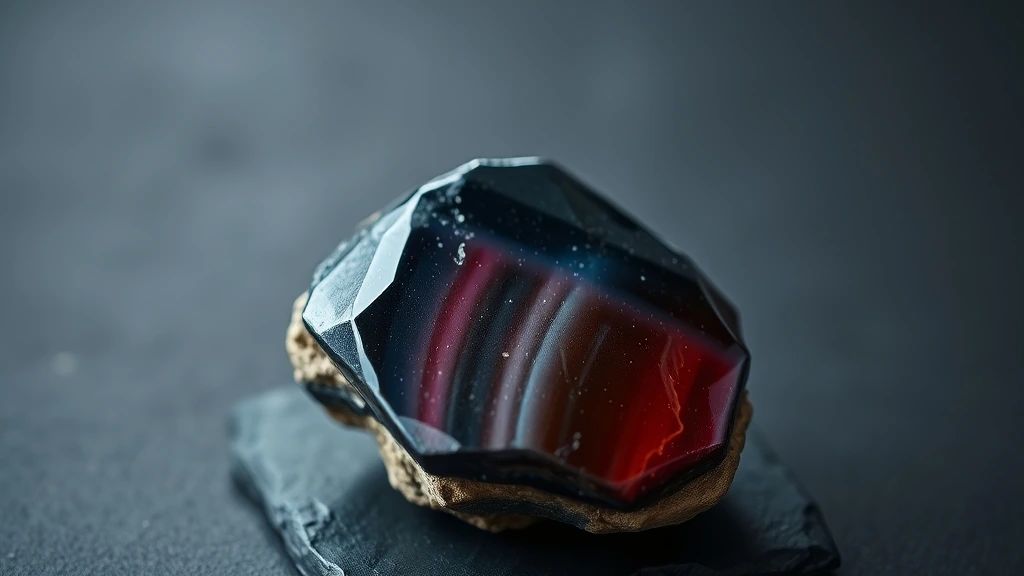
Rainbow obsidian belongs to the mineraloid family of extrusive volcanic glasses, formed when felsic lava cools so rapidly that crystals never have time to develop. This rapid quenching yields a glassy matrix that is structurally amorphous, lacking any long‑range order. Its striking iridescence is a surface phenomenon caused by light interference within thin layers of oriented nanocrystals that develop during slow cooling of the outer rind.
What is Rainbow Obsidian Gemstone? Geological Overview & Definition
Rainbow obsidian is a volcanic glass produced from silica‑rich magma that erupts at the Earth’s surface and solidifies in seconds. The glass retains the bulk chemical composition of the original lava but freezes before a crystal lattice can form, resulting in an amorphous solid.
The gemstone’s hallmark is its iridescent sheen, created by microscopic layers of magnetite and hematite that diffract light. These layers form a “rainbow” of colors—typically blues, greens, reds and golds—over a deep black or dark brown base, giving the stone its name and metaphysical allure.
Rainbow Obsidian Gemstone Chemical Composition & Crystallographic Properties
Rainbow obsidian’s chemistry is dominated by SiO₂ (≈70–75 %), with subordinate FeO, MgO, CaO, Na₂O and K₂O that act as chromophore agents. The lack of a repeating lattice means there is no true unit cell; instead, the structure is a disordered network of Si–O tetrahedra linked randomly.
Because the material is amorphous, it does not exhibit cleavage and breaks with a conchoidal fracture, a hallmark of glassy minerals. Substitutions of Fe²⁺/Fe³⁺ for Mg²⁺ and Ca²⁺ introduce localized color centers that absorb specific wavelengths, producing the observed rainbow effect.
Acid exposure can leach mobile cations, subtly altering surface coloration and reducing durability; therefore, cleaning with mild soap and water is recommended. Thermal treatment above ~600 °C can cause devitrification, forming micro‑crystals that permanently change the stone’s optical properties.
Despite its glassy nature, rainbow obsidian displays a measurable specific gravity of 2.3–2.5, consistent with other silica‑rich volcanic glasses, and retains a relatively low thermal conductivity, making it comfortable to wear in jewelry.
| Property | Specification |
|---|---|
| Mineral Group | Mineraloid (Extrusive Volcanic Glass) |
| Chemical Formula | Volcanic glass (70%+ SiO₂ with Fe, Mg silicates) |
| Mohs Hardness | 5.0 – 5.5 |
| Crystal System | Amorphous (Non-crystalline volcanic glass) |
| Specific Gravity (Density) | 2.35 – 2.60 |
| Refractive Index | 1.480 – 1.510 |
| Color & Optical Properties | Natural Rainbow Obsidian Gemstone color spectrum and optical dispersion |
| Primary Mining Localities | Mexico, USA (Oregon, Utah), Turkey (Kars, Agri), Armenia, Iceland |
| Water & Chemical Resistance | High (Natural volcanic glass; safe in water) |
| Chakra Alignment (Traditional) | Root Chakra (Muladhara) |
| Zodiac Affinity (Traditional) | Scorpio, Sagittarius, Capricorn |
| Symbolic Meaning (Traditional) | Aura shield, emotional truth mirroring, cord-cutting, and shadow grounding |
Rainbow Obsidian Gemstone Varieties & Color Spectrum
Rainbow obsidian is not a distinct mineral species but a specific structural modification of standard black obsidian. The iridescent sheen arises from microscopic gas bubbles and fluid inclusions trapped during rapid volcanic cooling. These tiny pockets refract light, creating a shimmering halo that distinguishes it from matte black glass.
Classic Rainbow Obsidian
This variety features a deep black base with a prismatic iridescence ranging from violet to green. The colors appear as a thin, metallic film on the surface rather than penetrating the stone’s core. It is the most commercially available form, prized for its balanced aesthetic and moderate hardness.
Fire Obsidian
Fire obsidian displays intense, fiery hues of orange, red, and yellow against a dark background. These vibrant colors result from specific iron oxide inclusions interacting with light at particular angles. Its rarity makes it significantly more valuable than standard rainbow varieties in the gem market.
Sheen Obsidian
Sheen obsidian exhibits a metallic luster that resembles a brushed silver or bronze finish. This effect is caused by a dense concentration of microscopic bubbles aligned in parallel layers. It lacks the distinct spectral colors of classic rainbow obsidian but offers a unique, reflective quality.
Gold Obsidian
Gold obsidian contains tiny, pyrite inclusions that sparkle like gold dust within the black glass. These metallic flecks provide a distinct contrast to the smooth, vitreous texture of the host stone. It is often confused with fire obsidian but is geologically distinct due to its mineral content.
Where is Rainbow Obsidian Gemstone Found? Geological Mining & Extraction
Rainbow obsidian forms in volcanic lava flows that cool rapidly, trapping gas bubbles that create the iridescent effect. The primary geological host is basaltic or andesitic volcanic rock, where pressure changes during eruption facilitate bubble formation. These deposits are typically found in areas with recent or historical volcanic activity.
The most famous source is the Pachuca region in Hidalgo, Mexico, which supplies the majority of global trade. Other significant deposits exist in the United States, particularly in Oregon and California, as well as in Turkey and Indonesia. Extraction involves careful hand-picking to preserve the delicate iridescent surfaces from fracture.
Historical Significance & Cultural Lore of Rainbow Obsidian Gemstone
Ancient Mesoamerican civilizations, including the Aztecs and Mayans, revered obsidian as a sacred material for spiritual and practical tools. They used it to craft obsidian blades, mirrors, and ceremonial daggers known as macuahuitl. The iridescent variety was considered a powerful conduit for divine energy and protection.
In modern metaphysical traditions, rainbow obsidian is associated with the Root Chakra and emotional truth mirroring. Practitioners use it for aura shielding and cutting negative energetic cords, believing it grounds the user’s shadow self. This cultural legacy continues to drive its popularity in contemporary wellness and jewelry markets.
Modern Uses & Jewelry Applications of Rainbow Obsidian Gemstone
Lapidaries primarily cut Rainbow Obsidian into cabochons to maximize the visibility of its iridescent surface patterns. Faceting is generally avoided because the stone’s high reflectivity can obscure the delicate spectral colors. Instead, skilled carvers often shape these pieces into pendants, rings, or ornamental carvings that highlight the natural sheen.
- Cabochon Cutting: The most common method, preserving the smooth, domed surface essential for viewing the rainbow flash.
- Pendant Design: Popular for showcasing large, uncut slabs where the iridescence is most prominent across the face.
- Ornamental Carving: Used in artistic sculptures and decorative objects where the stone’s glossy texture serves as a focal point.
Metaphysical Uses & Origins of Rainbow Obsidian
According to historical traditions and metaphysical lore, Rainbow Obsidian is revered as a powerful tool for emotional truth mirroring. Practitioners believe it acts as a spiritual mirror, reflecting hidden emotions and subconscious patterns back to the wearer. This reflective quality encourages deep introspection and the release of suppressed feelings.
The stone is also associated with aura shielding, believed to protect the wearer’s energy field from negative influences. It supports cord-cutting rituals, helping individuals sever toxic ties with past relationships or environments. By grounding the shadow self, it facilitates a deeper connection to one’s authentic identity.
Which Chakra and Zodiac Signs Align with Rainbow Obsidian Gemstone?
In chakra theory, Rainbow Obsidian is strongly aligned with the Root Chakra (Muladhara). This energy center governs feelings of safety, stability, and physical survival. The stone’s grounding properties help anchor the wearer’s energy, promoting a sense of security and presence in the physical world.
Astrologically, this gemstone resonates with the signs of Scorpio, Sagittarius, and Capricorn. Scorpios appreciate its depth and transformative power, while Sagittarians value its ability to ground their visionary nature. Capricorns find its protective qualities complementary to their structured approach to life.
How to Identify Real vs. Fake Rainbow Obsidian Gemstone
Artificial imitations of Rainbow Obsidian are commonly crafted from synthetic glass or dyed volcanic rock. These fakes often lack the natural, random distribution of iridescent bands found in genuine specimens. Glass imitations may appear too uniform, with bubbles or swirls that are not present in natural obsidian.
Practical At-Home Authenticity Tests
- Temperature Test (Thermal Feel): Genuine obsidian feels distinctly cold to the touch initially and warms slowly. Glass imitations often reach room temperature much faster due to their different thermal conductivity.
- Specific Gravity & Weight Test: Real obsidian is denser than glass, so a genuine stone will feel heavier than a similarly sized glass replica. This difference in specific gravity is a reliable indicator of authenticity.
- Scratch & Hardness Test (Mohs Comparison): Obsidian has a Mohs hardness of 5 to 5.5, meaning it can be scratched by a steel knife or a harder mineral. Glass, which is harder, will not scratch easily under the same conditions.
- Microscopic & Loupe Inspection (Internal Inclusions): Use a 10x loupe to check for internal inclusions like tiny bubbles or swirls. Natural obsidian is typically clear of these artificial flaws, while glass fakes often contain visible air bubbles.
Rainbow Obsidian Gemstone Valuation Factors, Grading & Pricing
Market value hinges primarily on Color Saturation, where deep, iridescent flashes command higher premiums. Uniformity of tone across the stone’s surface ensures visual consistency for buyers. High optical clarity and a sharp vitreous luster further distinguish premium specimens from lower-grade material.
Carat Weight significantly impacts pricing, as larger stones with minimal inclusions are rarer and more desirable. Facet symmetry is critical for maximizing light return in cut gemstones. The presence of distinct matrix patterns or internal inclusions can either enhance uniqueness or reduce overall clarity.
Geographical Provenance Premium often elevates prices for stones from renowned volcanic regions. Wholesale trends show steady demand for high-quality rainbow obsidian in the metaphysical market. Retail values typically reflect a markup over wholesale, influenced by current collector interest.
How to Clean and Care for Rainbow Obsidian Gemstone
Rainbow obsidian is a natural volcanic glass that is safe to handle in water. You can gently wash the stone using warm water and a soft cloth to remove surface dust. This method effectively cleans the surface without risking structural damage to the brittle material.
Strictly avoid ultrasonic cleaners, as the high-frequency vibrations can cause chipping or cracking. The inherent brittleness of volcanic glass makes it susceptible to fracture under mechanical stress. Always inspect the stone for existing cracks before any cleaning process to prevent further damage.
Cleansing and Recharging Rainbow Obsidian Gemstone (Energetic Care)
For energetic maintenance, use dry methods that respect the stone’s physical integrity. Smoke smudging with sage or palo santo is a popular technique for clearing negative energy. This ritual allows the stone to absorb positive vibrations without exposure to moisture or heat.
Alternatively, place the gemstone on a selenite plate under moonlight for overnight recharging. This passive method aligns with the stone’s association with the Root Chakra. It ensures the obsidian remains energetically balanced while preserving its physical structure.
Frequently Asked Questions About Rainbow Obsidian Gemstone
Is rainbow obsidian safe to wear in water?
Yes, it is water‑resistant and can be worn in pools, showers, or the ocean. Rainbow obsidian is a natural volcanic glass, so its dense, non‑porous structure does not absorb moisture. This high water resistance makes it suitable for everyday wear, though prolonged exposure to harsh chemicals should still be avoided.
Can I clean rainbow obsidian with an ultrasonic cleaner?
No, ultrasonic cleaning is not recommended for rainbow obsidian. While the stone tolerates warm water, the rapid vibrations of an ultrasonic bath can cause the brittle glass to chip or fracture. Instead, gently wipe the surface with a soft, damp cloth and a mild soap solution.
Which zodiac signs are most compatible with rainbow obsidian?
Scorpio, Sagittarius, and Capricorn are the primary astrological matches. These signs are said to benefit from the stone’s grounding energy, which aligns with their need for emotional truth and resilience. Wearing rainbow obsidian may help amplify focus and inner strength for these signs.
Which chakra does rainbow obsidian balance?
Rainbow obsidian is linked to the Root Chakra (Muladhara). This chakra governs stability, security, and physical vitality. The stone’s deep, grounding vibrations are believed to anchor the wearer, supporting shadow grounding and a sense of rootedness.
How should I store rainbow obsidian to prevent damage?
Store it separately in a padded jewelry box or soft pouch. Because the material is a brittle volcanic glass, impacts from harder stones can cause chips. Keeping it isolated and cushioned protects its iridescent surface and preserves its natural luster.
Does rainbow obsidian fade or lose color over time?
No, its color remains stable under normal conditions. The stone’s rainbow sheen is produced by light interference within microscopic layers of iron and magnesium oxides, which are chemically stable. Proper care—avoiding prolonged sunlight and harsh chemicals—will keep the iridescent play of colors vivid.
Can rainbow obsidian be set in metal jewelry without special treatment?
Yes, it can be set directly, but a protective bezel is advisable. The stone’s hardness (≈5.5–6 on the Mohs scale) is sufficient for most settings, yet its brittleness calls for a protective bezel or prong that shields edges from knocks. This reduces the risk of chipping during everyday wear.
Is rainbow obsidian suitable for meditation or energy work?
Absolutely; it is prized for grounding and protective meditation practices. Practitioners use it to create an aura shield, mirror emotional truths, and assist in cord‑cutting rituals. Its connection to the Root Chakra helps anchor the practitioner, fostering a calm, centered state.