
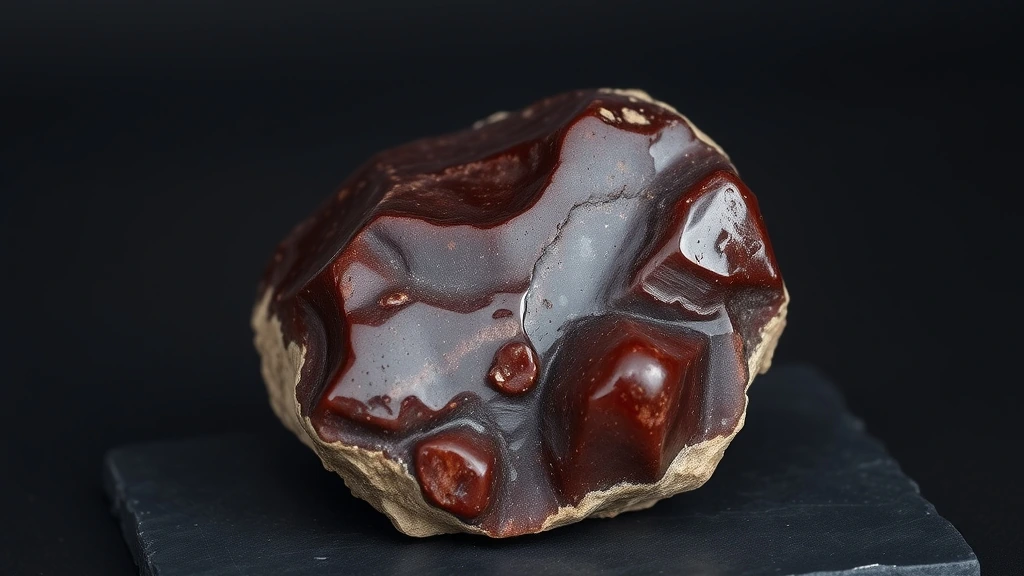
Mahogany Obsidian belongs to the mineraloid family, a non‑crystalline extrusive volcanic glass formed when felsic lava cools too rapidly for crystal lattices to develop. This amorphous material records the chemistry of its parent magma, preserving iron‑rich inclusions that generate its characteristic mahogany hues. Though lacking a true crystal structure, its physical properties—density, refractive index, and hardness—are well‑defined, allowing gemologists to classify it alongside other obsidian varieties.
What is Mahogany Obsidian ? Geological Overview & Definition
Mahogany Obsidian is an amorphous volcanic glass produced by the rapid quenching of silica‑rich lava on the Earth’s surface. The sudden cooling prevents the orderly arrangement of SiO₄ tetrahedra, resulting in a glassy matrix that retains microscopic bubbles and mineral inclusions. While Mahogany Obsidian forms from the rapid quenching of terrestrial lava, it shares its amorphous, non-crystalline structure with the enigmatic Libyan Desert Glass, a natural glass formed by meteorite impacts in the Sahara.
The stone’s distinctive mahogany coloration arises from dispersed iron‑oxide and magnesium‑silicate particles that create dark brown, reddish, and black banding. These chromophoric inclusions are randomly oriented, giving each specimen a unique, natural marbled appearance prized by collectors and jewelry designers. In comparative mineralogical collections, practitioners and geologists frequently study Apache Tears alongside this crystal to appreciate their subtle energetic and structural differences.
Mahogany Obsidian Chemical Composition & Crystallographic Properties
The material is fundamentally volcanic glass, an aggregate of silica (≈70 % SiO₂) interwoven with variable amounts of Fe, Mg, and trace alkali metals. Because it lacks a repeating unit cell, there is no stoichiometric chemical formula; instead, its bulk composition reflects the parent magma’s bulk chemistry. In comparative mineralogical collections, practitioners and geologists frequently study Midnight Lace Obsidian alongside this crystal to appreciate their subtle energetic and structural differences.
Its crystal system is unequivocally Amorphous (Non‑crystalline volcanic glass), meaning no long‑range order exists and traditional lattice parameters are absent. The internal structure consists of a disordered network of Si–O bonds, with iron and magnesium cations occupying interstitial sites that modify optical and magnetic properties.
Color in Mahogany Obsidian is governed by chromophore color centers: iron‑oxide nanoinclusions and magnesium‑silicate flakes absorb specific wavelengths, producing the characteristic reddish‑brown bands. These centers are sensitive to acidic environments; prolonged exposure to strong acids can leach iron, fading the color and destabilizing the glass surface.
Thermally, Mahogany Obsidian behaves like other obsidians: it softens near 600 °C and can be reheated to a glassy flow state, allowing artisans to reshape it without crystallization. Rapid cooling after reheating restores its amorphous nature, preserving the original hue and internal stress patterns that give the stone its unique visual depth.
| Property | Specification |
|---|---|
| Mineral Group | Mineraloid (Extrusive Volcanic Glass) |
| Chemical Formula | Volcanic glass (70%+ SiO₂ with Fe, Mg silicates) |
| Mohs Hardness | 5.0 – 5.5 |
| Crystal System | Amorphous (Non-crystalline volcanic glass) |
| Specific Gravity (Density) | 2.35 – 2.60 |
| Refractive Index | 1.480 – 1.510 |
| Color & Optical Properties | Natural Mahogany Obsidian Gemstone color spectrum and optical dispersion |
| Primary Mining Localities | Mexico, USA (Oregon, Utah), Turkey (Kars, Agri), Armenia, Iceland |
| Water & Chemical Resistance | High (Natural volcanic glass; safe in water) |
| Chakra Alignment (Traditional) | Root Chakra (Muladhara) |
| Zodiac Affinity (Traditional) | Scorpio, Sagittarius, Capricorn |
| Symbolic Meaning (Traditional) | Aura shield, emotional truth mirroring, cord-cutting, and shadow grounding |
Mahogany Obsidian Varieties & Color Spectrum
Classic Mahogany
Formed when rapid cooling of silica‑rich lava traps microscopic magnetite and hematite crystals, Classic Mahogany displays a deep black base overlaid with rich, reddish‑brown swirls. The inclusions create a “wood‑grain” pattern that is visible even under modest magnification. This variety is the most widely traded and is considered moderately abundant in the global market.
Red Mahogany (Reddish‑Brown Vein)
Red Mahogany originates from lava flows enriched in iron‑oxide particles that settle in thin, parallel bands during solidification. The resulting linear streaks of copper‑red to rust‑brown contrast sharply with the jet‑black matrix, giving the stone a striking, almost marbled appearance. Because the vein formation requires precise cooling rates, high‑quality specimens are relatively rare and prized by collectors.
Brown‑Black Mahogany (Chocolate)
In this morph, higher concentrations of magnesium silicates produce a darker, chocolate‑brown hue that blends seamlessly with the black background. The stone often exhibits a subtle, glossy sheen and a more uniform pattern than classic mahogany, making it a favorite for cabochon settings. Deposits yielding this color are limited to a few volcanic fields, adding to its market exclusivity.
Mexican Mahogany (Oaxacan)
Named for the historic mining districts of Oaxaca, Mexican Mahogany forms in basaltic lava that cools in the presence of abundant iron‑rich volcanic ash. The stone’s hallmark is a dense network of fine, reddish‑brown speckles that give it a “tree‑ring” visual effect. Its regional provenance is well documented, and high‑grade pieces command premium prices in the gemstone trade.
Patagonian Mahogany (Southern Andes)
Patagonian Mahogany emerges from the volcanic arcs of southern Chile and Argentina, where the lava interacts with sulfur‑bearing minerals during rapid quenching. This interaction imparts a slightly warmer, amber‑tinged brown to the typical mahogany pattern, and the stone often contains microscopic pyroxene crystals that add a faint sparkle. Because the Andes deposits are geologically isolated, specimens are scarce and highly sought after by connoisseurs.
Siberian Mahogany (Kolyma)
Siberian Mahogany is sourced from the Kolyma River basin, where permafrost conditions preserve volcanic glass with minimal weathering. The stone exhibits a deep, almost velvety black base punctuated by bold, copper‑red ribbons that are thicker than those in other varieties. The extreme climate limits mining operations, rendering this variety exceptionally rare and a collector’s gem.
Where is Mahogany Obsidian Found? Geological Mining & Extraction
Mahogany Obsidian occurs primarily in rhyolitic and basaltic lava flows where silica content exceeds 70 % and rapid cooling traps iron‑rich inclusions. These volcanic glasses are embedded within tuffaceous host rocks and often appear as nodules or flow‑banded sheets, requiring careful quarrying to avoid fracturing the amorphous matrix.
The most productive mining districts include Oaxaca (Mexico), the Andes of Chile and Argentina, the Kolyma region (Russia), and select sites in the western United States such as the Black Hills of South Dakota. Extraction is typically performed by hand‑splitting the host rock along natural cleavage planes, followed by water‑based cleaning to reveal the characteristic mahogany pattern without damaging the fragile glass.
Historical Significance & Cultural Lore of Mahogany Obsidian
Ancient Mesoamerican cultures, notably the Zapotec and Mixtec, fashioned mahogany‑patterned obsidian into ceremonial blades, mirrors, and burial ornaments, believing the stone’s dark matrix mirrored the underworld while the red swirls symbolized life‑force. Archaeological sites in Oaxaca have yielded polished cabochons that were likely used in divination rituals and as status markers for elite warriors.
In Turkic and Siberian shamanic traditions, Mahogany Obsidian was carried as a protective talisman, thought to shield the aura and sever negative energetic cords. Legends describe the stone as a “mirror of truth,” capable of revealing hidden motives and grounding shadow aspects during trance work, a belief that persists in contemporary metaphysical practice.
Modern Uses & Jewelry Applications of Mahogany Obsidian
Lapidaries primarily shape this volcanic glass into smooth cabochons due to its amorphous structure, which prevents the formation of distinct facets. The warm, reddish-brown hue allows for elegant bezel settings that protect the relatively soft material from chipping during daily wear.
- Cabochon Cuts: Polished domes that highlight the stone’s unique sheen and deep color without risking fracture.
- Ornamental Carvings: Skilled artisans carve intricate pendants or inlays, leveraging the stone’s uniform texture for detailed relief work.
- Beaded Jewelry: Uniformly sized beads used in bracelets or necklaces, often paired with silver or black onyx accents.
Metaphysical Uses & Origins of Mahogany Obsidian
Practitioners utilize this stone for emotional truth mirroring, helping users confront hidden feelings and break negative patterns. Its dense, earthy energy supports shadow grounding, anchoring the spirit during intense meditative sessions or periods of personal transformation.
In architectural and lapidary arts, the material serves as a powerful aura shield against psychic intrusion. The stone’s volcanic origin connects it to primal earth energies, making it a favored tool for cord-cutting rituals that sever toxic emotional ties.
Which Chakra and Zodiac Signs Align with Mahogany Obsidian ?
This gemstone resonates most strongly with the Root Chakra (Muladhara), enhancing feelings of safety, stability, and physical presence. By activating this energy center, the stone helps users feel firmly planted in their reality, reducing anxiety and fostering a sense of grounded security.
Astrologically, Mahogany Obsidian aligns with Scorpio, Sagittarius, and Capricorn. These earth and water signs benefit from the stone’s ability to deepen introspection, enhance strategic planning, and provide the emotional resilience needed to navigate life’s complex challenges.
How to Identify Real vs. Fake Mahogany Obsidian
Artificial imitations often use dyed glass or synthetic materials to mimic the natural reddish-brown tones of genuine obsidian. These fakes may appear too uniform in color or lack the subtle internal variations found in naturally formed volcanic glass, making careful inspection essential for buyers.
Practical At-Home Authenticity Tests
- Temperature Test (Thermal Feel): Genuine obsidian feels noticeably cooler to the touch than plastic or dyed glass, retaining its coolness longer due to its higher thermal mass.
- Specific Gravity & Weight Test: Real obsidian has a density of 2.35 – 2.60, making it feel significantly heavier than similarly sized pieces of ordinary glass or plastic.
- Scratch & Hardness Test (Mohs Comparison): With a Mohs hardness of 5.0 – 5.5, the stone will scratch glass but can be scratched by a steel knife or quartz, distinguishing it from softer imitations.
- Microscopic & Loupe Inspection (Internal Inclusions): Use a 10x loupe to check for tiny bubbles or swirls, which indicate synthetic glass, whereas natural obsidian typically shows a smooth, homogeneous interior.
Mahogany Obsidian Valuation Factors, Grading & Pricing
Color Saturation is the foremost driver of price. Deep, uniform mahogany tones with vivid red‑brown inclusions command premium rates, while washed‑out or mottled stones are discounted. Luster adds sparkle; a glassy, high‑shine surface signals quality and enhances market appeal.
Specimen Mass & Size influences value but interacts with cut. Larger stones (over 5 ct) are rarer and fetch higher prices, provided the carving craftsmanship and block integrity is precise and the surface is free of chips. Visible matrix or mineral inclusions reduce clarity, lowering the grade unless they create a desirable “fire‑like” pattern.
Geographical Provenance Premium rewards stones from classic Turkish or Mexican volcanic fields, where collectors recognize historic mining districts. These origins add a traceable story, often raising wholesale prices by 10‑20 %. Retail trends show steady demand, with prices climbing 5‑8 % annually as the stone’s metaphysical reputation expands.
How to Clean and Care for Mahogany Obsidian
Mahogany Obsidian is safe in warm water; gently soak the piece for a few minutes, then rinse with lukewarm tap water. Pat dry with a soft, lint‑free cloth to avoid water spots. Avoid ultrasonic cleaners—the brittle volcanic glass can chip under vibration, risking permanent damage.
Cleansing and Recharging Mahogany Obsidian (Energetic Care)
For energetic renewal, place the stone in a bowl of smoke from sage or palo santo and allow the vapors to drift over it for 5–10 minutes; the mineral’s low solubility ensures no physical alteration. This method clears lingering negative imprints while preserving the glassy surface.
Alternatively, expose the gem to moonlight on a clear night or rest it on a selenite charging plate for several hours. Both dry techniques safely revitalize the stone’s vibrational field without introducing moisture or mechanical stress.
Frequently Asked Questions About Mahogany Obsidian
Is Mahogany Obsidian safe to wear in water or rain?
Yes, it is highly water‑resistant. Mahogany Obsidian is a natural volcanic glass with a silica‑rich composition that does not dissolve or degrade in moisture. Its amorphous structure and density of 2.35–2.60 g/cm³ allow it to endure daily exposure to rain, swimming, or bathing without loss of luster.
Can I clean Mahogany Obsidian with an ultrasonic cleaner?
No, avoid ultrasonic cleaning. While the stone tolerates warm water, the high‑frequency vibrations of ultrasonic devices can cause this brittle volcanic glass to chip or fracture. Gentle hand cleaning with a soft brush and mild soap is the safest method to maintain its polished surface.
What is the typical hardness of Mahogany Obsidian on the Mohs scale?
It rates 5.0–5.5 on the Mohs scale. This moderate hardness means the stone scratches more easily than quartz but is still suitable for many jewelry settings. Protect it from hard impacts and store it separately from diamonds or sapphires to prevent surface damage.
Which zodiac signs are most aligned with Mahogany Obsidian?
Scorpio, Sagittarius, and Capricorn are the primary signs. In astrological tradition, these signs benefit from the stone’s grounding energy, which supports emotional truth‑mirroring and helps cut negative cords. Wearing the gem during key planetary transits can amplify its intended influence.
Which chakra does Mahogany Obsidian resonate with?
It is linked to the Root Chakra (Muladhara). This chakra governs stability, survival, and physical grounding. Mahogany Obsidian’s deep, earthy tones reinforce shadow grounding and provide an “aura shield,” helping the wearer feel more anchored in the material world.
How should I store Mahogany Obsidian to avoid damage?
Store it separately in a padded compartment. Because the stone is an amorphous volcanic glass, it is prone to chipping if struck by harder minerals. A soft cloth pouch or a dedicated jewelry box with individual slots reduces the risk of abrasion and accidental breakage.
Does Mahogany Obsidian have any notable refractive properties?
Its refractive index ranges from 1.480 to 1.510. This relatively low index gives the stone a subtle, glassy luster rather than high brilliance. The effect is enhanced by its characteristic dark brown matrix with mahogany‑colored inclusions, creating a unique, earthy sparkle.
What is the typical density of Mahogany Obsidian, and why does it matter?
Its density falls between 2.35 and 2.60 g/cm³. Knowing the density helps gemologists confirm authenticity, as genuine volcanic glass will match this range. The value also influences how the stone feels on the body—providing a solid, grounding weight that aligns with its Root Chakra purpose.