
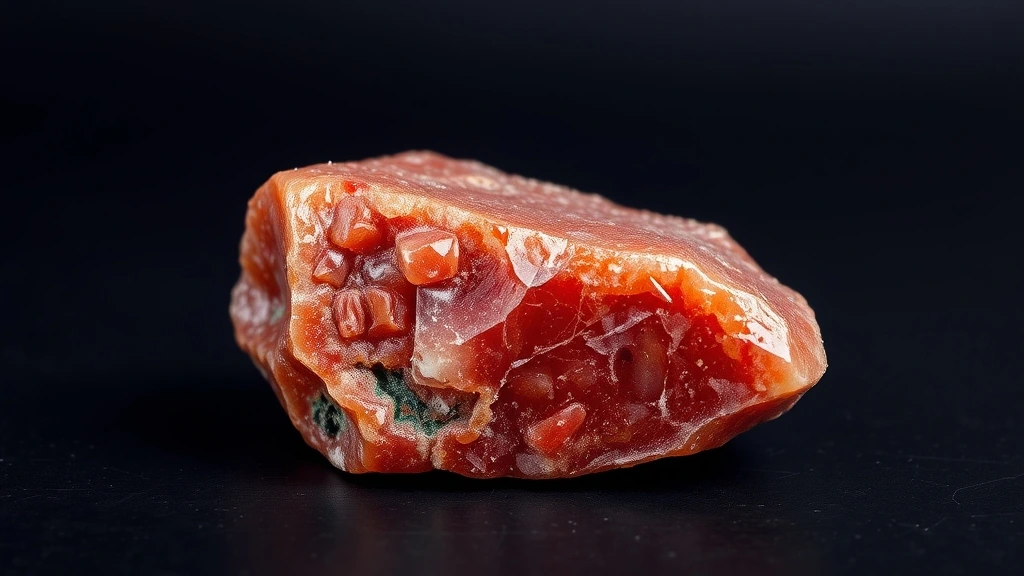
Red aventurine belongs to the quartz mineral group, a ubiquitous natural crystal found across diverse geological formations. It is not a distinct species but a varietal form of crystalline silica. The stone’s identity hinges on specific trace inclusions rather than unique stoichiometric differences. Geologists classify it under the broader silicate mineral family. Its formation involves hydrothermal processes that deposit silica in cavities. This results in a macroscopically banded or mottled appearance.
What is Red Aventurine? Geological Overview & Definition
Red aventurine is a macrocrystalline aggregate of quartz containing fine, plate-like inclusions. These inclusions, often hematite or cinnabar, create the characteristic metallic luster known as aventurescence. The host quartz forms a trigonal lattice that encases these reflective particles. This structure scatters light, producing the stone’s vibrant red coloration.
The term “aventurine” derives from the Italian *avventura*, meaning chance, reflecting its accidental discovery. Unlike pure quartz, this variety displays a granular texture due to the embedded impurities. The red hue varies from deep crimson to soft salmon depending on inclusion density. Crystallographic orientation of the inclusions significantly impacts the visual intensity. In comparative mineralogical collections, practitioners and geologists frequently study Flower Stone alongside this crystal to appreciate their subtle energetic and structural differences.
Red Aventurine Chemical Composition & Crystallographic Properties
The primary component is silicon dioxide (SiO₂), arranged in a trigonal crystal system. This lattice structure features a helical arrangement of silicon-oxygen tetrahedra. The space group typically belongs to the P3₁21 or P3₂21 types. Such symmetry dictates the stone’s piezoelectric properties and cleavage behavior. In comparative mineralogical collections, practitioners and geologists frequently study Dioptase alongside this crystal to appreciate their subtle energetic and structural differences.
Coloration arises from chromophore centers within the inclusions, not the quartz host. Hematite (Fe₂O₃) inclusions provide the dominant red tones through iron oxidation. Trace elements may substitute for silicon in the lattice, altering optical properties. Cation substitution remains minimal in the host quartz structure itself.
The stone exhibits moderate acid sensitivity, resisting dilute acids but reacting to strong alkalis. Thermal stability is high, with quartz melting near 1,650°C. However, rapid temperature changes can induce thermal shock fractures. The refractive index of the host quartz ranges from 1.544 to 1.553. Inclusions may slightly modify the overall optical response.
| Property | Specification |
|---|---|
| Mineral Group | Natural Mineral / Crystal |
| Chemical Formula | SiO₂ |
| Mohs Hardness | 6.5 – 7.0 |
| Crystal System | Trigonal |
| Specific Gravity (Density) | 2.65 |
| Refractive Index | 1.544 – 1.553 |
| Color & Optical Properties | Natural Red Aventurine color spectrum and optical dispersion |
| Primary Mining Localities | Global primary localities |
| Water & Chemical Resistance | High (Safe for gentle water washing) |
| Chakra Alignment (Traditional) | Sacral Chakra (Svadhishthana) |
| Zodiac Affinity (Traditional) | Sagittarius, Pisces |
| Symbolic Meaning (Traditional) | Spiritual awareness and universal harmony |
Red Aventurine Varieties & Color Spectrum
Red aventurine is not a single mineral species but a trade name for quartz containing inclusions that create a shimmering effect. The primary variety features hematite or iron oxide inclusions, which impart the characteristic deep red to rusty orange hue. This aventurescence results from light reflecting off microscopic, plate-like mineral inclusions suspended within the transparent quartz matrix.
Classic Red Aventurine
This standard variety displays a vibrant, fiery red color with a distinct metallic sheen when viewed from different angles. The iron oxide inclusions are typically fine-grained, creating a dense, glittering appearance across the stone’s surface. It is the most commercially available form, often sourced from Brazil and Madagascar for the global gem market.
Deep Crimson Aventurine
Distinguished by its darker, wine-like saturation, this morph contains higher concentrations of magnetite or coarse hematite particles. The visual signature is less sparkly and more opaque, offering a rich, velvety red tone that absorbs more light. Collectors prize this variety for its intense color depth and reduced transparency compared to lighter grades.
Rusty Orange Aventurine
Often found in the same deposits as classic red, this variety exhibits a warm, terracotta or burnt orange coloration. The inclusion density is usually lower, allowing more light to pass through the quartz host crystal. This lighter tone is frequently used in beadwork and carvings where a softer, earthy aesthetic is desired.
Pinkish-Red Aventurine
This rarer morph presents a softer, salmon-pink hue with subtle red undertones and a gentle shimmer. The quartz matrix is typically clearer, enhancing the delicate play of light from the sparse inclusions. It is highly sought after for its gentle appearance and is often confused with rose quartz by inexperienced buyers.
Mottled Red Aventurine
Characterized by irregular patches of red inclusions against a clear or white quartz background, this variety lacks uniform color distribution. The geological formation process results in uneven dispersion of the metallic particles throughout the crystal structure. While less consistent in appearance, it offers a unique, organic aesthetic that appeals to lapidaries.
Where is Red Aventurine Found? Geological Mining & Extraction
Red aventurine primarily forms within pegmatite deposits, where slow-cooling magma allows for the growth of large quartz crystals and the incorporation of metallic inclusions. These coarse-grained igneous rocks provide the ideal environment for the hematite particles to settle and become embedded within the growing quartz lattice. The geological process requires specific pressure and temperature conditions to achieve the characteristic aventurescent effect.
The primary mining regions for high-quality red aventurine include Brazil, Madagascar, and India, where extensive pegmatite fields are exposed. In Brazil, the state of Minas Gerais yields significant quantities of the classic red variety, while Madagascar produces stones with particularly vibrant saturation. Extraction involves open-pit mining techniques, followed by careful sorting to identify specimens with the highest concentration of reflective inclusions.
Historical Significance & Cultural Lore of Red Aventurine
Ancient civilizations valued red-toned quartz varieties for their perceived protective and energetic properties, often incorporating them into ritualistic artifacts. In Greco-Roman traditions, red stones were associated with Mars, the god of war, symbolizing courage and vitality in battle. Archaeological evidence suggests that similar shimmering quartzes were traded across the Mediterranean, serving as status symbols for the elite.
In Vedic and Chinese historical records, red gemstones were linked to the life force and physical vitality, often used in healing practices. These cultures believed that the stone’s fiery color could stimulate blood circulation and enhance overall well-being. Throughout early archaeological records, such minerals were consistently revered for their ability to connect the wearer to primal earth energies.
Modern Uses & Jewelry Applications of Red Aventurine
Red aventurine is most often cut as a smooth cabochon to showcase its characteristic glittering inclusions, though skilled lapidaries also produce faceted stones for high‑shine settings. The stone’s moderate Mohs hardness (6.5‑7) allows precise carving without excessive risk of fracture, making it popular for rings, pendants, and earrings. Artisans also carve ornamental beads, intaglios, and small figurines, capitalizing on the stone’s warm hue and affordable price point.
- Cabochon pendants for pendant necklaces
- Faceted rings and earrings for contemporary designs
- Carved beads and intaglios for vintage‑style jewelry
- Decorative inlays for watch faces and ornamental boxes
Metaphysical Properties & Traditional Meaning of Red Aventurine
According to historical traditions and metaphysical lore, red aventurine is associated with spiritual awareness and the cultivation of universal harmony. Across ancient Mediterranean lapidary records, the stone was prized for its ability to invigorate the heart and stimulate courageous action, while Vedic texts linked its red hue to the life‑force energy that fuels ambition and compassion. In contemporary practice, the gemstone is believed to nurture emotional resilience, encouraging optimism during periods of change.
Which Chakra and Zodiac Signs Align with Red Aventurine?
Red aventurine resonates most strongly with the Sacral Chakra (Svadhishthana), supporting creativity, sensuality, and the flow of personal energy. Practitioners report that meditating with the stone can balance this chakra, fostering confidence in artistic pursuits and intimate relationships.
The stone’s astrological correspondences are the fire‑sign Sagittarius and the water‑sign Pisces. Sagittarius benefits from the stone’s motivational boost, while Pisces finds emotional grounding, aligning the gem’s energetic profile with the expansive optimism of the archer and the intuitive depth of the fish.
How to Identify Real vs. Fake Red Aventurine
Artificial imitations of red aventurine include dyed quartz, colored glass, and synthetic resin composites that mimic the stone’s glitter but lack its natural inclusions. Synthetic glass often appears overly uniform, while dyed replicas may show uneven coloration under light. Recognizing these differences requires careful visual and tactile assessment.
Practical At-Home Authenticity Tests
- Temperature Test (Thermal Feel): Genuine red aventurine feels cool to the touch initially and warms slowly, whereas glass or plastic warms rapidly in the hand.
- Specific Gravity & Weight Test: The stone’s density is slightly higher than quartz; a real piece will feel heavier than a similarly sized glass imitation.
- Scratch & Hardness Test (Mohs Comparison): Using a steel file (hardness ~5.5), a genuine aventurine will resist scratching, while softer glass will show visible marks.
- Microscopic & Loupe Inspection (Internal Inclusions): Under 10× magnification, natural red aventurine displays fine, reflective mineral inclusions (aventurescence); synthetic glass appears clear or shows uniform bubbles without sparkle.
Red Aventurine Valuation Factors, Grading & Pricing
Red Aventurine is evaluated primarily by its color saturation and the natural energetic luster that the stone displays. A vivid, deep crimson hue with a subtle greenish sparkle commands higher prices, as it reflects the mineral’s intrinsic vibrancy and perceived metaphysical potency. Collectors often seek specimens that exhibit a balanced play of light, indicating a well‑formed crystal lattice and minimal surface blemishes.
The second key determinant is crystal size and weight (grams), together with the quality of the raw versus tumbled polish. Larger, well‑polished pieces that retain their natural matrix inclusions are prized for both aesthetic appeal and structural integrity. In the market, stones are graded by their mass and overall dimensions rather than by carat or tumbled polish and natural crystal geometry, ensuring that the valuation reflects the true bulk and visual impact of the specimen.
Finally, ethical sourcing and locality premium significantly influence pricing within holistic and collector circles. Stones mined from responsibly managed sites with transparent supply chains attract a premium, as do specimens from renowned localities such as the Red Aventurine deposits of the United States, Brazil, or the Philippines. Provenance documentation and certifications of fair‑trade practices enhance the stone’s desirability and justify higher price points.
How to Clean and Care for Red Aventurine
Red Aventurine is water‑resistant and can safely be cleaned with warm soapy water and a soft cloth. Gently wipe the surface to remove dust and fingerprints, ensuring that the cloth is damp but not saturated. Avoid ultrasonic cleaners, as the vibration can induce micro‑fractures in the quartz lattice, compromising the stone’s structural integrity.
Cleansing and Recharging Red Aventurine (Energetic Care)
To cleanse the stone’s energetic field, place it in a gentle herbal smudge session, allowing the aromatic vapors to pass over the surface without direct contact. After smudging, expose the stone to soft moonlight for a few hours, which helps to recharge its vibrational energy without exposing it to heat. Resting the Aventurine on a selenite charging slab during this period further amplifies its natural resonance, ensuring a balanced and revitalized energetic state.
Frequently Asked Questions About Red Aventurine
Red Aventurine displays distinct mineralogical characteristics across its geological varieties and structural habits. Gemologists evaluate these natural varieties based on crystal habit, trace chromophore concentrations, and visual luster.
Primary Natural Red Aventurine
The benchmark natural variety exhibiting diagnostic color saturation and classic crystallographic symmetry.
Distinct Geological Morphs of Red Aventurine
Secondary regional and structural varieties formed under localized geological temperature and pressure conditions.
What is the chemical composition of red aventurine?
Red aventurine is a variety of quartz with the chemical formula SiO₂. Its structure is a trigonal crystal system, giving it the typical hardness of 6.5–7.0 on the Mohs scale. The red hue comes from iron inclusions, which also enhance its optical clarity and slight sparkle.
Is red aventurine safe to wear in the shower or during light rain?
Yes, red aventurine is water‑resistant and safe for gentle washing. It can withstand occasional exposure to water, but prolonged soaking may dull its surface. A quick rinse with lukewarm water and a soft cloth preserves its surface integrity without compromising durability.
How should I clean my red aventurine jewelry to avoid damage?
Use warm soapy water and a soft cloth, avoiding ultrasonic cleaners. Gently wipe the stone to remove oils and dirt; ultrasonic vibrations can cause micro‑fractures in quartz. After cleaning, pat dry with a microfiber towel to maintain its polished luster.
Can I use an ultrasonic cleaner on red aventurine?
No, ultrasonic cleaners should be avoided for red aventurine. The high‑frequency vibrations can induce stress fractures in the quartz structure. Stick to manual cleaning methods to preserve the stone’s structural integrity and aesthetic appeal.
Which zodiac signs are associated with red aventurine?
Red aventurine is linked to Sagittarius and Pisces. These signs are believed to resonate with the stone’s energetic properties, fostering balance and creative insight in those born under these celestial influences.
Which chakra does red aventurine correspond to?
Red aventurine aligns with the Sacral Chakra (Svadhishthana). This chakra governs creativity, emotional balance, and sensuality, and the stone’s warm tones are thought to support harmonious flow of energy in this center.
Does red aventurine contain any harmful substances?
Red aventurine is free of toxic elements. Its composition is purely silicon dioxide with trace iron, making it safe for everyday wear and handling. The stone’s non‑toxic nature ensures it is suitable for all skin types.
How do I store red aventurine to prevent scratches?
Store red aventurine separately in a soft pouch or lined jewelry box. Avoid contact with harder stones or abrasive surfaces, and keep it away from direct sunlight to prevent color fading. Proper storage preserves its crystalline clarity and overall longevity.