
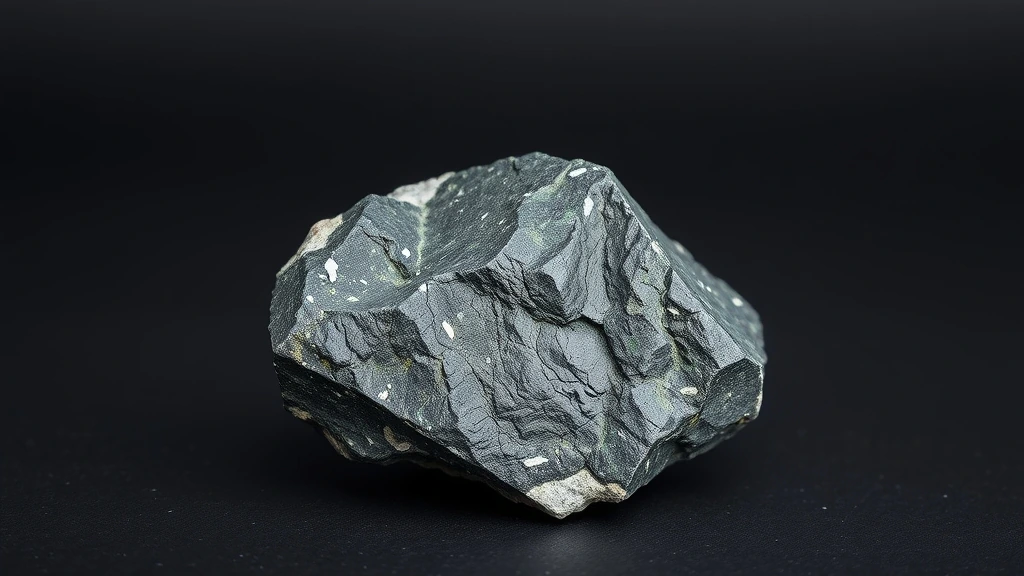
Serpentinite forms when ultramafic rocks such as peridotite undergo hydrothermal alteration, incorporating water into their crystal lattices. This process reorganizes the original olivine and pyroxene structures into a fibrous aggregate of antigorite, lizardite, and chrysotile, all belonging to the serpentine mineral group. Classified within the Natural Mineral / Crystal parent group, serpentinite retains a trigonal symmetry at the mineral level, though the rock itself appears as a massive, often banded, metamorphic aggregate. Its durability, combined with a vibrant green palette, has secured its place in ornamental stonework and metaphysical practices worldwide.
What is Serpentinite? Geological Overview & Definition
Serpentinite is an ultramafic metamorphic rock that results from the hydration of mantle-derived peridotite during low‑ to medium‑grade metamorphism. The name derives from the Greek *serpens*, reflecting the snake‑like, fibrous texture that emerges as the original minerals recrystallize into serpentine phases.
Across ancient lapidary traditions, serpentinite has been prized for its soothing green tones, often fashioned into carvings, seals, and ornamental panels. Its formation signals the presence of past tectonic subduction zones, making it a key indicator mineral for geologists mapping ancient plate boundaries.
Serpentinite Chemical Composition & Crystallographic Properties
The rock is an aggregate of serpentine-group minerals, primarily antigorite, lizardite, and chrysotile, each sharing the general formula (Mg,Fe)_3Si_2O_5(OH)_4 but differing in layer stacking and water content. Because serpentinite lacks a single stoichiometric formula, its chemistry is expressed as a solid solution where magnesium and iron substitute freely within the octahedral sites.
All serpentine minerals crystallize in the trigonal crystal system, characterized by a threefold rotational axis and a hexagonal lattice that is slightly distorted by layer corrugation. This symmetry governs the development of the rock’s characteristic sheet‑like cleavage and contributes to its flexible, yet brittle, mechanical behavior.
Serpentinite is acid‑sensitive; exposure to strong acids can leach magnesium and disrupt the hydroxyl layers, leading to surface etching and loss of luster. The green coloration arises from trace chromophore ions such as Fe²⁺ and Fe³⁺ occupying octahedral sites, which absorb specific wavelengths and impart the stone’s range of emerald to olive tones.
Thermally, serpentinite dehydrates between 300 °C and 700 °C, releasing bound water and transforming antigorite to olivine and talc. This endothermic reaction is a crucial factor in subduction‑zone metamorphism, where released fluids can trigger melting in the overlying mantle wedge.
| Property | Specification |
|---|---|
| Mineral Group | Natural Mineral / Crystal |
| Mohs Hardness | 6.5 – 7.0 |
| Crystal System | Trigonal |
| Color & Optical Properties | Natural Serpentinite color spectrum and optical dispersion |
| Primary Mining Localities | Global primary localities |
| Water & Chemical Resistance | High (Safe for gentle water washing) |
| Chakra Alignment (Traditional) | Throat Chakra (Vishuddha) |
| Zodiac Affinity (Traditional) | Capricorn, Taurus |
| Symbolic Meaning (Traditional) | Grounding, vitality and protection |
Serpentinite Varieties & Color Spectrum
Serpentinite displays distinct mineralogical characteristics across its geological varieties and structural habits. Gemologists evaluate these natural varieties based on crystal habit, trace chromophore concentrations, and visual luster.
Primary Natural Serpentinite
The benchmark natural variety exhibiting diagnostic color saturation and classic crystallographic symmetry.
Distinct Geological Morphs of Serpentinite
Secondary regional and structural varieties formed under localized geological temperature and pressure conditions.
Green Serpentinite (Chrysotile‑rich)
Formed in ultramafic mantle sections that have undergone hydrothermal alteration, this variety displays a deep, glossy emerald hue due to abundant chrysotile fibers. Fine‑grained inclusions of magnetite and tremolite create subtle speckles that enhance its visual depth. It is the most widely traded form, sourced chiefly from the United States, Canada, and New Zealand, and is considered moderately common in the gem market.
Black Serpentinite (Jet‑like)
Developed where serpentinization is complete and iron‑rich minerals dominate, the black variety exhibits a satin‑like luster reminiscent of organic jet. Microscopic magnetite platelets give it a metallic sheen, while occasional calcite veins produce faint white veining. Rare outside of Madagascar and the Philippines, its opaque darkness makes it prized for high‑contrast jewelry settings.
Blue‑Green Serpentinite (Lazurite‑Stained)
In regions where serpentine interacts with siderite and trace copper, a striking blue‑green tint emerges, most famously from the Zambian Copperbelt. The coloration is enhanced by thin lamellae of copper‑bearing minerals that diffract light, creating a subtle iridescence. This morph is scarce, with limited commercial extraction, and is highly sought after by collectors for its unique hue.
Yellow‑Brown Serpentinite (Limonite‑Infused)
Formed in oxidizing environments where limonite replaces iron‑bearing phases, this variety shows warm, honey‑colored tones with a buttery translucency. Fine limonite streaks produce a mottled appearance that can mimic amber. Predominantly mined in the Carpathian region of Romania, it is less common in global trade but valued for its earthy aesthetic in artisanal pieces.
Red Serpentinite (Ferruginous)
When serpentinization occurs alongside intense oxidation, hematite crystals embed within the matrix, imparting a vivid rust‑red coloration. The mineral often exhibits a polished, glassy surface that accentuates the red speckles. This rare form is chiefly sourced from the Kalahari Craton in South Africa and commands premium prices due to its striking contrast with typical green serpentine.
White Serpentinite (Calcite‑Veined)
Occurring where carbonate fluids infiltrate serpentine bodies, this variety displays a milky white background intersected by delicate calcite veins. The calcite inclusions create a marble‑like pattern that is prized for ornamental carving. Found mainly in the Alpine ophiolites of Italy and Austria, it is the least abundant commercial grade, often reserved for high‑end sculptural work.
Where is Serpentinite Found? Geological Mining & Extraction
Serpentinite occurs within ophiolitic complexes, where mantle peridotite has been thrust onto continental crust and subsequently altered by seawater‑derived fluids. The mineral typically resides in massive, foliated bodies rather than discrete veins, making bulk extraction the norm; crushing and sieving are used to isolate gem‑quality fragments from host rock.
Major mining districts include the Lizard Peninsula in Cornwall (UK), the Kalahari Craton (South Africa), the Zambian Copperbelt, and the Carpathian arc of Romania. In each locale, open‑pit or small‑scale quarry operations target serpentine outcrops, employing water‑based washing to remove silica and iron impurities before the material is cut and polished for the gemstone market.
Historical Significance & Cultural Lore of Serpentinite
Across ancient lapidary traditions, serpentinite was fashioned into amulets and seals by the ancient Egyptians, who associated its serpentine sheen with the protective deity Wadjet. Excavations at Saqqara reveal polished serpentinite scarabs dating to the Old Kingdom, underscoring its early status as a symbol of royalty and rebirth.
In Greco‑Roman contexts, serpentinite was mined in the Anatolian region of Lycia and used for ornamental inlays in mosaics and jewelry, believed to channel the earth element and grant vitality. Vedic texts reference a green stone called “Shankh‑pashā” for its grounding properties, aligning with modern esoteric attributions of grounding, vitality, and protection.
Modern Uses & Jewelry Applications of Serpentinite
Serpentinite is prized for its subtle green‑to‑gray hues and fine grain, making it suitable for lapidary cutting into cabochons that highlight its natural luster. Jewelers often fashion faceted pieces such as rings and pendants, where the stone’s moderate hardness (6.5–7.0 on the Mohs scale) allows precise polishing without excessive wear. In ornamental carving, serpentinite’s workability permits intricate designs for architectural accents, vases, and decorative panels.
- Cabochon earrings and pendants
- Faceted rings and brooches
- Carved ornamental panels and architectural accents
Metaphysical Properties & Traditional Meaning of Serpentinite
According to historical traditions and metaphysical lore, serpentinite is believed to embody grounding and protective energies, fostering stability in the wearer’s life. Across ancient Mediterranean and Vedic lapidary lore, the stone is associated with the Throat Chakra (Vishuddha), encouraging clear communication and authentic self‑expression. Its earthy tones are thought to resonate with the Capricorn and Taurus zodiac signs, reinforcing determination, resilience, and a deep connection to the material world.
Which Chakra and Zodiac Signs Align with Serpentinite?
Serpentinite’s alignment with the Throat Chakra (Vishuddha) underscores its role in enhancing verbal articulation and emotional honesty. The stone’s energetic profile complements the Capricorn and Taurus signs, whose traits of practicality, ambition, and steadfastness find harmonious support in serpentinite’s grounding influence.
How to Identify Real vs. Fake Serpentinite
Artificial imitations of serpentinite often appear as dyed glass, synthetic glass, or low‑grade feldspar. These replicas may lack the stone’s characteristic green‑gray banding and can exhibit inconsistent hardness or density.
Practical At-Home Authenticity Tests
- Temperature Test (Thermal Feel): Real serpentinite feels cool to the touch due to its higher thermal conductivity; synthetic glass warms quickly.
- Specific Gravity & Weight Test: Measure the stone’s weight relative to a known volume; serpentinite typically has a specific gravity around 2.7–2.9, heavier than most glass replicas.
- Scratch & Hardness Test (Mohs Comparison): Use a standard Mohs kit; serpentinite should scratch quartz (7) but not corundum (9), matching its 6.5–7.0 hardness.
- Microscopic & Loupe Inspection (Internal Inclusions): Under magnification, serpentinite often shows fine fibrous inclusions or mica flakes, whereas synthetic versions display uniform, glassy textures.
Serpentinite Valuation Factors, Grading & Pricing
Market valuation primarily hinges on Color Saturation, where deep, uniform emerald greens command the highest premiums. Specimens exhibiting vibrant, consistent hues without dulling brownish oxidation are highly sought after by collectors. The stone’s natural, waxy luster further enhances its visual appeal and perceived energetic potency.
Pricing is determined by Crystal Size & Weight (Grams), with larger raw chunks or polished tumbles valued by mass and dimension. High-quality tumbled stones feature smooth, even polish that highlights the rock’s dense, fibrous texture. Natural matrix inclusions, such as pyrite flecks, can either detract from value or add unique character depending on the buyer’s preference.
Ethical Sourcing & Locality Premium significantly influences pricing in holistic and collector markets. Stones from verified, environmentally responsible mines often carry a higher price tag due to supply chain transparency. Specific localities with historical significance or exceptional mineralogical consistency also attract premium bids from serious gemologists.
How to Clean and Care for Serpentinite
Maintain your serpentinite’s integrity by using warm soapy water and a soft cloth for gentle surface cleaning. This method effectively removes dust and oils without compromising the stone’s structural stability. Always ensure the soap is mild and free from harsh chemical additives that could alter the surface finish.
It is critical to avoid ultrasonic cleaners entirely, as the high-frequency vibrations can induce structural fractures within the rock. Serpentinite’s fibrous nature makes it susceptible to internal stress when subjected to intense mechanical agitation. After washing, dry the specimen thoroughly with a lint-free towel to prevent water spots or mineral residue buildup.
Cleansing and Recharging Serpentinite (Energetic Care)
For holistic energetic maintenance, place the stone on a selenite charging slab overnight to restore its vibrational frequency. This dry method allows the serpentinite to absorb ambient lunar energy without exposing it to moisture or heat. Selenite’s high clarity complements the grounding properties of the serpentinite, creating a balanced energetic exchange.
Alternatively, perform gentle herbal smudging using white sage or palo santo to clear stagnant energy from the specimen. Keep the flame at a safe distance to prevent thermal shock, which could damage the crystal lattice. This traditional practice respects the mineral’s physical limitations while honoring its metaphysical significance in various cultural traditions.
Frequently Asked Questions About Serpentinite
Serpentinite displays distinct mineralogical characteristics across its geological varieties and structural habits. Gemologists evaluate these natural varieties based on crystal habit, trace chromophore concentrations, and visual luster.
Primary Natural Serpentinite
The benchmark natural variety exhibiting diagnostic color saturation and classic crystallographic symmetry.
Distinct Geological Morphs of Serpentinite
Secondary regional and structural varieties formed under localized geological temperature and pressure conditions.
What is serpentinite and how is it formed?
Serpentinite is a metamorphic rock composed mainly of serpentine minerals, formed by the hydration and metamorphism of ultramafic rocks. The process involves the addition of water to olivine and pyroxene, producing a green‑to‑gray matrix rich in magnesium and iron. This transformation typically occurs in tectonic settings where oceanic crust is thrust onto continental margins.
Is serpentinite safe to wear in the shower or during swimming?
Yes, serpentinite is water‑resistant and can be gently washed with water. Its durability (Mohs 2.0–4.5) allows it to withstand mild moisture exposure, but prolonged soaking or harsh chemicals may dull its surface. A quick rinse and dry with a soft cloth preserves its luster.
How should I clean a serpentinite jewelry piece?
Use warm soapy water and a soft cloth; avoid ultrasonic cleaners to prevent fractures. Gently wipe the stone, then rinse with clean water and pat dry. The mineral’s fibrous structure can crack under vibration, so manual cleaning is safest.
Does serpentinite have any metaphysical or chakra associations?
Serpentinite is linked to the Throat Chakra (Vishuddha). In esoteric traditions, it is believed to enhance communication, grounding, and protective energy, encouraging clear expression and emotional balance.
Which zodiac signs are said to resonate with serpentinite?
The zodiac signs Capricorn and Taurus are traditionally associated with serpentinite. These earth signs are thought to benefit from the stone’s grounding properties, fostering stability and determination.
Can serpentinite be used in industrial or architectural applications?
Yes, serpentinite’s hardness and resistance make it suitable for decorative stonework and countertops. Its green hues and fibrous texture are prized in historic buildings, while modern applications include tiles and ornamental panels.
Are there any safety concerns when handling serpentinite?
Serpentinite should be handled with care; while brief contact is usually safe, inhaling fine dust—especially from chrysotile‑rich varieties—can pose serious respiratory hazards, so wear a mask and use proper ventilation when cutting, sanding, or polishing. Wear gloves when cutting or polishing to protect against fine particles, and ensure adequate ventilation during machining.
What should I avoid when caring for serpentinite jewelry?
Avoid abrasive cleaners, harsh chemicals, and ultrasonic cleaning devices. These can damage the stone’s surface or cause microfractures. Instead, use mild soap solutions and a soft cloth, and store the piece separately from harder gemstones to prevent scratches.