
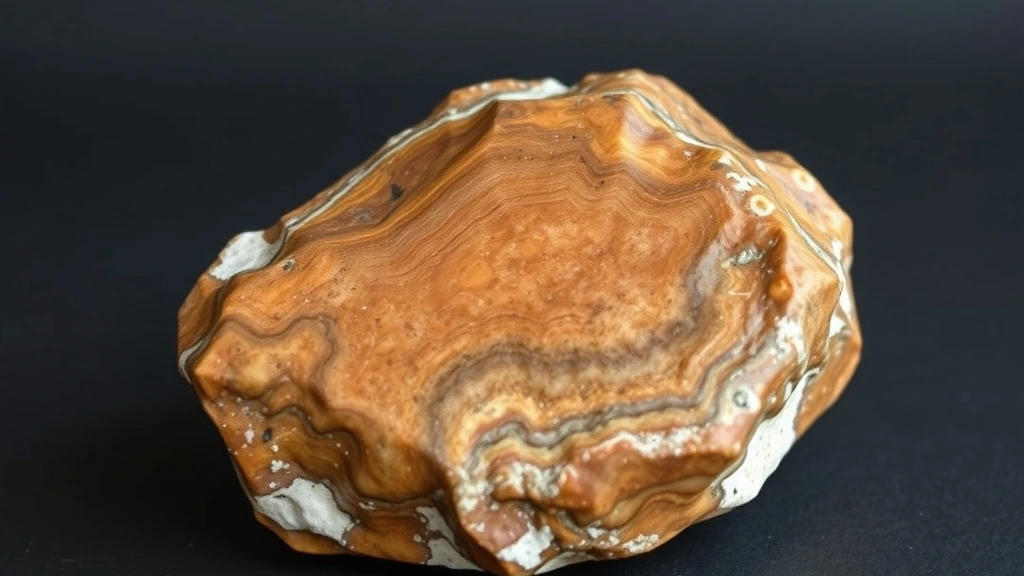
Spider Web Jasper belongs to the chalcedony family, an aggregate of microcrystalline SiO₂ that forms within the trigonal crystal system of quartz. Though commonly called a “jasper,” it is not a true mineral but a cryptocrystalline rock composed of intergrown quartz fibers and iron‑oxide inclusions that create its characteristic web pattern. This material crystallizes in the same lattice as quartz, yet its fine‑grained texture results from rapid silica precipitation in volcanic or sedimentary environments, often filling fissures and cavities.
What is Spider Web Jasper? Geological Overview & Definition
Spider Web Jasper is a cryptocrystalline aggregate of silica, where individual quartz crystals are too small to be seen without magnification. The distinctive dark veins arise from iron‑oxide or manganese oxides that replace silica in localized zones, producing the spider‑like network prized by collectors.
In geological terms, the stone is classified as a jasper, a subtype of chalcedony distinguished by its opaque body color and patterned inclusions. It forms in hydrothermal veins, alluvial deposits, or weathered volcanic tuffs, where silica‑rich fluids cement fine particles and trap mineral impurities that later manifest as the webbed design.
Spider Web Jasper Chemical Composition & Crystallographic Properties
The bulk composition is essentially SiO₂, the same as quartz, but the material lacks a single, uniform stoichiometric formula because it is an aggregate of countless micro‑crystals. Its trigonal crystal symmetry mirrors that of macro‑crystalline quartz, with each quartz fiber aligned along the c‑axis of the lattice.
Cation substitution occurs when trace amounts of Fe³⁺, Mn²⁺, or Ti⁴⁺ replace Si⁴⁺ within the silica framework, generating the dark chromophore centers that outline the web pattern. These substitutions also influence the stone’s slight variations in refractive index and cause subtle pleochroic effects under polarized light.
Spider Web Jasper is chemically stable under most conditions but can be etched by strong acids, which dissolve the silica matrix and release the embedded metal oxides. Thermal treatment above 600 °C may cause partial devitrification, converting some amorphous silica to micro‑crystalline quartz and altering the visual contrast of the webbing.
Overall, the stone’s physical and optical properties are governed by its microcrystalline quartz lattice, the distribution of oxide inclusions, and the interplay of trace elements that together produce its unique aesthetic and metaphysical reputation.
| Property | Specification |
|---|---|
| Mineral Group | Natural Mineral / Crystal |
| Chemical Formula | SiO₂ |
| Mohs Hardness | 6.5 – 7.0 |
| Crystal System | Trigonal |
| Color & Optical Properties | Natural Spider Web Jasper color spectrum and optical dispersion |
| Primary Mining Localities | Global primary localities |
| Water & Chemical Resistance | High (Safe for gentle water washing) |
| Chakra Alignment (Traditional) | Throat Chakra (Vishuddha) |
| Zodiac Affinity (Traditional) | Gemini, Virgo |
| Symbolic Meaning (Traditional) | Clear communication, truth and serenity |
Spider Web Jasper Varieties & Color Spectrum
Spider Web Jasper displays distinct mineralogical characteristics across its geological varieties and structural habits. Gemologists evaluate these natural varieties based on crystal habit, trace chromophore concentrations, and visual luster.
Primary Natural Spider Web Jasper
The benchmark natural variety exhibiting diagnostic color saturation and classic crystallographic symmetry.
Distinct Geological Morphs of Spider Web Jasper
Secondary regional and structural varieties formed under localized geological temperature and pressure conditions.
Classic Spider Web Jasper
This variety displays a silvery-white matrix with fine, translucent web-like veins of darker quartz. The veins are formed by silica-rich fluid infiltration during late-stage pegmatite crystallization. The result is a striking contrast that resembles a delicate cobweb. It is prized for its clarity and is relatively common in the United States and Brazil.
Black Spider Web Jasper
Black Spider Web Jasper is characterized by a deep black background punctuated by bright, white or gray spider‑web patterns. The black coloration arises from iron oxide inclusions within the quartz matrix. These inclusions give the stone a dramatic, almost mystical appearance. It is rarer than its classic counterpart, often sourced from the high‑grade deposits of the United States.
Red Spider Web Jasper
In Red Spider Web Jasper, the web veins are tinted reddish-brown due to hematite or goethite inclusions. The background is a lighter, almost creamy quartz, creating a subtle, warm contrast. This variety is less common and is frequently found in the Brazilian and South African quartz deposits. Its gentle hue makes it popular for ornamental carvings.
Green Spider Web Jasper
Green Spider Web Jasper incorporates chlorite or epidote within the web veins, giving a faint green tint to the otherwise silvery matrix. The green veins are usually thin and delicate, providing a subtle, nature‑inspired aesthetic. This variety is relatively rare and is mainly mined in South Africa and India. Its unique coloration appeals to collectors seeking a more subdued palette.
Blue Spider Web Jasper
Blue Spider Web Jasper features blue‑tinged veins that are typically attributed to trace copper ions or the presence of fine clay mineral inclusions within the quartz matrix, rather than actual turquoise mineral inclusions. The background remains a clear quartz, making the blue veins appear almost ethereal. This variety is extremely rare and is typically sourced from South African pegmatites. Its scarcity drives high demand among gemstone enthusiasts.
Yellow Spider Web Jasper
Yellow Spider Web Jasper displays yellowish veins formed by titanium or manganese inclusions. The overall stone is a light quartz, creating a gentle, sunlit effect. This variety is uncommon, with most specimens originating from Brazil and India. Its warm tones are favored for decorative jewelry.
Where is Spider Web Jasper Found? Geological Mining & Extraction
Spider Web Jasper typically forms in silica‑rich pegmatite veins that develop during the late stages of granite crystallization. The quartz crystals grow in a trigonal lattice and incorporate fluid‑filled cavities that later become the web‑like inclusions. Major mining regions include the United States (Colorado, Arizona), Brazil (Minas Gerais), South Africa (Gauteng), and India (Karnataka), where extensive pegmatite bodies provide abundant deposits.
Extraction methods involve hand‑mining and small‑scale drilling to preserve the delicate web patterns. Once quarried, the stones are carefully sorted by color and vein quality, then cut and polished to enhance the natural spider‑web effect. The industry emphasizes sustainable practices to minimize environmental impact while maintaining the gemstone’s aesthetic integrity.
Historical Significance & Cultural Lore of Spider Web Jasper
Across ancient lapidary traditions, Spider Web Jasper was valued for its symbolic representation of clarity and communication. In Greco‑Roman culture, the stone was believed to aid in speech and was sometimes used in ceremonial jewelry. Egyptian artisans incorporated it into amulets, interpreting the web patterns as protective sigils against deceit.
In Vedic lore, the stone was associated with the Vishuddha (Throat) Chakra, promoting truth and serenity. Chinese lapidary traditions historically valued jasper for its durability and earthy tones in decorative carvings, but specific references to the ‘Spider Web’ variety in Han dynasty texts are not documented. These historical uses underscore the gemstone’s enduring cultural resonance across diverse civilizations.
Modern Uses & Jewelry Applications of Spider Web Jasper
Lapidaries primarily cut Spider Web Jasper into cabochons to showcase its distinctive web-like inclusions, as faceting would obscure the delicate silica patterns. The stone’s Mohs hardness of 6.5 – 7.0 allows for durable polishing, making it suitable for everyday jewelry pieces like pendants and rings. Artisans often select specimens with high-contrast webs to maximize visual impact in ornamental carvings and decorative objects.
- Cabochon Cutting: Polished into smooth, domed shapes to highlight the natural web patterns without disrupting the surface.
- Pendants & Rings: Popular for statement jewelry where the intricate internal structure serves as the focal point.
- Ornamental Carving: Used in small-scale carvings and decorative tiles where the stone’s earthy tones complement architectural designs.
- Tumbling Stones: Frequently tumbled for smooth, polished collectibles that reveal the webbing on all sides.
Metaphysical Properties & Traditional Meaning of Spider Web Jasper
According to historical traditions and metaphysical lore, Spider Web Jasper is revered for its ability to foster clear communication and emotional balance. Ancient Mediterranean and Vedic lapidary practices often associated siliceous stones with mental clarity and the articulation of truth. The intricate web patterns are symbolically linked to the interconnectedness of thoughts and the structure of honest expression.
In modern spiritual contexts, this stone is believed to promote serenity and help individuals navigate complex social interactions with grace. It is often used in meditation to quiet the mind and encourage truthful self-reflection. Practitioners suggest that holding the stone can aid in resolving communication conflicts and enhancing interpersonal harmony.
Which Chakra and Zodiac Signs Align with Spider Web Jasper?
Spider Web Jasper is canonically aligned with the Throat Chakra (Vishuddha), which governs communication, self-expression, and truth. This alignment stems from the stone’s association with clear verbal and non-verbal expression. The web-like patterns are seen as a visual metaphor for the complex networks of thought and language that this chakra manages.
Astrologically, this mineral resonates strongly with Gemini and Virgo. Gemini, an air sign, values intellectual exchange and social connectivity, which the stone’s communicative properties support. Virgo, an earth sign, seeks precision and order, finding resonance in the stone’s structured, web-like internal geometry.
How to Identify Real vs. Fake Spider Web Jasper
Artificial imitations of Spider Web Jasper often involve synthetic glass or dyed quartz designed to mimic the natural web patterns. These fakes may lack the subtle color variations and organic irregularities found in genuine specimens. Understanding the material’s physical properties is essential for distinguishing authentic jasper from manufactured replicas in the marketplace.
Practical At-Home Authenticity Tests
- Temperature Test (Thermal Feel): Genuine jasper feels cool to the touch initially and warms slowly, whereas plastic or glass imitations may feel warmer or change temperature more rapidly.
- Specific Gravity & Weight Test: Real Spider Web Jasper has a noticeable heft for its size; if it feels unusually light, it may be a lightweight synthetic substitute.
- Scratch & Hardness Test (Mohs Comparison): With a Mohs hardness of 6.5 – 7.0, the stone should not be easily scratched by a steel knife (Mohs 5.5), though it may scratch glass.
- Microscopic & Loupe Inspection (Internal Inclusions): Use a 10x loupe to examine the web patterns; natural inclusions appear organic and irregular, while fake patterns may look too uniform or contain tiny air bubbles typical of glass.
Spider Web Jasper Valuation Factors, Grading & Pricing
The market value of Spider Web Jasper hinges first on color saturation. Stones that display vivid, evenly distributed hues—especially the deep reds, oranges, and subtle greens that mimic a spider’s silk—command higher prices due to their visual vibrancy and perceived energetic luster. Second, crystal size and weight (grams) play a decisive role. Larger specimens or those weighing several grams are prized, and the distinction between raw, unpolished pieces and those that have undergone careful tumbling or hand‑polish affects pricing; a well‑polished surface enhances clarity without compromising the natural matrix inclusions that collectors seek. Finally, ethical sourcing and locality premium influence the market. Stones sourced from responsibly mined deposits, particularly those with documented provenance from renowned regions, attract a premium in both holistic and collector circles, reflecting growing demand for transparency and sustainable practices.
How to Clean and Care for Spider Web Jasper
To preserve the integrity of Spider Web Jasper, wash the stone gently with warm soapy water and a soft cloth. This method removes surface dust and oils while maintaining the crystal’s structural stability. After rinsing, pat the stone dry with a clean, lint‑free cloth and store it in a dry, low‑humidity environment to prevent moisture‑induced stress. Avoid ultrasonic cleaners, as the vibration can induce microfractures in the delicate quartz lattice.
Cleansing and Recharging Spider Web Jasper (Energetic Care)
For energetic renewal, place the stone in a quiet space and allow it to absorb gentle moonlight for a few hours; the natural lunar energy can cleanse without exposing the crystal to heat. Alternatively, lay the Jasper on a selenite slab or a clean quartz surface, letting the subtle electromagnetic field of the charging slab gently re‑energize the stone’s vibrational frequency. Herbal smudging with sage or cedar can also be employed, ensuring that the smoke does not linger on the crystal surface for extended periods. These dry, low‑energy practices respect the mineral’s lattice structure while supporting its metaphysical properties.
Frequently Asked Questions About Spider Web Jasper
Spider Web Jasper displays distinct mineralogical characteristics across its geological varieties and structural habits. Gemologists evaluate these natural varieties based on crystal habit, trace chromophore concentrations, and visual luster.
Primary Natural Spider Web Jasper
The benchmark natural variety exhibiting diagnostic color saturation and classic crystallographic symmetry.
Distinct Geological Morphs of Spider Web Jasper
Secondary regional and structural varieties formed under localized geological temperature and pressure conditions.
Is Spider Web Jasper safe to wear in the shower?
Yes, it is safe for gentle water exposure. The stone possesses high water resistance, making it suitable for brief contact with shower water or rain. However, prolonged submersion or exposure to harsh chemicals should be avoided to preserve the integrity of the silica matrix and its surface luster.
How should I clean my Spider Web Jasper jewelry?
Use warm soapy water and a soft cloth. Gently wipe the surface to remove oils and dirt without scratching the delicate inclusions. Avoid ultrasonic cleaners entirely, as the vibrations can cause structural fractures or dislodge the fine web-like patterns within the stone.
What is the Mohs hardness of Spider Web Jasper?
It ranges from 6.5 to 7.0 on the Mohs scale. This indicates a durable material that resists scratches from most everyday objects. Its composition as cryptocrystalline quartz ensures it maintains its physical structure well under normal wear conditions.
Which zodiac signs are aligned with Spider Web Jasper?
Gemini and Virgo are the primary aligned signs. These earth and air signs resonate with the stone’s energy of clarity and structured communication. Wearing this gemstone is believed to enhance the natural traits of truthfulness and mental organization for these individuals.
Which chakra does Spider Web Jasper activate?
It primarily activates the Throat Chakra (Vishuddha). This energy center governs self-expression, communication, and the ability to speak one’s truth. The stone’s serene vibration supports clear verbal articulation and helps dissolve blockages related to honest expression.
What is the chemical composition of Spider Web Jasper?
The primary formula is SiO₂, or silicon dioxide. This identifies it as a variety of chalcedony, a microcrystalline form of quartz. The distinctive web patterns are formed by iron oxide inclusions that permeate the translucent quartz matrix during geological formation.
Can Spider Web Jasper be used in ultrasonic cleaners?
No, you must avoid ultrasonic cleaning devices. The high-frequency vibrations can induce micro-fractures in the stone’s internal structure. Instead, rely on manual cleaning methods using mild soap and water to safely maintain its appearance and durability.
What makes the web pattern in this jasper unique?
It features intricate, thread-like inclusions resembling spider webs. These patterns are created by the interplay of chalcedony and hematite or other iron-rich minerals. The unique geometry of each piece makes no two stones exactly alike, adding to their lapidary appeal.