
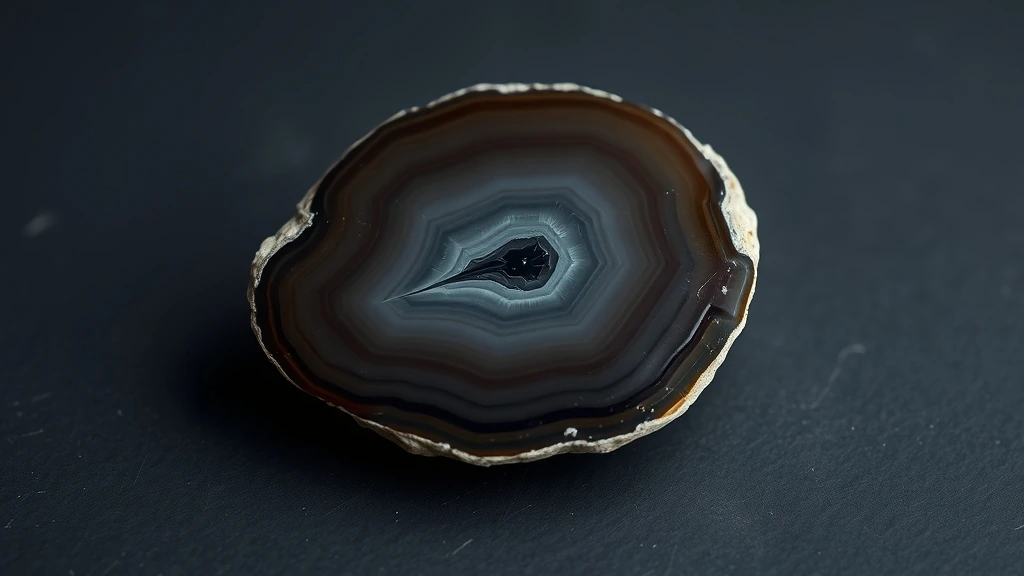
Striped agate belongs to the silicate family, specifically the chalcedony subgroup of cryptocrystalline quartz. Formed within silica‑rich cavities of volcanic or sedimentary rocks, it crystallizes as fibrous aggregates that interlace to produce its characteristic banding. The stone’s fibrous texture and fine grain size give it an opaque to slightly translucent luster, and its refractive index varies modestly with trace element content.
What is Striped Agate? Geological Overview & Definition
Striped agate is a type of chalcedony, a cryptocrystalline form of quartz that develops in fibrous aggregates. The stone’s defining feature is its concentric or parallel bands, created by successive layers of silica deposition during diagenesis. These bands often contain trace elements such as iron, manganese, or titanium, which impart the vibrant colors seen in natural specimens. Across geological settings, striped agate is typically found in volcanic tuff, basalt, or sedimentary limestone cavities where silica-rich fluids have migrated.
Striped Agate Chemical Composition & Crystallographic Properties
The crystal system of striped agate is trigonal, manifested in microcrystalline or cryptocrystalline fibrous aggregates. Each fiber consists of a hexagonal lattice of SiO₂ tetrahedra, but the overall aggregate lacks long‑range order, giving the stone its characteristic cryptocrystalline appearance. Cation substitution is minimal; however, trace Fe²⁺/Fe³⁺, Mn²⁺, and Ti⁴⁺ can occupy tetrahedral sites, forming chromophore centers that produce the stone’s band colors.
Striped agate is chemically inert to most acids, though prolonged exposure to strong acids can etch the surface, revealing the underlying fibrous structure. Thermal analysis shows that the material is stable up to about 600 °C, beyond which the fibrous quartz begins to recrystallize into coarser quartz grains. The stone’s refractive index ranges from 1.544 to 1.553, reflecting its uniform silica composition and the subtle variations introduced by trace element inclusions.
| Property | Specification |
|---|---|
| Mineral Group | Silicates (Chalcedony / Cryptocrystalline Quartz) |
| Chemical Formula | SiO₂ (Silicon Dioxide) |
| Mohs Hardness | 6.5 – 7.0 |
| Crystal System | Trigonal (Microcrystalline / Cryptocrystalline fibrous aggregates) |
| Specific Gravity (Density) | 2.60 – 2.65 |
| Refractive Index | 1.544 – 1.553 |
| Color & Optical Properties | Natural Striped Agate color spectrum and optical dispersion |
| Primary Mining Localities | Brazil, Uruguay, Turkey, India, Madagascar |
| Water & Chemical Resistance | High (Safe for gentle warm water and mild soap; avoid harsh acids and chlorine) |
| Chakra Alignment (Traditional) | Root Chakra and Sacral Chakra |
| Zodiac Affinity (Traditional) | Gemini, Virgo, Taurus |
| Symbolic Meaning (Traditional) | Grounding, emotional balance, physical endurance, and protection |
Striped Agate Varieties & Color Spectrum
Striped Agate displays distinct mineralogical characteristics across its geological varieties and structural habits. Gemologists evaluate these natural varieties based on crystal habit, trace chromophore concentrations, and visual luster.
Primary Natural Striped Agate
The benchmark natural variety exhibiting diagnostic color saturation and classic crystallographic symmetry.
Distinct Geological Morphs of Striped Agate
Secondary regional and structural varieties formed under localized geological temperature and pressure conditions.
Classic Striped Agate
Classic Striped Agate displays alternating bands of white, gray, and black formed by silica-rich fluids depositing in fissures of volcanic or metamorphic host rocks. The bands are typically parallel and uniform, giving the stone a clean, rhythmic appearance. This variety is common in the United States, Brazil, and the Philippines, making it widely available yet still prized for its classic aesthetic.
Rainbow Agate
Rainbow Agate incorporates a spectrum of colors—red, orange, yellow, green, blue, and purple—in concentric or parallel bands. The vivid hues result from trace metal ions such as iron, manganese, and titanium interspersed within the silica matrix. Though more expensive than plain striped agate, it remains a popular choice for jewelry in Mexico, Brazil, and the United States.
Black and White Agate (Banded Agate)
This variety features stark black and white bands that often form a striking contrast. The black bands are typically rich in iron oxides, while the white bands are pure quartz. Banded agate is especially abundant in the United States (particularly Arkansas) and Brazil, where it is harvested from volcanic ash deposits.
Selenite Agate
Selenite Agate is distinguished by translucent, milky bands that give it a glassy appearance. The translucency arises from finely distributed microcrystalline quartz. This type is relatively rare, found mainly in the United States (Arizona) and the Philippines, and is sought after for its ethereal glow.
Green Agate
Green Agate contains green bands formed by manganese or iron oxides within the quartz matrix. The green can range from pale sage to deep emerald tones, often creating a subtle, natural pattern. It is commonly mined in Brazil, the United States, and the Philippines, where it is used in ornamental carvings and jewelry.
Red Agate
Red Agate showcases reddish bands produced by iron oxide inclusions. The color intensity varies from light pink to deep crimson, giving the stone a warm, earthy feel. This variety is frequently found in Brazil, the United States, and the Philippines, and is prized for its vibrant, natural coloration.
Where is Striped Agate Found? Geological Mining & Extraction
Striped agate typically forms in silica-rich pegmatites and volcanic ash beds where hydrothermal fluids deposit quartz in fissures and cavities. The resulting fibrous aggregates create the characteristic banding. Major mining regions include the United States (Arkansas, Arizona, Nevada), Brazil (Rio de Janeiro, Minas Gerais), and the Philippines (Mindanao), where open-pit and underground operations extract large quantities of both raw and finished stones.
Extraction involves crushing the host rock, sieving the quartz fragments, and hand-picking the banded specimens. In some regions, artisanal miners use simple tools, while larger operations employ mechanical crushers and flotation techniques to separate agate from surrounding material. The global supply chain then transports the polished stones to markets in Europe, Asia, and North America.
Historical Significance & Cultural Lore of Striped Agate
Across ancient lapidary traditions, striped agate was valued for its perceived protective qualities. In Greco-Roman culture, it was believed to ward off misfortune and enhance courage, often incorporated into amulets and jewelry worn by soldiers and athletes. Egyptian artisans also utilized striped agate in funerary objects, associating its layered bands with the cyclical nature of life and rebirth.
In Chinese lore, striped agate was linked to the Root Chakra, symbolizing stability and grounding, and was used in talismans to promote emotional balance. Vedic texts reference agate as a stone of endurance, recommending its use to strengthen physical resilience. These diverse cultural narratives underscore the stone’s enduring appeal across civilizations.
Modern Uses & Jewelry Applications of Striped Agate
Striped agate serves as a versatile material in contemporary lapidary arts, prized for its distinct banding patterns and durable physical properties. Lapidaries primarily cut this stone into cabochons to showcase its smooth, polished surface and vibrant color zonation. Its moderate hardness allows for intricate ornamental carving, making it ideal for intaglio seals and decorative architectural elements.
- Cabochon Cutting: The most common form, emphasizing the stone’s natural banding and translucency without faceting.
- Faceted Jewelry: Occasionally faceted for smaller pieces, though the lack of brilliance limits this application compared to quartz varieties.
- Ornamental Carving: Used for cameos, intaglios, and architectural inlays due to its resistance to weathering and chemical stability.
Metaphysical Properties & Traditional Meaning of Striped Agate
According to historical traditions and metaphysical lore, striped agate has long been revered for its capacity to promote emotional balance and inner stability. Ancient Mediterranean cultures often associated the stone with protection, believing its layered structure mirrored the complexity of human experience. In Vedic traditions, similar banded stones were utilized in meditation practices to anchor the mind and foster clarity during spiritual exercises.
The stone is frequently described as a powerful tool for grounding, helping individuals maintain composure during periods of stress or transition. Practitioners suggest that the rhythmic bands of color encourage a sense of order and harmony within the psyche. This symbolic resonance extends to physical endurance, where the mineral is thought to bolster stamina and resilience in the face of adversity.
Which Chakra and Zodiac Signs Align with Striped Agate?
In esoteric crystal healing systems, striped agate is primarily aligned with the Root Chakra and the Sacral Chakra. The Root Chakra connection stems from the stone’s earthy tones and grounding properties, which are believed to stabilize the body’s energy field. Meanwhile, its association with the Sacral Chakra reflects its influence on creativity, emotional flow, and the management of primal instincts.
Astrologically, this gemstone is canonically linked to the signs of Gemini, Virgo, and Taurus. For Geminis, the stone is thought to provide the necessary focus to complement their dual nature. Virgos may find its grounding qualities helpful for reducing anxiety, while Taurus appreciates its reinforcement of stability and physical vitality. These alignments highlight the stone’s role in balancing mental agility with earthy resilience.
How to Identify Real vs. Fake Striped Agate
Distinguishing natural striped agate from artificial imitations requires attention to subtle visual and physical cues. Common fakes include synthetic glass replicas, which often appear too perfect and lack natural inclusions. Additionally, dyed chalcedony or plastic composites may mimic the banding patterns but fail to exhibit the consistent hardness and thermal properties of genuine silicate minerals.
Practical At-Home Authenticity Tests
- Temperature Test (Thermal Feel): Genuine agate feels cool to the touch initially and warms up slowly when held in the hand. Glass imitations tend to warm up more quickly or feel uniformly warm due to their different thermal conductivity.
- Specific Gravity & Weight Test: Real agate has a density of 2.60 – 2.65, making it feel heavier than plastic or lightweight glass of the same size. A genuine stone will have a substantial, dense heft that is difficult to replicate accurately in synthetic materials.
- Scratch & Hardness Test (Mohs Comparison): With a Mohs hardness of 6.5 – 7.0, natural agate will not be scratched by a steel knife or a standard coin. If the surface shows visible scratches from these tools, the material is likely a softer plastic or glass imitation.
- Microscopic & Loupe Inspection (Internal Inclusions): Under a 10x loupe, natural agate often displays fine fibrous structures or tiny bubbles that are irregularly shaped. Synthetic glass may contain perfectly spherical bubbles or lack any internal texture, while dyed stones might show color concentrated in surface fractures rather than throughout the banding.
Striped Agate Valuation Factors, Grading & Pricing
Color Saturation drives the top tier of striped agate prices. Stones that display vivid, evenly distributed bands of red, brown, or orange command premium rates because the visual vibrancy signals minimal dyeing and high natural energy. Collectors also prize a lively, glassy luster that catches light without artificial enhancement.
Crystal Size & Weight (Grams) is the second pricing pillar. Larger, heavier pieces—measured in grams rather than carats—offer more surface area for the characteristic striping, and solid, well‑polished surfaces increase market value. Natural matrix inclusions that are subtle rather than disruptive are viewed as authentic character, while heavy fractures lower the price.
Ethical Sourcing & Locality Premium influences both holistic and collector markets. Specimens sourced from recognized agate belts in Brazil, Uruguay, or India carry a locality premium when provenance is documented, reflecting responsible mining practices. Buyers increasingly reward stones that are mined without child labor or environmental harm, adding a moral dimension to the price.
How to Clean and Care for Striped Agate
Warm soapy water is ideal for solid striped agate; gently immerse the stone in lukewarm water with a mild, pH‑neutral soap, then rinse with clean water and pat dry with a soft microfiber cloth. Avoid ultrasonic cleaners unless the piece is confirmed to be untreated and free of fractures, as vibration can damage delicate internal banding. Store the cleaned agate in a low‑humidity pouch or drawer, away from acids, chlorine, and harsh chemicals that could etch the surface.
Cleansing and Recharging Striped Agate (Energetic Care)
For energetic maintenance, place the stone on a clean selenite slab for a few hours, allowing the selenite’s neutral field to absorb lingering negative impressions without exposing the mineral to heat. Alternatively, a brief session of herbal smudging with sage or cedar can clear subtle energetic residue; hold the agate at a safe distance to prevent ash contact.
Moonlight exposure offers a gentle, non‑thermal recharge; set the agate on a windowsill or outdoor tray during a clear night, allowing the soft lunar glow to revitalize its grounding properties. Limit exposure to a single night per week to avoid dew accumulation, then wipe the surface dry with a dry cloth before returning the stone to its display case.
Frequently Asked Questions About Striped Agate
Striped Agate displays distinct mineralogical characteristics across its geological varieties and structural habits. Gemologists evaluate these natural varieties based on crystal habit, trace chromophore concentrations, and visual luster.
Primary Natural Striped Agate
The benchmark natural variety exhibiting diagnostic color saturation and classic crystallographic symmetry.
Distinct Geological Morphs of Striped Agate
Secondary regional and structural varieties formed under localized geological temperature and pressure conditions.
What is the chemical composition of striped agate?
Striped agate is composed of silicon dioxide (SiO₂). This crystalline form of quartz is a microcrystalline aggregate, giving the stone its characteristic banded appearance. The uniform composition ensures consistent hardness and durability across specimens.
How durable is striped agate for everyday wear?
Striped agate has a Mohs hardness of 6.5–7.0, making it suitable for daily use. Its moderate hardness resists scratches from common metals and jewelry components, while its density (2.60–2.65) provides a solid feel. Proper care prevents chipping at edges or points.
Can I wear striped agate in the shower or while swimming?
Striped agate is water‑resistant and safe for gentle warm water and mild soap. Avoid exposure to harsh acids, chlorine, or prolonged soaking, as these can degrade surface polish. A quick rinse after showering keeps the stone pristine.
What is the best way to clean a striped agate piece?
Warm soapy water is ideal for cleaning solid agates. Gently wipe with a soft cloth, then rinse and dry. Avoid ultrasonic cleaners if the specimen is dyed, heavily fractured, or treated, as vibrations can damage delicate inclusions or surface patterns.
Are there any special care instructions for dyed or treated striped agate?
Avoid ultrasonic cleaning and harsh chemicals on dyed or treated agates. These treatments can flake or fade, so use a mild soap solution and a soft brush for dust removal. Dry the stone thoroughly to prevent moisture buildup in fractures.
Which zodiac signs are associated with striped agate?
Striped agate aligns with Gemini, Virgo, and Taurus. In astrological lore, these signs are believed to resonate with the stone’s grounding and emotional-balancing properties, enhancing personal growth and stability.
Which chakras does striped agate influence?
Striped agate is linked to the Root Chakra and the Sacral Chakra. These energy centers benefit from the stone’s grounding and emotional‑balance qualities, fostering physical endurance and protective calmness in daily life.
Does striped agate have any metaphysical benefits?
Striped agate is reputed to promote grounding, emotional balance, physical endurance, and protection. Across ancient lapidary traditions, it is used to stabilize energy flow, support decision‑making, and shield against negative influences, making it a popular choice for both adornment and meditation.