
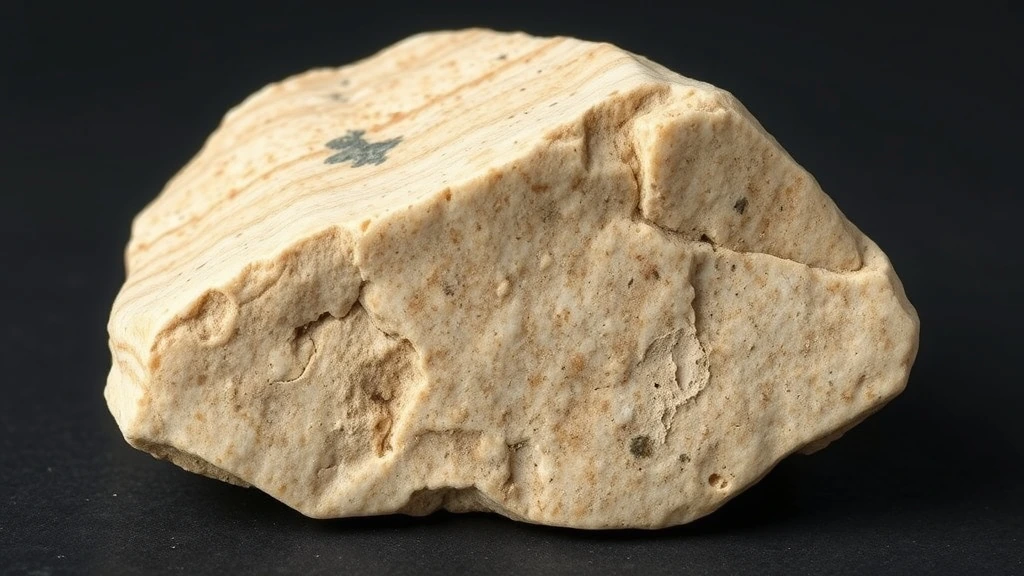
Travertine forms when mineral‑rich thermal waters precipitate calcium carbonate at or near the Earth’s surface, creating porous, banded deposits that are prized in architecture and jewelry. As a member of the natural mineral/ crystal group, it is an aggregate of calcite crystals (trigonal) and aragonite crystals (orthorhombic), each retaining the fundamental chemistry of CaCO₃ while differing in lattice symmetry. Its formation reflects rapid cooling and degassing of CO₂‑laden waters, producing the characteristic voids and flow‑band patterns that define the stone.
What is Travertine? Geological Overview & Definition
Travertine is a sedimentary carbonate rock that precipitates from supersaturated geothermal fluids, often at hot springs, geysers, or cave systems. The rapid loss of carbon dioxide forces calcium carbonate to crystallize, creating dense, layered masses that can be cut and polished for ornamental use.
Unlike pure mineral specimens, travertine is an aggregate of microscopic calcite and aragonite crystals bound by a matrix of mineral cement and occasional silica or iron oxides, which impart its diverse color range. Its porosity and banding record fluctuations in water chemistry, temperature, and flow rate during deposition.
Travertine Chemical Composition & Crystallographic Properties
The primary chemical constituent of travertine is calcium carbonate (CaCO₃), existing as the mineral calcite with a trigonal crystal system and, in minor amounts, aragonite with an orthorhombic system. Both polymorphs share the same stoichiometry but differ in lattice parameters, producing distinct optical and mechanical behaviors.
Calcite crystals in travertine adopt a rhombohedral lattice where carbonate groups orient parallel to the c‑axis, while aragonite forms elongated orthorhombic prisms that intergrow with calcite, enhancing the rock’s structural complexity. Trace cation substitution—commonly magnesium, iron, or manganese—can slightly modify lattice dimensions and influence refractive index values between 1.486 and 1.658.
Travertine reacts readily with dilute acids; the effervescence of CO₂ bubbles confirms the presence of carbonate minerals and distinguishes it from silicate stones. Color variations arise from chromophore centers such as iron oxides (yellow‑brown) or organic matter (tan), rather than from intrinsic crystal coloration.
Thermally, travertine exhibits modest expansion; heating above 400 °C can induce calcite‑to‑aragonite transformation or decompose the carbonate to calcium oxide and CO₂. This sensitivity underpins its use in geothermal studies, where temperature gradients are recorded in the mineralogical fabric of the deposit.
| Property | Specification |
|---|---|
| Mineral Group | Natural Mineral / Crystal |
| Chemical Formula | CaCO₃ (Calcite/Aragonite) |
| Mohs Hardness | 3.0 – 4.0 |
| Crystal System | Trigonal (Calcite) / Orthorhombic (Aragonite) |
| Specific Gravity (Density) | 2.65 – 2.71 |
| Refractive Index | 1.486 – 1.658 |
| Color & Optical Properties | Natural Travertine color spectrum and optical dispersion |
| Primary Mining Localities | Global primary localities |
| Water & Chemical Resistance | Sensitive (Avoid prolonged water soaking) |
| Chakra Alignment (Traditional) | Root Chakra, Sacral Chakra |
| Zodiac Affinity (Traditional) | Taurus, Virgo, Capricorn |
| Symbolic Meaning (Traditional) | Grounding, stability, and connection to the earth |
Travertine Varieties & Color Spectrum
Travertine exhibits a diverse range of natural colorations driven by mineral impurities during precipitation. The most common hues include cream, beige, and light brown, resulting from iron oxide contamination. Darker varieties often feature distinct banding patterns created by varying sediment flow rates. These geological signatures provide unique aesthetic identifiers for gemological identification.
Cream and Beige Travertine
This variety forms in low-turbulence spring environments where calcite precipitates slowly and uniformly. The resulting stone displays a soft, matte finish with subtle porosity that absorbs light gently. It is the most abundant trade variety, widely used in architectural applications. Its neutral palette makes it a versatile base for artistic carving.
Rust and Red Travertine
Rich red tones indicate significant hematite inclusion within the calcium carbonate matrix. These deposits often form near geothermal vents where iron-rich waters interact with limestone. The color intensity varies based on the concentration of ferric compounds. This variety is rarer than standard cream types and commands higher market value.
Black and Grey Travertine
Dark varieties result from high concentrations of organic matter and manganese oxides trapped during formation. The stone typically exhibits a dense, compact structure with minimal visible pore space. This density enhances its durability compared to lighter, more porous counterparts. It is frequently mistaken for limestone by untrained observers.
Banded and Zebra Travertine
This distinctive variety features alternating light and dark stripes formed by cyclical changes in water chemistry. The banded texture arises from seasonal variations in sediment load and temperature. Each band represents a specific period of geological deposition. These patterns create a striking visual contrast that appeals to collectors.
White Travertine
Pure white specimens indicate exceptionally clean water sources with minimal mineral impurities. The calcite structure remains highly crystalline, offering a bright, reflective surface. This rarity makes it a prized material for high-end decorative projects. Its pristine appearance often requires careful handling to prevent staining.
Where is Travertine Found? Geological Mining & Extraction
Travertine deposits primarily form in karst landscapes where groundwater emerges at the surface. These environments include hot springs, riverbanks, and cave entrances with active calcite precipitation. The host rock is typically limestone, which dissolves and reprecipitates under specific pressure conditions. Understanding this geological context is crucial for identifying viable mining sites.
Major extraction regions include Turkey, Italy, and the United States, particularly in Arizona and California. Turkish quarries produce some of the world’s most aesthetically pleasing banded varieties. Italian deposits, such as those in Tivoli, have been mined for millennia. Modern extraction techniques focus on minimizing waste while preserving the integrity of large slabs.
Historical Significance & Cultural Lore of Travertine
Ancient civilizations valued travertine for its workability and distinctive aesthetic qualities. The Romans extensively used it for monumental architecture, including the Colosseum and the Pantheon. Its calcite composition allowed for intricate carving while maintaining structural stability. Archaeological evidence confirms its widespread use in public buildings and temples.
Cultural lore often associates travertine with grounding and stability due to its earthy origins. Many traditions view it as a stone that connects the user to the physical world. Its porous nature symbolizes absorption and healing in various esoteric practices. This enduring legacy continues to influence its modern appreciation in both design and metaphysical contexts.
Modern Uses & Jewelry Applications of Travletine
Travertine is frequently cut into cabochons or faceted stones for rings, pendants, and earrings, capitalizing on its porous texture and warm hues. Lapidary artisans shape the stone into smooth, rounded forms that highlight natural banding, while skilled carvers produce ornamental plaques and architectural accents. Its durability at a Mohs hardness of 3‑4 makes it suitable for everyday wear, though care is needed to avoid excessive scratching.
- Cabochon pendants showcasing layered veining
- Faceted rings that emphasize light play within the stone
- Ornamental carving for wall panels, columns, and garden statues
- Inlay work in furniture and decorative objects
Metaphysical Uses & Origins of Travertine
Practitioners employ travertine in meditation and grounding rituals, believing its earthy composition fosters stability and a deep connection to the planet. The stone is often placed on altars or held during mindfulness exercises to reinforce grounding energy, while its historic use in temples and public buildings underscores a longstanding architectural symbolism of permanence.
Which Chakra and Zodiac Signs Align with Travertine?
Travertine resonates most strongly with the Root Chakra, supporting feelings of safety, security, and physical vitality. When activated, this chakra encourages a solid foundation for personal growth, mirroring the stone’s geological formation from mineral-rich spring waters.
In astrology, travertine aligns with Taurus, Virgo, and Capricorn, earth signs that value practicality, perseverance, and material stability. The stone’s grounding properties complement the Sacral Chakra, enhancing creative flow and emotional balance for those born under these signs.
How to Identify Real vs. Fake Travertine
Artificial imitations of travertine include dyed limestone, synthetic glass, and resin composites that mimic its characteristic pores and banding. These substitutes often lack the natural density range of 2.65‑2.71 g/cm³ and may feel uniformly smooth rather than subtly uneven. Recognizing genuine travertine requires a combination of visual inspection and tactile testing.
Practical At-Home Authenticity Tests
- Temperature Test (Thermal Feel): Real travertine absorbs heat slowly and feels cool to the touch, whereas glass or resin warms quickly in the hand.
- Specific Gravity & Weight Test: Compare the stone’s weight to a known sample; genuine travertine feels heavier than most synthetic look‑alikes of the same size.
- Scratch & Hardness Test (Mohs Comparison): Use a steel nail (hardness ~5.5); a real piece will resist scratching, while softer imitations will show visible marks.
- Microscopic & Loupe Inspection (Internal Inclusions): Examine under 10× magnification; authentic travertine reveals natural voids, mineral streaks, and occasional fossil fragments, whereas fakes appear uniformly patterned.
Travertine Valuation Factors, Grading & Pricing
Market value is primarily driven by Color Variations, ranging from creamy whites to deep umber tones. Natural texture and distinct aesthetic banding significantly enhance visual appeal for interior design applications. Consistent veining patterns often command premium pricing in high-end architectural projects.
Commercial grading heavily relies on Specimen Mass & Size, measured in kilograms for bulk ornamental blocks. Carving craftsmanship and structural block integrity determine suitability for intricate sculptural work. Uniform light diffusion through porous stone adds significant aesthetic value for lighting fixtures.
Geographical Origin & Authenticity play a critical role in establishing provenance and market trust. Verified sources from Turkey or Italy often fetch higher wholesale rates due to historical reputation. Current wellness market trends favor certified natural stones for therapeutic and decorative purposes.
How to Clean and Care for Travertine
Travertine is a porous, calcium-based stone that requires gentle maintenance to preserve its structural integrity. Wipe the surface briefly with a damp cloth to remove surface dust and minor residues. You must dry the stone immediately to prevent moisture from penetrating the porous matrix.
Avoid ultrasonic cleaners entirely, as high-frequency vibrations can cause structural fractures in the delicate calcite lattice. Do not use abrasive scrubbers or acidic cleaners, which will etch and dissolve the surface. Regular, gentle care ensures the stone maintains its natural texture and aesthetic longevity.
Cleansing and Recharging Travertine (Energetic Care)
For holistic energetic maintenance, employ dry methods that respect the stone’s physical sensitivity. Herbal smudging with sage or palo santo is an effective way to clear stagnant energy without introducing moisture. This traditional practice respects the mineral’s porous nature while addressing metaphysical cleansing goals.
Alternatively, place the specimen on a selenite charging slab or expose it to gentle moonlight overnight. These methods facilitate energetic replenishment without subjecting the crystal lattice to thermal stress or humidity. Avoid direct intense sunlight or heat sources, as extreme temperatures can compromise the structural stability of the stone.
Frequently Asked Questions About Travertine
Is travertine safe to wear in the shower?
No, travertine is water-sensitive and should not be exposed to prolonged moisture. As a porous calcium carbonate stone, it absorbs water readily, which can weaken its internal structure over time. Remove jewelry before showering or swimming to prevent permanent damage and discoloration.
How should I clean my travertine jewelry?
Use a dry microfiber cloth or a soft brush to remove dust and debris. Avoid ultrasonic cleaners and harsh chemicals, as they can cause structural fractures in the porous matrix. If necessary, wipe briefly with a damp cloth and dry immediately to prevent water spots.
What is the Mohs hardness of travertine?
Travertine has a Mohs hardness of 3.0 to 4.0, making it relatively soft. This places it below common gemstones like quartz, meaning it is susceptible to scratching from daily wear. Store it separately from harder minerals to preserve its surface integrity and aesthetic appeal.
Which zodiac signs are aligned with travertine?
Travertine is traditionally associated with Taurus, Virgo, and Capricorn. These earth signs resonate with the stone’s grounding properties and stability. Wearing travertine may enhance the natural connection to the earth that these zodiac signs already possess.
Which chakras does travertine activate?
Travertine primarily activates the Root Chakra and Sacral Chakra. It supports stability and connection to the earth, helping to anchor energy in the lower body. This alignment promotes a sense of security and emotional balance for the wearer.
Can I use ultrasonic cleaners on travertine?
No, you must avoid ultrasonic cleaners for travertine jewelry. The high-frequency vibrations can cause structural fractures within the porous stone, leading to irreversible damage. Instead, clean the piece gently by hand using a soft, dry cloth to maintain its structural integrity.
What is the chemical composition of travertine?
Travertine is composed of calcium carbonate, existing as calcite or aragonite. Its crystal system is trigonal for calcite and orthorhombic for aragonite. This composition gives it a specific refractive index range of 1.486 to 1.658, influencing its luster.
Is travertine durable enough for daily wear?
Travertine is moderately durable but requires careful handling due to its porosity. With a density of 2.65 to 2.71, it is stable but vulnerable to impact and moisture. Treat it as a delicate piece, removing it during physical activities or exposure to water.