
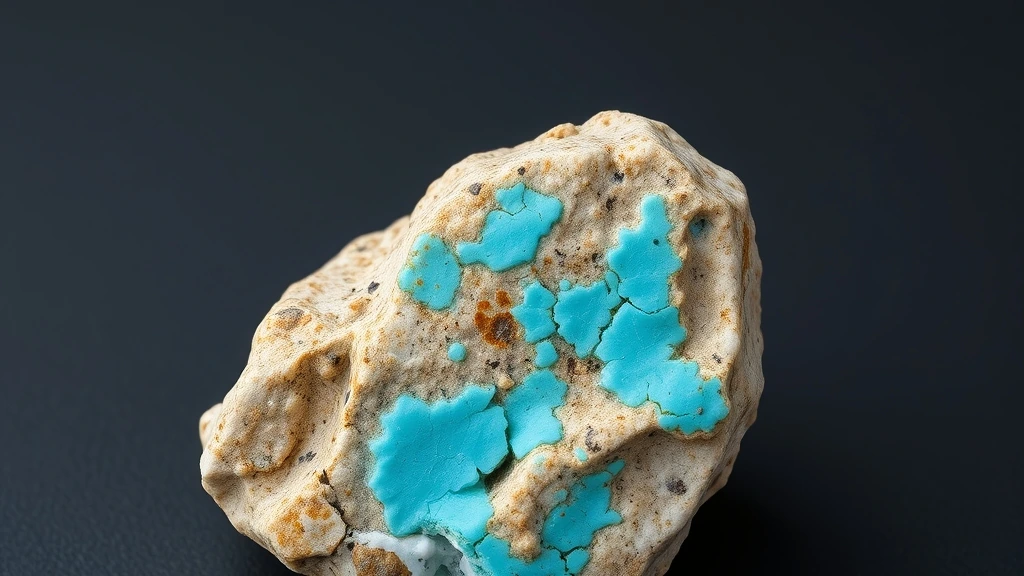
Quartz, a tectosilicate of the trigonal (rhombohedral / trapezohedral) crystal system, forms the foundational matrix of this composite gemstone. As a member of the Quartz Group, its silicon‑oxygen framework creates a robust, interlocking lattice that readily incorporates mineral inclusions, allowing turquoise—typically a hydrated copper‑aluminum phosphate—to permeate fractures and surface veins. This geological partnership yields a stone prized for both its optical brilliance and its cultural symbolism across ancient lapidary traditions.
What is Turquoise On Quartz? Geological Overview & Definition
Turquoise on quartz refers to a natural aggregate where turquoise mineralization fills cavities, cracks, or surface veins within a quartz host, creating a visually striking juxtaposition of colors. The turquoise component is a hydrated copper‑aluminum phosphate, while the quartz matrix remains pure silicon dioxide (SiO₂), preserving its characteristic transparency and hardness.
Historically, this combination has been valued in Mesoamerican and Near Eastern jewelry, where artisans exploited the contrasting hues for ornamental pendants and inlays. Modern gem cutters often enhance the effect by polishing the quartz to a high luster, allowing the turquoise’s chromophoric copper ions to glow against the glassy backdrop. In comparative mineralogical collections, practitioners and geologists frequently study Crazy Lace Amethyst alongside this crystal to appreciate their subtle energetic and structural differences.
Turquoise On Quartz Chemical Composition & Crystallographic Properties
The quartz host crystallizes in the trigonal (rhombohedral / trapezohedral) system, with a continuous three‑dimensional SiO₄ tetrahedral network that defines its density of 2.65 g/cm³ and refractive index of 1.544–1.553. Its lattice parameters resist acid attack, though prolonged exposure to strong acids can gradually dissolve the surface. While the quartz host exhibits a trigonal lattice with a refractive index of 1.544–1.553, its optical clarity often serves as a striking contrast to the deeper, more complex hues found in minerals like Violan Blue Diopside.
Turquoise, the secondary phase, lacks a single stoichiometric formula in this composite; it appears as hydrated CuAl₆(PO₄)₄(OH)₈·4H₂O crystals that occupy interstitial spaces. The copper ions act as chromophore centers, absorbing specific wavelengths to produce the characteristic blue‑green hue, while the aluminum and phosphate framework stabilizes the structure.
Cation substitution is common: trace amounts of iron or zinc can replace copper, subtly shifting the color toward greener tones. Because turquoise is porous, it is sensitive to heat and dehydration, which can cause color fading or cracking if the stone is subjected to temperatures above 150 °C.
Thermally, the quartz matrix remains stable up to 573 °C, the α‑β quartz transition point, while the turquoise component begins to dehydrate around 200 °C, leading to a loss of structural water and potential alteration to paratacamite or other copper oxides. This divergent thermal behavior necessitates careful handling during cutting and setting to preserve both components.
| Property | Specification |
|---|---|
| Mineral Group | Silicates (Tectosilicates / Quartz Group) |
| Chemical Formula | SiO₂ (Silicon Dioxide) |
| Mohs Hardness | 7.0 |
| Crystal System | Trigonal (Rhombohedral / Trapezohedral) |
| Specific Gravity (Density) | 2.65 |
| Refractive Index | 1.544 – 1.553 |
| Color & Optical Properties | Natural Turquoise On Quartz color spectrum and optical dispersion |
| Primary Mining Localities | Brazil, Madagascar, USA (Arkansas), Swiss Alps |
| Water & Chemical Resistance | High (Fully resistant to water and moisture) |
| Chakra Alignment (Traditional) | All Chakras (Universal Harmonizer) |
| Zodiac Affinity (Traditional) | All Zodiac Signs (Especially Leo and Aries) |
| Symbolic Meaning (Traditional) | Master energy amplifier, clarity, purification, and focus |
Turquoise On Quartz Varieties & Color Spectrum
Turquoise On Quartz displays distinct mineralogical characteristics across its geological varieties and structural habits. Gemologists evaluate these natural varieties based on crystal habit, trace chromophore concentrations, and visual luster.
Primary Natural Turquoise On Quartz
The benchmark natural variety exhibiting diagnostic color saturation and classic crystallographic symmetry.
Distinct Geological Morphs of Turquoise On Quartz
Secondary regional and structural varieties formed under localized geological temperature and pressure conditions.
Classic Blue‑Green Quartz
This variety exhibits a deep turquoise hue with subtle green undertones, often caused by trace amounts of copper and iron. It forms in quartz veins where hydrothermal fluids deposit copper‑bearing minerals, creating a smooth, glassy luster. The stone is prized for its vivid color and moderate rarity, especially in high‑grade specimens from the American Southwest.
Pale Blue Quartz
Pale blue quartz shows a light, almost translucent turquoise tint, typically resulting from low copper concentrations. Its fine, fibrous inclusions of mica give a delicate sparkle, while the overall appearance remains subtle and elegant. This variety is relatively common in the United States but prized for its understated beauty.
Green‑Toned Turquoise Quartz
Green‑toned turquoise quartz blends turquoise with a noticeable green cast, produced by higher iron content. The stone often contains needle‑like iron oxides that create a subtle banded effect. Its rarity increases when the green is evenly distributed, making it a sought‑after choice for collectors.
Turquoise‑Red Quartz
A rare hybrid where turquoise meets a faint red hue, this variety arises from mixed copper and iron impurities. The resulting dual‑tone effect is striking, with occasional crystalline inclusions that enhance its visual complexity. Its scarcity in major mining regions makes it highly valuable.
Turquoise‑Black Quartz
Turquoise‑black quartz displays a dark, almost charcoal background with turquoise veins. The black matrix is due to high iron oxide content, while the turquoise veins are formed by copper‑rich fluids. This dramatic contrast is rare, especially in polished cabochon cuts.
Turquoise‑White Quartz
Turquoise‑white quartz combines a bright turquoise band with a white quartz matrix. The white inclusions of quartz crystals give a crystalline sparkle, while the turquoise band remains vivid. Though more common than some hybrids, high‑quality specimens are prized for their striking contrast.
Where is Turquoise On Quartz Found? Geological Mining & Extraction
Turquoise on quartz typically occurs in pegmatitic environments where quartz veins intersect copper‑rich hydrothermal systems. The mineralization is often associated with granite intrusions that provide the necessary heat and fluid pathways for copper deposition.
Major extraction sites include the Bureau of Land Management (BLM) lands in the American Southwest, particularly in Arizona and Nevada, and the Sierra Madre region of Mexico. These areas yield the most consistent turquoise‑infused quartz, with artisanal miners often extracting the stone from shallow vein pockets.
Historical Significance & Cultural Lore of Turquoise On Quartz
Across ancient lapidary traditions, turquoise‑infused quartz was revered for its protective and healing properties. In Egyptian tombs, the stone appeared in amulets and jewelry, symbolizing divine protection and eternal life. Chinese artisans incorporated turquoise quartz into jade‑like carvings, believing it to balance yin and yang energies.
In Vedic lore, turquoise quartz was associated with the celestial waters and used in ceremonial rituals to enhance spiritual clarity. The stone’s universal appeal is evident in its presence in Greco‑Roman mosaics and medieval European reliquaries, underscoring its enduring cultural significance.
Modern Uses & Jewelry Applications of Turquoise On Quartz
Lapidaries primarily cut this specimen into cabochons to preserve the natural matrix and vibrant color contrast of the turquoise against the clear quartz. The Mohs hardness of the quartz host (7.0) provides exceptional durability, making it suitable for rings and bracelets that endure daily wear.
- Cabochon Cutting: Polished domes highlight the smooth surface of the turquoise pockets while showcasing the crystal’s transparency.
- Ornamental Carving: Skilled artisans carve intricate designs into the quartz matrix, leaving turquoise inclusions as focal points.
- Pendant Design: The natural shape of the quartz point often dictates the form of the final jewelry piece.
Metaphysical Properties & Traditional Meaning of Turquoise On Quartz
According to historical traditions and metaphysical lore, this combination is revered as a master energy amplifier that enhances clarity and spiritual focus. Ancient Mediterranean and Vedic practitioners believed the stone purified the aura and promoted mental purification during meditation.
The quartz acts as a conduit, magnifying the protective and healing energies associated with the turquoise inclusions. This synergy is thought to foster emotional balance and sharpens the mind for decision-making.
Which Chakra and Zodiac Signs Align with Turquoise On Quartz?
This specimen is traditionally aligned with All Chakras, functioning as a universal harmonizer that balances the entire energy system. It does not target a single center but rather supports the flow of energy from the root to the crown.
In astrological practice, it resonates with All Zodiac Signs, with a particular affinity for Leo and Aries. These fire signs benefit from the stone’s ability to ground their intense energy while amplifying their natural confidence.
How to Identify Real vs. Fake Turquoise On Quartz
Artificial imitations often use synthetic glass or dyed calcite to mimic the appearance of natural turquoise on quartz. These replicas may lack the subtle color variations and natural matrix patterns found in genuine specimens.
Practical At-Home Authenticity Tests
- Temperature Test (Thermal Feel): Genuine quartz and turquoise feel cool to the touch initially and warm up slowly, whereas plastic or glass imitations warm up almost instantly.
- Specific Gravity & Weight Test: Real specimens have a density of approximately 2.65, making them feel heavier than similarly sized glass or plastic fakes.
- Scratch & Hardness Test (Mohs Comparison): Quartz can scratch glass and steel, while turquoise may show minor abrasions; fakes often scratch easily or leave no mark.
- Microscopic & Loupe Inspection (Internal Inclusions): Use a 10x loupe to look for natural internal inclusions like iron oxide veins; synthetic glass often contains tiny, perfectly round air bubbles.
Turquoise On Quartz Valuation Factors, Grading & Pricing
The first decisive factor in market valuation is color saturation. A vivid, evenly distributed turquoise hue that radiates across the quartz matrix signals high energetic luster and natural polish. Collectors prize specimens where the turquoise band is deep and saturated, as this indicates minimal bleaching or surface alteration.
The second key element is crystal size and weight (grams). Larger, heavier quartz hosts with substantial turquoise inclusions command premium prices, especially when the stone is raw or lightly tumbled. A well‑polished surface that highlights the turquoise band without excessive matrix disruption enhances the visual appeal and justifies a higher price point.
Finally, ethical sourcing and locality premium drives value in both holistic and collector markets. Provenance from responsible mines, such as the ancient mines of the American Southwest or the historically significant deposits of the Middle East, adds authenticity and market desirability. Transparent supply chains and fair‑trade certifications further elevate a specimen’s prestige and price.
How to Clean and Care for Turquoise On Quartz
Physical cleaning of Turquoise On Quartz should be performed with warm water and a mild soap solution. Gently rinse the stone, then dry it with a soft, lint‑free cloth. The mineral’s composition allows safe use of ultrasonic cleaners, provided the stone is not heavily fractured; this method removes surface dust without compromising structural integrity.
Cleansing and Recharging Turquoise On Quartz (Energetic Care)
To recharge the stone’s energetic properties, place it under gentle moonlight for several hours. This natural illumination restores vibrancy without exposing the crystal to damaging heat. Alternatively, rest the quartz on a selenite slab or a clean, dry surface while surrounded by calming herbs such as sage or lavender; the subtle aroma supports energetic renewal without physical contact.
Both approaches maintain the mineral’s integrity and enhance its metaphysical qualities, ensuring the Turquoise On Quartz remains a vibrant, ethically sourced treasure.
Frequently Asked Questions About Turquoise On Quartz
Turquoise On Quartz displays distinct mineralogical characteristics across its geological varieties and structural habits. Gemologists evaluate these natural varieties based on crystal habit, trace chromophore concentrations, and visual luster.
Primary Natural Turquoise On Quartz
The benchmark natural variety exhibiting diagnostic color saturation and classic crystallographic symmetry.
Distinct Geological Morphs of Turquoise On Quartz
Secondary regional and structural varieties formed under localized geological temperature and pressure conditions.
What is Turquoise On Quartz and how does it differ from pure turquoise?
Turquoise On Quartz is a quartz crystal with turquoise inclusions or surface coatings. The quartz core provides a clear, refractive backbone, while the turquoise layer adds a distinctive blue‑green hue. This combination offers both the durability of quartz and the aesthetic appeal of turquoise, making it popular in jewelry and decorative items.
Is Turquoise On Quartz safe to wear in the shower or during swimming?
Yes, Turquoise On Quartz is fully resistant to water and moisture. Its quartz matrix is impervious to water, and the turquoise layer does not dissolve or flake under normal exposure. This makes it suitable for everyday wear, even in humid or wet environments, without risk of damage.
How should I clean Turquoise On Quartz to maintain its luster?
Clean it with warm water and mild soap, or use an ultrasonic cleaner if the stone is not heavily fractured. Gently rinse and pat dry with a soft cloth. Avoid harsh chemicals or abrasive tools, as they can dull the quartz surface or damage delicate turquoise inclusions.
Can I use an ultrasonic cleaner on Turquoise On Quartz with fractures?
Only if the fractures are minor; heavily fractured pieces should not be subjected to ultrasonic cleaning. Ultrasonic waves can exacerbate cracks, leading to further breakage. For fragile specimens, a gentle hand wash and careful drying is recommended.
Which zodiac signs are most associated with Turquoise On Quartz?
All Zodiac Signs are aligned, especially Leo and Aries. The stone’s energetic properties are believed to support leadership, courage, and vitality, traits traditionally linked to these fire signs, while its universal appeal extends to all other zodiac personalities.
Which chakras does Turquoise On Quartz influence?
All Chakras (Universal Harmonizer). The stone is thought to balance and harmonize the entire chakra system, promoting overall spiritual equilibrium and emotional clarity across all energy centers.
Does Turquoise On Quartz have any special metaphysical properties?
It acts as a master energy amplifier, clarity, purification, and focus enhancer. In metaphysical lore, the stone is used to sharpen concentration, dispel negativity, and foster a calm, focused mindset, making it a favored crystal for meditation and study.
Is Turquoise On Quartz durable enough for everyday jewelry use?
Yes, it is highly durable thanks to quartz’s hardness of 7.0 on the Mohs scale. The quartz core provides resilience against scratches and impacts, while the turquoise layer adds aesthetic value without compromising structural integrity.